
The spring thaw came late to Crompville that year. Throughout the bitter Adirondack winter, Havens Mill sat silent and still, its great saws and machines rendered impotent by ice and snow. The Chateaugay River flowed sluggishly under sheets of gray ice, black logs locked in frozen suspension beneath the surface.

But finally, in late April, the warm winds blew up from the south. The river began to churn and crack, the ice breaking up into jagged floes that piled up at the edge of Havens Mills’ millpond before sliding over the small dam in a mini glacier. Meltwater loosened the blanket of snow and sent it sliding from the roofs of the mill buildings in wet heavy sheets.
As the snow receded, the mill sprang back to life. The yard filled with the shouts of men and the squeal of machines as the log drive resumed. Hookmen in tall cork boots waded into the frigid millpond, attaching cables to frozen logs. The big steam winches whistled and roared, dragging the huge trunks ashore. Sawyers fired up the giant circular saws, the teeth screaming against the wood as they sliced logs into planks and beams.
I stood on the bank overlooking the millpond, in the sharp scent of thawing earth and pine sap. It was good to see Havens Mill in operation again. The little town of Crompville depended on the mill for its prosperity. When the mill was silent, a gloom fell over the place. But the return of spring drove away the quiet desperation of winter.
As I strolled along the river’s edge, movement drew my eye. A mink emerged from the bulrushes, its slick dark brown fur glistening with water droplets. It eyed me for a moment before turning and disappearing between the reeds. Birdsong filled the air, mingling with the machine sounds from the mill. A pair of kingfishers swooped and dove over the river, spearing fish with their long sharp beaks.
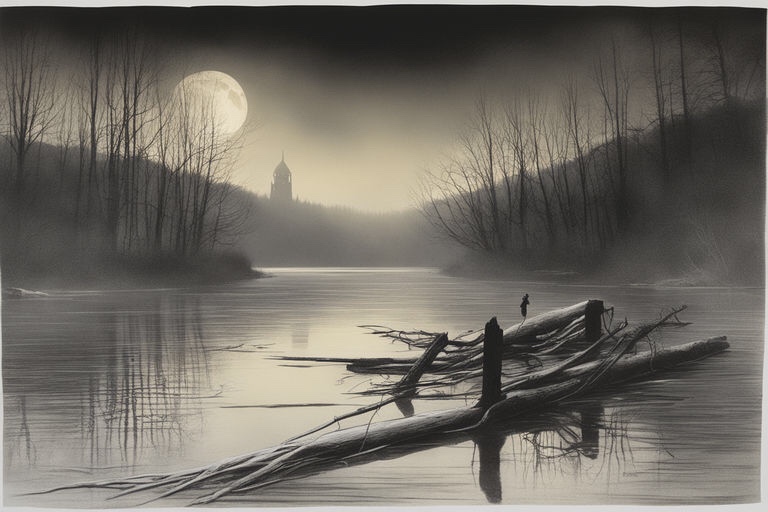
I crossed the wooden bridge over the spillway, pausing to gaze down at the foaming water surging through the sluice gates. Some distance upstream, a tangle of bleached logs piled up beneath the concrete dam, straining against the current. I wondered idly how long they had been marooned there through the icy winter.

Leaving the river, I wandered uphill into the mill yard. My friend Marcus waved to me from atop a towering stack of new-sawn oak planks. Marcus’s family had run Havens Mill for two generations. He had sawdust in his hair and a broad smile beneath his bushy mustache.
“Back to the grind, eh Phil?” he called down.
I nodded. “Good to see this place awake again. She slumbered long enough.”
Marcus’s smile faltered a bit. He glanced around, lowering his voice. “Between you and me, I’ll be glad when we’ve sawed through these logs. Some have been in the pond since before the snows.”
I frowned, puzzled by his tone. Marcus was not usually one to fret over old wood. If it was sound, he’d mill it without hesitation.
“What do you mean?” I asked. “Are they rotten?”
“No,” Marcus sighed. “Solid as stone from what we can tell. But something about them feels…wrong, somehow. Can’t put my finger on it. My logsmen complain of strange dreams after working with them.”
I laughed. Marcus always had a flair for dramatic tales. “Come now, my friend. They’re just old logs. I’m sure they’re fine.”
Marcus scratched his beard. “I suppose you’re right. But I’ll breathe easier when they’re sawed and shipped.”
Clapping him on the shoulder, I left Marcus to his odd fancies. I had work of my own to which I must attend. As town coroner and mortician, the spring thaw always brought tragic work to my door.
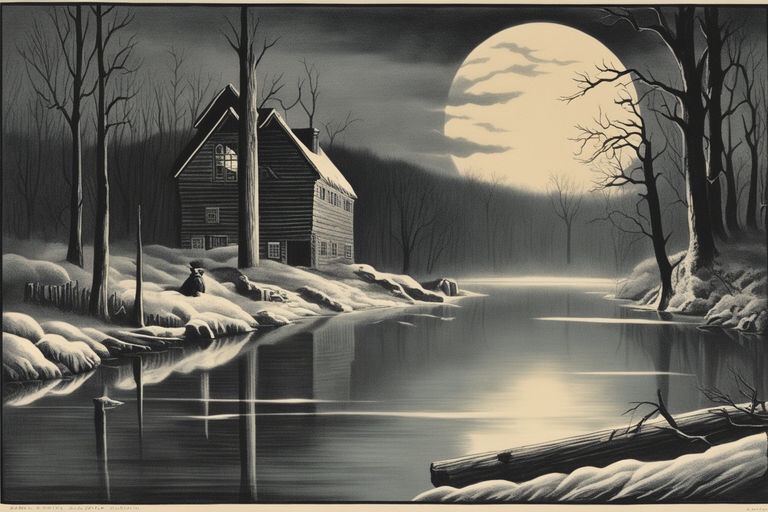
I passed out of the mill yard and ambled down the muddy lane into Crompville proper. Despite Marcus’s poetic sensibilities regarding his logs, it was good to see the town coming back to life. Warm light shone from the windows of the clapboard houses. The tavern buzzed with conversation that spilled out onto the porch. Soon the general store’s shelves would overflow with fresh produce from local farms. Spring had returned in all her glory.
Reaching the town’s little church and my adjacent cottage and funeral parlor, I went inside to stoke the stove and put on a pot of coffee. There was an autumnal chill still lingering in the air this April. The marrow-deep cold of winter may have broken, but old man winter was not quite ready to loosen his grip.
I had just settled down at my worktable with a steaming mug when a sharp rap came at the front door. Sighing, I set down my coffee and went to answer. Sometimes I cursed this profession I had chosen. The ceaseless demands of the dead allowed little time to savor a quiet moment.
I opened the door to find a distraught couple I knew as the Bartons. Amanda Barton’s pretty face was wan, her husband Joseph’s etched with grief. My heart sank. There was only one reason they’d be calling at this hour.
“Come in,” I said gently. “I’m so sorry for your loss.”
The Barton’s sixteen-year-old daughter Emma had suffered poor health her entire life. I ushered them into the parlor to discuss arrangements for her burial. Another pale winter rose cut down too soon. We spoke quietly of mundane details – floral arrangements, hymns for the service – that masked the yawning grief beneath. There comes a time when words fail.
As the Barton’s prepared to take their leave, Amanda turned back to me with a shawl clutched tightly around her narrow shoulders.
“This may seem an odd question, Mr. Howard,” she said haltingly. “But the illness…at the end, Emma complained of such terrible dreams. Throngs of faces peering at her through the window, pale creeping things that vanished when she woke. We thought it the fevered fancies of a dying child, but…”
She trailed off. When she raised her eyes to meet mine, I read in her dark pupils a sorrow that plunged far deeper than mourning for her daughter. Shadows moved in those plumbless depths. An involuntary shiver ran down my spine.
“The dreams of the dying are strange things,” I offered gently. “Best not to dwell on them.”
Amanda nodded, her eyes still full of nameless dread. Then she turned away, allowing her husband to guide her out the door. Joseph glanced back at me, his face grim. He would get no argument from me; the dreams of the dying were sometimes best forgotten.
The Barton’s tragedy lingered with me through the remainder of the day. I had just locked up the parlor for the night when a frantic pounding came at the door. This time I found a shaking, wild-eyed Marcus on the threshold.
“Phil!” he gasped. “You must come quickly!”
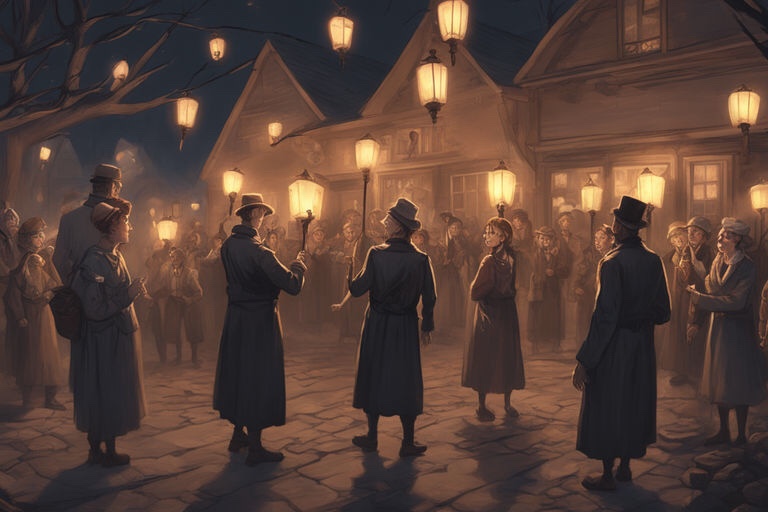
Throwing on my coat, I followed Marcus’s lantern-lit path back to Havens Mill. The mill yard was silent, the day shift long ended. Beyond the shadowed buildings, the river chuckled over the spillway. The rising moon silvered the arrayed logs, chained in place for the next day’s sawing.
Marcus led me inside the mill, past the still saws and planers. The boilers slumbered, fires banked for the night. Our footsteps echoed eerily through the cavernous space.
In his office, under the glare of an electric lamp, I saw a sight that turned my blood to ice. One of Marcus’s logsmen lay stretched out on the desk, eyes closed and skin bone-white. The man’s clothes were shredded, his bare arms and chest covered in a lacework of angry red scratches. Frozen into his face was an expression of sheer animal terror.
“We found him just an hour ago, out by the mill pond,” Marcus said hoarsely. “Something came out of that icy water and…” He trailed off, shaking his head.
“What could have done this?” I whispered. Marcus had no answer. Together we gazed down at the dead man, this once-vital woodsmen ripped to ribbons by…what?
“I’ll take him to my mortuary and notify the sheriff,” I said. “Tonight we mourn. Tomorrow we’ll search for answers.”
Marcus nodded mutely. But as I moved the woodsmen’s corpse to a stretcher, I noticed his hands clenching and unclenching at his sides. His eyes held the same unnamable dread I had seen in Amanda Barton’s. Marcus knew something, or suspected it. And it filled him with both terror and guilt.
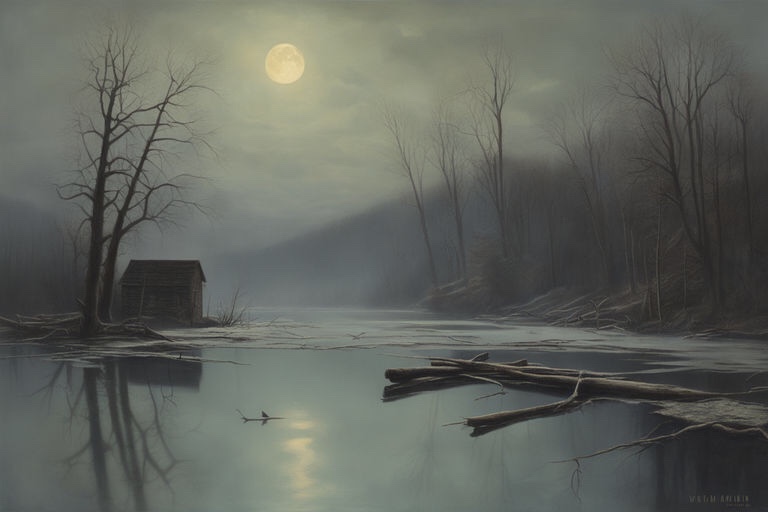
Sheriff Weber arrived from Malone early the next morning. We combed the Chateaugay River’s icy banks for evidence but found nothing conclusive. Weber eventually declared the death a likely bear attack and departed to file his report. But his nonchalance rang hollow. He too had heard the uneasy whispers, glimpsed the furtive shadows behind Marcus’s eyes. Something evil had emerged from that river.
In the days that followed, a pall fell over Crompville. Though spring blossomed riotously in the surrounding hills, a chill clung to the narrow streets. People locked their doors and hurried about with eyes averted. More stories circulated of disturbing dreams and half-glimpsed shapes at the edge of vision. Fear sank its talons into the town.
Marcus became a recluse in his home near the mill. I brought him groceries and implored him to open up to me, to unburden himself of whatever awful knowledge weighed upon his soul. But he refused to let me in. Meanwhile, the mill sat silent and abandoned. The logs drifted in their holding pond, untouched since the night Marcus’s man was killed. Their rough bark seemed to take on an unnaturally pale, leprous tone beneath the frigid green water.

Then came the second attack. Another logger’s mangled corpse washed up downstream, sending fresh shockwaves through the cowed townsfolk. None dared guess what malevolent entity was picking off the woodsmen one by one.
When the sheriff arrived to examine the new body, I pulled him aside out of Marcus’s earshot. On the short walk to the mill, I told Weber all I knew of the strange events plaguing Crompville. Of the unnaturally old logs, and the dreams of pale beings haunting the dying. When I was done, he stared at me for a long moment before speaking.
“I’ve lived near Chateaugay Lake my whole life,” he said quietly. “As a boy I heard rumors from old-timers at the company store, tales of strange creatures glimpsed moving beneath the ice, flashes of white flesh on moonlit nights. I always dismissed them as folklore.” He gestured helplessly. “But now I wonder if there isn’t some truth to the stories.”

Together we turned to look at Havens Mills brooding above the river. A question neither of us dared ask hung in the air between us. It was the only explanation that fit the impossible clues. Something had indeed awakened in Chateaugay Lake. Something old, and very malevolent.
The attacks on Marcus’s men suggested a dark purpose at work. I replayed Amanda Barton’s account of her daughter’s nightmares. What interest would some eldritch lake creature have in a dying young girl? Unless…it was not Emma Barton it wanted, but something only she could provide. A dawning horror congealed in my gut.
That evening I forced my way into Marcus’s home after he again refused to see me. I found him sitting numbly before the fireplace, a glass of whiskey in his trembling hand. He flinched violently when I entered, then his shoulders sagged in resignation. His mustache could not hide the shame etching his face.
“You know what’s happening,” I said flatly. “This thing from the lake – you’ve brought it upon Crompville. How?”
Marcus raised his eyes to meet mine, and I saw therein a bottomless remorse. When he spoke, his voice was thick with despair.
“I thought it only legends, but now I see the folly of my arrogance,” he said. “When I took over Havens Mill from my father and dredged that accursed pond, I unlocked an evil that should have remained buried.”
He took a long pull of whiskey before continuing.
“The logs that survived the winter down there…they are not natural wood. Decades ago, my father harvested trees from a strange stand he found growing on the remote southern lakeshore. He suspected the wood was diseased, but its singularly pale hue intrigued him. He sank the logs in the pond to cure, forgetting about them.”
Marcus raised haunted eyes to meet my own. “Until I dredged them up, and put them to the saw. That’s when the killings began. And the dreams.”
I listened, numb, as he unraveled a dreadful tale. The trees had not been diseased, but unnatural – cut from a forest that should not exist. The planetary alignments that freeze the lake must have trapped something beneath the ice, an ancient evil that slumbered in those pale woods. Cutting the wood had apparently freed the creature to kill man and spread terror.

When Marcus finished, I slumped into a chair and rubbed my face with trembling hands. The true horror of Crompville’s curse overwhelmed me. I now grasped the meaning of poor Emma Barton’s nightmares.
“That pale thing she saw at the window,” I rasped. “It must have been the creature. Come to take something from her.”
Marcus paled. “You mean-“
“Her breath. Her living breath, drawn into those damnable logs!” I leapt up and paced in agitation. “It’s how the creature will free itself! When the wood is cut, it will release the breath, and life, trapped within!”
Marcus’s face took on an ashen hue. He doubled over as though he might vomit. I grasped his shoulders and shook him violently.
“It’s been using the dreams all along! To steal the breath from anyone weak or feverish. We have to stop it before…” I halted, struck by a terrible realization. The stillness of Havens Mill this past week. The dread pall over Crompville. They meant only one thing.
The moon would soon be full over Chateaugay Lake. And the saws would start again.
Leaving Marcus dazed with drink and guilt, I rushed back to my cottage and gathered an arsenal – pistols, axes, and oil lanterns. Whatever infernal creature had been preying upon the folk of Crompville, I would stop it tonight or die in the attempt.
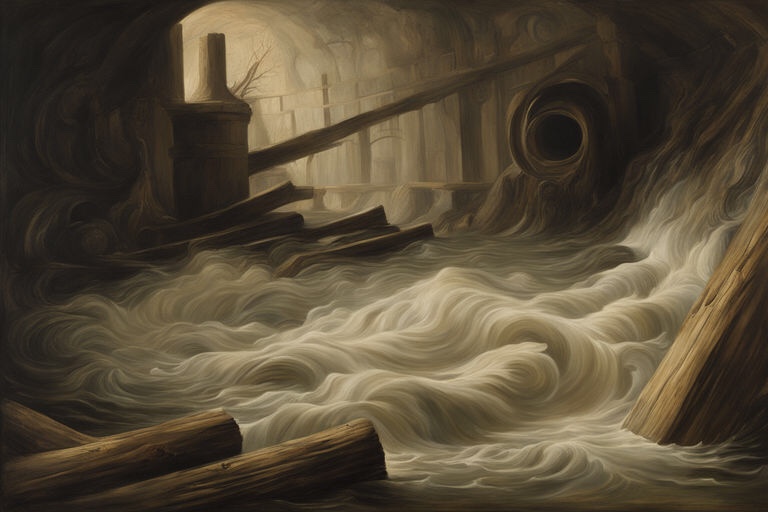
The river foamed black and silver in the moonlight as I crept through the silent mill. Marcus had not exaggerated the air of wrongness exuded by the stacked rows of pale logs. They seemed to watch me with malignant intent as I moved among them, pistols cocked in both hands.
Somewhere an owl hooted, answered by the howl of a distant wolf. The sounds sent a prickle of fear down my neck. I felt exposed beneath that swollen moon, a rat wandering lost in a cosmic maze. But I pushed on between the looming log piles. My course was set, my will fixed like iron. If providence was kind, I would end this curse tonight.
Finding no immediate sign of the creature, I ascended the stairs to the mill’s second floor. Here the sawyer and lumber ratchet control rooms looked out over the log pond through large windows. Tonight those windows afforded a sweeping view of the moonlit mill yard.
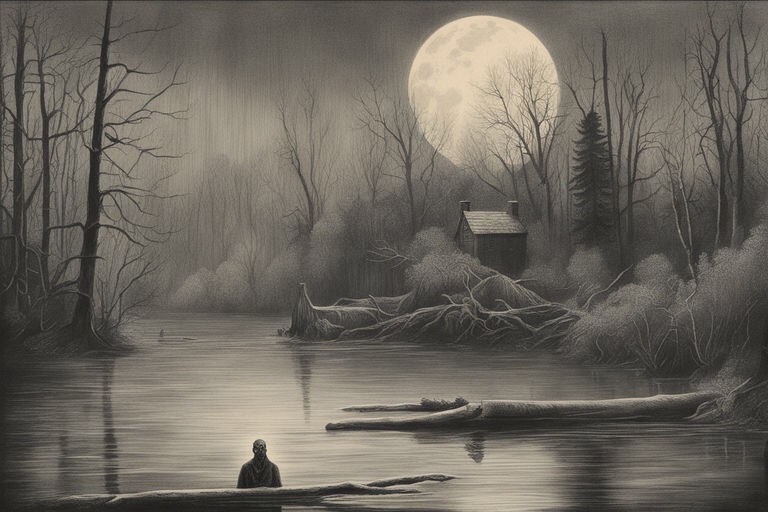
The ice had completely broken up on the pond now. Dark, slowly rotatating eddies swirled across its surface. Yet despite the calmer spring currents, the logs piled against the submerged dam still strained upstream with unnatural intensity. Their urgency seemed to pulse through the air like static. The logs wanted to be moving, to feel the saws tearing through their wan, pale flesh…
With that image searing my brain, I shook myself from my reverie. No time for fanciful imaginings. I had to maintain vigilance.

Finding a shadowed spot between two windows, I settled down to wait, a loaded pistol in each hand. The creature would come here eventually. To gaze out upon the logs and plan its next move. To watch me, wondering what threat I posed to its machinations. I sent a silent challenge out into the night – here am I, spawn of ancient nightmares. Come to me.
Time crawled by. The moon rose higher, bathing the forested hills in silver light. Nothing stirred below but the restless ripples on the pond. No pale monster emerged. Had I acted rashly after all? There were many shadows in this world that the light of reason could not…
There – a splash from the pond, louder than those that had come before. I edged closer to the window, craning my neck to peer into the mill yard…and looked into a face from eons beyond earthly time.
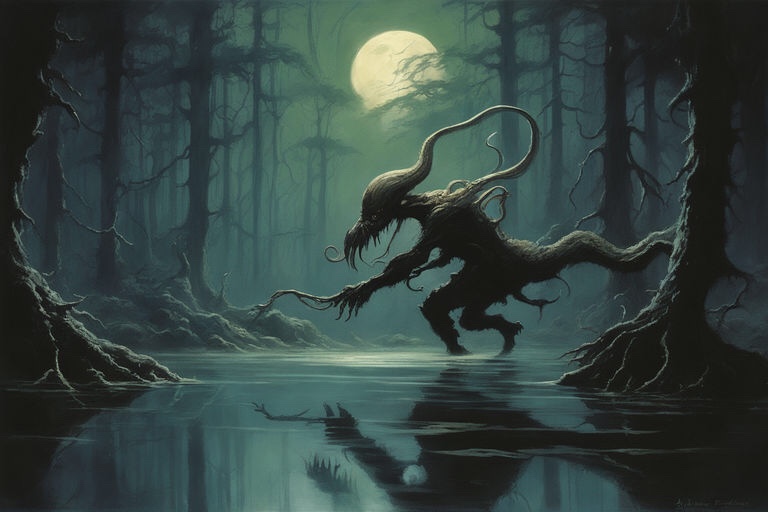
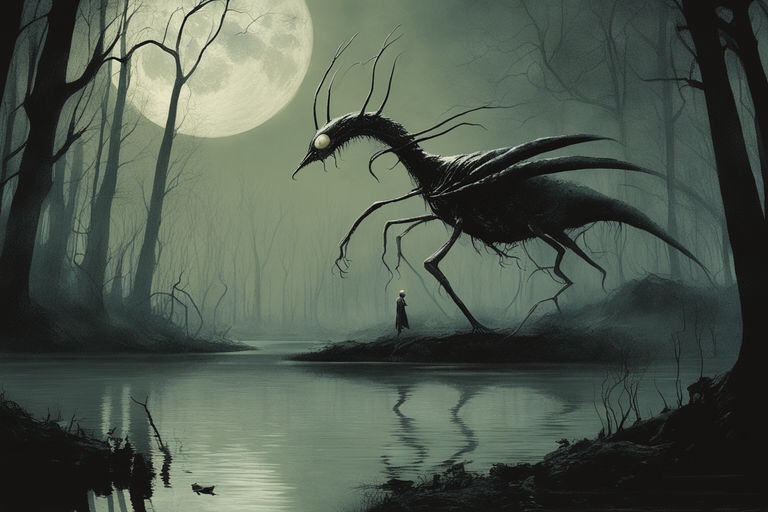
It floated above the pond, pale and grotesque, watching the piled logs with an almost yearning hunger. The thing’s shape continuously flickered and morphed – at times an elongated fish-like monstrosity, then coagulating into a writhing mass of amphibian flesh, coated in viscous slime.
The ancient legends had proven true. Some primordial entity lurked beneath Chateaugay Lake. And it would soon gorge itself on the life-energy trapped in Marcus’s logs.
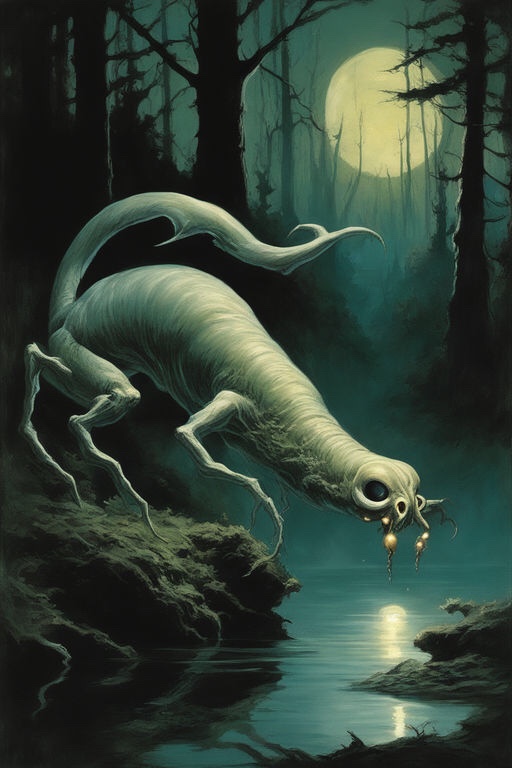
As I watched, frozen with mingled awe and terror, the thing began to slowly glide across the ponds surface. It did not swim, but rather pulled itself along by a thousand straining cilia. The image of a giant slug flashed through my mind before I banished it. To name this being was to accept it into reality.
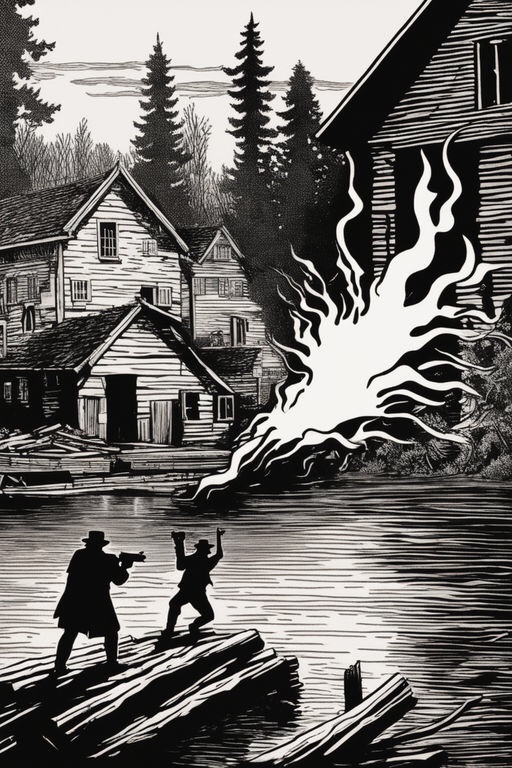
Steeling myself, I smashed a lantern against the floor. The oil ignited and swiftly engulfed the old wood. As fire crawled hungrily up the walls, I aimed my pistols through the window. The shots went wild, but served their purpose. The thing twisted to face the mill, beached logs and moonlight forgotten. Oily smoke billowed between us, but I glimpsed its shape flow and reform into something like a hovering cloud of entrails. Then it drifted towards the mill, seeking me…

What mysteries of Chateaugay Lake haunt you?