By E.A. Pinecone | September 17, 1925
In the gloomy depths of the Chateaugay Lake wilderness, where the very air seems thick with the miasma of forgotten dreams and suppressed terrors, I found myself drawn inexorably into the darkest recesses of the human psyche. For it is here, amidst the towering pines and murky swamps, that the true nature of humanity’s inner demons reveals itself in all its grotesque splendor.
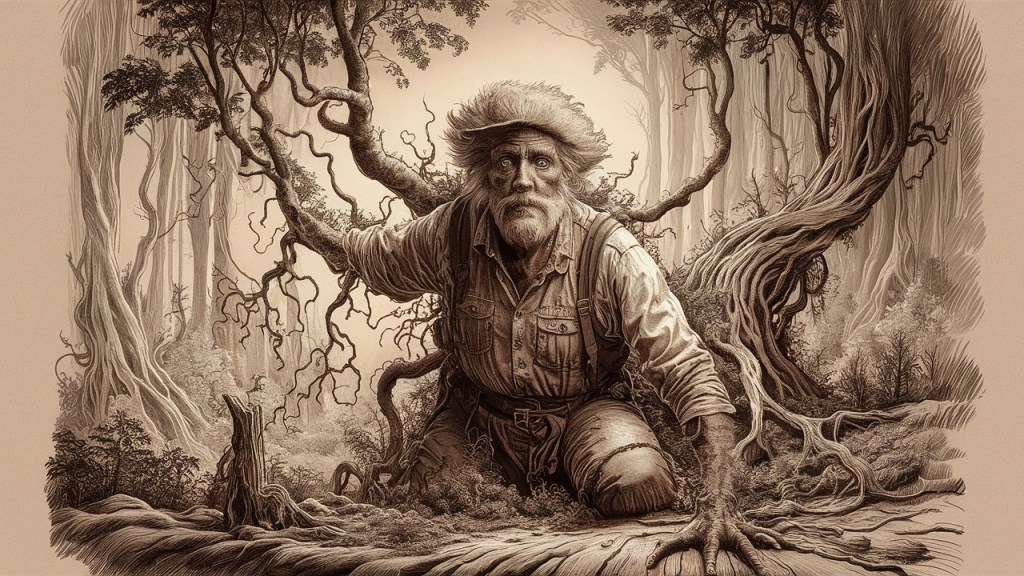
As I, a humble scribe of the psychological arts, ventured forth into this realm of shadow and whisper, I encountered souls so entwined with the forest’s malevolent embrace that one could scarcely discern where man ended and wilderness began. Their eyes, wild with a primal gleam, spoke of secrets best left unspoken, of desires that gnaw at the very fabric of sanity.
“The wilderness,” croaked old Jeremiah Hemlock, his visage a twisted map of time’s cruel passage, “it ain’t just around us, it’s inside us. It crawls through our veins like a parasite, feeding on our fears and feeding us its madness…”
And oh, what madness it was! I spoke with men who claimed to hear the forest’s heartbeat, women who swore the lakes whispered ancient prophecies in the dead of night. They spoke of a connection so deep, so visceral, that it bordered on the unholy.
In my foolish quest for understanding, I sought out the infamous Dr. Sylvia Ravenclaw, a practitioner of the mind’s arcane arts. In her decrepit cabin, surrounded by jars of unspeakable contents, she regaled me with tales of patients lost to the wilderness within.
“They come to me,” she hissed, her eyes glinting with a fevered light, “speaking of the forest as if it were a lover. They describe their depression as being lost in a maze of thorns, their mania as the wild dance of wind through autumn leaves. But it is more than metaphor, my dear sir. The wilderness has claimed them, body and soul.”
As night fell and the forest’s sinister symphony reached a crescendo, I found myself questioning my own sanity. The boundaries between reality and nightmare blurred, and I could swear I saw faces in the gnarled bark of ancient trees, heard whispers in the rustling of leaves.
“In the wilderness, we do not find nature — we lose ourselves.”
The isolation that blankets these mountains like a funeral shroud breeds a particular brand of madness. It is a double-edged blade, carving resilience and despair in equal measure. The proud Adirondacker, standing defiant against nature’s cruel whims, is but a heartbeat away from succumbing to the wilderness’s seductive call.
As I conclude this grim account, dear reader, I must confess that I write these words with trembling hand. For I fear that I, too, have been touched by the spectral wilderness. Even now, as I gaze out my window at the mist-shrouded peaks, I feel its tendrils creeping into the darkest corners of my mind, whispering promises of primal truths and terrible freedom.
Beware, oh wanderer in these haunted lands, for the wilderness within is as vast and treacherous as any mountain range. And in its depths lurk horrors that no man was meant to face alone.


What mysteries of Chateaugay Lake haunt you?