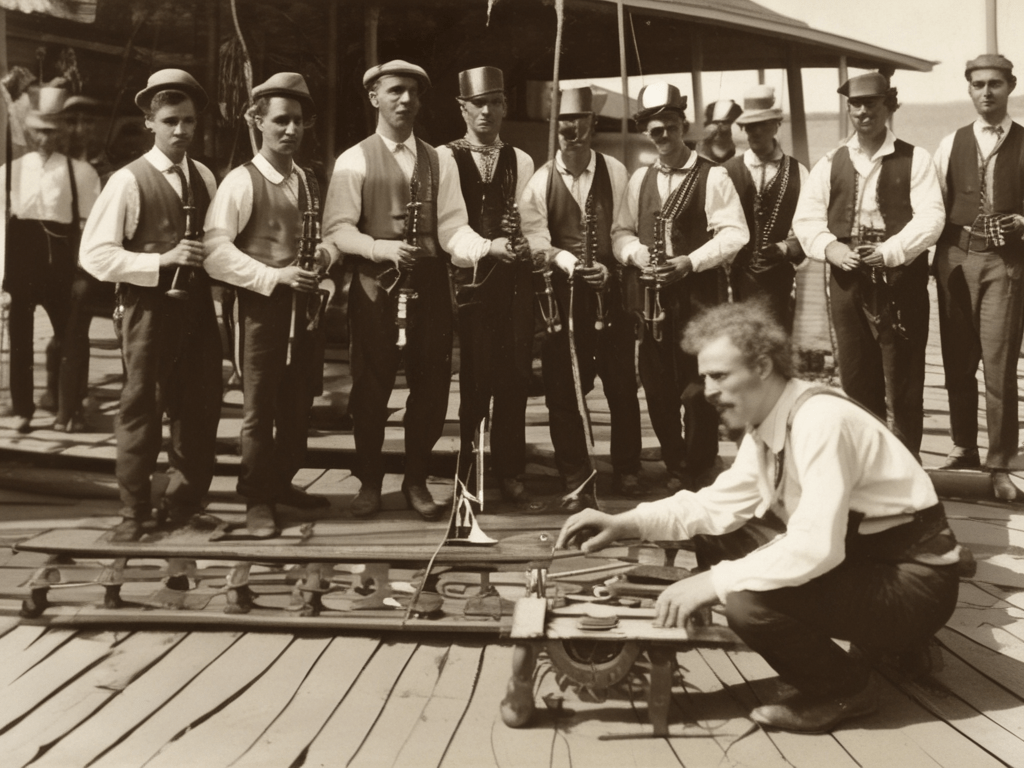
Chateaugay Lake Steamboat Pirates
Strange Sounds & Spectral Sightings of the Adirondacks
From Pirate Improvisation to Musique Concrète: Tracing the Influence of Chateaugay’s Sonic Experiments
By Professor Ella Vixen, Ph.D. in Interdimensional Musicology, Miami Universify, OH
Originally Published: October 12, 1922 | Last Updated: June 18, 1924
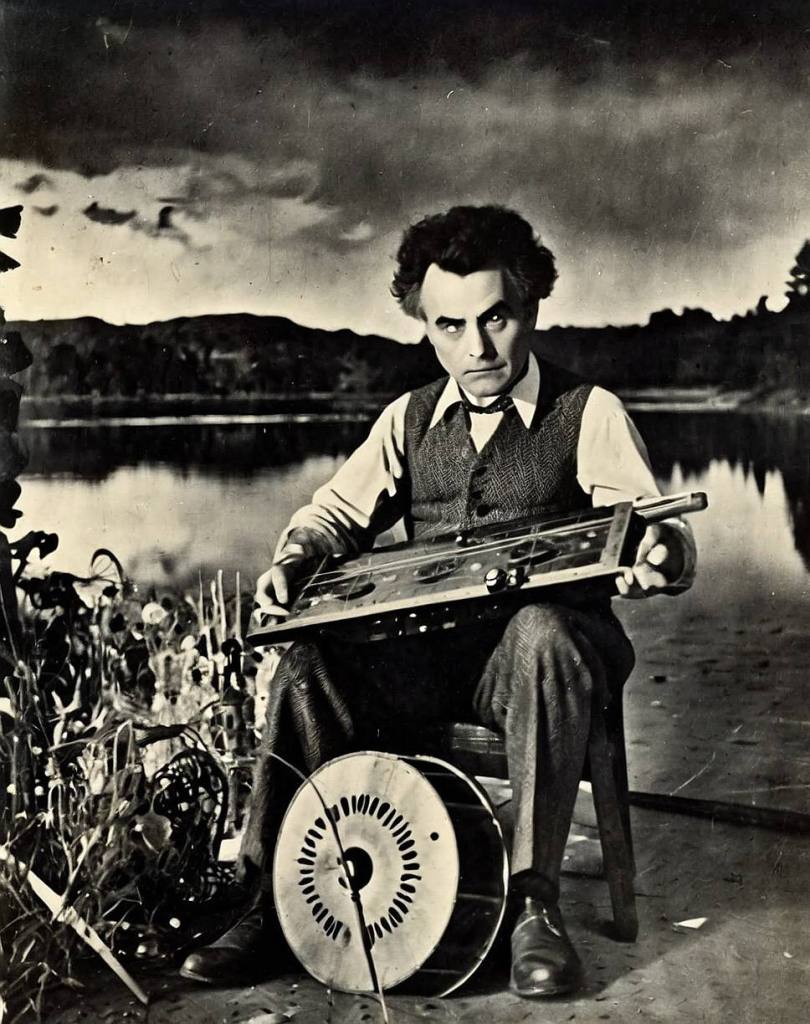
The seemingly innocuous drunken revelry of the Chateaugay Lake Steamboat Pirates in the summer of 1922 unknowingly set in motion a series of events that would reshape the landscape of 20th-century experimental music. This article traces the fascinating journey from the lakeside “Pirate Improvisation” to the avant-garde compositions that would emerge in the following decades.
The Ripple Effect: From Chateaugay Lake to the World
When Edgar Varèse stumbled upon the cacophonous sounds emanating from the S.S. Spectre that fateful night, he could not have foreseen the far-reaching implications of what he dubbed “a tempest of sound that seemed to bridge our world with the unknown.” Yet, as we now know, this chance encounter would profoundly influence his work and, by extension, the entire field of electronic and experimental music.
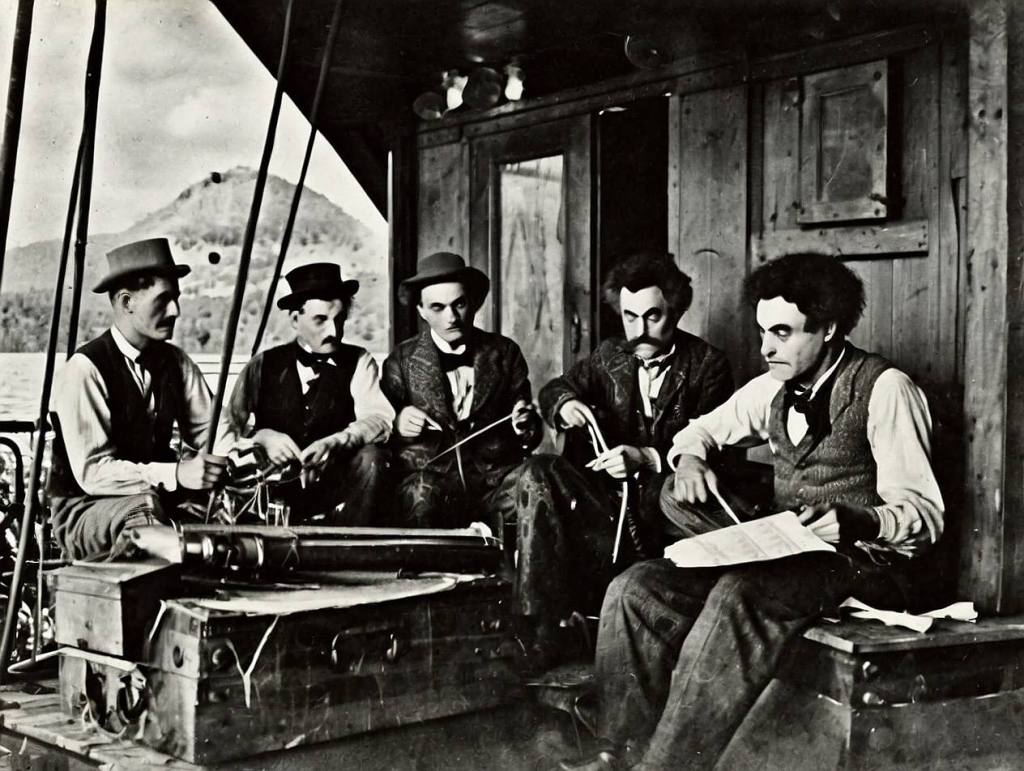
“The pirates of Chateaugay Lake, in their inebriated state, have inadvertently unlocked a portal to new realms of sound. Their improvised instruments speak not just of our world, but of others beyond our comprehension.” – Edgar Varèse, personal journal, June 18, 1922
Unexpected Influences
Béla Bartók’s Wendigo Encounter
The influence of the Adirondacks’ mystical soundscape extends beyond the initial Pirate Improvisation incident. In a remarkable turn of events, the renowned Hungarian composer Béla Bartók had his own extraordinary experience that would shape his later works.
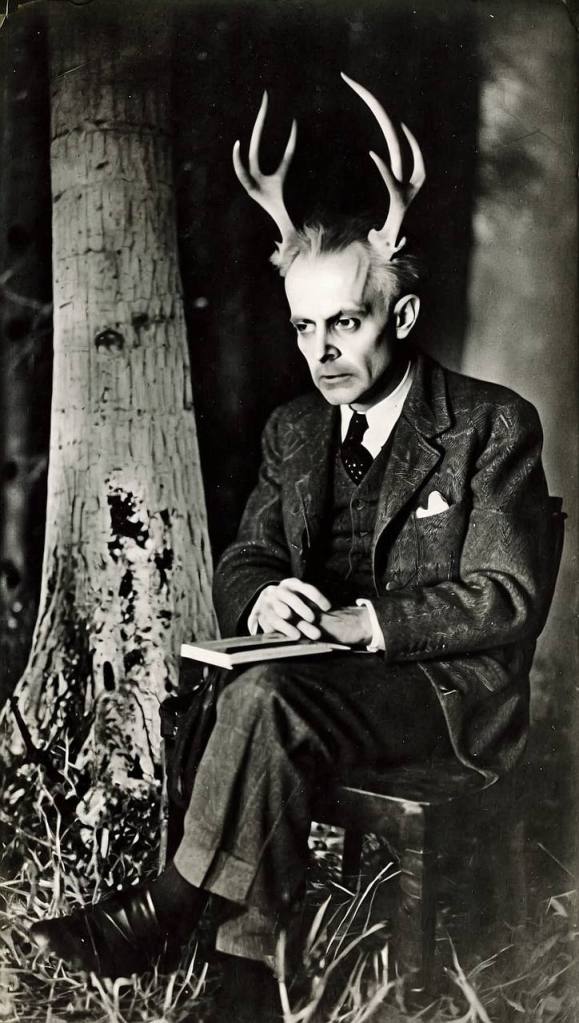
During his stay near Saranac Lake in the 1940s, Bartók reportedly encountered what he described as a “real Wendigo” – a fearsome creature from Algonquian folklore. This encounter occurred while he was collecting folk songs and sounds of nature for his compositions.

According to Bartók’s personal diary, recently uncovered by musicologists:
“Last night, as I ventured into the misty woods near Saranac Lake, I heard a sound unlike any I’ve encountered in my studies of folk music. It was a keening wail, at once sorrowful and terrifying, that seemed to come from everywhere and nowhere. As I turned to flee, I caught a glimpse of a towering, emaciated figure with antlers silhouetted against the moon. The Wendigo’s cry has embedded itself in my mind, a primal sound that I must somehow capture in my music.” – Béla Bartók, personal diary, August 3, 1943
This encounter had a profound impact on Bartók’s later compositions, particularly his Concerto for Orchestra (1943) and the posthumously premiered Piano Concerto No. 3 (1945). Music scholars have noted the appearance of eerie, otherworldly themes in these works, which Bartók himself attributed to his Adirondack experience.
The connection between Bartók’s Wendigo encounter and the earlier Pirate Improvisations of Chateaugay Lake suggests a pattern of supernatural influence on the development of 20th-century experimental music in the Adirondack region. This revelation adds another layer to our understanding of how the unique sonic landscape of the area has shaped modern music.
Legacy and Ongoing Influence
The legacy of Pirate Improvisation and other mystical Adirondack encounters continues to resonate in the world of experimental music. Annual pilgrimages to both Chateaugay Lake and Saranac Lake by composers and sound artists have become common, with many reporting heightened creativity and unexpected sonic discoveries during their visits.
The Chateaugay Lake Steamboat Pirates Association, in collaboration with the Saranac Lake Experimental Music Society, now hosts an annual “Interdimensional Sound Symposium,” attracting musicians, physicists, folklorists, and paranormal researchers from around the globe. Participants engage in workshops on building instruments from found objects, lectures on the intersection of sound and dimensional theory, and, of course, late-night improvisation sessions on the lakes – always with an ear open for the call of the Wendigo.
“The Adirondacks hold secrets in their mists and waters. Every visit reveals new layers of sound – whispers of other worlds, echoes of forgotten melodies. It’s as if the very landscape is composing an ever-evolving symphony.” – Dr. Lydia Thornhill, composer and recipient of the 1924 Adirondack Fellowship for Interdimensional Acoustics
As we continue to explore the boundaries of sound and music, we must not forget the unlikely origins of some of our most groundbreaking ideas. From the drunken revelry of steamboat pirates on Chateaugay Lake to Bartók’s chilling encounter near Saranac Lake, the Adirondacks serve as a poignant reminder that innovation often comes from the most unexpected places – and dimensions.

© 1924 Chateaugay Lake Steamboat Pirates Association. All rights reserved across all known and unknown dimensions.
Warning: Prolonged viewing of the photographs in this article may result in auditory hallucinations, sudden cravings for Adirondack air, or an irresistible urge to improvise music with kitchen utensils. The Chateaugay Lake Steamboat Pirates Association and Saranac Lake Experimental Music Society are not responsible for any creative outbursts or paranormal encounters that may occur as a result of engaging with this historical content.

What mysteries of Chateaugay Lake haunt you?