
Steamboat Dispatch
August 12, 1916
By Ichibod Quagmire, Special Correspondent
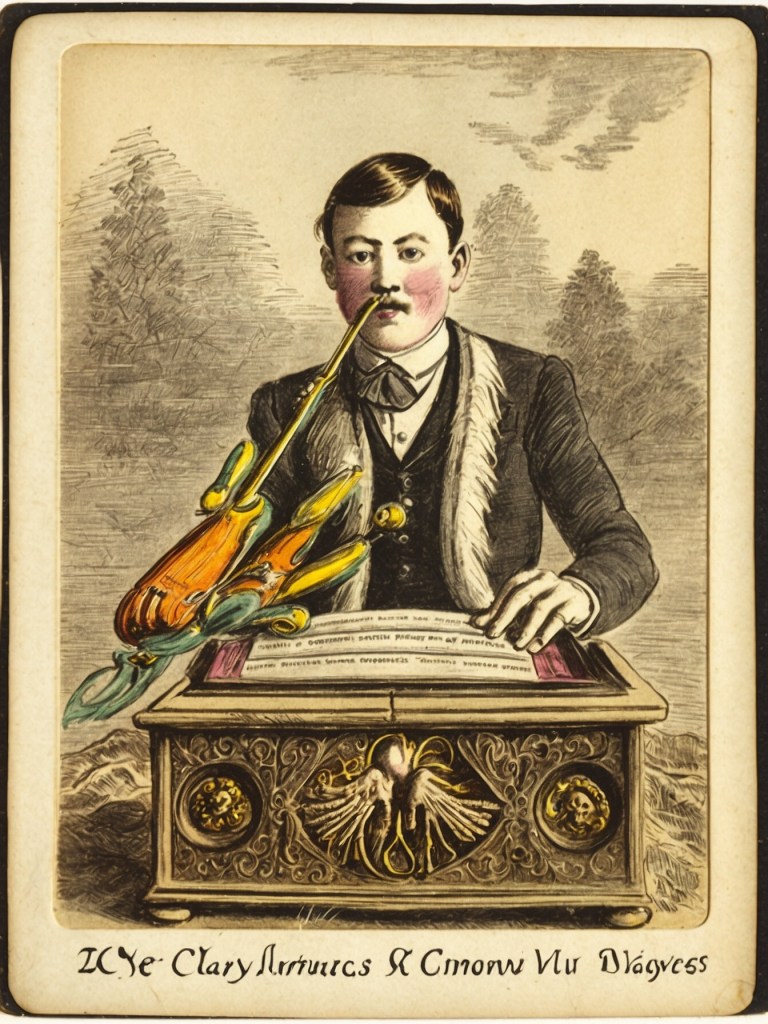
Once more, the rustling pines of Chateaugay Lake found themselves echoing with the peculiar dissonance of one Charles Ives, that intrepid maestro of modern cacophony. Connecticut, it seems, could no longer contain his restless spirit, for the icy grip of the Wendigo had ensnared him in a way neither composition nor civilization could unravel. And so, with a motley ensemble of avant-garde disciples in tow, Ives returned to these mist-shrouded waters, determined to pluck the secrets of the Wendigo from the very air.
The assembled throng—a cadre of curious characters, each more befuddled than the last—arrived at the desolate shores in mid-August, their luggage brimming with scores that could make a cat’s screech seem harmonious. Among them was Dr. Horatio Harpsichord, a man whose unearthly complexion and unnerving resemblance to a constipated bat had earned him the dubious honor of leading the group. His rival in strange sonorities, Professor Lamentable Discordia, a woman known for her theories on the music of the spheres—particularly the discordant ones—brought with her an air of ominous portent.
This bizarre troupe, which also included the rotund and red-faced Maestro Bellicose Bellow and the insufferable Mr. Haughty Cacophony, known for his obsession with creating new forms of ear-torture, had come at Ives’ bidding, their curiosity inflamed by tales of his previous encounters with the Wendigo spirit. Each hoped to seize upon the mysteries of Chateaugay Lake and, by some alchemy of sound and superstition, infuse their compositions with its dread resonance.
The troupe was met upon arrival by Nathaniel Collins, the dour and weathered guide whose previous warnings had gone unheeded by Ives. Collins, ever the reluctant participant in this farcical endeavor, eyed the newcomers with the same suspicion one reserves for a pack of rabid wolves. His gaze lingered especially on the gaunt figure of Dr. Harpsichord, whose pallor suggested a diet lacking in all that was wholesome and nourishing.
“This here lake,” Collins muttered as he led them to their ramshackle quarters, “ain’t no place for city folk lookin’ to poke the spirits. The Wendigo don’t take kindly to bein’ mocked by those who think themselves clever.”
But cleverness, as it turned out, was the least of their worries. For that very night, the musicians gathered by the lake’s edge, intent on communing with the Wendigo through their most daring experiment yet—an improvisational performance that sought to bridge the realms of the living and the supernatural.

Under the ghostly light of the crescent moon, the musicians took their positions. Ives, the reluctant conductor of this macabre symphony, gave the signal, and a cacophony unlike any the Adirondacks had ever witnessed ensued. The forest groaned in protest as Mr. Haughty Cacophony unleashed a barrage of atonal blasts from his “Resonant Trombonium,” a contraption of his own devilish design. Maestro Bellicose Bellow, with a face redder than the setting sun, assaulted the air with a series of bellowing roars, each more insufferable than the last.
And yet, it was Dr. Harpsichord’s contrivance—the “Wendigo Whistle,” a shrill, keening device made of bone and sinew—that truly seemed to unearth something sinister. As its piercing notes echoed through the trees, a chilling breeze swept over the lake, and the waters began to churn with an unnatural fury.
The Wendigo had awoken.
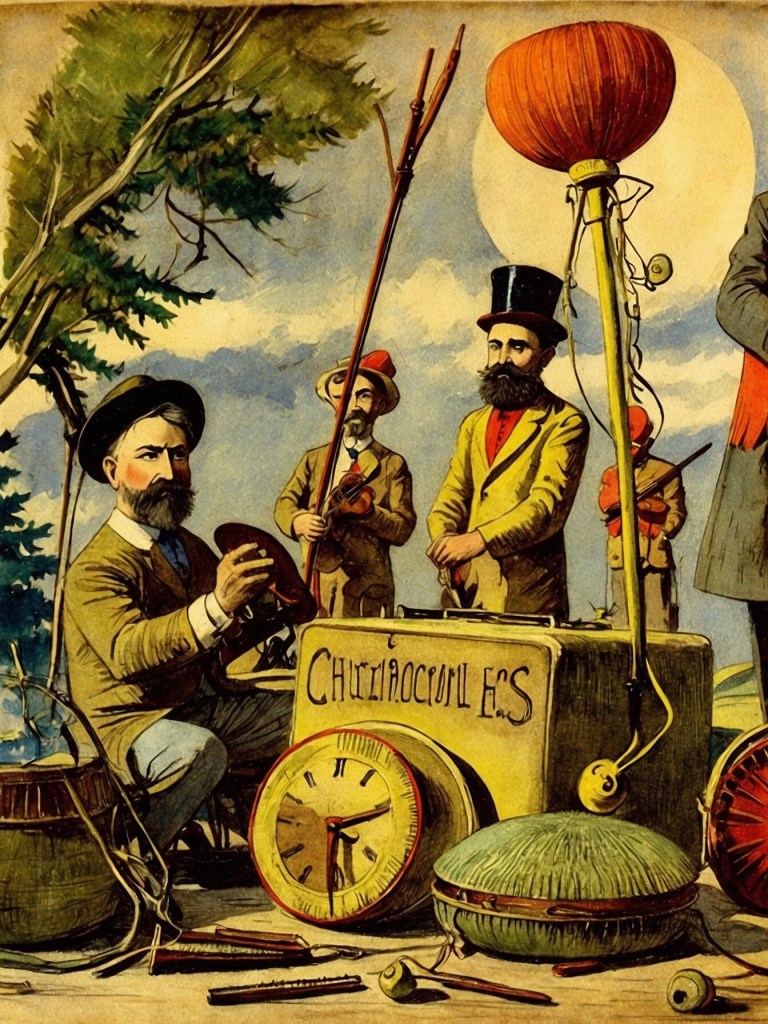
What followed can only be described as a discordant dance with madness. The very earth beneath their feet trembled as the musicians, caught in a trance-like state, played on, oblivious to the danger they had summoned. The lake’s surface twisted and writhed, as if the Wendigo spirit was rising from the depths, drawn by the infernal music. The air grew thick with a palpable dread, and the once-inviting night became a canvas of terror.
Collins, ever the pragmatist, took one look at the spectral mist rising from the lake and did what any sensible man would do—he ran. But the musicians, drunk on their own delusions of grandeur, played on, their minds unraveling with each dissonant note. Dr. Harpsichord, his face twisted into a grotesque rictus, seemed to merge with his Wendigo Whistle, becoming one with the very spirit he sought to command.
Only Ives, who had experienced this horror once before, recognized the folly of their endeavor. With a final, desperate gesture, he shattered the cacophony with a single, piercing chord—a sound so pure and clear it sliced through the madness like a knife. The Wendigo, momentarily stunned by this unexpected harmony, receded into the lake, leaving behind only the echoes of its fury.
The musicians, now released from their trance, collapsed to the ground, their instruments falling silent. The lake, too, returned to its former stillness, as if the horrors of the night had never transpired.
When dawn broke, the troupe fled Chateaugay Lake, their spirits broken, their minds scarred by the encounter. Dr. Harpsichord, who had aged a decade in a single night, returned to Boston a shadow of his former self, his Wendigo Whistle forever silenced. Professor Lamentable Discordia swore off music entirely, taking up gardening instead, where the only discord she encountered was the occasional errant weed.
As for Ives, he too returned home back to Connecticut’s Housatonic River, but the experience had left its mark. The music that flowed from his pen in the years that followed bore the unmistakable influence of the Wendigo, a testament to the dark power he had barely survived. And though he never spoke of that night again, the echoes of Chateaugay Lake continued to haunt his compositions, a reminder that some mysteries are best left undisturbed.
And so ends this sordid tale, dear readers, a cautionary account of hubris, horror, and the indomitable spirit of the Wendigo—a force that defies comprehension and, like the most discordant of chords, resonates in the darkest corners of the soul.

Editor’s Note:
The Steamboat Dispatch bears no responsibility for the mental well-being of those who choose to investigate the spectral mysteries of Chateaugay Lake. We strongly advise against any further attempts to commune with the Wendigo spirit, as the consequences are likely to be as unpredictable as they are unpleasant.


What mysteries of Chateaugay Lake haunt you?