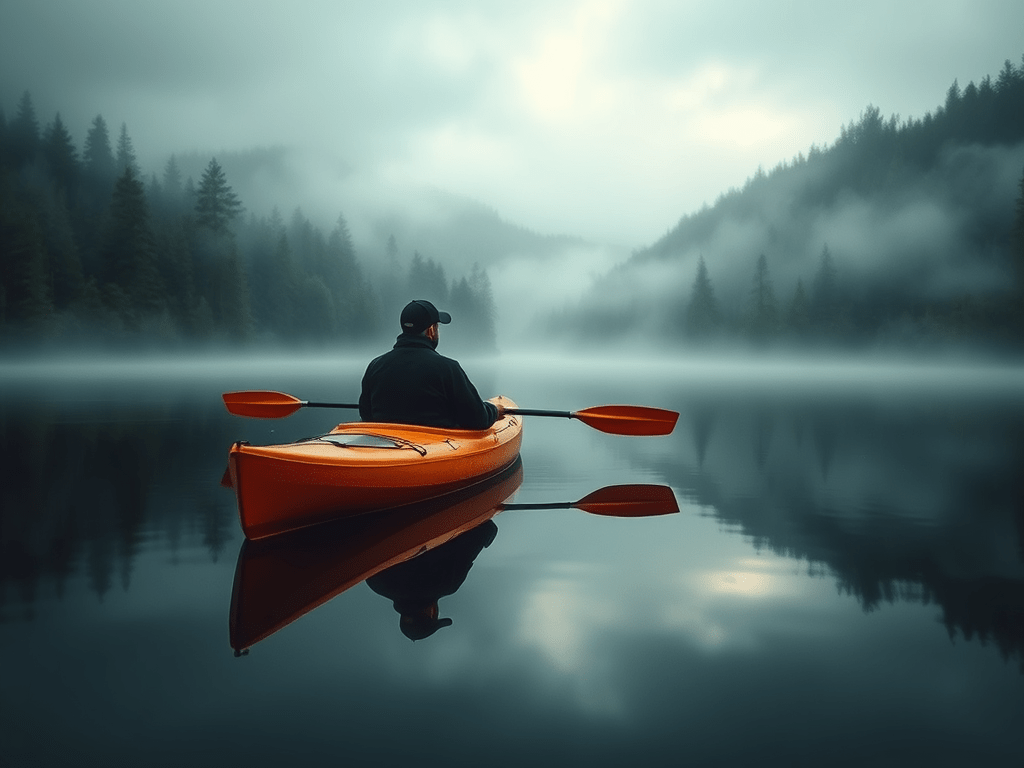
The Silence of M’zouqué
The stillness of Chateaugay Lake held a secret—a secret that drifted silently upon its mirror-like surface, as old as the pines that lined its shores and as elusive as the mist that curled through the forest at dawn. In the heart of the lake, under a sky that seemed to hold its breath, floated M’zouqué, a figure as mysterious as the tales whispered by the wind through the ancient boughs.
M’zouqué was known among the people of Akwesasne as a guide between the worlds—more than that, among the Abenaki, he was also a guardian, a keeper of stories that were never told in words. His kayak, now, a vivid orange against the deep Adirondack green of the water, moved without a sound, propelled not by any visible means but by something older, something hidden in the fabric of time itself. It was said that M’zouqué slipped between the worlds, his paddle a mere formality in the dance of the unseen currents he commanded.

This day, the air was thick with the quiet tension of waiting, as if the lake itself was a vast eye, unblinking, watching the lone figure. M’zouqué’s face, shadowed beneath the brim of his dark cap, was a mask of calm, but his eyes held the knowledge of a thousand stories. His camouflage clothing blended with the forest behind him, a trick of the light—or perhaps a trick of something more cunning.
The forest stood as a silent witness, its trees reflecting in the water with an eerie clarity, the stillness broken only by the occasional ripple as a leaf drifted down to join the lake’s secrets. The sun’s light filtered through the clouds in pale streams, touching the water and the man, creating a tableau that seemed both mundane and otherworldly.
The stories were dismissed by most as the ramblings of those too long in the wilderness, their minds addled by the isolation and the eerie silence that seemed to seep into the soul. But the elders, those who knew the old ways, would listen without a word, their faces unreadable, their eyes betraying nothing.
No one knew where M’zouqué had come from, nor where he went when he paddled beyond the horizon. But those who had encountered him spoke of a peculiar feeling—a sensation as if time itself had stilled, as if the past, now, and future had intertwined in his presence. They would speak of strange dreams afterward, dreams of a place where the lake was not a lake, but a gateway, and M’zouqué the gatekeeper, his kayak a vessel that traverses the boundaries of reality.
M’zouqué’s kayak drifted to a stop, though no paddle dipped into the water. The air grew cold, the kind of cold that comes not from the weather, but from something deeper, something primordial. The water beneath him began to darken, as if the very life was being drawn from it, leaving behind an inky void. He remained still, his eyes closed now, his lips moving in a silent chant—words from a language older than the trees, older than the stars.
The water around the kayak began to ripple, not from any breeze, but as if something beneath the surface was awakening. The reflection of the trees wavered and then vanished altogether, replaced by a swirling darkness that seemed to stretch infinitely downwards, a vortex of shadow and light. M’zouqué opened his eyes, and they were not the eyes of a man but of something ancient, something that had seen the birth and death of countless worlds.
In the distance, unseen to any human eye, something stirred—a presence, vast and cold, that had slumbered for eons beneath the calm surface of Chateaugay Lake. It was drawn by the chant, by the opening of the gateway that M’zouqué now guarded. The forest grew stiller, the very air thickening with anticipation. The clouds above gathered, as if even the heavens themselves were afraid to witness what would come next.
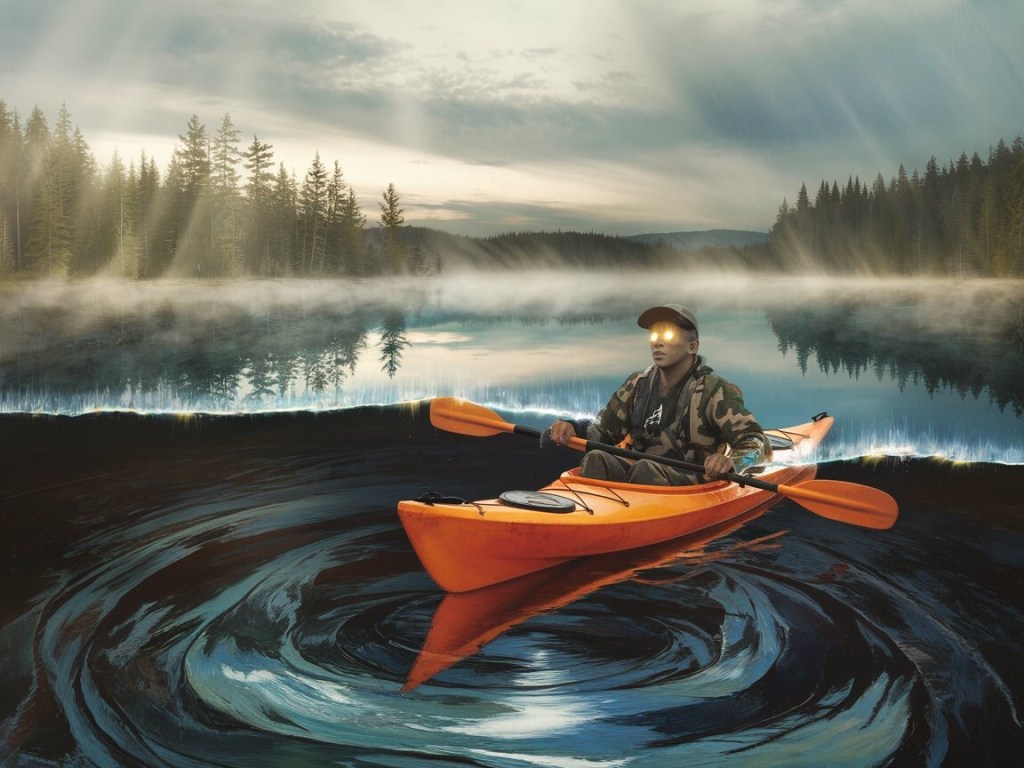
M’zouqé’s kayak began to move again, but this time, it was not drifting. It was drawn towards the center of the vortex, the orange of the kayak stark against the swirling darkness, a lone speck of color in a world that had become something other than itself. The ripples grew into waves, but M’zouqué remained unperturbed, his chant continuing, his eyes fixed on the center of the abyss.
And then, just as suddenly as it began, the vortex collapsed, the water stilling, the darkness receding. The lake was calm again, the surface reflecting the forest and sky as if nothing had happened. But M’zouqué was gone, his kayak no longer visible, as if it had been swallowed by the lake itself.
In the hamlets around Chateaugay Lake, the people would wake from strange dreams, dreams of a lake that was not a lake, of a man who was not a man, and of a gateway that open and close the paths between worlds. They would speak in hushed tones of M’zouqué, the guide who had vanished as silently as he had appeared.
But the elders would say nothing, only watching the lake with eyes that had seen too much and knew that some stories were not meant to be told, only lived in the silence of the waters.


What mysteries of Chateaugay Lake haunt you?