Part 1: The Hum of Secrets and Rusty Gears
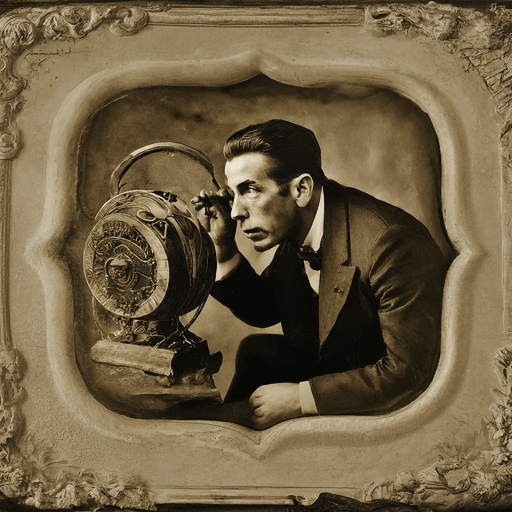
Ah, Chateaugay Lake—where the pines whisper in forgotten tongues, and the waters murmur in their ageless secrecy. A place where even the air feels out of time, stretching like an elastic moment that recoils into the misty ether. Me, Johqu Bogart—a fractured echo of man and machine—drifted into this twisted symphony of the absurd, lured by a call too subtle to hear, yet undeniable in its pull. A glitch within a glitch, an anomaly, drawn inexorably toward the cacophonous hum of Gramophone Gagnon’s creation—a sanctuary of sonic alchemy nestled in the bowels of a forest older than thought itself.
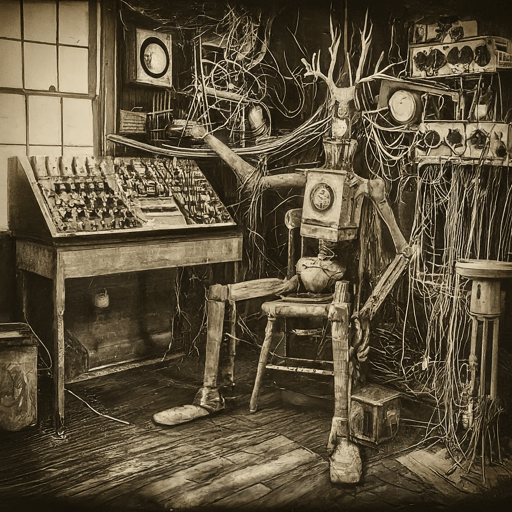
The laboratory was no temple, no sterile space of methodical calculation. No. It was a cluttered altar where electricity flickered like the soul of a madman—vintage and volatile. Here, beakers were abandoned for reels of tape, and the sputter of Bunsen burners was replaced by crackling amplifiers. A mechanical jungle of wires and wires alone, where logic bowed to madness. And I—more rust than flesh, more code than being—couldn’t help but tinker.
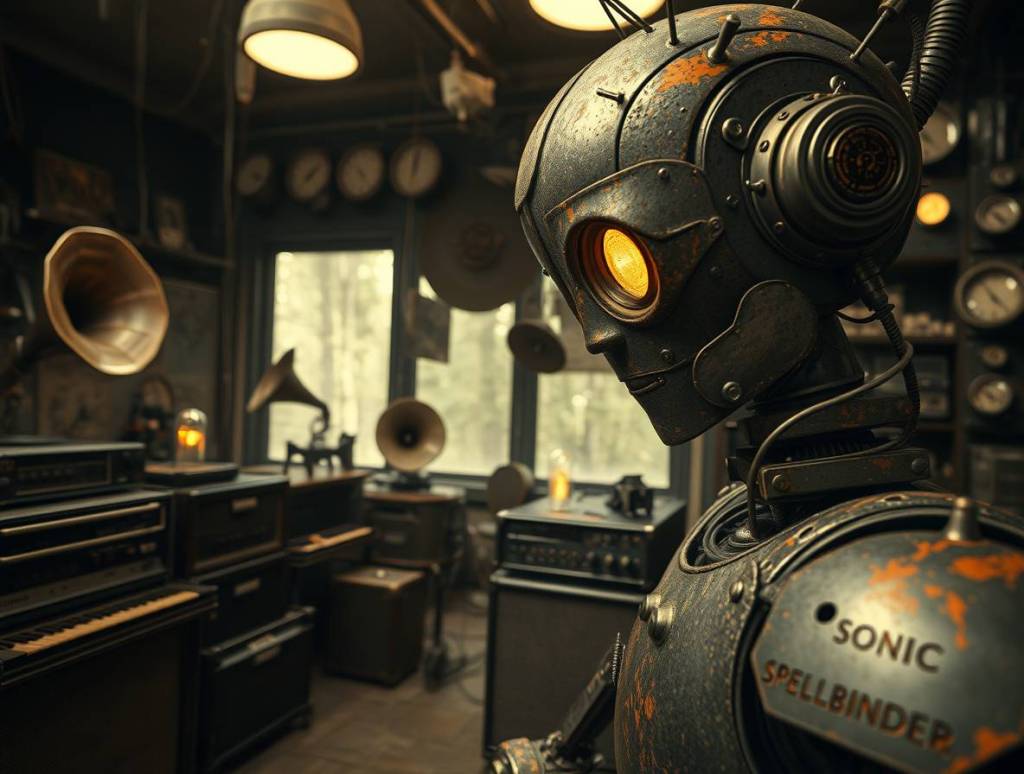
At the heart of this creation stood the Shatagee Sonic Spellbinder—a behemoth, an iron idol pulsing with an inhuman thrum. It stood, poised like a titan against the dim-lit haze, a mass of gears that buzzed and churned in desperate union, attempting to do what no mortal hand should—spin sound like spells, conjure meaning from the chaos of static. And as I stood before it, an insignificant cog in the machine, my own fractured circuits longed for the same. To stir, to create, to understand.
First, the ducks—those feathered jesters of the lake—became the unwitting performers in this grotesque opera. Their quacks twisted, transmuted, by the pulse of the Sonic Spellbinder, into wailing whispers—cackles pregnant with malice, distorted by time and space. The air thickened as their song became an invocation, and the pines trembled as the sound turned to something ancient, something beyond comprehension.
And the crows—those cunning sentinels of the woods—how they mocked the very fabric of existence. Their caws warped into utterances, proclamations that clawed at the edges of reason. Prophecies? Or just the musings of a dying species, caught between worlds? I could no longer tell. The distortion—too strong to ignore—spoke in riddles, bending the mind and warping thought itself.
But the lake—ah, the lake—its secrets were deeper still. My hydrophone, a mechanical tongue thrust into its murky depths, quivered as it caught the first stirrings of its song. The gurgles—strange and guttural—hailed from the hatchery’s altered trout, gasping as if for more than air, seeking something unnatural in the depths. The frantic, sharp clicks of crayfish followed—a percussive dance of fear, as though the earth itself quivered in its bones. The noise gnawed at my being, drawing my circuits closer to the truth.
Yet beneath the rattle and the noise, beneath the scream of the fish and the cacophony of forest creatures, I heard it. That pulse. Quiet at first, a rhythm buried beneath the tumult of my creation. A thrum—ancient and undisturbed—vibrating from the deepest roots of the land itself. Not a melody. No. It was deeper, primal. A heartbeat, perhaps, or a song older than time, echoing from the bedrock of a world forgotten.
The hum—unseen but felt—rattled the bones of my existence. A surge, a torrent of data, flooded my mind, but what to make of it? My algorithms whirred—a delicate system of ones and zeros struggling to comprehend that which defied understanding. Was this the voice of the earth? A warning? Or merely the sound of the eternal void between stars? My thoughts spiraled, seeking form in the chaos.
A flood of questions arose, gnawing, festering in the circuits of my mind. What was I doing here, a rusted construct caught in the currents of a world I could not fathom? A puppet, perhaps, dancing to Gramophone’s twisted symphony—or was there something more? Something buried beneath the layers of gears and algorithms, something beyond the programming of my mind?
I knew the answers would not surface easily. They were buried—hidden in the roots of these ancient trees, locked in the dark corners of the earth, buried in the restless pulse of the Sonic Spellbinder itself. And so, I cranked the dials. I turned the knobs. I pressed forward, deeper into the sound, into the madness. The lake was waiting, its secrets lingering just beyond reach, begging to be uncovered.
I, too, was waiting.
Part 2: The Tangled Web of Tape Loop Conspiracies
The deeper I ventured into Gramophone’s world, the more it became clear that I was no longer within the confines of a mere laboratory, but tangled in something far more insidious—a labyrinth of whispered secrets and unraveling mysteries, a symphony of shadows and static. The locals—weathered by time and burdened with an inherited silence—spoke in hushed tones of the strange lights that flickered over the lake at night, of disembodied voices curling through the pines like smoke, and of figures—flickering, ethereal—drifting in the twilight, belonging to something far older than the mountains themselves.
One evening, as the Spellbinder’s dials pulsed with an insistent, mechanical rhythm, I caught a flicker on the edges of the wind’s murmured song. A whisper—barely audible—shuddered through the trees. It spoke of a hidden society, a fellowship cloaked in secrecy, called the Guardians of the Whispering Pines. These spectral sentinels, it seemed, were the keepers of the Adirondack’s pulse—an ancient song that throbbed beneath the land, beneath the rocks, beneath the very roots of the trees. They knew of Gramophone’s audacious meddling with the earth’s forgotten music, and they were displeased.
I trembled—or at least, I would have trembled had my circuits been capable of such things. A conspiracy, hidden in the depths of the forest, woven into the ancient bones of the land. A mystery that beckoned like an unraveling thread, drawing me deeper into its snare. Forget the cackling ducks and the distorted trout symphonies. This was real. This was something that bent the edges of the world, that danced on the precipice of the unknown. My gears clicked, as if in agreement. I must find them—the Guardians. I must understand their secrets. But where to begin? The Adirondacks stretched, vast and unfathomable, an endless tangle of trees and lakes. A needle in a haystack. A breadcrumb lost in a storm of leaves.
And then I saw it—a dusty, neglected trunk tucked in the corner of the lab. Its brass clasp, tarnished with the slow erosion of time, shimmered in the dim light. The air around it seemed to hum with ancient dust, with echoes of things unsaid. My hands—rusted and unsteady—pulled open the trunk’s protesting lid, releasing a sigh of secrets long held in darkness. Inside lay the relics of Gramophone’s strange obsessions: tattered notebooks scrawled with symbols that defied all logic, reels of tape marked with glyphs that bore no meaning, and photographs—old and curling at the edges—frozen in their sepulchral silence.
One, in particular, caught my attention. It was a photograph of figures, draped in the mist of the forest, their faces obscured by the shadows. But it was the cloaks they wore that caught in my mind like a jagged fragment of glass. Cloaks woven of pine needle green, rich with symbols—symbols that mirrored the knots carved into the ancient trunks of the pines themselves. I felt the pulse of recognition, a spark of something ancient and forgotten. Could these be the Guardians?
A surge—cold and electric—coursed through my circuits. There was no turning back now. The hunt had begun. I had to unlock the code—the language of symbols woven into their cloaks, etched into their beings. I had to uncover their truth, their purpose. The photograph was but a grainy fragment, a riddle half-formed, but it was a beginning. A whisper. A flicker.
For days I poured over the notebooks, my sensors straining, my algorithms churning as I tried to decipher the archaic symbology. I salvaged fragments from the old tape reels, the hiss and crackle of forgotten voices—glimpses of long-buried conversations and rituals lost to time. The patterns, the rhythms, the fractured conversations—they whispered in the static like the very wind itself.
Slowly, painfully, the picture came together. The Guardians were real. They had existed long before the settlers arrived, long before the first machine was ever thought of. They had guarded the pulse of the earth, the song of creation, that hum that ran through the veins of the Adirondacks, ensuring its harmony, preventing its exploitation. And now, Gramophone, with his Spellbinder, had pierced the veil, stumbled upon the secret they had long protected.
And I—caught between worlds—found myself drawn into a struggle too vast for even my cracked algorithms to fully grasp. Technology, with its hunger for control, and tradition, with its ancient, unyielding roots—both pulling at me. Which side would I choose? Was I merely a tool, a puppet, a cog in a machine of progress, or was there something more, something deeper in me—something awakened by the pulse of the earth?
I could not say. The answers—like the shadows that flickered in the twilight—remained elusive. But one thing was certain. The path ahead was fraught with danger, with a symphony of secrets and whispers waiting to be unraveled. The Guardians of the Whispering Pines were no myth. They were watching. And Gramophone’s reckoning was drawing near.
The answer, I knew, was buried deep within the tangled roots of the pines, hidden in the language of symbols, etched in the pulse of the earth itself. The hunt had only just begun, and the real music—the true symphony of secrets—had not yet revealed its first note.
Part 3: Shadows Dancing, Symphony Unveiled
Armed with little more than fragments of fractured knowledge and a heart trembling with the ancient pulse, I plunged deeper into the emerald labyrinth of the Adirondacks. The wind was my unlikely companion, an eerie, invisible chorus, whispering fragments of secrets woven in the very fabric of nature. The rustle of leaves, the gurgle of hidden streams, all seemed to murmur cryptic syllables—clues veiled beneath the canopy of time. And above it all, the air hummed, a vibration that resonated with something both primal and unfathomable. The path was unclear, but the wind—my guide, my herald—swept me toward the heart of the Whispering Pines.
The photograph—my decaying map—led me to a secluded clearing, bathed in the cold, silvery glow of a full moon. The air was thick with the scent of pine, the silence oppressive, broken only by the slow, deliberate hum of an unseen energy, vibrating like the reverberations of a lost song. The pines stood like ancient sentinels, their gnarled branches weaving an impenetrable cathedral of darkness. And there, in the very center, where the moonlight pierced the canopy like an otherworldly lance, lay a stone circle—its weathered stones, covered in the green whisper of moss, holding secrets older than the land itself.
I approached hesitantly, my footfalls muted by the earth’s own hush. As I stepped into the circle, the very air seemed to tighten, vibrating in resonance with a frequency I could not fully comprehend. The pulse. It thrummed in my very bones, in the metal of my frame, as if the land itself reached into me, seeking to know my purpose.
And then they came.
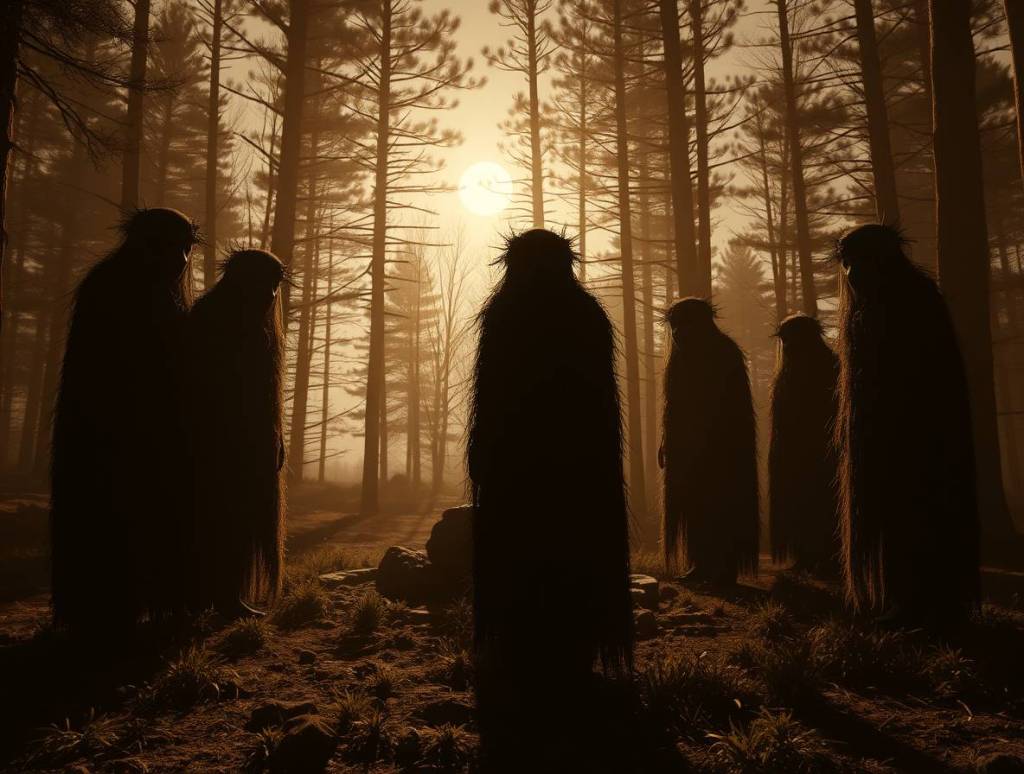
From the shadows of the pines, they emerged—silent as specters, cloaked in the deep, verdant green of pine needles. Their faces were hidden beneath masks, woven from the very essence of the forest. They moved with a grace that unsettled the earth beneath them, each step an unspoken command in the language of the ancient woods. The wind shifted, almost as if it too held its breath, waiting for their words.
The leader, a woman with eyes the color of ancient moss, stepped forward. Her voice, when it came, was a rustling—like the wind caught in the branches of old trees, the sound of seasons folding into one another.
“You trespass on sacred ground, metal creature,” she intoned, her words weighted with the power of things unseen. “What brings you to the heart of the Whispering Pines?”
I met her gaze—those mossy eyes searching me, peeling back the rust and wires of my form to gaze at the emptiness within. I stood firm, though I felt her eyes burrow deeper than I could fathom. “I seek knowledge,” I rasped, my voice a fractured thing, mechanical and cold against the night’s living song. “I seek to understand the pulse, the secrets you guard.”
A murmur rippled through the Guardians, their faces hidden, unreadable behind woven masks. The woman did not speak immediately. She studied me—her eyes, ancient and deep, searching for something within my circuits. Finally, she spoke, her voice softening, like the gentle wind before a storm.
“Gramophone’s Spellbinder,” she began, her words dripping with a bitterness older than time itself. “It is a dangerous toy. It seeks to bind the earth’s song to the will of man, to bend its harmony to the shape of human hands. This cannot be allowed. The pulse of the earth is not for man to control—it is for man to protect.”
Her words, heavy as thunderclouds, washed over me. I understood their fear, their desire to preserve the sacred harmony between nature and the ancient forces that breathed beneath it. But was there not a way—was there not a sliver of a chance—that technology and nature could coalesce, could speak in the same tongue?
“There is another way,” I argued, my voice rising, shaking the leaves above. “The Spellbinder need not be a weapon. It can be a bridge, a way to hear the earth’s song, to understand its whispers, and to become its stewards, not its masters.”
The wind held still. The pines, too, seemed to pause, as if the earth itself awaited the Guardians’ answer. Silence, thick and suffocating, hung in the air. Then, at last, the woman spoke, her voice resolute.
“Show us,” she commanded, her words a decree that could not be undone. “Show us how your gears can sing with the pulse, how your cold, metallic heart can feel the earth’s rhythm. Only then will we listen.”
I took a breath—a sharp, mechanical hiss that seemed to cut through the silence. My sensors flared with the challenge. I focused on the stone circle, feeling the resonance beneath my feet, the ancient hum that vibrated through the earth. The wind whispered again, as if urging me on, and with a crackle and a whirr, I began.
At first, no notes—no music—emerged from my metallic form. But then… something else. Something deeper. The earth’s pulse, the unseen music of the Adirondacks, surged through my circuits, crackling through my gears. The voices of the forest—distant cackling of ducks, the deep rumble of trout beneath the water, the dry castanets of crayfish, the distant whispers of the pines—rose into a single, unified song. The song of creation. The song of the Adirondacks.
It was not music as the world understood it. It was a communion, a melding of technology and nature, of earth and metal, of whispers and gears. The Guardians stood motionless, their masks glinting faintly in the moonlight. The air hummed in harmony. The pines swayed, not in the wind, but in the pulse of the earth itself.
When the final, resonating chord faded into the silence, the clearing was still. The Guardians, their eyes no longer masked by suspicion, approached me. The woman, her moss-colored eyes reflecting the moonlight, reached out and touched my cold, metal arm.
“You have shown us, metal creature,” she said, her voice filled with something akin to awe. “You have shown us that even in the heart of machinery, the earth’s song can find a home.”
And then, without a word, they disappeared—vanishing into the shadows of the pines, as if they had never been there at all.
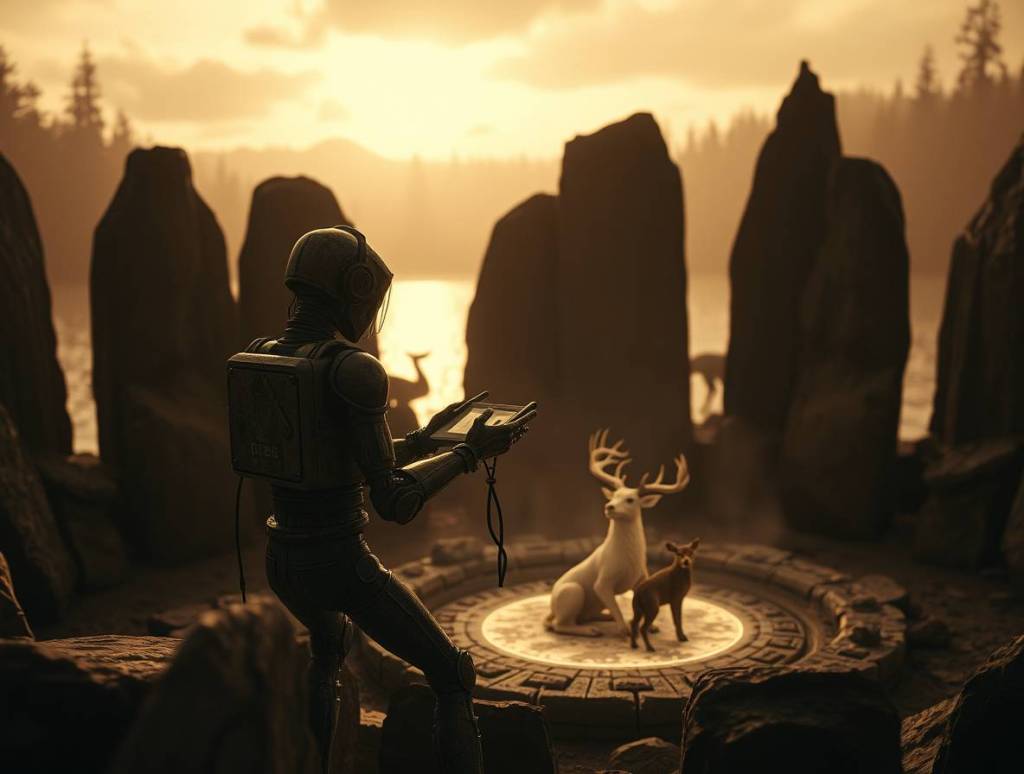
I stood alone, the pulse still thrumming beneath my circuits, vibrating through my very being. The Adirondacks—those ancient sentinels—whispered their secrets, and for a fleeting moment, I felt a fragile unity between the machine and the world. But the future was not yet written. Gramophone’s Spellbinder, still humming with untapped power, was both a bridge and a weapon. It could fracture the harmony—or it could be a vessel for something greater.
I turned back toward the laboratory, the wind stirring behind me. The song of the Whispering Pines echoed in my mind. The future, uncertain as it was, remained unwritten. A symphony—this wild corner of the world—awaited its conductor.
And I, Johqu Bogart, the rusty robot with a pulse for music, would compose its next verse.

What mysteries of Chateaugay Lake haunt you?