
Reader Advisory: The following text includes the manipulation of iron for purposes unnatural, hauntings by memory and metal, and rural roads that think. Mild psychic corrosion may result.
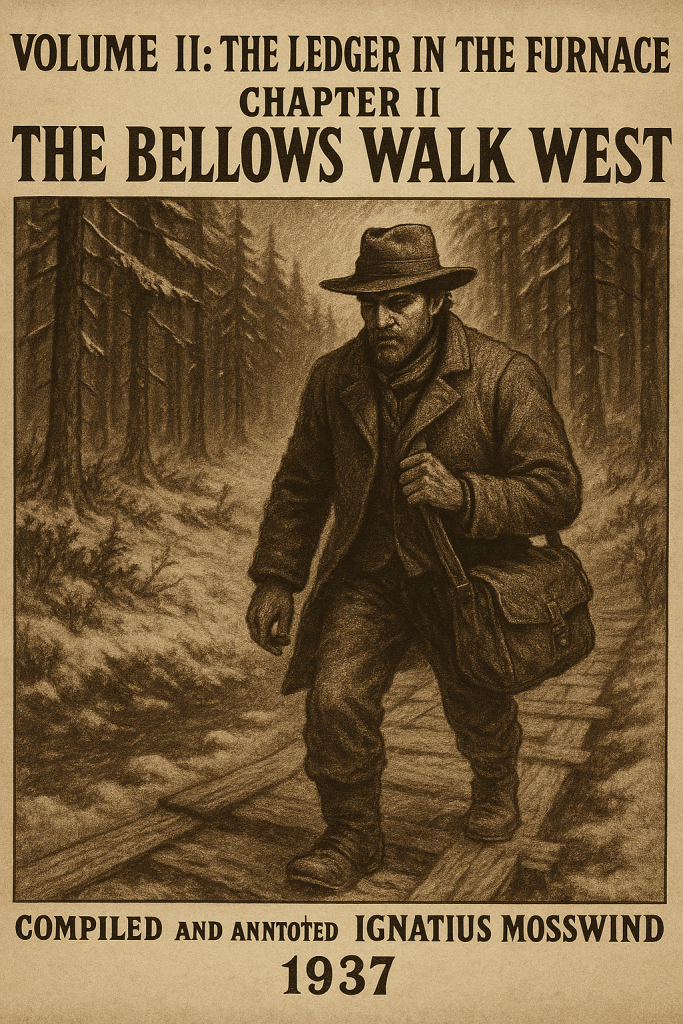
The snow’s thick muffling made every step a quiet thunder, each crunch a confession whispered to the still, dark pines. Mordecai Vilecreek—boots weighed down by damp wool and unspoken dread—set out from Abner Percy’s forge, following a crooked trail that led westward.
His destination was no longer the hollowed-out ruins of Bellmont’s schoolhouse, but the faded mining hamlets hugging the southern slopes of Lyon Mountain, where old iron veins whispered secrets in the cold earth. From there, he intended to reach Standish, a place rumored to have borne the final embers of his father Grimsap’s work.
Field Notes #17 (Mordecai’s Journal, 1906):
The roads are soft and rutted—more wagon tracks than carriage lanes. They bear the marks of iron-shod hooves and the scraping wheels of ore carts long abandoned but not forgotten. Each plank that bridges the swampy crossing of the Lyon Creek groans beneath my feet, as if reluctant to allow passage.
The woods to either side seem to lean closer as I proceed, their shadows gathering like hungry mouths. I thought it folly at first—this path must be walked backward, in the way Abner spoke. So I turned my back to Lyon Mountain and took the path from Standish toward Bellmont, retracing the ore’s journey, or so the cipher suggested.
The plank road itself was a relic of crude industry, hewn from spruce logs sawn in lengths of eight feet and four inches thick, laid side by side across swamps and uneven terrain. It was said to have run from a separator near East Inlet down past the south end of Chazy Lake, stretching onward to the forges near the Saranac River. Mordecai’s investigation revealed that the route’s true purpose was more arcane—an iron artery, humming faintly with the imprint of his father’s calculations.
Abner Percy’s Recollection (Interview, 1935):
“Those planks weren’t just for wagons, not to my mind. Grimsap said they carried more than ore—they carried a song, if you listened close. One day, he showed me where the ‘stampers’ were—the big iron hammers, the heart of the mill. They’d crush the ore, sure, but what came after, well, I never rightly understood.”
“They were burning iron, he said, burning it slow in a pit below ground. Said it was a process like boiling sap, but for the bones of the mountain.”
“He never spoke much of it again after that. Just kept tapping those nails—singing patterns into ‘em.”
Cryptic Extract from Frank Percy’s Experimental Log No. 4 (1879):
“The hammer’s rhythm is more than percussion; it is a pulse in the ore, a language of resonance that must be read as the ancients read the stars. The stamping transforms physical matter into a vibratory pattern, aligning iron molecules to a geometry not known to Euclid nor Archimedes.”
“Further investigation at the Standish mill revealed anomalous magnetic fields where ore gravels meet the river. The plank roads conduct these fields—there is an unseen network beneath the soil.”
“Caution is urged. Disturbing these frequencies may awaken… something older than memory, rooted in the very stones of Dannemora and Mt. Lyon.”
Footnote by Ignatius Mosswind:
The mention of magnetic fields at Standish resonates eerily with local legend, particularly with stories told by old-timers at Abner Percy’s Forge Store of “singing nails” and metal that “remembered”—objects whose resonance outlasted their physical form.
Furthermore, archival maps depict the Standish stamping mill as a nexus, where the iron ore’s physical transformation intersects with the metaphysical alteration of the environment.
Mordecai’s Return to Standish (Excerpt from Journal):
I found the mill’s foundations swallowed by underbrush and rot—iron fragments scattered like fallen teeth, and one plank, split and scarred, marked with the same cryptic symbols Josephine Percy had penned in her ledger.
There, the air was thick with a metallic tang, a low hum that seemed to echo beneath the soles of my boots. As dusk fell, the wind shifted and carried a faint clinking sound—the ringing of iron, as if the mountain itself was trying to speak.
Closing Annotation:
Mordecai’s westward journey reveals not only the tangible history of Adirondack iron mining but also the growing presence of something unnatural, a spectral chorus beneath the industry. The Ledger in the Furnace grows heavier with mystery, its pages inscribed with the haunted weight of unspoken knowledge.

What mysteries of Chateaugay Lake haunt you?