
Dedicated to the memory of Calvin Collins
⚠️ Adirondack Unease Advisory: This post contains haunting imagery, buried geometry, and unsettling themes drawn from Chateaugay Lake folklore. Reader discretion urged—especially for those sensitive to wilderness grief, vanished children, or cursed lilies.
I remember the afternoon light striking Camp Jack’s veranda just so—slanting through the broken slats, gilding the porches with dying gold. I was seated on the narrow lawn, my charcoal box open at my side, sketching the lodge’s hunched silhouette against the ridge that led—if one climbed high enough and turned east—to Bluff Point. The air was still, too still, and even the wildflowers at the water’s edge held their breath.
First Lines

I drew the lodge as best I could: heavy timbers sagging under their own weight, shuttered windows like unblinking eyes, and the five crooked chimneys that crowned its roof. Around it, I traced the faint spiral arcs and golden‐ratio lines I’d learned from Cassius Bellows’s old Sky-Rope teachings—how nature’s geometry binds the world to the Infinite. Even then, bending my charcoal to those sacred curves felt like planting stakes of truth in a place that was already unsteady.
Beyond the lodge, I sketched six lilies—white petals trembling atop dark water—because they quivered when Mother and Jack first eased their oars into the lake. I wanted their quiver on the page, that moment’s tremor, though I didn’t yet understand why my heart had broken into fragments of panic.
Warnings

Days earlier, Cassius had leaned close in his boathouse doorway, voice low but urgent: “Stay off the bluff at dusk, Russell. There’s old magic up there, something the Wendigo clan once worshipped—and feared.” He spoke of his ancestor Jonathan’s journals, of sable traplines run through those pines, and of Algonquian hunters who never trod too far from the lodge after dark. He never named the terror; he only called it “the thing beneath.”
I nodded, but my pencil kept moving, snaking around the lilies, weaving the spiral across my page. I felt safer tethered to those lines, as though the spiral held the world together. Cassius’s warning smelled of pine and old sweat, but I preferred the geometry’s crisp certainty.
First Unease

That afternoon, Mother and Jack glided past the lilies, their reflections yawning long and ragged in the water. Mother’s laugh rang hollow as an empty bucket; Jack’s back was rigid, shoulders trembling beneath his linen shirt. They traded glances that flickered like candle flames in a draft. I pressed my charcoal harder against the page, darkening the shadows around them.
When they returned to shore, Mother’s eyes were glassy. Jack scooped me into his muscular arms—then set me down with surprising force. He mumbled something about “vibrations” in the lake, “the bones of the coffin clicking.” But Mother only brushed at my hair and said, “Let’s pack up, dear. We’ll go into Merrill tomorrow.” I watched her lips part and close, as though rehearsing a different phrase each time.
Coffin’s Edge
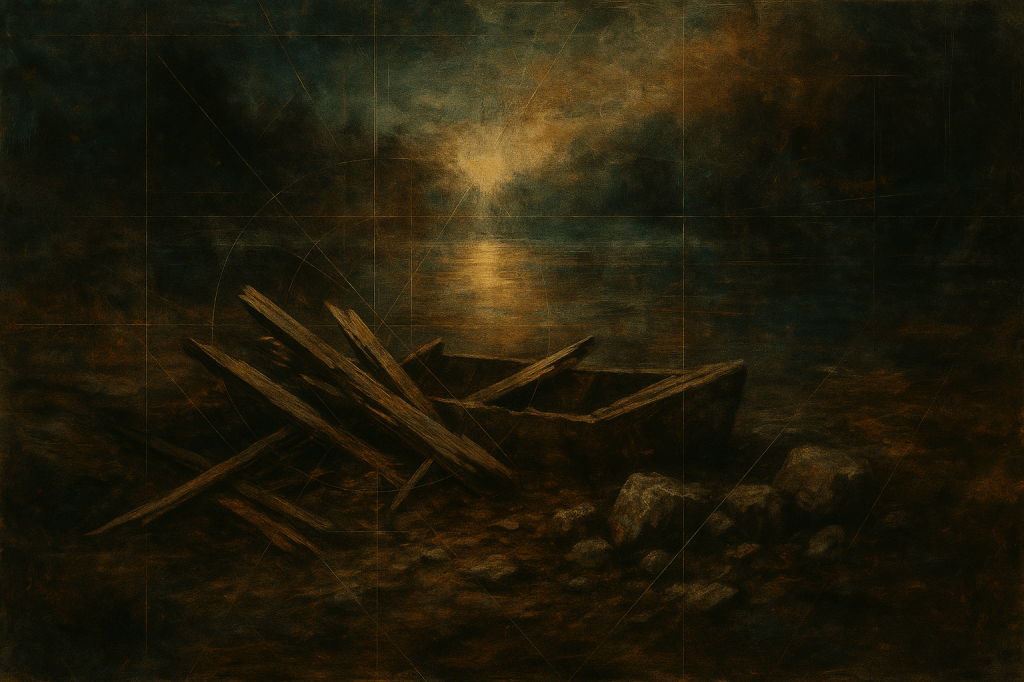
On the third day, I crept to the boathouse at dawn and found shattered planks strewn across the mudflats, shards of canvas from the old rowboat, and clumps of cement laced with rusted wire. My heart thundered; I drew the fragments in furious strokes—the sharp angles of broken wood, the jagged lumps of concrete. In that moment, I heard Mother’s voice carrying across the lodge’s veranda: “We must remove it. It shouldn’t lie here any longer.” Jack’s laughter answered her—a dry, broken sound that set my teeth on edge.
Flowers’ Watch

Later that morning, I walked the ridge path—just far enough to feel the pine needles give way underfoot. I glanced east toward Bluff Point, but the lodge lay behind me, heavy and mute. At the ridge’s crest, I paused to sketch the horizon, but the lilies below had crept closer since yesterday: ten now, fifteen—white watchmen in a sea of trembling stalks. Their petals drooped toward the water as though bowing to something vast and hungry beneath.
An invisible ripple pulsed through the air, and for a heartbeat I thought I heard whispered voices—ancient syllables filtered through the pines. I swallowed hard and drew the lilies’ bent heads, anchoring them in graphite so they couldn’t slip away.
Geometry
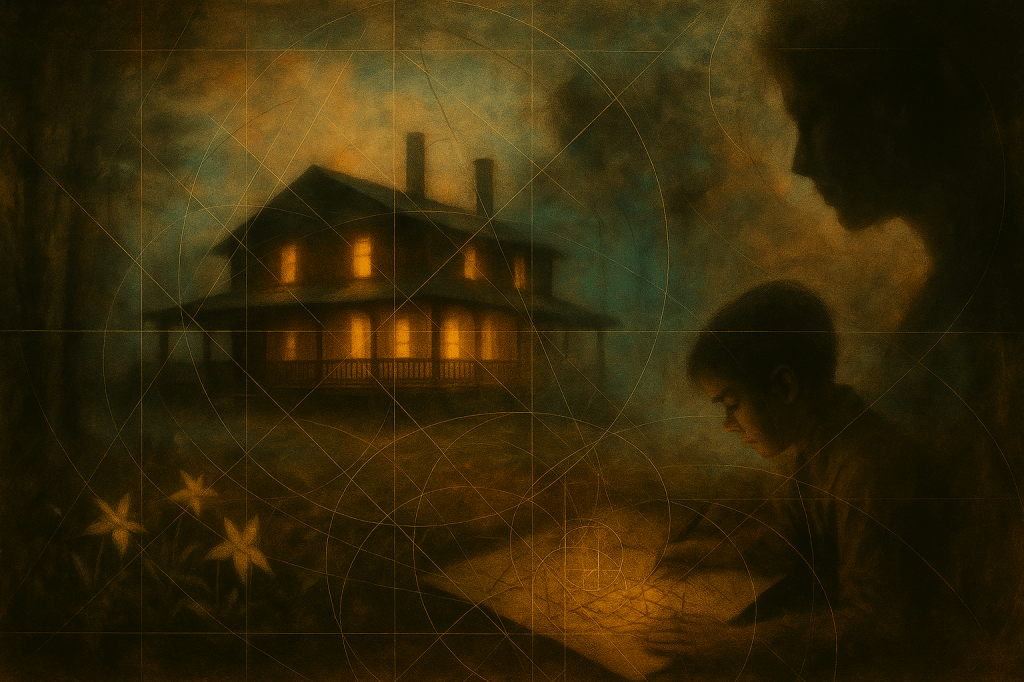
At dusk, the lodge’s windows glowed with lantern light that sliced through the gathering mist. I returned to my drawing on the lawn, laid my page flat, and traced new spirals—overlapping, interlocking—until the entire scene sat within a lattice of sacred geometry. Mother peered over my shoulder. Her breath came in quick, shallow gasps. “What are you drawing, Russell?” she asked, voice brittle as dried reeds.
“Truth,” I said. She frowned, then gently laid a hand atop my sketch. My charcoal smeared beneath her palm. She withdrew her hand as if burned. “You mustn’t draw that,” she whispered. But my lines were already set.
Shadow at the Edge

That night, lanterns bobbed on the veranda as Mother and Jack sat in stiff chairs, conversing in hushed tones. I lingered in the doorway, my sketchbook pressed to my chest. From the corner of my eye, I saw it: a rank silhouette crouched among the lilies, half-gloved by shadow, half-reaching toward the lodge. No jaw, only an abyss where a face should be. It watched them, patient and elemental.
Jack abruptly stood, knocking over his chair. Mother gasped and rose, hands trembling at her throat. They quickly crossed the lakeside lawn to the boathouse as though drawn by an invisible magnet. I followed them, numb with fear, until they pushed Cassius’ crafted guideboat into the water and carefully stepped aboard. Mother’s hair billowed like a sail; Jack’s firm grip on the oars was white-knuckled. They drifted toward the lilies, their forms mirrored in the lake’s black ink of infinity.
Spiral’s Refuge
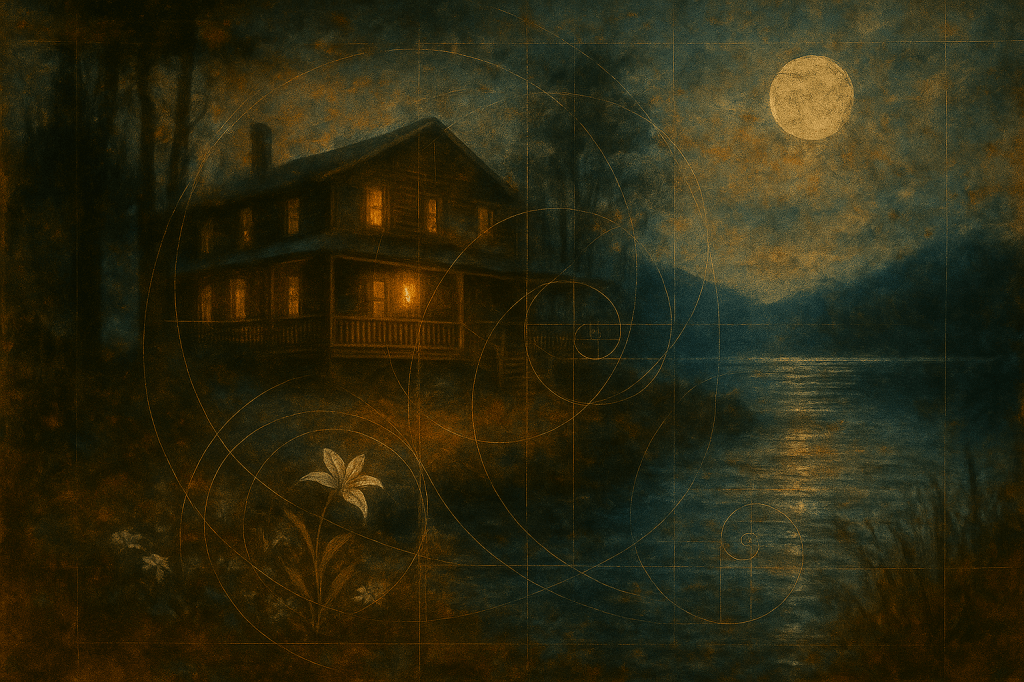
Left alone on the shore, I sank to my knees and opened my sketchbook. The golden‐ratio spirals now twirled inward until the lilies formed a ring around the lodge, and the broken planks lay like ribs beneath the water’s skin. I drew a final spiral at the page’s center, sealing the scene with graphite’s promise of truth.
As dawn’s first light brushed the ridge, I rose and laid the sketch atop the veranda’s rail. The mist was lifting, and the lilies swayed in a breeze I could not feel. The coffined horror beneath the water’s surface remained unnamed—even by Jack and Mother, who had not returned. But my drawing held their story: the lodge’s crooked grin, the lilies’ silent vigil, the fractured fragments of wood and cement, the spirals binding the scene—and beyond it all, the shape at the water’s edge that needed no name to claim its place in the dark.

Years later, people still ask about the drawing that vanished from Camp Jack’s veranda. They say the paper frayed into dust, but the spirals remain—etched into the lodge’s timbers, into the lilies’ faint beat, into the ridge’s silent watch. And every summer, new visitors speak of a child’s laughter carried on the wind, a whisper tracing the golden ratio across moonlit water, a single lily blooming on the shore when no seed was ever sown.
I, Russell Nesbit Thaw, confirm it all. My hand trembled when I first put charcoal to page, but the spirals held true. And in that geometry, the Infinite One witnessed the Wendigo’s unspoken covenant—binding me, binding Camp Jack, binding every soul drawn to that lake, to its ancient coffin, to the curse that blooms like lilies under the watchful pines.


What mysteries of Chateaugay Lake haunt you?