
East Bellmont content advisory: Adirondack Guide and Innkeeper reports penitent Loup-Garou; expects skeptics; includes expert commentary, community theories, parish extracts, challenge to test ice at midnight; mixes civic news, dread, humorous bravado.

“The moon’s an arrant thief, and her pale fire she snatches from the sun.”
—Timon of Athens, Act IV, Scene iii
Chateaugay Record — Correspondence from East Bellmont, Week of January 12

Mr. Editor,—Plainly stated so even our sober deacons may keep their supper: a most uncommon perambulation has occurred upon our winter roads. French trappers up from the St. Lawrence, trading their pelts through Ormstown and Howick, report a penitent Loup-Garou walking the river ice by moon-mark and catechism count, seven Easters’ worth of contrition worn thin as boot-leather. The news has padded south with the freight and—mark me, dear reader—has made our lake look over its shoulder.
Allow me to set it down in the manner of a respectable paper, though the thing itself resists ledgers.

First, the catechist. He signed “Brother Rémi Leduc, Lay Instructor of Doctrine,” and wrote in a hand tidy enough to iron a collar:
“The creature keeps a procession, not a hunt. I observed, from the St. Malachy road, a figure pacing the Châteauguay by measured stations, pausing at every seventh stride to cross itself clumsily, as if paws remembered fingers. I recited the Confiteor once, then twice, but the thing recited its guilt back at me by gait alone. Pale frost lifted in sheets, and the river beneath rang like a bell struck under snow.”

Second, the voyageur, one Étienne “Ti-Noir” Desrosiers, a man accustomed to difficult cargo and flexible truth but a champion at making both arrive on schedule:
“Ah ha, by gar, not wolf, non—monsieur priest with hair on hees teeth! He carry the moon on hees back like pack-basket, big, beeg, and he walk straight line over black water ice—no slip, not even wan—counting Easter like rosary beads. I say, ‘Allô, mon grande chien, you go confession or you go supper?’—He show me good manners, he stay hungry.”
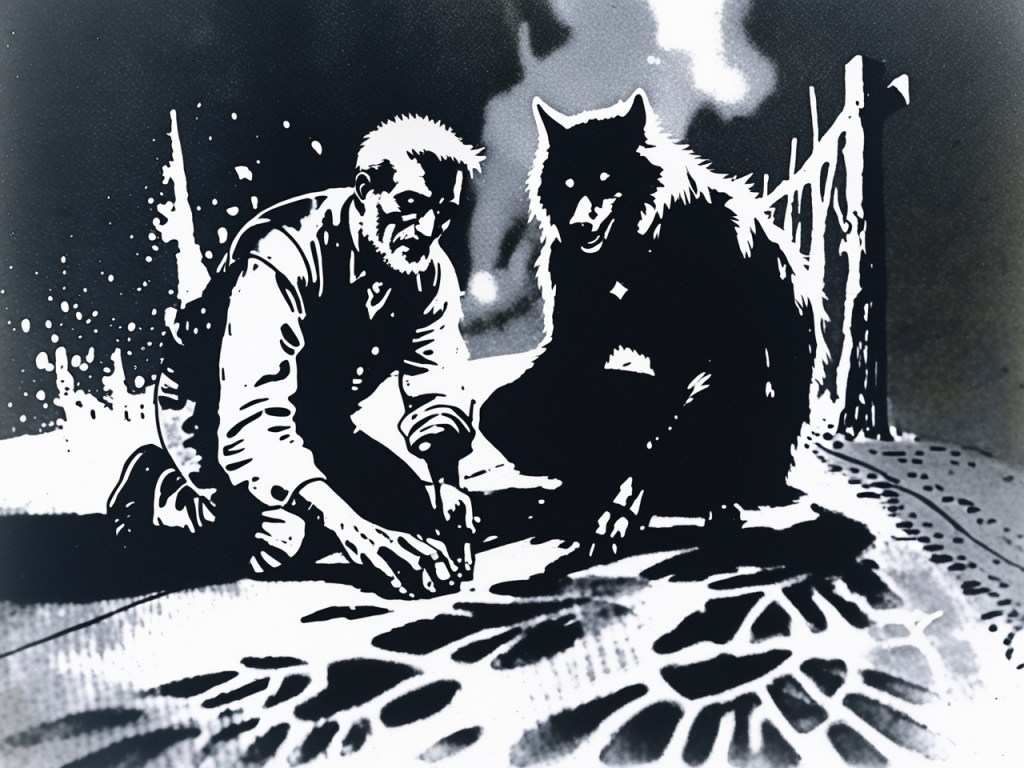
Third, the deputy. Not one of ours (I would have said), but a passing Essex County man by the name of Crosby, attached to a feed-sled bound for Malone. His statement arrived folded around a sandwich of cold ham, which speaks to his priorities:
“I ain’t calling it a monster. Call it a parishioner in need of a barber. The tracks were narrow as a nun’s smile, and each toe-nail sharp enough to italicize the ice. Whoever wore them did so with intention—turned only at the sound of the bell from St. Brigid’s, then squared his shoulders to the north as if reckoning a debt.”

You will object, dear reader, because that is your office and pleasure, that wolves do not count holy days nor pause for bells. Permit me an expert before you sharpen a pencil. Professor Honoria Bell of our short-lived Shatagee Woods Academy for Natural & Unnatural Philosophy (she keeps a room above O’Nolan’s, pays her bill in Latin and cash) offered this:
“Lycanthropic penitence is a folk-ritual of calendar and ice. The beast, under a moon of high albedo, performs a circuit of atonement along low-friction planes—rivers, roads, lakes—where guilt may achieve maximal glide. One notes the seven-Easter periodicity: the conscience exhales by sevens. Errant moonlight, refracted through hoarfrost prisms, can produce a luminous nimbus about the subject, the so-called aureola lupina dear to rural metaphysics.”
You will observe how comfortably she straddles science and stove-talk. She is paid to do so; I am paid (in smaller amounts) to print it.

Our local eccentric, Old Fog LaRue—the guide who maps what isn’t there until it is—presented a diagram upon a flour-sack. It showed the Châteauguay as an artery joined by “subterranean channels of sanctity” to our own lake:
“See here, Mordecai,” says Fog, tapping his knuckle the way a man requests a card. “The ice roads are not merely roads. They’re pen-lines in a ledger heaven keeps on us. A sinner with feet like chisels may walk an account from parish to parish, from Ormstown to our Narrows, balancing columns till dawn. If he overpays, he turns back a man. If he under, he arrives a dog. Old rule. Don’t fuss.”

And—you will insist on a young innocent witness, as is proper in any controversy that wishes to breathe—so we have Miss Eloise Marchand, lately employed at Alfie King’s store and prone to stay late straightening the licorice:
“At closing,” she avers, “I saw a glimmering arc of silver spread over the lake’s skin, finely etched like fish-scales, and in the center a form, almost apologetic, adjusting its shape as if trying on an old coat—man to wolf, wolf to man—never settling. When St. Mary’s clock struck, the figure lay down on the ice as one might lay down a sorrow and listen to whether it cracks.”

You ask for documentation; we are a respectable county, after all. The editor allows these parish notes as boxed matter, that the pious may point with a clean finger:
— Parish Register Extracts (St. Malachy; St. Brigid’s) —
Bapt. Remigius Leduc, son of Jean & Marie (née Fournier), catechist’s assistant. Entry notes “steady count of beads, ice-pilgrim in winter.”
Mar. Étienne Desrosiers to Rosalie Gagnon, witness: “LaRue, called Fog.” Margin remark: “honest man, creative map.”
Bur. (undated) Unknown male, frost-bitten, fingers scar-shaped as claws. Priest notes: “Confession incomplete; absolution deferred.”
[Clerk’s stamp faint; ink light as moonmilk.]
Now to community theories (and here we throw open the hall): Our deacons propose a traveling penance, adjudicated by bells. The old fiddlers prefer a love-trouble dressed in fur. The schoolchildren say it is the shadow of our own boat-parade, practicing under heaven’s mirror. A trapper at the stove says nothing, which is a statement of its own.

To the scoffers—and I name you with affection—I submit the following experiment, as gentlemanly as any chemistry: proceed to our Narrows at midnight when the moon is two days fat of full. Bring a lantern, a string of seven beads, and a nickel for St. Mary’s poor box. Stand upon the black ice where the river thinks of becoming lake. Count one to seven with your teeth together. If the air grows colder by a clean degree, and the stars step back as if making a corridor, then you owe the parish a prayer and me a letter. If nothing happens, you owe me still the letter, describing your nothing with sufficient detail to cast a shadow.
By morning the news returns upriver. Our informants declare the penitent, having paced his tally to the bell’s last note, turned his face north and thinned into the blue faintness that rides over ice before the sun. If he arrives again—if the ledger is not settled—he will pass down the white roads to us in the same slow dignity, leaving scratches that italicize our winter.

Dear reader, I do not insist, but I am willing. The lake wears its pale fire like a serious joke, the kind that keeps you company. And in that theatrical hush before dawn, when our boathouses hold their breath and even the drifts lean in to listen for footfalls, there is sometimes the soft rhythm of paddles where no open water lies, each stroke marking time for a penance no one disputes and no one entirely understands.
I remain, as ever,
Mordecai Vilecreek
Adirondack Guide and Innkeeper
East Bellmont, where our lake remembers what the road pretends to forget.


What mysteries of Chateaugay Lake haunt you?