
Contains eerie frontier justice, spectral fauna, mild historical blasphemy, and one regrettable incident of being devoured by an incorporeal bear. Reader discretion—and lantern oil—strongly advised; the hill’s appetite remains uncertain.

Throwing a few more slabs of birch on the crackling fire at the foot of Larrabee Hill, Nate Thurber stood tall amid the circle of concerned neighbors, his face etched deep with the lines of a man who had wrestled the wilderness since 1816. The air hung thick with the scent of damp earth and pine resin, and the gathered folk—hardy souls from the eastern reaches of Bellmont—shifted uneasily on logs and stumps, their eyes darting to every rustle in the underbrush, as if the very trees concealed listening ears. Samuel C. Drew, the first to stake claim near Chateaugay Lake, leaned on his axe handle, his kin from New Hampshire stock eyeing the shadows where the mountain sloped up into the impenetrable black, whispering among themselves that unseen forces might already be closing in. Enoch Merrill, with his nets and tales of netting wagonloads of whitefish, muttered low to his brother, Paul, beside him, their words laced with suspicion that the lake itself harbored secrets, watching their every move, while John Sanborn, ever the one to push for naming the town after himself, gripped a lantern that cast flickering ghosts across the faces of the Jacksons, Otises, and Estabrooks boys, each man glancing over his shoulder as though expecting betrayal from his neighbor.
“Well, neighbors,” Nate began, his voice steady but edged like a honed blade, though his gaze flicked nervously to the encroaching darkness, “you all know why we are here, but do you truly? My girl, young Eliza, vanished three nights back whilst gathering berries on the ridge, and the tracks lead straight to that hermit’s shack up the hill—old Zebulon, the one what lives with naught but squirrels and that cursed bear shadow folks swear guards his door. But is it just him? Evidence is plain: her kerchief snagged on a thorn by his path, boot prints matching his ragged soles, yet who among us can say if others are involved, if eyes are upon us even now, plotting in the gloom?” The words hung heavy, seeding doubt like weeds in fertile soil, as folks began to eye one another sidelong, wondering if the person next to them had seen something and said nothing—or worse, aided the vanishing.
A murmur rippled through the crowd, swelling into uneasy accusations, folks nodding and crossing themselves while scanning the treeline for shapes that might not be mere branches. John B. Jackson, the mill man who had bought Gates Hoit’s sawmill back in 1822 and ground stones from native boulders with John D. Miles’ help, cleared his throat, his voice trembling slightly as he confessed, “I seen it meself once, that bear—not flesh and blood, no sir—passed right through a spruce without bending a twig. But what if it’s not alone? What if Zebulon is in league with it, and it with others, turning nature agin us all, whispering our names to the wind? We cannot wait for some fancy court in Malone; frontier justice will do, with the hill itself as judge, lest the shadows swallow us one by one before dawn.”
Roswell A. Weed, supervisor in 1833 and 1836, stood up slow, his frame still sturdy from hauling lumber forty miles to Champlain for Meigs, but his hands clenched as if warding off invisible threats. “Let us set this tribunal proper-like, though I wonder if we are truly alone here. Nate, you accuse. Zebulon will defend if he shows—we sent word by the Merrill boy this morn, but did the boy return unchanged? Witnesses first: Enoch, you was fishing the lake foot when you heard the cry, but was it only her voice, or something mimicking to lure us deeper?”
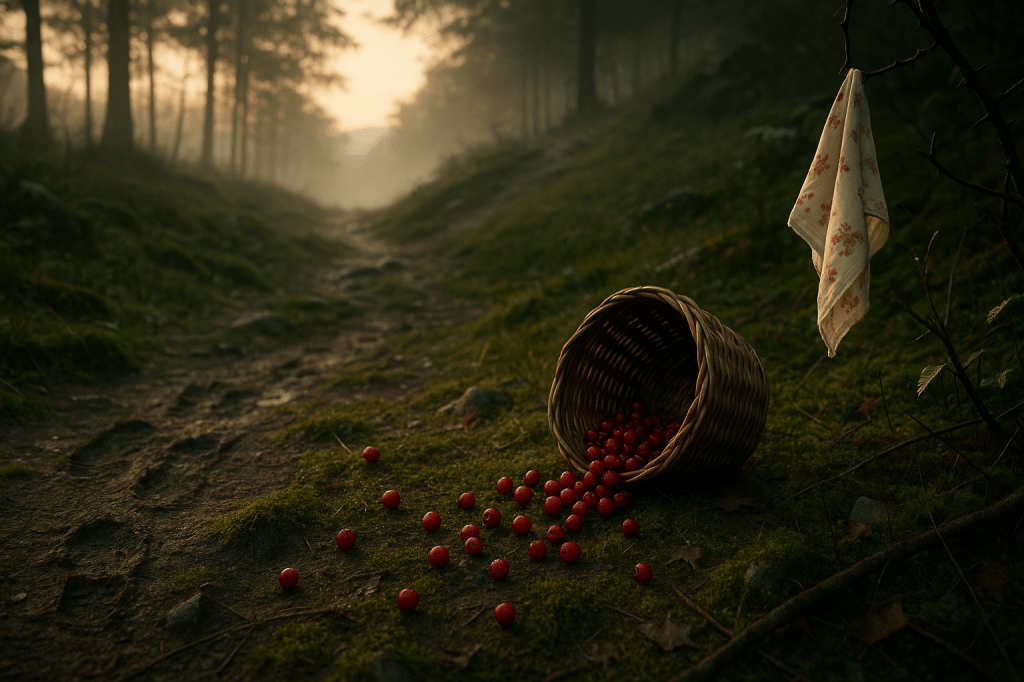
Enoch nodded, his voice gravelly from years of calling across the waters, but now hushed as if afraid the lake might overhear. “Ayuh. It was dusk, and I was pulling nets heavy with trout and whitefish—fine panfish, mind you, better than any south of here. Heard a shriek up the hill, sharp as a hawk’s, then silence, but for a low growl that shook the reeds. Next day, found her basket overturned, berries scattered like blood drops. And tracks—man’s and beast’s, mingling queer. But what if those tracks are faked, meant to turn us against each other, while the real culprit watches from afar?”
Paul Merrill chimed in, his tone urgent, fueling the growing dread, “And do not forget how netting clears the big ones that eat the fry. That bear? It is like them predators, guarding Zebulon from justice, but perhaps guarding secrets we all share unknowingly. If we do not act, it will pick us off one by one, starting with those who speak loudest tonight.”
The unease built like a storm over Ellenburgh Mountain, folks now huddled closer yet pulling away, paranoia weaving through their ranks as old tales resurfaced of the Old Military Tract, where soldiers’ ghosts wandered since 1786, and William Bell’s lands hid secrets deeper than his pockets—secrets that might implicate any of them. Jonathan Bellows, kin to the boat builders who would launch the Adirondack on the lake in 1882, spoke up, his words hurried. “My pa told of crevices in these hills where vines twist like ropes to the top, hiding lairs. Zebulon has been here since afore the Hogans bought from the Indians in 1824. Irish swarmed in after, but he stayed lone, talking to shadows. That bear is his familiar, spectral or no—evidence points clear, but what if it points to us next, revealing what we have buried?”
Just then, a rustle from the treeline—sharper than the wind—and out stepped Zebulon, gaunt as a winter wolf, his beard tangled with burrs, eyes wild under a tattered hat. No bear at his side, yet the crowd tensed, lanterns swinging wildly to light his path, some whispering that he had been listening all along, or sent spies in the form of night creatures. “You called, so I come,” he rasped, voice like wind through dead leaves, his gaze sweeping the group as if noting who to target later. “Ain’t touched the girl. She wandered too far, that is all. The hill takes what it wants—bears, spirits, lost souls. Nature is the real thief here, and it knows your fears better than you do.”
Nate pounded a fist on a stump that served as podium, his voice rising with accusation. “Lies! Your shack has her ribbon—found it meself. And that bear of yours, glowing in the fog, driving off searchers. But is it only yours, or does it serve a greater pact? We demand proof: call it forth, let the beast testify, or admit the conspiracy that binds you to these woods!”
Zebulon laughed, a dry cackle that echoed unnaturally, sending shivers through the assembly. “You fools. The bear ain’t mine to command—it is the guardian of these woods, older than Constable’s ships or Bell’s will. But if you insist on frontier reckoning, let the hill decide. Climb the crevice yonder, where the woodbine ladders up the bluff. If I am guilty, it will claim me. If not, you will see the truth—and perhaps your own dooms reflected back.”
The crowd buzzed, the air thick with suspicion as clouds scudded over the moon, casting elongated shadows that seemed to point fingers. John D. Miles, estimable citizen and supervisor in 1838 and 1850, nodded grave, though his eyes betrayed fear. “Fair enough. Nature as witness—and executioner. Up you go, Zebulon, but if you fall, what curse follows us?”

The hermit gripped the vine, thick as a man’s arm, and began the ascent, the crevice yawning two feet wide, penetrating deep into the rock like a maw waiting to devour. Halfway up, a growl echoed from the depths, low and thunderous, reverberating in their bones.
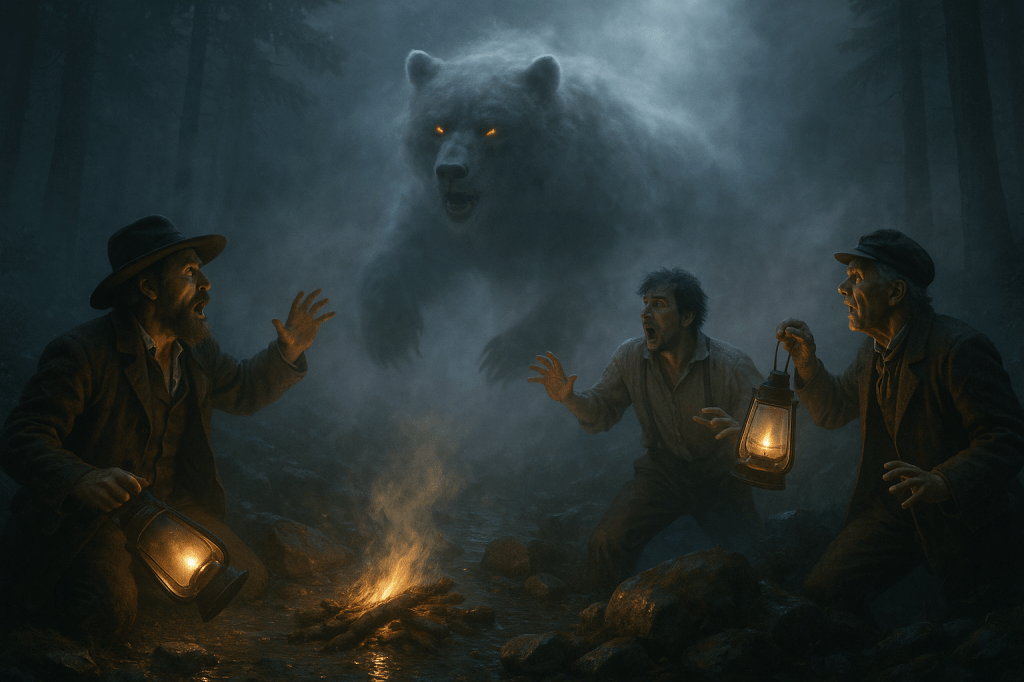
Folks gasped as a shape materialized—massive, furred, eyes burning red, not quite solid, pawing the air, its form shifting as if multiplying into a horde. Zebulon froze, then slipped, vines snapping like whips under unseen strain. He plummeted, screaming, but the spectral bear lunged, jaws wide, swallowing him whole afore he hit ground, its essence lingering in the mist, eyes turning toward the crowd as if selecting the next.
Nate stared, face ashen, voice barely above a hush. “Justice done? Or the hill’s hunger just beginning, with us as the feast?”
Enoch shook his head, glancing warily at the others. “Reckon we best leave these parts be, before it turns on us all. Still, they go west—Johnson, Higgins, all heading to Dakota. Too many vanishings make things gloomy, and who knows who among us is marked.”
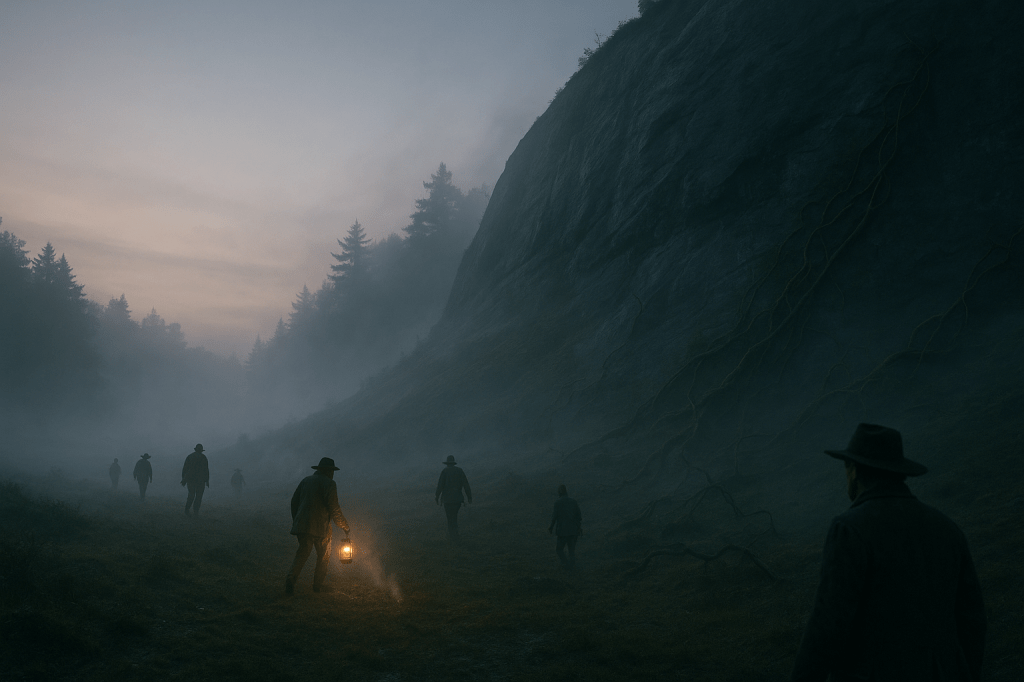
And as the lanterns dimmed, the crowd dispersed, muttering of bands forming in Popeville, brass and correct, to ward off the dark—yet each man walked alone, back to homes that now felt watched. Up on Larrabee, the crevice waited, vines twisting anew, nature’s tribunal ever vigilant, ever expanding its reach. Played out, some said, but the hill knew better, and so did the shadows that followed them home.

What mysteries of Chateaugay Lake haunt you?