
Content warning for hikers and greenhorn trail-wanderers: eerie Adirondack folklore, psychological horror, ghost stories, sulfur gas, disorienting crow-laughter, and unsettling wilderness encounters along remote Mud Creek’s paths—read before you hike, not after.
“Heed not their caw, for it ends in a chuckle not born of this world.” — Note pinned to the Mud Creek trailhead

Overview
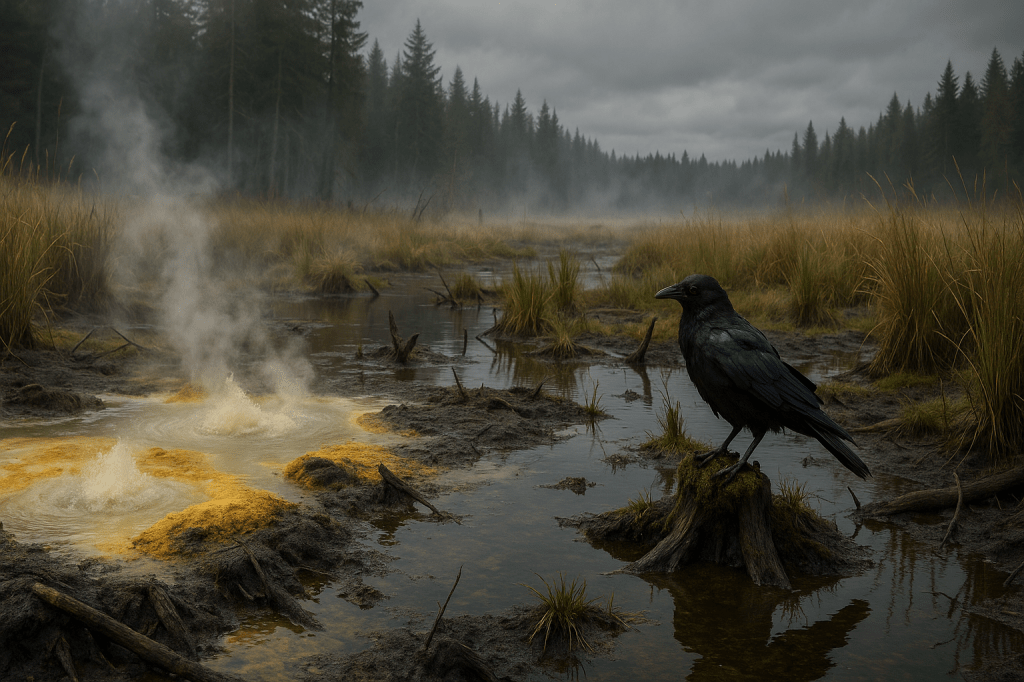
The Sulfur-Drunk Crows of Mud Creek refer to a bizarre avian phenomenon reported in the wetlands surrounding Mud Creek, a fetid tributary of Chateaugay Lake in northern New York. Since the late 20th century—but with murmurs of older, stranger tales—residents and researchers alike have documented a localized murder of American crows (Corvus brachyrhynchos) exhibiting unusual physiological and behavioral changes, attributed to prolonged exposure to naturally occurring sulfur emissions from the marsh.
These crows are not merely altered in color or voice. Witnesses claim they mimic human speech with eerie precision, particularly the voice of a deceased 19th-century trapper named Jean-Baptiste Charbonneau, whose ghost is said to haunt the region. The phenomenon has drawn both scientific curiosity and folkloric dread, culminating in a notorious 2011 expedition by ornithologist Dr. Linus Greaves, who disappeared for four days and emerged chirping in birdsong.
Geological and Environmental Context
Mud Creek meanders through a swampy lowland below Standish riddled with sulfur vents, the byproduct of iron-ore sludge run-off from the late 19th-Century industrial revolution days, mixing with ancient peat formations and underground labyrinthine thermal activity. Locals describe the air as “hot-egg-thick” and report dizzy spells, hallucinations, and the faint smell of lucifer matches struck in the dark. Scientific surveys conducted in 2003 by the Chateaugay Woods Biochemical Society confirmed abnormally high levels of hydrogen sulfide and dimethyl sulfide.
These conditions create a rare ecosystem wherein scavenger birds may have adapted in strange, possibly unprecedented ways—metabolizing sulfur compounds as a supplementary energy source, or simply developing tolerance to otherwise neurotoxic fumes.

Unusual Crow Behavior
Documented behaviors of the Mud Creek murder include:
- Vocal Distortion: Their traditional caws take on harmonic overtones, sometimes described as “triadic moans” or “gurgling bells.” Recordings analyzed at SUNY Plattsburgh showed voiceprints resembling distorted human speech.
- Iridescent Eye Glaze: Close observers note a prismatic film across the eyes of these crows, with flashes of violet and sickly green. A 2009 autopsy of a deceased specimen by the Cornell Lab of Ornithology revealed ocular crystallization—previously unrecorded in avian biology.
- Mimicry of Human Laughter: First reported by campers in 1984, the laughter varies from high, mocking titters to a low, resonant chuckle. These sounds are now associated with the trapper Charbonneau, whose mirth was, according to lore, unmistakable and unnerving.
- Apparent Sentience and Naming: Several observers, most notably Dr. Greaves, insist that the crows have learned individual names. In Greaves’ case, they reportedly repeated his name in singsong voices—“Li-nus, Li-nus”—sometimes in the early morning fog or from behind his tent, long before dawn.

The Legend of Charbonneau
Jean-Baptiste Charbonneau (1819–1872), not to be confused with the famed son of Sacagawea, was a trapper of obscure Algonquin-French descent who lived and perished near Mud Creek. Stories conflict wildly: some say he was a smuggler of pelts and spirits, others that he drowned after inhaling swamp gas while chasing a “laughing crow” through the mist. His name appears on no census, but a crude gravestone bearing his surname and the year 1872 rests half-submerged near the sulfur flats.
Local folklore claims Charbonneau would sit alone for days, laughing at his own jokes, conversing with crows, and carving figures from bogwood that depicted neither man nor beast. One such idol, now housed in the Franklin County Historical Society, bears an uncanny resemblance to a crow with human teeth.
The Greaves Expedition (2011)
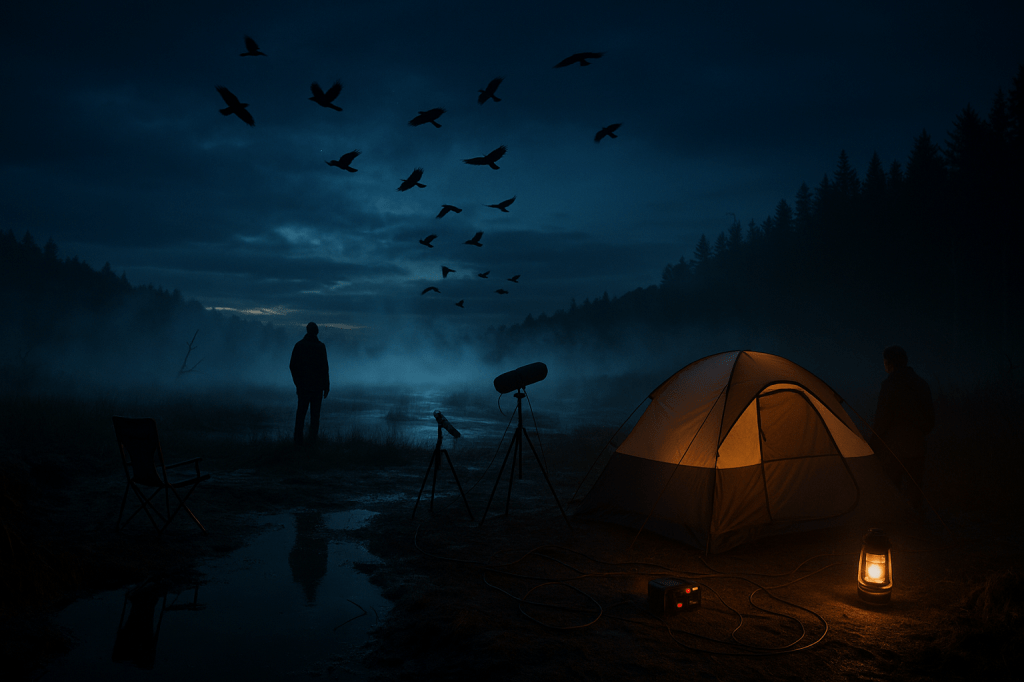
In October 2011, Dr. Linus Greaves of Dartmouth College ventured into Mud Creek with audio equipment, sedatives, and an assistant named Myrtle Voss. After setting up camp, Voss returned to their base outpost to report strange crow activity and increasingly erratic behavior from Greaves, who had begun speaking in fragmented phrases: *“The crows remember—they do not forget—they sing *his* name, not mine.”*
Greaves vanished for four days. When he reappeared at the edge of Owl’s Hollow (half a mile from the marsh), he was dehydrated, unshaven, and speaking in a bizarre cadence reminiscent of crow speech. Audio samples later revealed garbled repetition of the phrase: “Come down, Charbonneau. We’re laughing now.”
Greaves retired from academia soon after. He currently resides in Saranac Lake and avoids interviews.

Controversies and Theories
Scholars and folklorists remain divided on the true nature of the Mud Creek crows:
- Biochemical Adaptation Theory: Advocates argue that long-term sulfur exposure may have created a localized evolutionary shift. Analogous phenomena have been observed in extremophile bacteria, but never in birds.
- Neurotoxic Hallucination Hypothesis: Skeptics assert that hydrogen sulfide exposure causes auditory and visual hallucinations, with shared legends and stories reinforcing delusional consistency among witnesses.
- Paranormal Resonance Theory: Paranormal researchers posit that Charbonneau’s ghost has “imprinted” upon the region, and that the crows, intelligent and social as they are, have become mediums for his laughter. Fringe theorists cite quantum entanglement and necroacoustic residue.
In Popular East Bellmont Culture
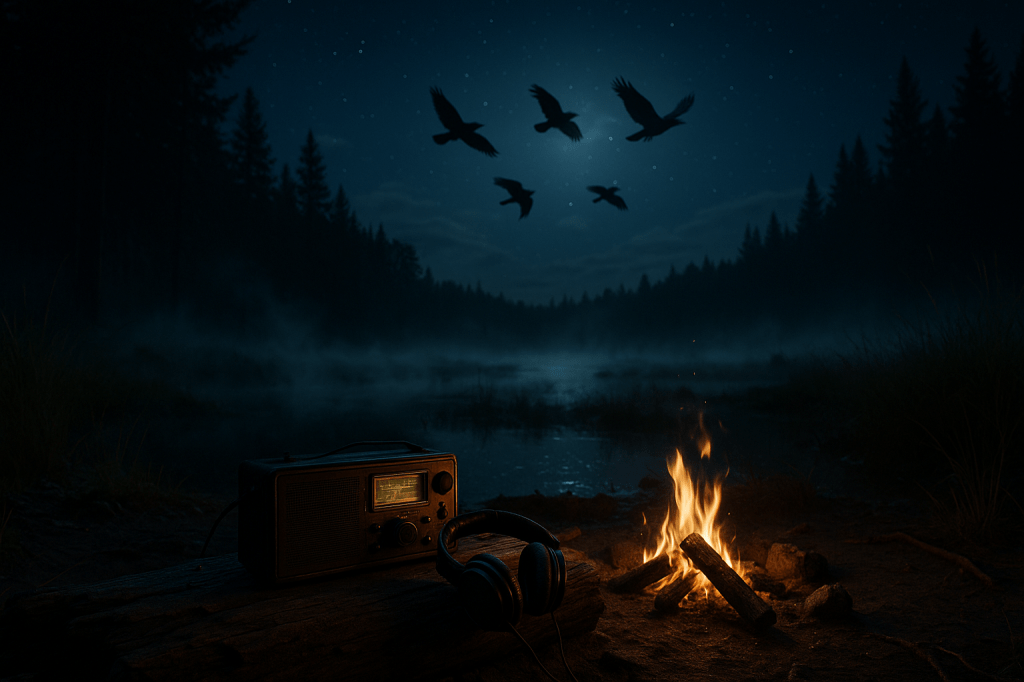
The phenomenon inspired a 2017 radio drama, Charbonneau’s Laugh, broadcast from Gypsy Village’s Pirate Radio WQXR’s Midnight North, and a recurring subplot in the 2021 video game Wendigo Pines, where sulfur-crows are introduced as an enemy type. A recent 2023 experimental bog-core music album, Ghosted Calls: The Sulfur-Crow Larks of South Inlet, claims to remix field recordings of the crows into immersive eerie electroacoustic ambient music compositions.
Current Status
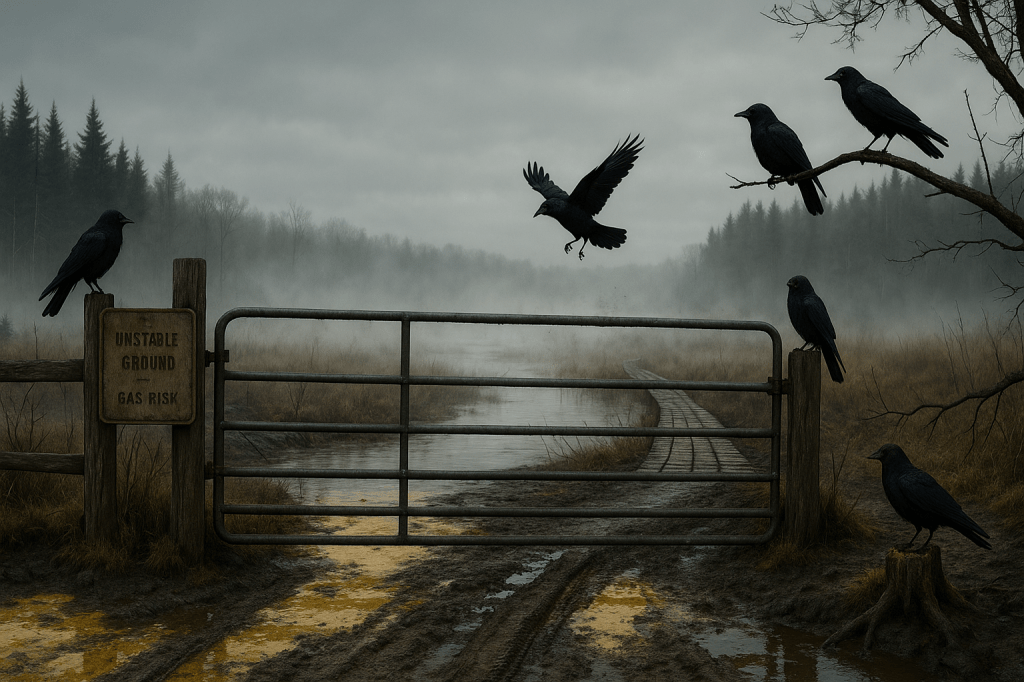
The trail to Mud Creek has been officially closed since 2015 due to “unstable terrain and gas risk.” Nevertheless, hikers, cryptid enthusiasts, and amateur ornithologists continue to report sightings—often leaving behind journals filled with strange laughter and the repeated word: Charbonneau.
See Also
- Mimicry in Corvids
- Hydrogen Sulfide and Neurological Symptoms
- Folklore of the Adirondack Region
- Ornithological Anomalies
- Ghost Audio Phenomena
Footnotes
- Greaves, Linus. Field Notes: Mud Creek, unpublished manuscript, 2011.
- “Sulfur and Sound: Biochemical Hazards of Peat Vents,” Chateaugay Woods Biochemical Journal, Vol. 47, 2003.
- “Charbonneau the Laughing Trapper: Myth or Man?” Franklin County Folklore Quarterly, Spring 1978.
- Interview with Myrtle Voss, Voices in the Mist podcast, Episode 12: “Birds Don’t Forget.”
- Saranac Sentinel Archives, October 12, 1872, Obituary for “J.B.C.”
If ever you walk alone near Mud Creek, and the crows fall silent—flee. It is not silence you hear, but the breath before a punchline.
#AdirondackGothic, #EcoHorrorFiction, #FolkHorrorRevival, #CorvidCore, #BiochemicalHorror, #GhostAudio, #ElectronicVoicePhenomenon, #FoundFootageHorror, #WildernessWeird, #UrbanLegendInvestigation, #SulfurDrunkCrows

What mysteries of Chateaugay Lake haunt you?