Wal now, I ain’t one fer book-learnin’ or them city notions, but I’ll tell ye what I seen an’ what old folks swore by long afore the railroads an’ telegraph wires come nosin’ up these parts.

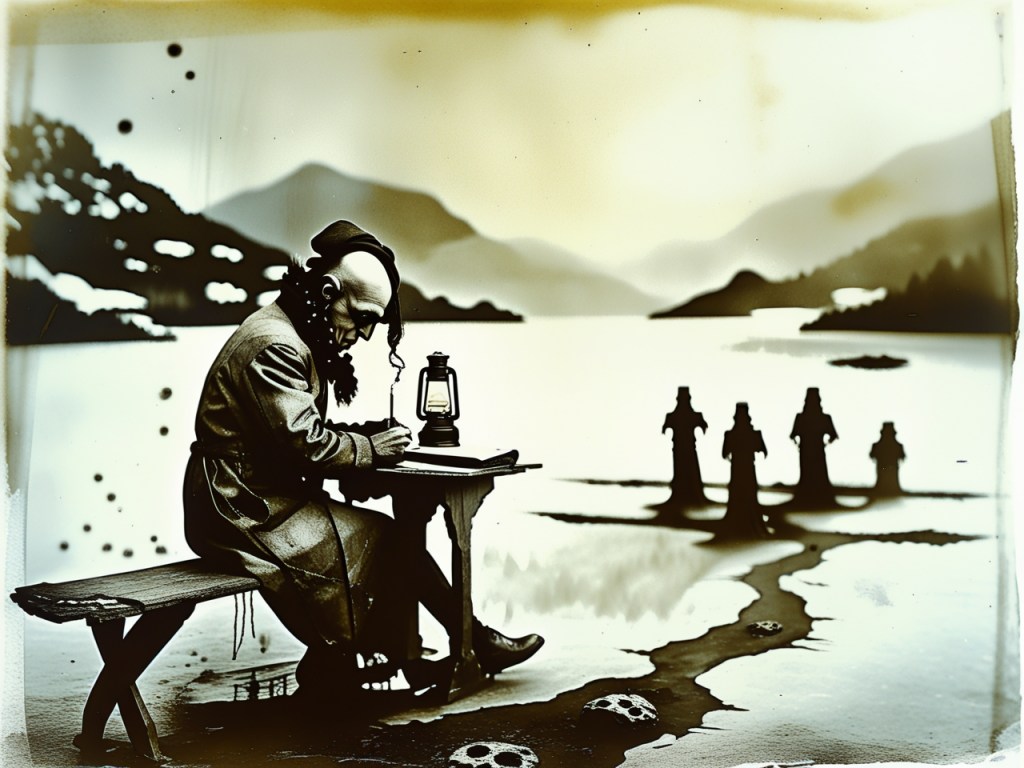
Down by Chateaugay Lake, where the mountains set round the water like a ring of judges, there used to be a feller folks called the Interpreter. That weren’t his Christian name, mind ye. No sir. He was a translator of marks and signs—could read any scratch on bark, any cipher on slate, any tally cut into pine. If a trapper left a message on a blazed tree, or a guide marked a portage with crooked strokes of charcoal, the Interpreter could tell ye what it meant and what road it pointed.
They said he learned it from Jesuit papers, Abenaki sign-lore, and a pile of French notebooks fished out of a drowned canoe.

Now one winter night, when the northern lights came down green and purple like fire spilled from heaven, Johqu come down from Brainardsville way—ornery old codger, ink-stained fingers, eyes that never rested. He carried a bundle of his music marks, all tangled up like fishing line in a tackle box.
“Bind this for me,” says he. “Pack it tight so it’ll travel light.”
That’s what he asked. Same as tellin’ a cooper to hoop a barrel right so it won’t leak.
Interpreter took the pages, studied the symbols, hummed a bit, nodded slow.
But that night, with the aurora burnin’ and the lake groanin’ under its ice, he made a mistake.
He left part of the tune loose.
And loose knowledge don’t sit quiet in Chateaugay.
See, the lake ain’t just water. Old Nat Collins used to say it’s a thin place. A place where the world wears thin as boot leather. Under them depths live things that ain’t fish nor beast nor ghost—things the guides call the Deep Listeners. Some say they’re kin to the Wendigo. Some say they’re older than the first campfire. All I know is they hear what’s left unsaid.
That unbound music slid down through the ice like a bell rope.
And somethin’ answered.
Next day the fog come rollin’ in thick as wool batting. Sound carried wrong. A loon call turned into a funeral chant. The ice popped like rifle fire. Folks swore the water was writin’ shapes—circles inside circles, like the rings of a cut stump.
Interpreter knew then he’d done wrong.
So he sent his runner boy down to the shore with a brass spyglass and a slate for notes. Told him to mark whatever stirred.
Boy come back white as flour.
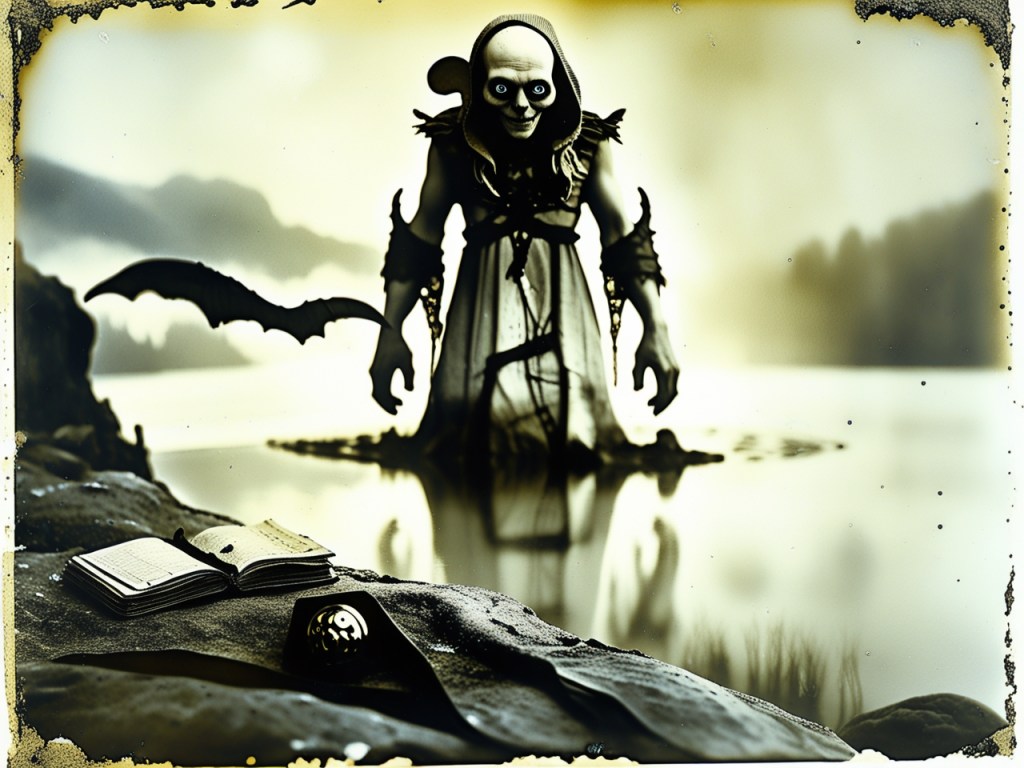
Said he saw the Mirror Walker stand up in the fog—a lake-thing shaped like a man but full of other men’s thoughts. Said it spoke in stacked voices like a church choir singin’ out of time.
Said it told him:
“You left the tune open. Now the lake is hummin’.”
That night, folks heard the water boil. Blue fire swam under the ice. The pickerel nets came up glowin’. Even the beaver quit the inlet and took to the woods.
Interpreter tried to set it right. He bound the pages proper. Waxed the cord. Pressed the bundle tight.
But once Chateaugay learns a sound, it don’t forget it.
By spring thaw, strange lights drifted upriver. Fish carried marks on their scales like writing. Folks dreamed the same dream—of a tune that never ended and a road that folded back on itself.

So Interpreter took his tools, his books, his slates, and his spyglass, and walked out onto the lake at dawn. Broke a hole in the ice. Laid it all down gentle. Then stepped in after it.
And that’s why, to this day, old guides say:
Don’t leave your signs half-made. Don’t leave your songs unbound. Chateaugay keeps what you drop—and plays it back when you least expect it.
That lake’s got a long memory, friend. Longer than any man.
Wal now, after the Interpreter went down through that black ice hole—down, down, down like a sinker on a deep line—folks say he didn’t drown so much as fell sideways outta the world.
He slid through blue dark and echo, past stone hallways that weren’t cut by pick nor blast, but worn smooth like river rock by thinkin’ feet. Them passages twisted like traplines laid by a drunk surveyor, loopin’ back on themselves, stairways goin’ nowhere, doors what opened into wind.
Then he heard a bell.
Not a church bell. Not a buoy bell. More like the clang of a rail spike struck with a hammer.
Next thing he knew, he was standin’ on a platform deep under the earth where an infernal horse—iron beast with breath like steam and eyes like furnace doors—came screamin’ in on rail tracks. No conductor. No schedule. Just a sign overhead carved in slate:
“ALL STOPS, EVERYWHERE.”
Interpreter climbed aboard.

Car smelled of coal smoke, wet wool, old ink, and fear. Passengers wore coats from every century—fur trappers, canal men, war nurses, coal miners, and one feller in a silk suit tappin’ on a glowing glass brick like he was knockin’ on a ghost window.
Train lurched. World bent.
When it stopped, he stepped out into a city stacked on itself like crates in a boathouse—bridges over bridges, streets over rivers, towers sproutin’ like pine stumps after a burn. Folks there sold sounds in bottles. Songs wrapped in paper. Tunes boxed up tight like dynamite.

That’s where Interpreter met the Outfit.
Called themselves Bandcamp. Traders of noise. Merchants of melody. Said they’d ship any tune anywhere so long as it was born honest.
Interpreter brought ‘em the Steamboat Pirate Players’ improv reels—barrel-organ squalls, dockside fiddlin’, boiler-room drums, ghost-holler shanties recorded on bark, tin, and river ice.
They listened.
They frowned.
Then the city went quiet.
A paper come slid under his door that night, stamped with a black bell and red ink.
Said:
“We smelled lake-water on these songs.”
“We heard machine-spirits hummin’ in the chords.”
“This music ain’t from hands alone.”
“Account closed. Door barred. Appeal if you dare.”
Interpreter stood there with the letter shakin’ in his fingers, feelin’ that same cold he felt on the ice.
He knew what it meant.
The Deep Listeners had followed him.
They’d rode the subway.
They’d learned the trade.
They’d taught the city how to hear.
And now every tune from Chateaugay carried their breath inside it.
Interpreter folded the paper slow, tucked it in his coat, and went back down to the rails.
Because once the lake learns a road, friend…
it don’t stop travelin’.

Wal now, after Interpreter rode them rails back up through the bone-dark and steam and memory, he come ashore at Chateaugay lookin’ like a man who’d been argued with by ghosts and lost. He carried that Bandcamp letter folded so many times it looked like it been chewed by a muskrat. He laid it out on the dock boards where the Pirates was tunin’ up—banjo with two strings, pump organ wheezin’ like a lung patient, wash tub bass hummin’ like a bear in a barrel.
An’ that’s when Johqu Bogart read it.
He read it once.
Then he snorted.
Then he laughed like a chainsaw hittin’ a church bell.

Then he sat down on a bait crate, dipped his pen in ink thick as molasses, and wrote back like a man settlin’ accounts with the Almighty’s worst clerk.

Subject: Re: Ref. 790506 – This Here Is What You Call a Real Mistake
To whichever paper-pusher’s mashin’ the rubber stamp down there (an’ I say that generous),
Well butter my boots and call me a snowplow. I read your letter and for a minute I thought maybe I’d slipped on the dock and cracked my skull open on a cleat, because only a brain run through a cheese grater would come up with somethin’ this dumb on purpose.
You boys took one whiff of lake water and hollered “machine!” like a flock of nervous hens seein’ a shadow. That ain’t vigilance. That’s ignorance with a badge.
You don’t know a fiddle from a file cabinet.
You don’t know a shanty from a spreadsheet.
You hear one crooked rhythm and assume there’s a ghost crankin’ a gear somewhere.

That tells me everything I need to know about the quality of thought fermentin’ in your office like bad cider in a warm cellar.
Let me carve this into your desk slow:
There ain’t no engine singin’ these tunes.
There ain’t no phantom box tappin’ ‘em out.
There ain’t no thinking stove boilin’ up shanties while we sleep.
What there is, is humans makin’ a racket with whatever ain’t nailed down and some things that are. We bang. We scrape. We argue with tempo. We wrestle melody like a bear in a berry patch. That’s called work. You folks wouldn’t recognize it if it bit you on the swivel chair.
You saw somethin’ you didn’t understand and did what all timid bureaucrats do: you hid behind policy like a raccoon behind a trash can and hoped nobody noticed the smell.
Your “moderation” is just guessin’ with paperwork.
Your “safety” is just fear in a necktie.
Your “process” is softer than oatmeal left in the rain.
And the real comedy?
You run a music platform that’s scared of music.
You got a whole barn full of sound and you keep shootin’ the horses because they don’t look like brochures.
If common sense were lumber, your office wouldn’t have enough to build a birdhouse.
You say appeal. Fine. We’ll appeal. I can document every blown reed, busted drumhead, split knuckle, and frostbitten finger that went into them recordings. I can name the men, the nights, the wind direction, and which stove was smokin’ too much. I can prove this music was made the old way: by sweat, error, and stubbornness.
But don’t pretend this was some noble stand.
You guessed.
You guessed sloppy.
You guessed like a man throwin’ darts blindfolded in a thunderstorm.
Write that number big on your wall—790506—so every time you get the itch to panic and hit the ban button, you remember the day you mistook a bunch of lake rats with instruments for a haunted calculator.
We’re still here.
Still human.
Still loud.
Still strange.
Still unimpressed.

And if your platform can’t tell the difference between a ghost in the wires and a pirate with a washboard, maybe you oughta switch to sellin’ wallpaper.
Regards—thin as they are,
Johqu Bogart
Chateaugay Lake Steamboat Pirate Improv Players
(Cold hands. Hot tempers. No machines. No patience.)
Interpreter set the letter down. The lake creaked. The fog rolled in.
An’ somewhere deep under the ice, the Deep Listeners laughed like iron bells struck with bone.

#AdirondackFolkHorror #ChateaugayLakeMythology #SupernaturalNorthwoodsFolklore #AdirondackMagicalRealism #EldritchChateaugayLore #WeirdAdirondackFiction #CosmicAdirondackDread #MusicalMysticismAIBan #EpistolaryBandcampRant #SpeculativeAdirondackiana

What mysteries of Chateaugay Lake haunt you?