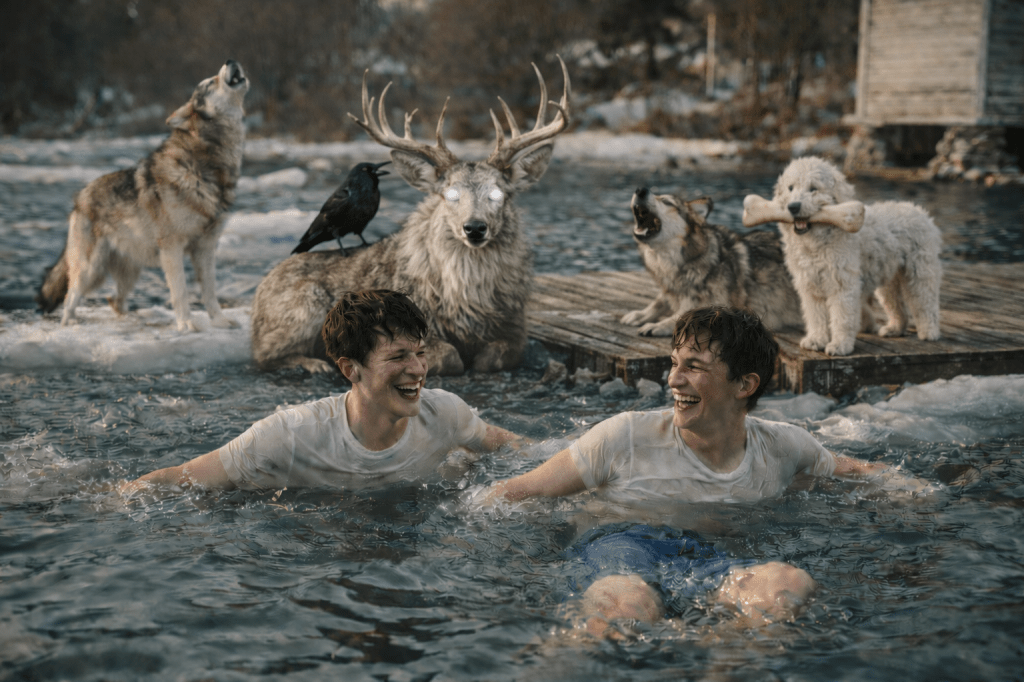
Content warning: Yipping coy-dogs led by feral poodles bearing brass tags with unfamiliar names ravage nervous deer herds across Upper Chateaugay Lake leaving trampled snow and silent woods in their wake.
Facebook Disclaimer (Brainardsville / April ’69 Edition):
This here post is a work of recollection, misrecollection, and the sort of storytelling that tends to improve once the ice goes out and nobody can quite agree what happened. It draws on real places, names, and general North Country circumstance, but any specific acts—swimmin’, not swimmin’, rememberin’, not rememberin’—are purely narrative conveniences and not to be entered into evidence, town record, or family argument.
Any appearances by wildlife, weather, or questionable judgment have been rearranged for literary purposes. No claim is made as to historical accuracy, eyewitness reliability, or who dared who first. Nothing herein constitutes legal advice, medical advice, moral instruction, or a binding statement under any jurisdiction—domestic, foreign, or bureaucratic with a fondness for forms in triplicate.
If you believe you were present, you might be right. If you’re certain you weren’t, you’re probably safer that way. By reading further, you acknowledge this is fiction, folklore, and a little bit of spring thaw loosenin’ the screws. Not quite there yet.
Carry on. Nobody’s in trouble. Probably.
UPPER LAKE UNDER STRAIN—DEER TROUBLES, RETURNING ICE, AND WHISPERED DIRECTIONS AFTER DARK
BANNER HOUSE & INDIAN POINT. APRIL 1969.
Everything appears outwardly quiet up here, yet a strange stir runs beneath the surface, like a log that looks sound until you lay a hand upon it and feel the hollow within. We have had weather enough to keep a man guessing: one morning at 18 degrees, the air so keen it seemed to ring when you spoke; then 38 degrees with clouds, fog, and a soft rain that made the evergreens drip as if freshly dipped in the lake; and after that, a clear, sunny day followed by a dusting of snow in the night, as though winter, turned away at the door, threw a pinch of flour over the threshold in spite. These quick shifts put folks in mind of older seasons when the Lake was said to “set its own rules,” and some now speak of it in that half-jesting way that is never wholly jest—as if the place possessed a mind, a temper, and an ear.
There has been much sober talk of the deer on the Upper Lake, for dogs are killing them, and others claim coyotes join the fray when night falls thick. At the old Jack Clifford camp, four were found dead in one spot; the sight would spoil any hearty man’s appetite. The snow there was torn and trampled as if a rough dance had taken place, and the woods around stood strangely quiet, as though even the small birds had drawn back to let the matter pass. Later came word of twenty-nine dead between South Inlet and Bluff Point—and that is no tale stretched for effect. They were counted one by one, with the slow, careful tally of a man who wishes the number untrue. Others report more, and it begins to feel as though the Upper Lake is taxed beyond its common measure. Some blame the hard winter and hungry mouths; others point to neglect—dogs allowed to roam because they wear collars and so must belong to somebody. Yet more than one man has noted that collars do not always mean a master, and lately we have seen brass tags that make a fellow clear his throat and look away.
Carmen Merrill shot a coyote the other day and did what he could. He also took moving pictures of the ordeal—a new thing in these parts—which has set the boys agog, as if the woods themselves might now be brought into the parlor to perform. But there was little mirth in the telling, for the story spread through the neighborhood in the same tone as news of a sickness. When men spoke of the pack seen up close, their voices lowered of their own accord. Those dogs were marked, and that is what troubles folks most: brass tags, cleanly stamped, bearing names no one in the township recalls. When those names were read aloud on the store porch, the old men fell quiet in that particular way they have when memory enters the conversation uninvited. No one said, “I remember,” yet no one laughed either. In that silence, you could have heard a match strike on the far side of the room.
The geese, too, have behaved in a way that keeps the mind uneasy. Eighteen to twenty of them rest on the Upper Lake, but they do not shift about like ordinary birds following open water and feeding where they may. They arrive in the same exact count, at the same hour, in the same formation, and stand as if upon firm ground—though no open water exists, and the ice shows no rift wide enough to explain their poise. A man can forgive a mystery once, but when it repeats so faithfully, it feels less like chance and more like an appointment kept. Several have gone out with glasses to check for tricks of light or hidden leads, yet the answer remains: no open water, and still those geese, steady as church-goers, as if the Lake had laid something down for them that cannot be seen.
The ice itself has played a curious game. One morning it broke at this end, dispersed as it commonly does, and folks said, “There, spring has done its work.” Yet later—not as new ice from cold, but as though winter had changed its mind—plates of old ice drifted back up the lake, riding the current like rafts returned by a stubborn hand. This ice is stained with the season’s refuse: twigs, hair, and odd scraps—once a glove, once a hymn-sheet folded as if for a pocket, once a child’s toy, wet and bright as if recently lost. The strange part is not the finding, but the ownership. Nobody claims the glove. Nobody claims the hymn-sheet. Nobody claims the toy. Mothers check their children’s shelves; fathers mutter that boys lose things. Yet a tightness lingers in the denials that does not sit easy. It has made some women reluctant to let the little ones wander—not for fear of wolves or thin ice, but because of that quiet question: if Chateaugay Lake can bring a thing back, what else might it return?
Marty and I went out on snowshoes after a half-foot of snow fell overnight. It was a fine, clean morning, with the sun trying to break through and the air so bright that every spruce needle looked newly sharpened. We traveled from Gadway’s down through Camp Chateaugay, onto the lake, up the shore, through the cut behind the Bluff, onto the lake again to the Jack Clifford camp, up the road, and back. In places, thirty-eight to fifty-four inches of snow lie in the woods, altering the forest: familiar stumps vanish, low places become false flats, and a man’s sense of distance shifts so that a short way feels long and lonesome. We noted three deer in the little swamp between the Bluff and the road, standing close and still, as if they had learned that motion draws attention. We saw enough dog tracks that Marty said plainly, “They are ranging.”
Talk has circulated for days of a blind deer found by Carmen. I went with him by snow sled to Indian Point to seek it, but we could not find it then. We searched in the careful way a man does when he half-hopes not to succeed—scanning the edges and shadows between trunks, listening for a stumble or breath, calling out with cautious cheer to see if it might give its location away. It was found later by others, and their report did not sound like any common account of a hurt animal. They said it stood upright, not fallen or tangled, but straight and facing them in a way that silenced the men. Its eyes were milk-white, yet it turned its head precisely toward whoever spoke, as if not blind at all, but listening as it nodded to an invisible beat—listening with an exactness that felt too timely, as though the words drew its face like a magnet draws a needle. One fellow, not given to fancies, said, “It stood like it was waiting for the next sentence,” then fell quiet and would add no more.
Banner House had its own commotion, as it often does when young blood seeks to prove itself against the season. April 27, two Brainardsville boys, young John Glennon and Bradley Perry, went swimming off the dock the day the ice broke and floated, rushing spring as if it were a race to be won by boldness. The older folks shook their heads and said, “They will get their pay,” expecting no worse than a cold. But what followed has puzzled the neighborhood. They took what folks call “season-rush,” yet it did not settle into plain pneumonia. They sleep badly, and in their sleep they speak—long, delirious though steady directions about “the cut behind the Bluff,” naming Algonquin turns, landmarks, and a place seemingly near enough to walk to, yet no one can locate it by daylight, not even men who have known those woods since boyhood. Their mothers stand by their bedside listening, not wanting to be frightened yet unable to leave. Both of the fathers watch the new and pretend to read while straining their ears, for it is one thing to hear a child talk nonsense and quite another to hear him describe a strange route with the calm certainty of an experienced old guide.
As if these matters were not enough to unsettle minds, a thaw arrived carrying a smell like a forge. A warm wind came off the Upper Lake, heavy with wet charcoal and iron—like Popeville in its working days, though the forge lies long quiet and its fires are now only stories. The odor lingered, and folks miles away found fine soot on their window-sills in the morning, dark as old trouble. Some blamed chimney ash blown far; others suggested road dust. But the scent matched neither, and the soot looked too clean, too even, as if sifted. One woman wiped her sill and said, “It is like the Lake has been working in the night,” then laughed at herself—but only once.
Church services remain well attended when roads permit, and we are thankful for good preaching and singing, for music steadies the mind when the woods begin to feel over-attentive. Still, men watch their dogs more closely now, keep children nearer the house at dusk, and exercise more caution on the ice than a month ago. It is not only fear of breaking through; it is a sense—hard to put into plain words—that the Lake has been answering back lately, not with thunder or storm, but with small, repeated signs that make a person question his own eyes. Let others take warning: be careful, and do not treat the Upper Lake as a thing that can be taken for granted. It has moods like a living creature, and in certain seasons it seems to listen.
BELZORAM.
#AdirondackGothic #WeirdNaturalism #SentientLandscape #EcoSupernatural #FolkOmens #HydrologicalMysteries #OneiricDirections #ArtifactRecurrence #CryptidCanines #CommunalApprehension

What mysteries of Chateaugay Lake haunt you?