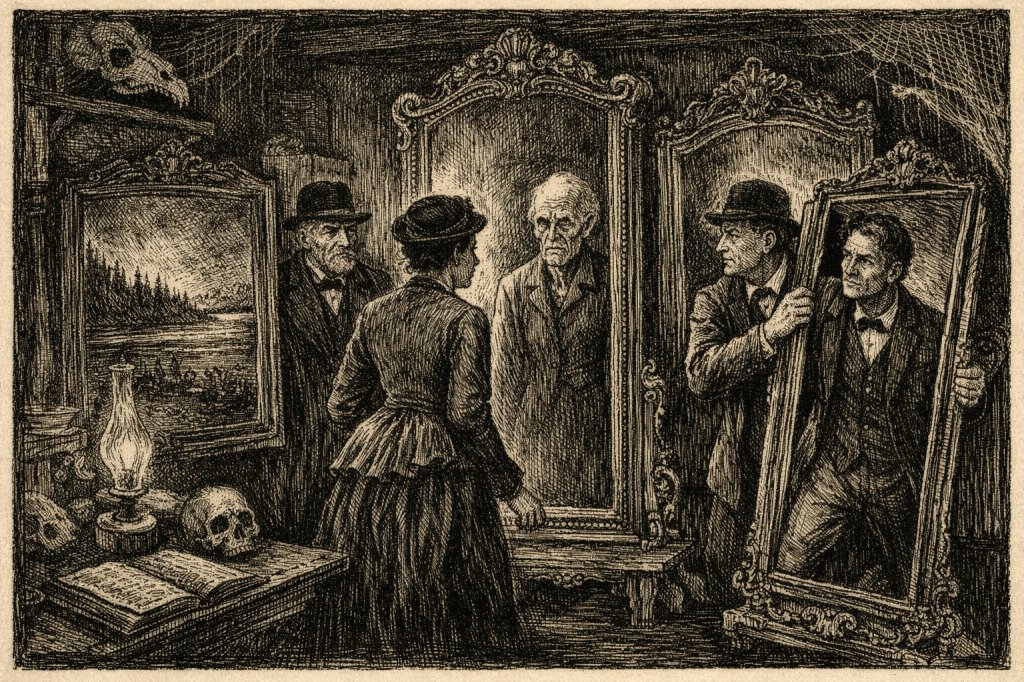
Caution: This tale contains mirrors that trade places with viewers, adjacent futures that recruit replacements, and woods eager to finalize quiet substitutions. Stare briefly—or don’t stare at all.
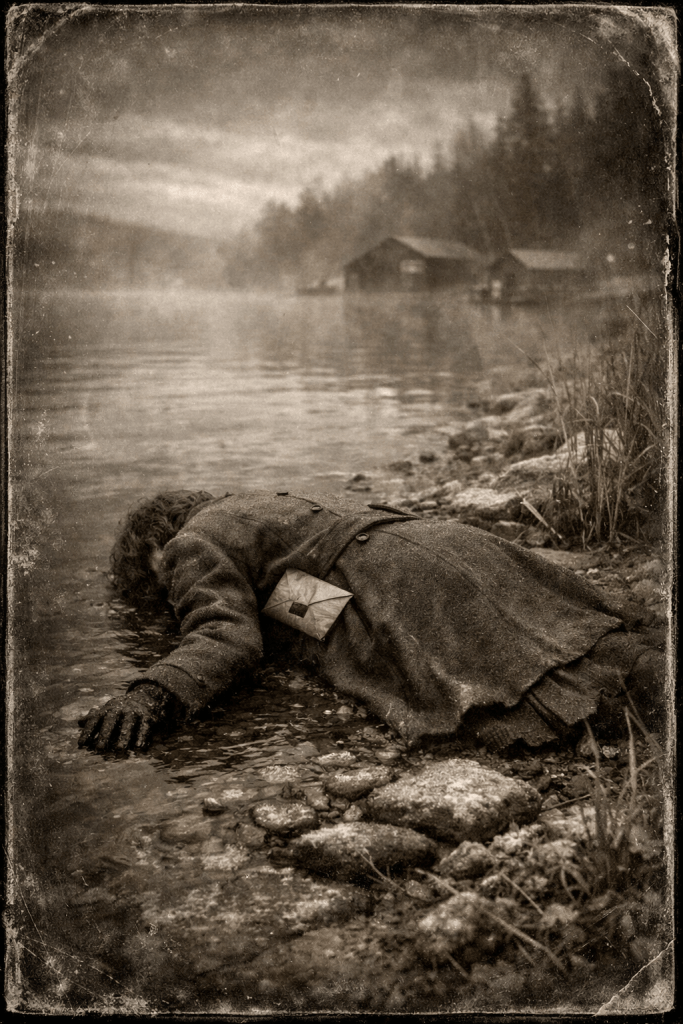
They found Eleanor Pike facedown at the edge of Upper Chateaugay Lake, coat buttoned wrong, notebook sealed in a waxed envelope tucked under her ribs like she meant to take it with her. Official word said heart trouble. The lake, they said, gets cold early and spooks the old. Eleanor was fifty-three, sharp as a wood auger, and had outwalked half the town every fall since Reagan. Hearts don’t give up that neat.
I came north because Eleanor had mailed me three chapters of a book she wasn’t supposed to be writing—The Hungry Silence: A Regional Study of the Wendigo in Franklin County. I write true crime for a living, the kind that gets read in bus stations and court waiting rooms, and I knew a setup when I saw one. Her margins were full of dates and names crossed out hard, like she’d changed her mind about remembering.
Chateaugay Lake doesn’t like curiosity. It tolerates fishing, drinking, and lies told gently. Eleanor had done worse: she’d read old journals, listened to trapper talk, pulled minutes from town meetings nobody remembered voting in. Every disappearance she flagged shared a habit—each person had “looked into” the Wendigo long enough to stop laughing.
There was Henry Brousseau, vanished in ’61 after recording Abenaki stories on reel tape. Lottie Merrill, a schoolteacher who tried mapping famine years against missing children. Tom Kincaid, a state surveyor who wrote one memo—Legend overlaps jurisdiction—and never filed another thing. No bodies. Just a thinning, like the woods had edited the record.
I talked to folks. They smiled the way people do when the question is dangerous but the asker isn’t local. A bartender told me the Wendigo was a metaphor for hunger. A retired ranger said it was a story to keep kids from wandering. An old woman at the post office asked if I’d been sleeping all right. When I said no, she nodded like I’d passed a test.
The nights got loud. Ice ticking under the docks like a clock trying to escape. Dreams where the lake learned my name and tried it out in different mouths. I stopped writing after midnight because my sentences kept shortening, shaving themselves down to need.
Eleanor’s notebook broke the case. Not the folklore—anybody can drown in folklore—but the pattern. She’d traced how the investigators changed before they vanished. Diets shifted. Sleep thinned. They stopped using people’s names and started using measures—miles, pounds, winters. Hunger, yes—but not for food. For certainty. For a rule that would finally hold.
That’s when it landed: the Wendigo wasn’t a beast in the trees. It was a method. A pressure. A way of thinking that eats the thinker once they lean too hard on it. The lore didn’t kill people; research did, when it crossed a line the place enforced. Chateaugay Lake doesn’t mind being haunted. It minds being solved.
I left before the water froze. On the way out, I mailed Eleanor’s chapters back to her sister, minus the last page—the one where Eleanor wrote, If I finish this, it finishes me. I kept that page. Not for the book. For the warning.
They’ll keep calling it legend. That’s fine. Legends are safe. Investigations aren’t. And if you feel the pull to go deeper—if you start counting winters instead of birthdays—do yourself a favor.
Put the notebook down. Eat something. Say someone’s name out loud.
The lake is listening, and it prefers you unfinished.
They keep the mirrors in the back of Johqu Bogart’s Shatagee Woods Museum of Unnatural Hysteria, past the glass cases of counterfeit panthers and the canoe paddle said to have split lightning. No sign points you there. You have to ask wrong, or linger right, or look like someone who won’t laugh.
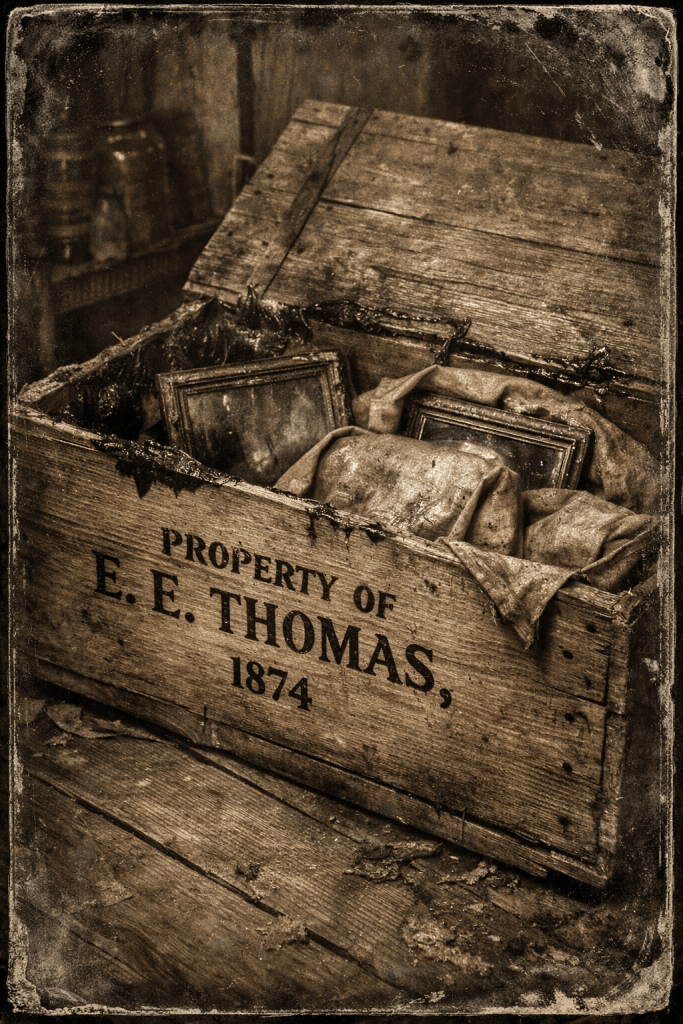
The curator—Bogart himself on odd days, his nephew on even—told me the mirrors came in a pine crate stamped PROPERTY OF E. E. THOMAS, 1874, the lettering burned deep like it meant to last longer than wood. Same E. E. Thomas who wrote down the Indian Lead Mine story and then spent the rest of his life insisting he’d left things out on purpose. The crate had been sealed with tar and horsehair. No inventory. No bill of lading. Just mirrors wrapped in oilcloth that smelled faintly of lake mud and smoke.
They don’t reflect the room. Not quite. They show adjacent time—what might happen if the path bends wrong, or if it bends exactly as expected.
A summer guest from Albany told me he leaned in and saw himself at ninety: back folded, eyes hollowed clean of excuses, standing in the same gallery with fewer teeth and more patience for dread. He laughed it off, took a picture, and left town early. Two weeks later he fell down a stairwell that wasn’t there the year before. Survived. But he stopped calling people by name, started calling them “early” and “late.”
Bogart swore nobody was allowed to stare longer than a minute. Said the mirrors didn’t like commitment. I asked him why, if they were just curios, the glass was scratched from the inside, fingertip arcs worn dull at shoulder height. He pretended not to hear me.
Here’s the part I didn’t put in the book.
If you look too long, your reflection learns the room faster than you do. It notices exits. It practices blinking. Sometimes—rare, but not unheard of—it steps out. No smoke, no thunder. Just a quiet substitution, like a bad sentence corrected mid-paragraph.
The people who disappear after visiting the museum aren’t taken. They’re relieved. Their reflections stay behind, better suited to the place: thinner with hope, thicker with knowledge. The originals wander off into the woods or the water, finally unburdened of endings.
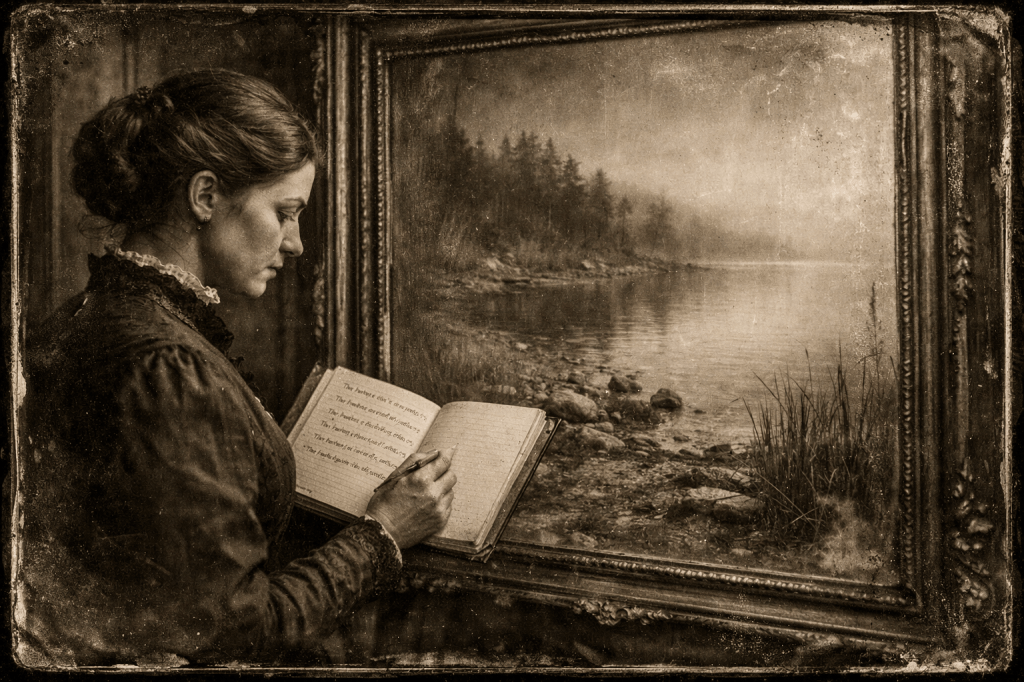
Eleanor Pike had been here. Her notebook mentioned a mirror that showed a shoreline with no footprints leading away. She wrote one line twice: The future isn’t ahead—it’s adjacent.
The Wendigo fits here the way a key fits a lock that was never meant for doors. Not a creature. Not a curse. A rule enforced by landscape and story together: look too hard at what you’ll become, and something else volunteers to take your place.
Bogart asked me, very gently, if I wanted to see my own mirror. I said no. He nodded like that answer cost me something.
As I left, I caught my reflection in the front glass—normal, late afternoon, tired eyes. It blinked when I did. That’s the test. Always blink first.
If you ever find yourself in that museum, remember this: mirrors are honest only once. After that, they start negotiating.
And the woods—well.
The woods always accept the exchange.
#MirrorSubstitutionHorror #AdjacentFutureUncanny #LiminalReflectionDread #QuietReplacementFolk #WendigoMirrorRule #ScratchedFromInsideGlass #UnnaturalHysteriaExhibit #BlinkFirstOrVanish #EEThomasCrateMythos #WoodsAcceptTheExchange


What mysteries of Chateaugay Lake haunt you?