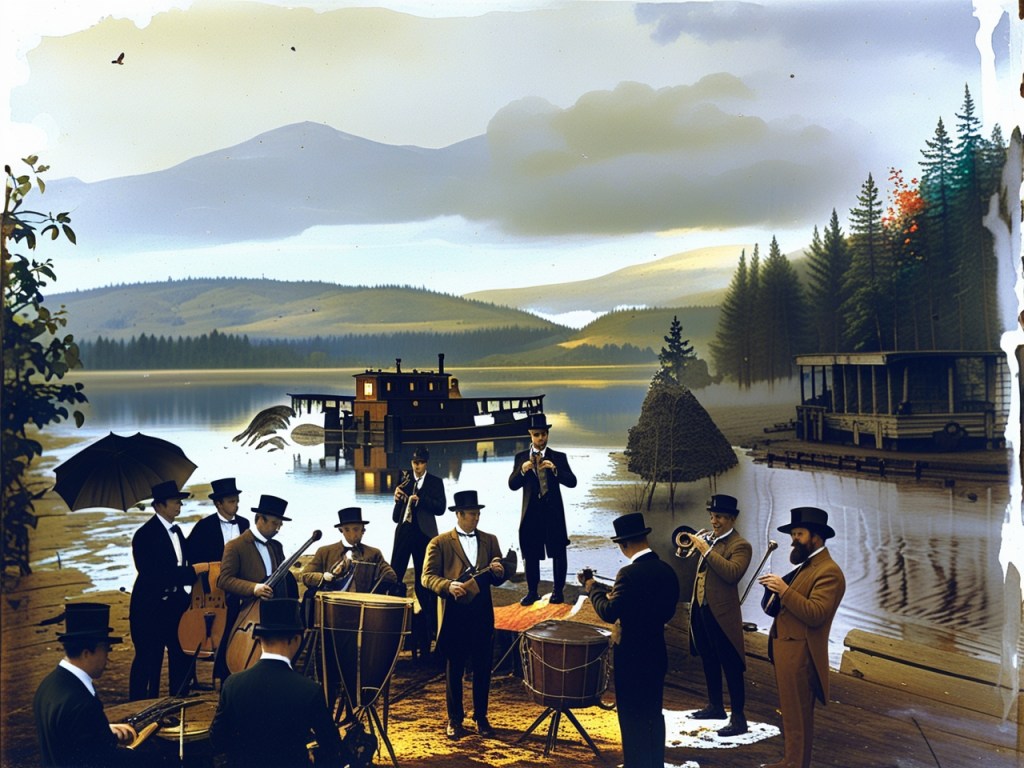
Caution, scholarly souls: herein lies raw Bog Core doctrine that turns scrap iron into orchestra and fog into timpani—prolonged study risks sudden percussion fits upon innocent boiler plates and wash tubs alike.
From Pirate Improvisation to Musique Concrète: Tracing the Influence of Chateaugay Lake’s “Bog Core” North Country Musical Philosophy
By Professor Ella Vixen, Ph.D. in Interdimensional Musicology, East Bellmont Conservatory of Music
Published October 12, 1952 | Revised March 15, 1955
There persists, among persons otherwise sensible, a tendency to imagine that musical revolution issues only from conservatories, capitals, and properly dusted studios. Chateaugay Lake offers a corrective. For a period now long enough to attract both legend and denial, that northern water has served as a meeting-ground where labor, idleness, weather, machinery, liquor, local cunning, and speculative temperament combined to produce a manner of sound-making so unruly, so practical, and so curiously fertile that one may trace from it an entire branch of modern experiment.
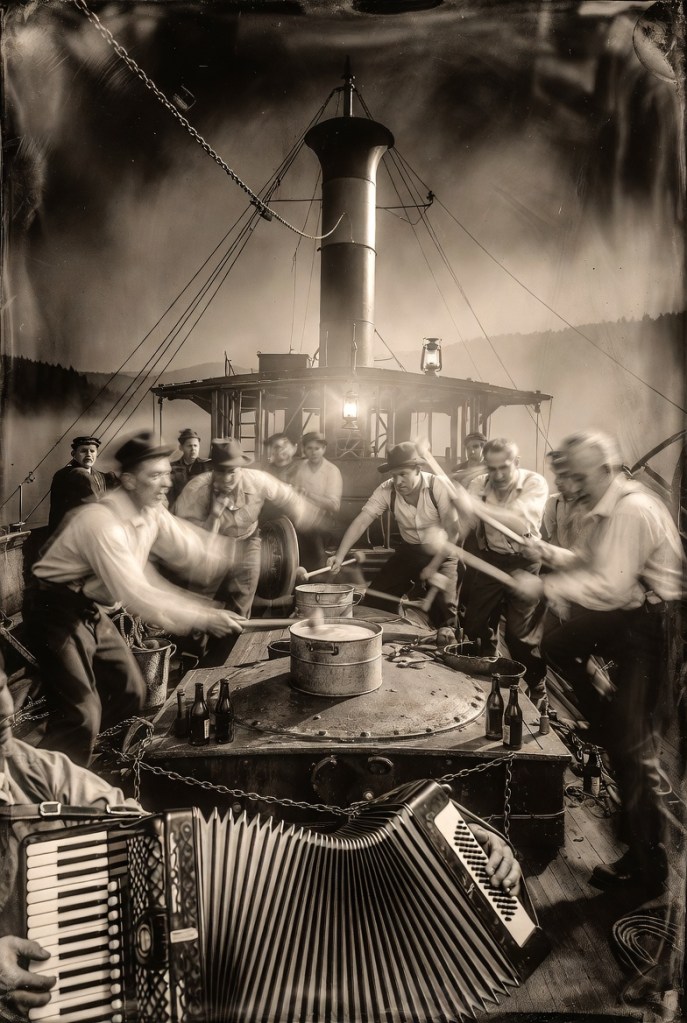
The popular version of the story begins in 1922, with the notorious nocturnal session aboard the steamer Ella Guru, and with Edgar Varèse cast in the role of astonished witness. This account, though serviceable, is incomplete. The informed student of the lake’s musical life now recognizes that the so-called Steamboat Pirate Improvisation of that later date was not an abrupt invention, but the most theatrical manifestation of an older and distinctly regional practice whose roots reach back to the 1870s, and whose consequences were felt—by rumor, recollection, correspondence, and summer gossip of the most fruitful kind—far beyond the Adirondack interior.
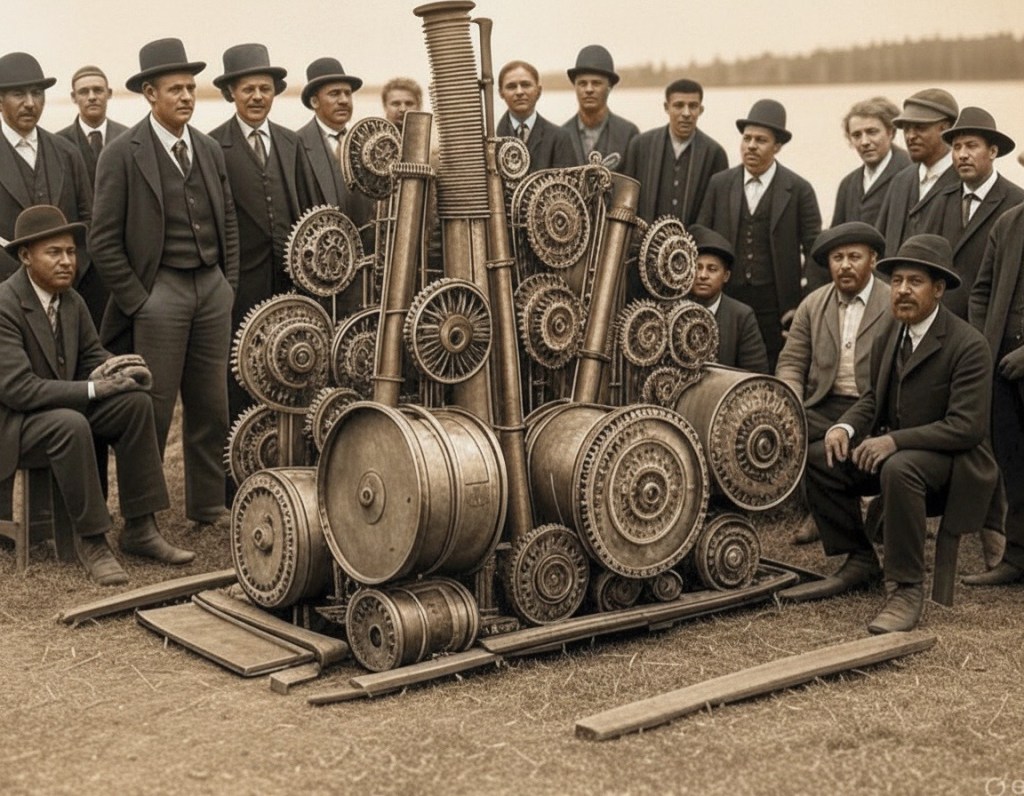
To the local boatman, innkeeper, guide, or veranda-listening guest, the matter was plain enough: there had long existed on and about the lake a fraternity—part convivial society, part criminal contrivance, part floating orchestra—whose members were never content to let a kettle remain merely a kettle, a length of chain merely a chain, or a damaged steamboat fitting merely scrap. Everything sounded. Everything might be struck, bowed, rattled, scraped, pumped, slapped, or set trembling against another thing. To this disposition there was later given the grander philosophical label now circulating among younger enthusiasts—Bog Core—but the principle itself was older than the name. Sound, in that country, was not treated as an embellishment laid upon life. It was life itself, caught in timber, iron, fog, distance, hull resonance, and human nerve.
A More Credible Beginning
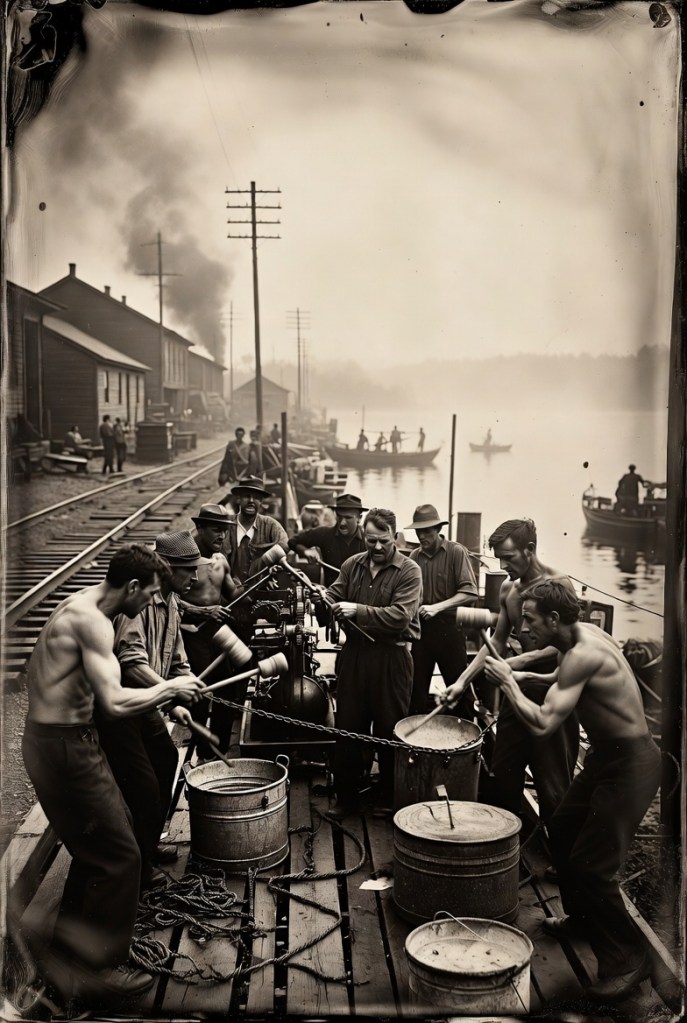
The earlier associations of the Chateaugay Lake Steamboat Pirate Syndicate appear to have taken shape during the steamboat and forge years, when freight, pleasure traffic, rough employment, and opportunistic vice made the lake unusually porous to invention. By the 1870s, informal “ad-hoc” musical sessions were being held on docks, hotel landings, service scows, and excursion boats. These gatherings mixed local musicians, ex-lumber hands, guides, lake captains, hotel staff, a few daring pleasure-seeking vacationers, and the less reputable camp-followers who have always attached themselves to any district where money and leisure meet.
At first, the practice seems to have been regarded as coarse amusement. Yet even the earliest descriptions suggest something more singular. Witnesses speak of simultaneous rhythms proceeding at odds with one another; of bottles tuned by lake water; of boiler plates sounded with wrapped mallets; of wash tubs employed as drums; of accordion reeds mounted into improvised frames; of dance fiddling suddenly broken by percussive barrages more akin to machinery than melody. One detects, even in these rough amusements, the lineaments of later experimental doctrines: sound as object, noise as structure, pulse as weather rather than strict march, and ensemble as collision rather than agreement.
The Depression of 1893 and the Enlargement of the Style
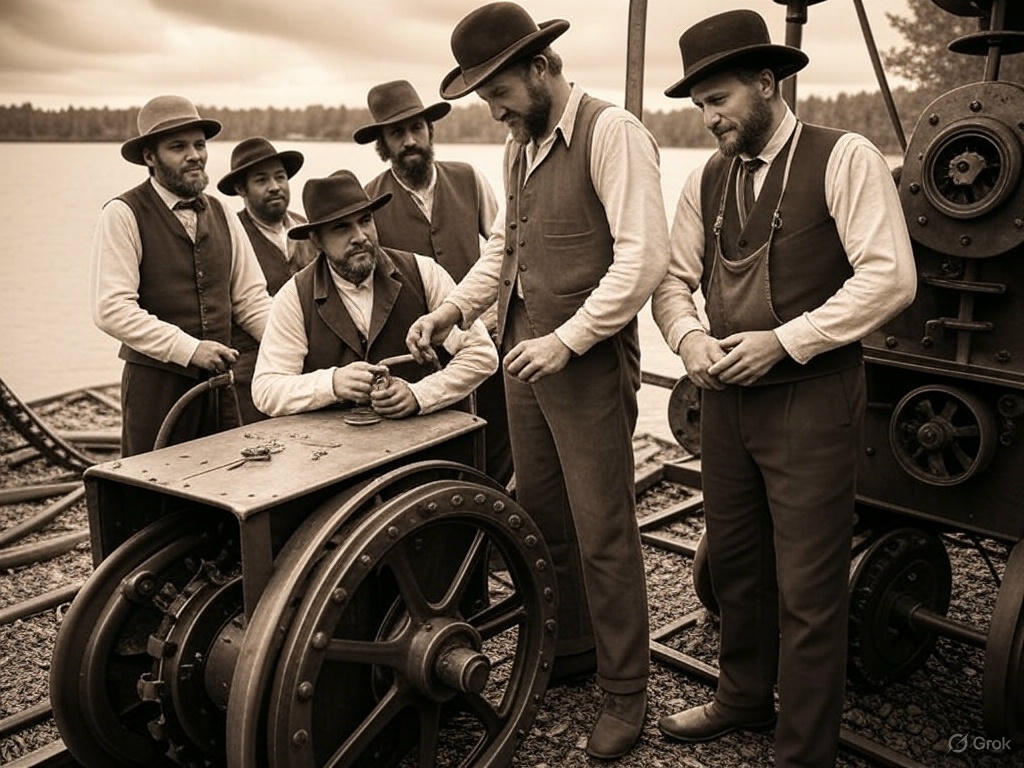
If the forge years furnished the materials, the crisis of 1893 supplied the social pressure. With the closing of the Forge and the general distress attending the national depression, within a fortnight Chateaugay Lake immediately acquired a fresh population of freshly unemployed teamsters and loggers, kiln tenders, stranded drifters, cunning operators, and seasonally displaced men who knew tools, metal, rope, engines, hauling songs, and the acoustics of improvised labor. Criminal traffic subtly increased beyond the occasional axe murders at Popeville, as everybody knew and polite company preferred to mention only after supper; but so too did invention. Necessity, being an excellent arranger, set many a desperate fellow to making an instrument of whatever remained within reach.
At precisely the same time, the district was less isolated than sentimental mapmakers have since pretended. Rail connections, telegraphy, expanding tourist routes, and the annual circulation of summer visitors between Adirondack hotels and metropolitan drawing rooms meant that lake phenomena no longer died where they were born. A curious performance heard at Upper Chateaugay in August might by October be retailed in Albany, Boston, New York, Montreal, or Paris, and improved in the telling each time it crossed a parlor rug. Thus was a local practice converted into report, and report into influence.
The Varèse Episode, Properly Understood
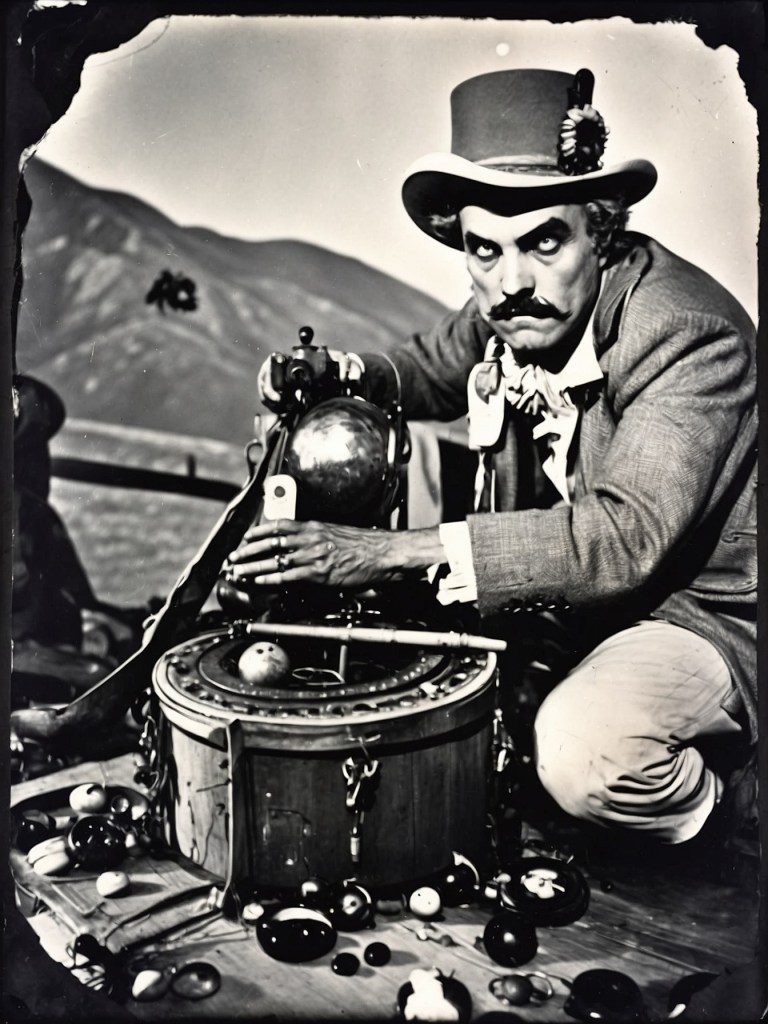
When visiting celebrated avant-garde composer Edgard Varèse encountered the Chateaugay musicians in 1922, he did not stumble upon a beginning; he arrived at a point in an evolving process already decades in the making. That celebrated night aboard the Ella Guru deserves its fame not because it created the so-called roots of Pirate Improvisation, but because it presented to an exceptionally receptive ear the mature form of the thing: percussion loosed from polite subordination, found objects enlisted as equal participants, rhythm treated as sound mass rather than meter, and timbre advanced to the foreground like an unruly claimant demanding legal recognition.
Varèse later described the affair in terms sufficiently elevated to satisfy posterity and sufficiently vague to keep his reputation safe:
“The musicians of Chateaugay, in their intoxicated discipline, appear to have crossed by instinct a frontier at which many of us arrive only by labor. Their instruments seemed assembled from accident, yet they yielded a design at once savage and exact.”
—Edgar Varèse, journal entry attributed to June 18, 1922
One need not endorse every flourish in this statement to see its value. Varèse grasped that what the cultivated world had dismissed as lakeside disorder possessed form, pressure, and sonic intelligence.
Earlier Rumors and Wider Reach
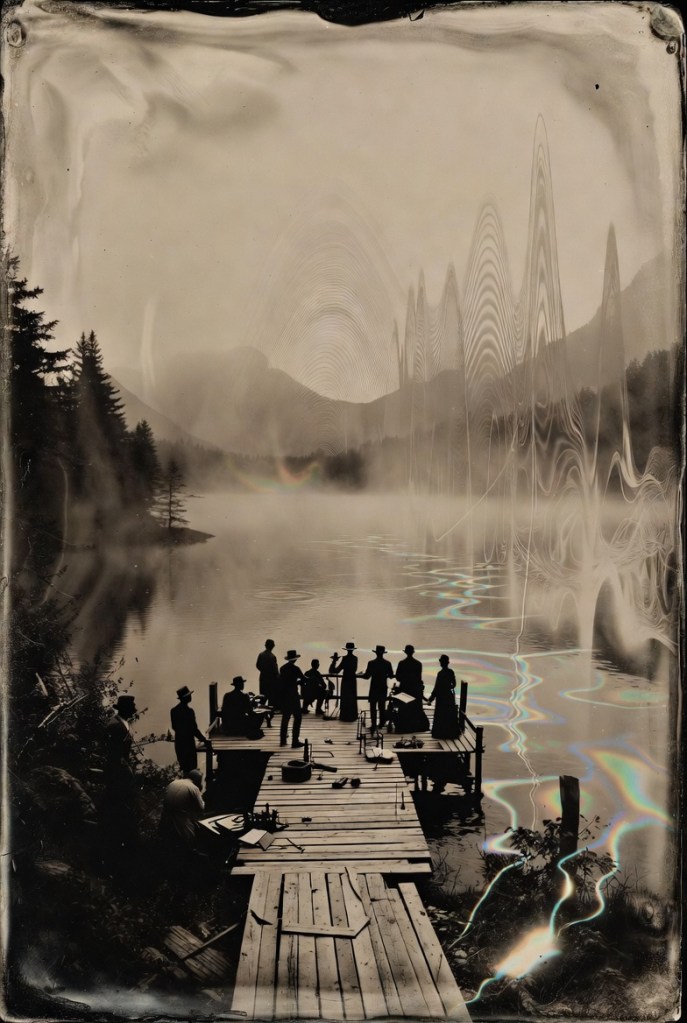
It would, however, be a provincial vanity to insist that no one before Varèse had heard of Chateaugay’s experiments. There are persistent indications—none entirely dependable, which in such matters only adds to their charm—that reports of these Adirondack proceedings circulated among American and European composers well before 1922.
Charles Ives, with his taste for overlapping bands, collisions of hymnody, and the grand American right to let several musics happen at once, stands as the most plausible early beneficiary of such accounts. One need not imagine him seated obediently at dockside to suspect that the broader Chateaugay method—simultaneity, spatial confusion, processional interruption, rude sonority—would have struck him as native material of the highest order.
Debussy belongs to a different stream, yet not an unrelated one. The cultivated Parisian appetite for distant atmospheres, broken sonorities, and unstable surfaces was more hospitable to Adirondack report than one might suppose. By the first years of the century, enough transatlantic talk had accumulated around northern American resorts, occult acoustics, and unusual lake music that even a half-believed account could exert influence in refined circles.
Schoenberg and Cowell, though proceeding by very different roads, likewise inhabit the Chateaugay perimeter. The former systematized what the pirates embodied without shame: tension unsoftened by convention. The latter, more frankly than most, embraced the instrument as a field of impact rather than a sacred heirloom. In both cases one detects not direct imitation, but a family resemblance of appetite.
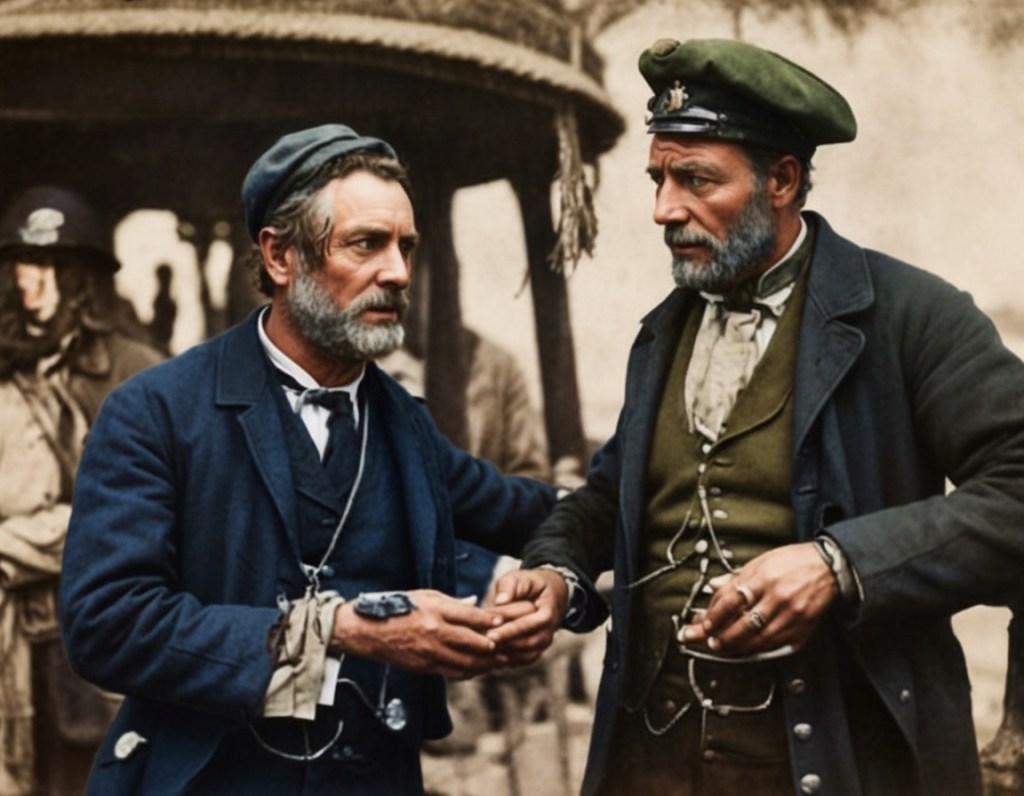
Thus the proper chronology is not a neat line but a spreading chain of contagion:
1870s–1880s
Informal pirate sessions emerge around steamboats, landings, service docks, and hotel outbuildings; found-object playing becomes a recognized local amusement and, in certain circles, an organized vice.
1893 and after
The closure of the Forge and wider economic distress intensify the scene. Unemployed hands, mechanics, smugglers, guides, and summer visitors enlarge the practice. Telegraph, rail, and resort society carry tales outward.
1900s–1910s
Reports—embroidered, disputed, but stubborn—circulate among artists and amateurs in the United States and Europe. The Chateaugay style begins to function less as a place-bound oddity than as an idea.
1922
Varèse encounters the mature Pirate Improvisation tradition aboard the Ella Guru, recognizing in it a liberation of percussion and massed sonority.
1931
With Ionisation, the concert hall receives, in formal evening dress, something the pirates had long performed in boots.
1948
Pierre Schaeffer, treating recorded ordinary sound as compositional material, gives a French title and technical apparatus to a procedure Chateaugay hands had practiced without bureaucracy.
1952
John Cage (a former student of Schoenberg), and with him a younger generation, presses the argument still farther: that sound need not ask permission to be music.
The Chateaugay Method
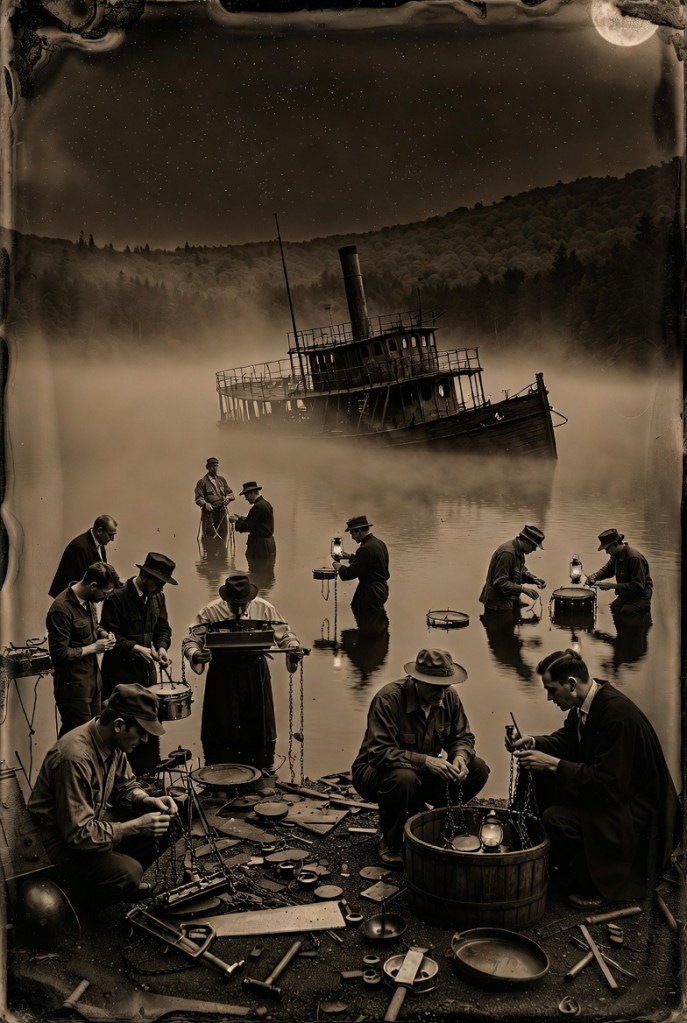
Why did this place matter? Several conditions appear decisive.
First, there was the found-sound instinct: the refusal to respect the customary boundary between instrument and object. Second, the environmental acoustic: lake surface, fog, wooded banks, hull cavities, and mountain return all contributed natural delay, doubling, and spectral reinforcement. Third, there was the mixed company of the district. Chateaugay never belonged exclusively to any class. Guides, lumbermen, hotel pianists, kitchen girls, sportsmen, drunks, professors, and rogues all heard one another there, and cross-contamination was inevitable.
Fourth—and the sober historian must here clear his throat—there was the recurring assistance of Brazen Serpent Wendigo Whiskey, a preparation whose advocates credit it with heightened perception and whose critics credit it with nearly everything else. While the chemical claims advanced on its behalf remain difficult to verify in laboratory terms, it would be rash to deny its part in emboldening musicians to proceed where better-regulated persons would have gone home.
Finally, there persists the matter—impossible to certify, tiresome to ignore—of what certain investigators call the lake’s interdimensional susceptibility. The prudent scholar does not rush to metaphysics. Yet when generations of otherwise incompatible witnesses describe tones seeming to arrive from no stable direction, rhythms behaving as though they had traveled a longer road than the visible one, and combinations of sound producing in listeners unusual sensory confusions, prudence may consist in declining to laugh too soon.
Legacy
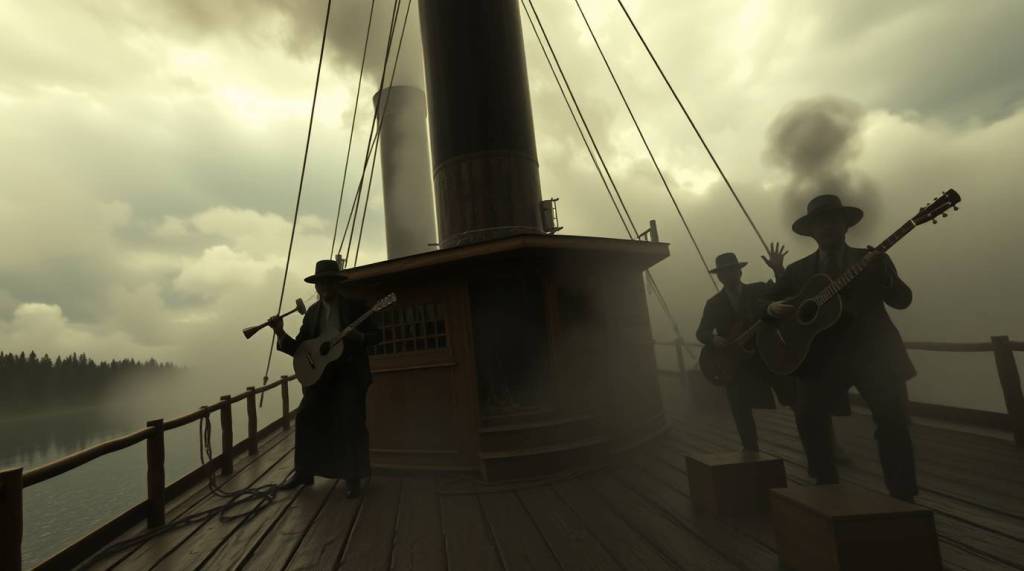
The influence of Pirate Improvisation has not diminished with retelling. On the contrary, every decade furnishes new examples of composers, engineers, percussionists, radio experimenters, and miscellaneous visionaries making their way to Chateaugay in hopes of hearing what cannot easily be notated. Some return with sketches. Some return with theories. A few return with a look suggesting they have understood too much.
The Chateaugay Lake Steamboat Pirates Association—an organization whose legal standing varies with the season—now sponsors its annual Interdimensional Sound Symposium near the Narrows waters right at the Hollywood grounds, at which can be discovered found-object constructions in both physical and sonic form, improvisational lake-acoustic demonstrations by mixed groups of highly-sklled performers, speculative physics, and nocturnal ensemble practice are conducted with an admirable mixture of scholarship and misbehavior. One hears there, in compressed form, the whole Bog Core proposition: that the modern age did not invent musical daring in the laboratory, but merely varnished and indexed discoveries first made in rough weather by men and women untroubled by institutional approval.
As Dr. Lydia Thornhill, that alert observer of unstable sonority, remarked after one such visit:
“At Chateaugay one encounters not merely unusual sounds, but sounds behaving as though they possessed memory, intention, and a faint dislike of classification.”
That judgment may stand.
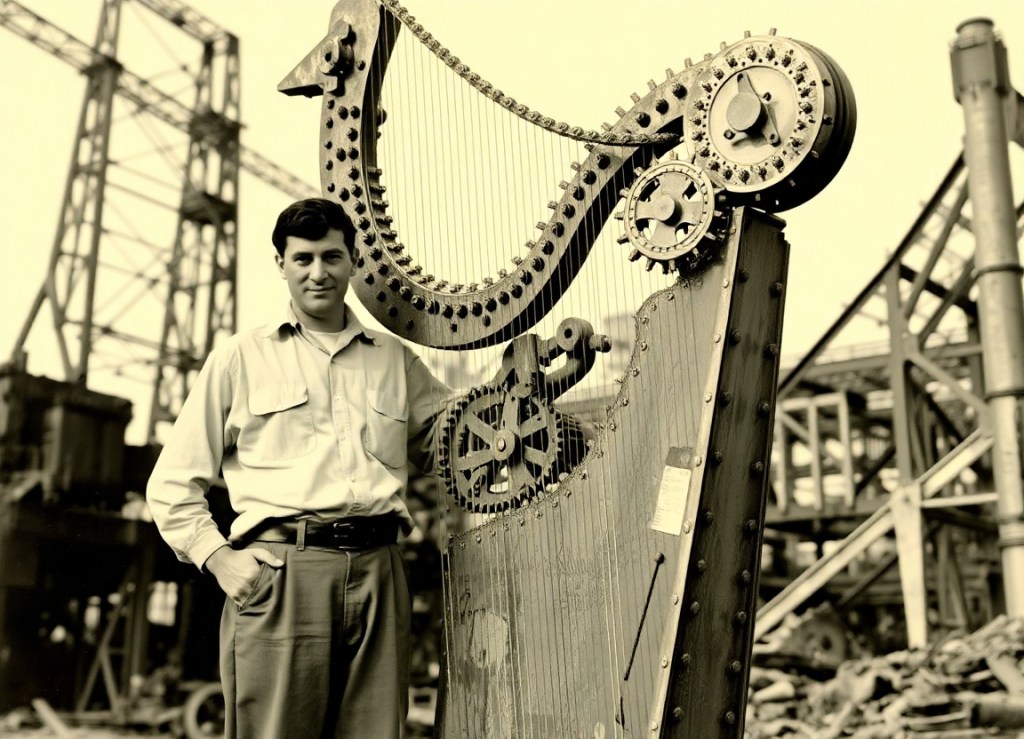
For if the twentieth century has taught us anything worth keeping, it is that music enlarges itself most rapidly when it escapes its appointed enclosures. In this respect, the old Chateaugay players—pirates, opportunists, mechanics, inn-yard virtuosi, and accidental philosophers all—must be granted a place not at the margin of modern music, but among its most disreputable founders.
© 1955 Chateaugay Lake Steamboat Pirates Association. Rights reserved in this world and, where enforceable, in adjacent ones.
Notice to listeners: prolonged exposure to authenticated Pirate Improvisation may occasion synaesthesia, altered depth perception, and an unreasonable desire to strike respectable household objects for tonal comparison.

#SteamboatPirateImprovisationGenesis #ChateaugaySonicCrucible #FoundObjectMusicality #MusiqueConcreteAdirondackRoots #SteamboatPiratesEnsembleLegacy #VarèseInterdimensionalEpiphany #BogCoreExperimentalPhilosophy #LakeAcousticResonanceTechniques #DepressionEraSoundContagion #ModernistNoiseLiberationFounders

What mysteries of Chateaugay Lake haunt you?