
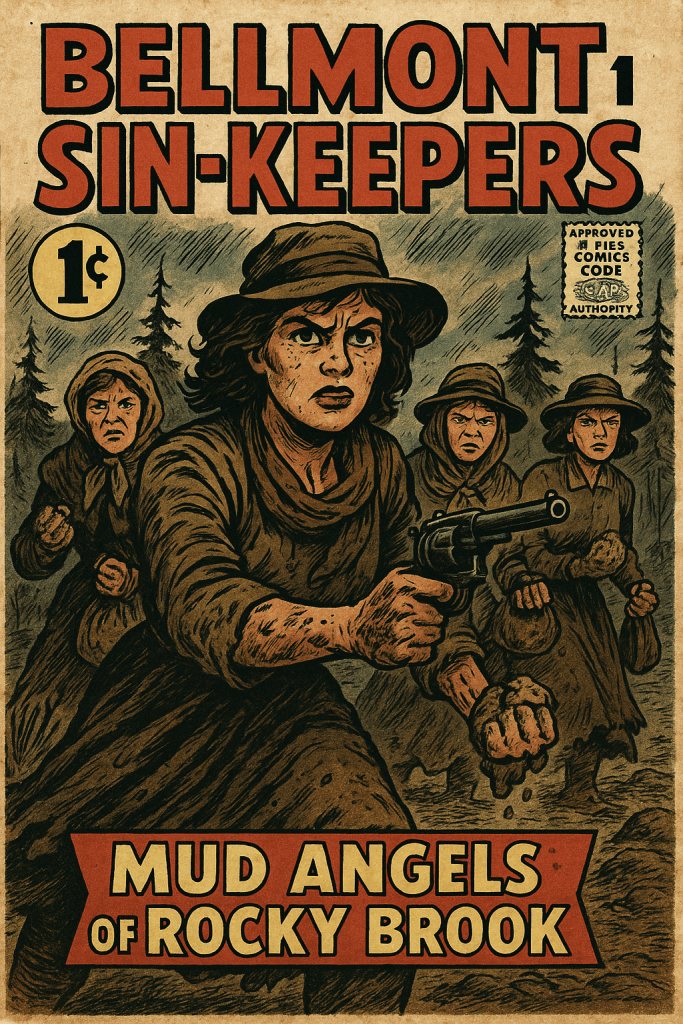
Features militant churchwomen, illicit whiskey, and the tactical deployment of handbags as blunt instruments. Strong themes of community justice, improvised weaponry, and righteous mudslinging. Might disturb smugglers or needlework enthusiasts.



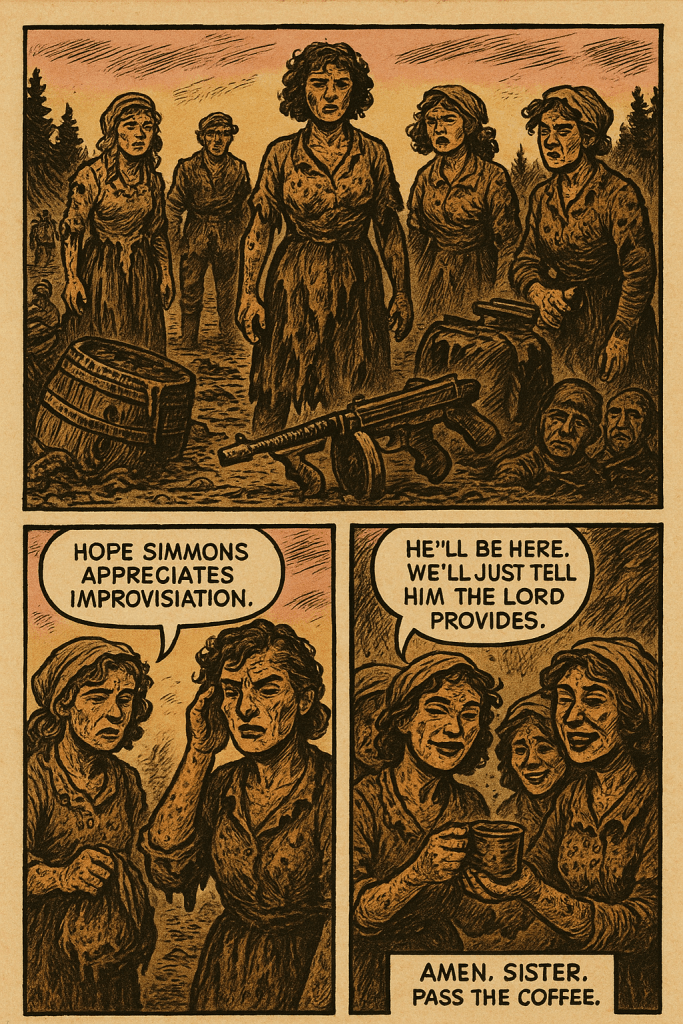


Cora Kirby never did like early mornings—too much dew, too little coffee—but by God, there she stood, ankle-deep in mud at 4:00 a.m., squinting through fog as thick as yesterday’s porridge. Rocky Brook Camp loomed ahead, squat and dark, logs hunkered down like old bruised fighters. Behind her, the Brainardsville ladies crouched in a line, damp stockings sagging, shawls thrown hastily over shoulders, pistols tucked snugly in crocheted handbags.
“Just like rehearsed,” Cora murmured, shifting uneasily in borrowed fisherman’s boots. “Two-by-two and quiet as church mice.”
Of course, they weren’t church mice. Not anymore. Not since they’d traded lace doilies for derringers and embroidered samplers for shotgun shells.
The air smelled of lake water and wet bark as they closed in. The old logging road twisted like a crooked sermon through the trees, leading right into the heart of Pirate Syndicate territory. This raid was supposed to be swift, clean: catch the smugglers napping, confiscate their poison, and deliver them trussed up to Sheriff Simmons before breakfast biscuits cooled.
But as usual, plans had a habit of unraveling at the seams.
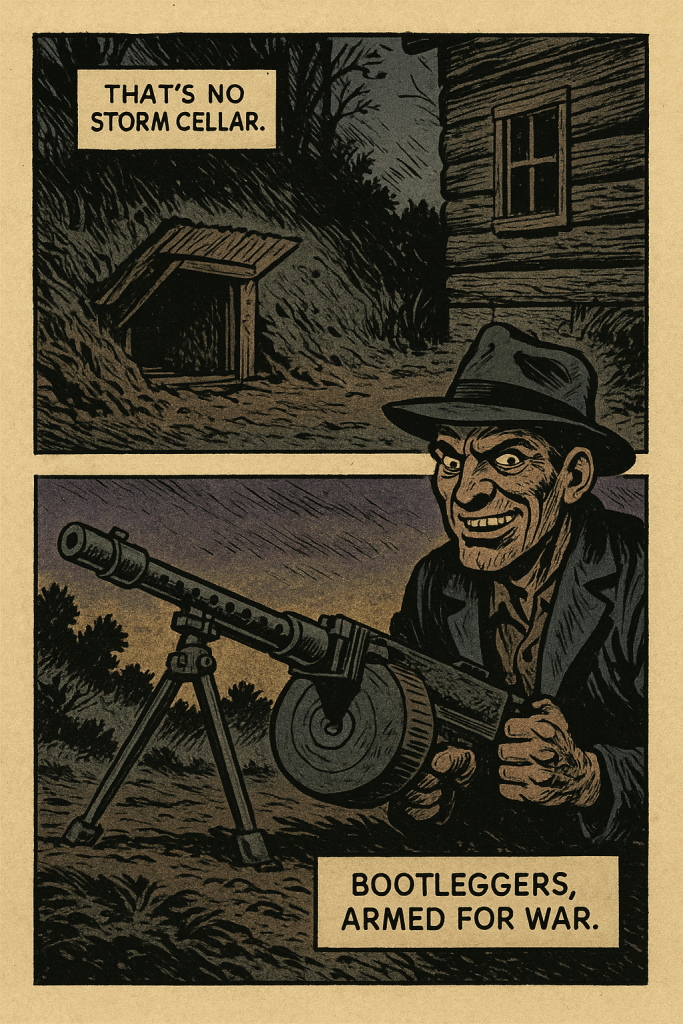
When they hit the edge of the clearing, the sleepy hush exploded into chaos. Someone in the Syndicate camp kicked over a coffee pot. Voices rose, tangled curses cracking like brittle kindling. A door slammed, then another, and suddenly a wooden panel lifted on the hillside behind the cabin.
“That ain’t no storm cellar,” muttered Abigail, her voice tight as fresh-wound fishing line.
It wasn’t. A steel barrel thrust forward, fat muzzle aimed squarely at the lake—the unmistakable bulk of a Thompson submachine gun, mounted heavy on a tripod, drum magazine bulging obscenely beneath it. Cora swallowed, tasted rust and old fear. Bootleggers weren’t supposed to have guns like that, weapons meant for trenches, not backwoods whiskey wars.
“Get low!” Cora barked, rolling instinctively toward cover. Dirt sprayed as a short burst stitched across the ground near her boots, spattering skirts and ruining Abigail’s fine needlework bag. Angry shouts rippled through the woods, laughter chased by a shout:
“Go on home, girls, or your sewing circle’s gonna lose a few stitches!”
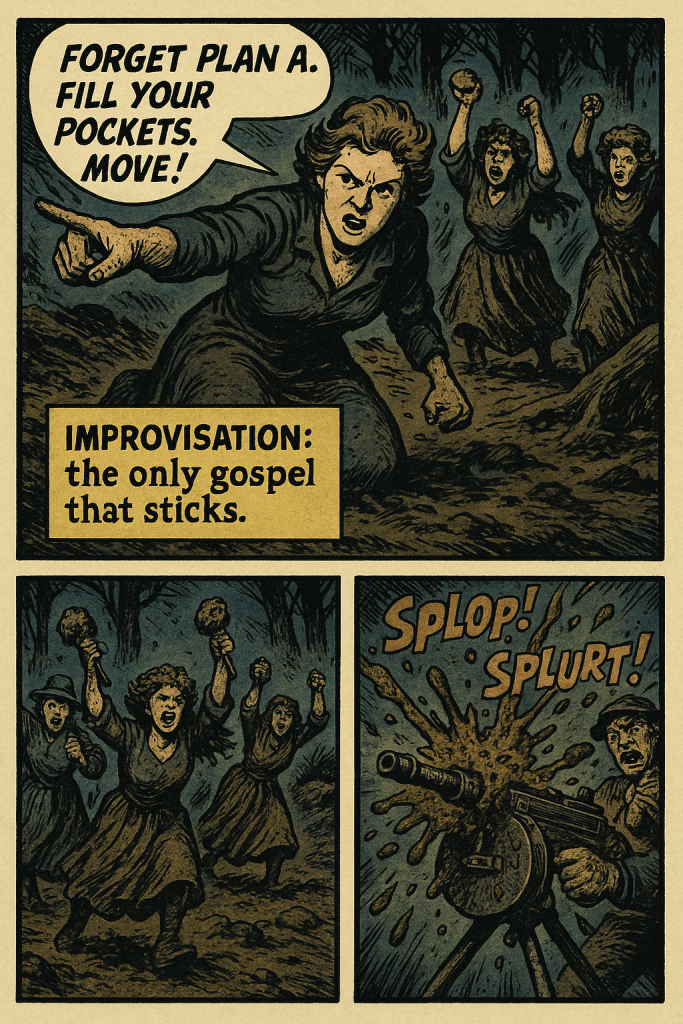
Cora Kirby wasn’t inclined to lose anything—not stitches, not dignity, and certainly not this fight. She reached down, grabbed a fistful of sand and sticky clay, and gestured sharply at her ladies.
“Forget Plan A,” she said, voice low but carrying like it did on the church choir. “We’ll use their own cleverness against ‘em. Fill your skirts and pockets. Move now!”
And just like that, skirts flapping, hats askew, those women rushed forward like lunatic shorebirds, scooping handfuls of mud and grit from the shoreline near Hitcherupnanny Point. They charged, shrieking psalms and curses alike, and flung the muddy mess at the tripod gun, at the pirate crew, at any moving target. Half-blind, half-laughing in disbelief, the smugglers fired wildly. But sand jammed mechanisms, clay slicked the drum magazine, and the Thompson sputtered, coughed, and choked into silence.
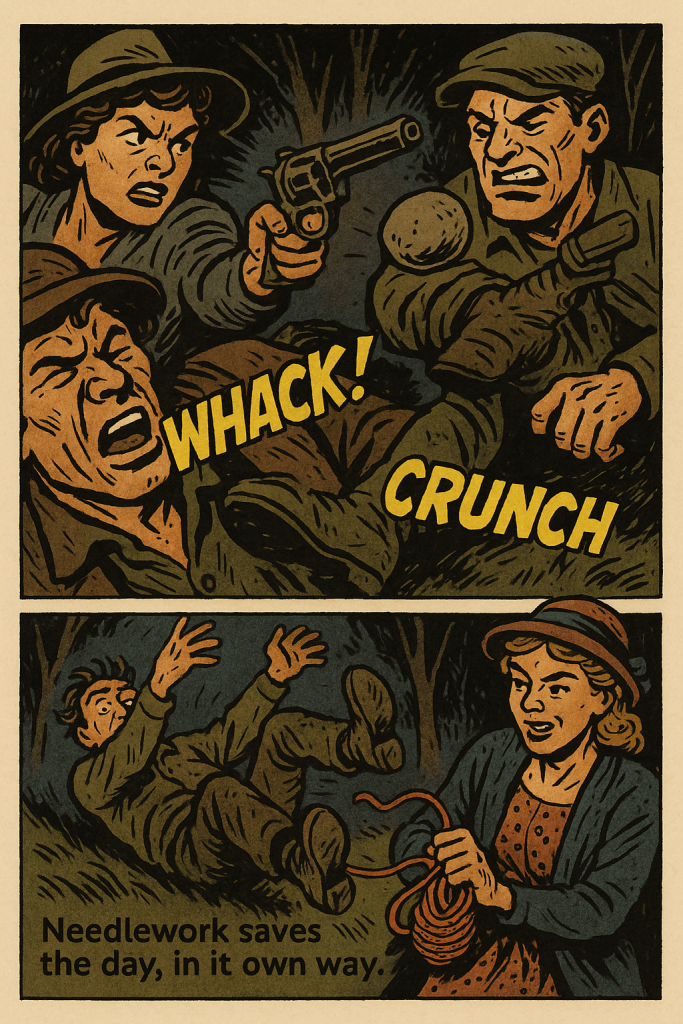
In the confusion, the women surged forward, tackling men twice their size, swinging handbags weighted with river stones and scripture. Cora saw one of the syndicate men slip headlong down the muddy slope, only to be trussed up tight by Abigail’s knitting yarn.
By dawn’s weak pink glow, Rocky Brook Camp lay humbled: barrels cracked open, whiskey trickling uselessly into the dirt, the feared machine gun tipped uselessly sideways in the clay. The women stood there, panting, victorious but smeared with enough mud to make even their own husbands raise eyebrows.
Cora brushed wet hair from her eyes, surveyed the damage, and chuckled quietly. Abigail stood beside her, shaking mud from her ruined handbag.
“I hope Sheriff Simmons appreciates fine improvisation,” Abigail said, sighing as she plucked a river stone from her purse and dropped it with a wet plop onto the cabin steps.
“He’ll be here soon enough,” Cora said, slipping her derringer discreetly back into the pocket Psalter tucked in her skirt. She smiled wearily. “And when he comes asking how exactly we pulled this off, we’ll just tell him the good Lord provides.”
Abigail laughed, a tired, mud-slicked laugh that carried toward the lake like a hymn. “Amen, sister. And pass the coffee.”


What mysteries of Chateaugay Lake haunt you?