“What’s past is prologue.” —The Tempest, II.i
To the Editor of The Steamboat Gazette, East Bellmont, N.Y.
Special Correspondence from W Mountain, near Upper Chateaugay Lake — November 19, 1895
By PLAYED OUT, Belmont Adirondack Guide, Yarn-Spinner, and Reluctant Chronicler of the Uncanny
The Abenaki Curse Awakens at the Lake, with Fresh Revelations of the Gitaskog’s Wrath
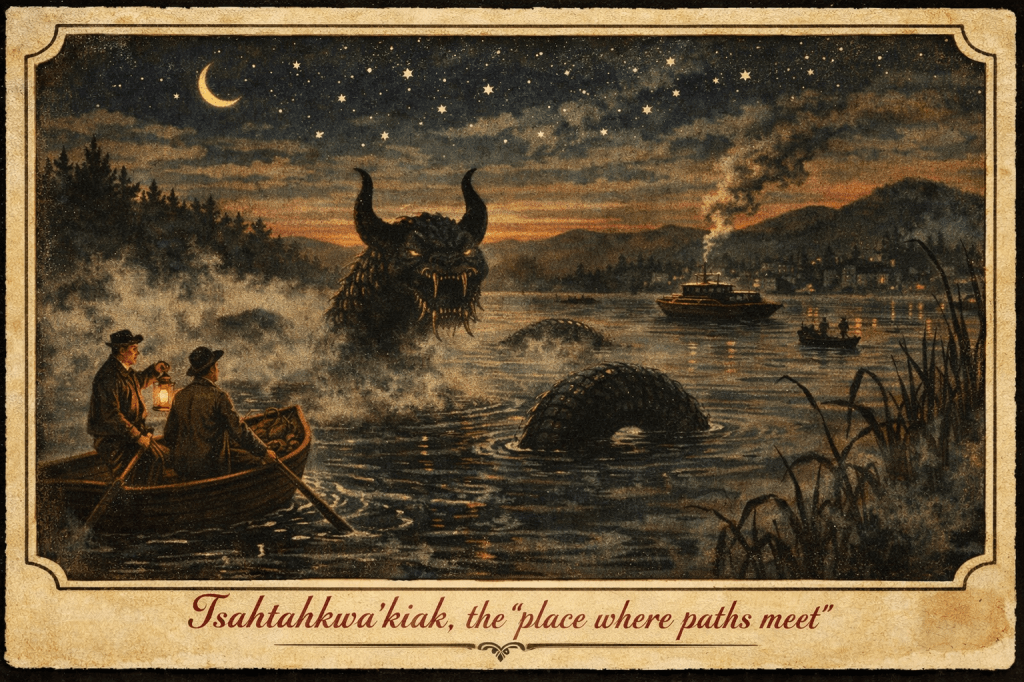
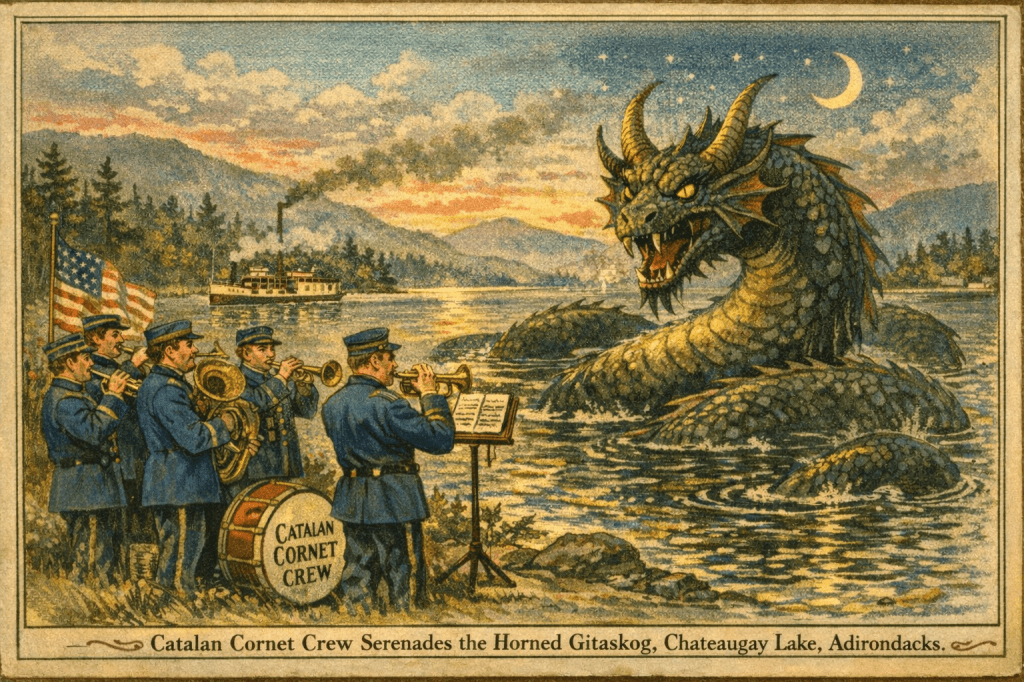
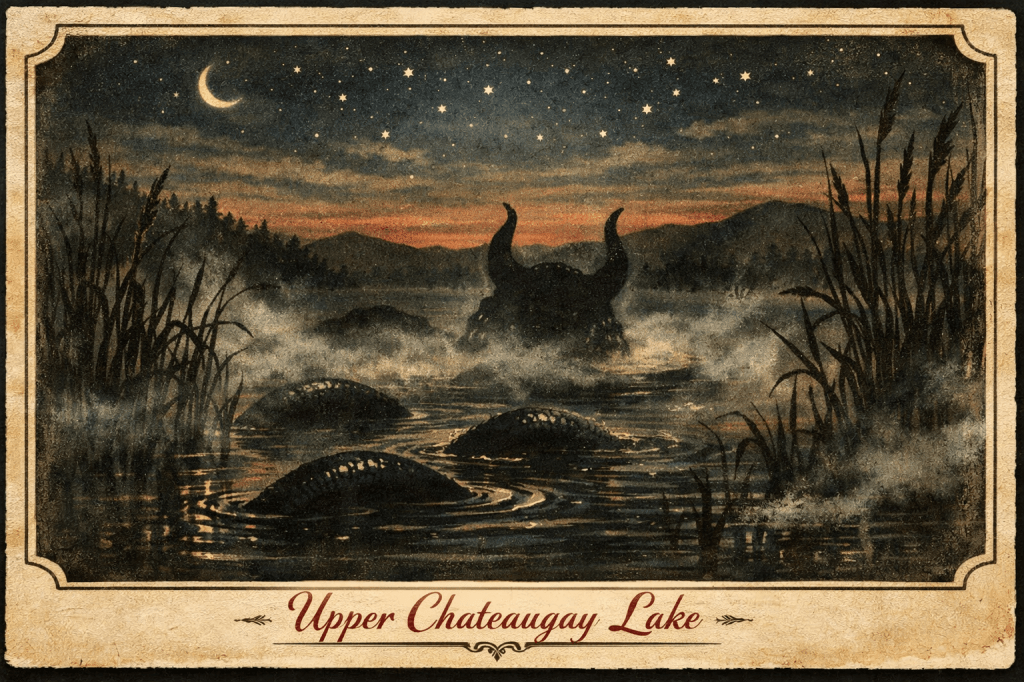
Sir,—since my last missive on the spectral strains of the Popeville Band rousing the ancient Abenaki “Curse of Chateaugay Lake,” further inquiries have unearthed a trove of past sightings that lend a serpentine spine to the tale. I speak, of course, of the Gitaskog—that horned abomination from Abenaki lore, a guardian serpent said to coil in the depths of our northern waters, like its kin in Lake Champlain, where it warns interlopers with hisses of impending doom. Here on Upper Chateaugay Lake, however, the beast appears not as mere myth but as a slithering satire on human hubris, devouring the unwary while mocking our pretensions to mastery over nature. Founded in dim antiquity, when shamans cursed those who disturbed the “place where paths meet” (Tsahtahkwa’kiak), the Gitaskog now demands tithe for every ore barge that scarred the lake in the 1870s, every politician’s pompous toast at ice cream socials, and every brass blat from the Popeville Band’s martial strains. With vanishings mounting and the dark convergence nigh—a cosmic miasma where a million minds groan beneath one eldritch burden—I append these expanded chronicles of sightings by locals, vacationing Bostonians (those refined souls seeking rustic respite), and professors from Syracuse Normal College (that bastion of pedagogical pomposity, whence scholars ventured north in the 1870s and ’80s to “study” our wilds). Their accounts, conflicting as a politician’s promises, pile folklore upon folklore like so much iron slag, amplifying the satirical wit of a lake that laughs at our folly while swallowing us whole.
It began, as such absurdities often do, with the Chateaugay Ore and Iron Company’s heyday in the 1870s, when Andrew Williams and Smith M. Weed’s Catalan forge at Popeville belched forth blooms and the band’s marches echoed like unwitting summons. Yet sightings of the Gitaskog predate even that industrial insolence, reaching back to the early century, when Abenaki elders whispered of a horned serpent that punished despoilers with disappearances sans trace. “Turn back now and you will know peace,” they chanted; “go forward and you will see darkness.” And lo, the dogs howl, shadows creep, and the moon gleams like curdled milk upon black waters alive with unspoken horrors.
I submit the following augmented testimonies—now swollen with historical girth—and expert surmises with the sobriety of one who has heard the lake’s iron song too often, inviting our readers (and the city skeptics in their gas-lit salons) to grapple with this yarn, where the stars twist into indictments of mortal meddling.
Eyewitness Stack (Expanded with Serpentine Sightings)
I. “Drums Beatin’ from Below” — Statement of a Guide & Part-Time Trapper (taken verbatim)
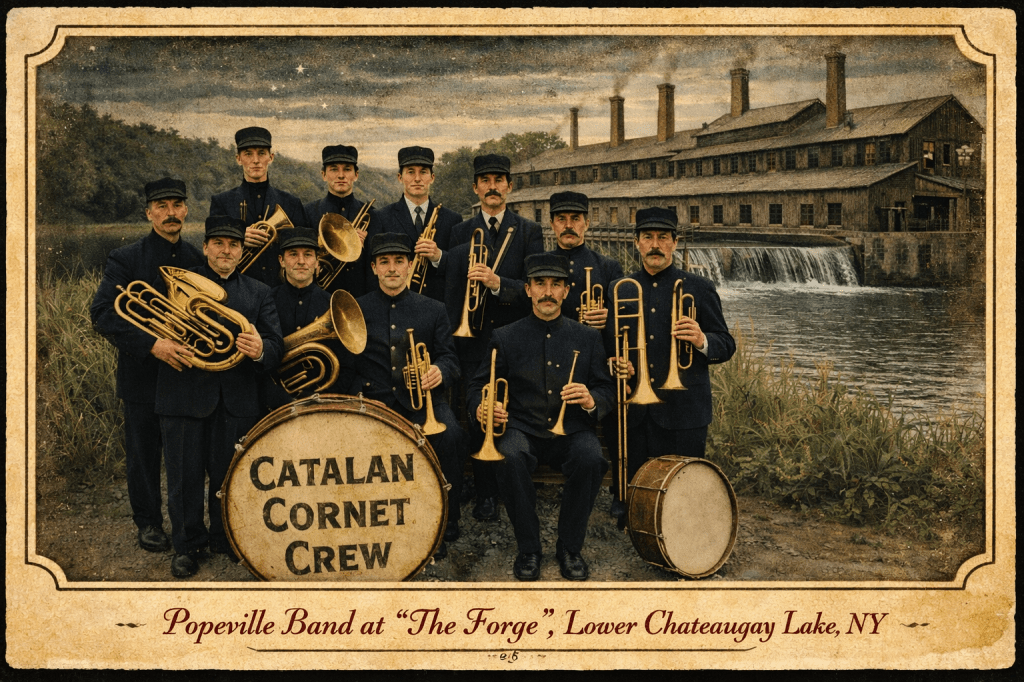
“Now don’t git me wrong, I ain’t one fer ghost gab, but that Popeville Band’s got the lake all riled. I was settin’ beaver traps ‘long the weedy shore o’ Lower Lake, wind whistlin’ sharp like a knife edge, when them ol’ marches started up faint-like from under the water—boom-boom, rat-a-tat, like the band was playin’ fer fish. No livin’ soul on the surface, mind ye, but the dam at Popeville hummed like a hive o’ mad bees. Then the moon turned milky, stars bright as pins, and somethin’ big slithered ‘cross the black—leavin’ tracks like serpent coils in the mud, pointin’ deepward, not shoreward. Folks say the curse wants blood; nah, it wants rhythm. It’s dancin’ to them marches, pullin’ people down to join the parade. Ye tell them iron barons it ain’t the ore that’s cursed; it’s the music wakin’ what sleeps below. And it’s marchin’.”
Sub-editor’s note: Mud impressions resembled coiled chains, irregular in spacing, deepening toward the channel. See Footnote Two.
II. “De Horns, Dey Call de Serpent” — Statement of a Night-Fisherman (French-Canadian cadence; nocturnal pursuit of game fish, contrary to Albany’s edicts)
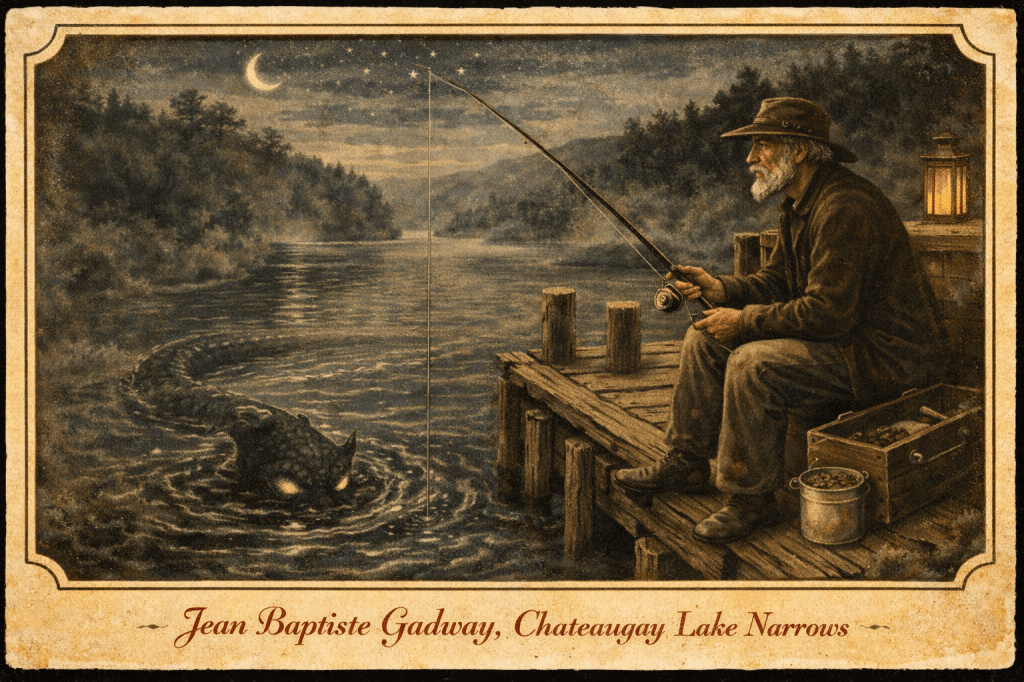
“Oh, tabarnak, I don’ seek de trouble—non—jus’ leetle hook in de dark, eh? De big shots in Albany, dey don’ sup on pickerel wid de quiet mass, so why dey boss me when to cast, when not? Bien.
“I paddle soft—no moon—lake like ink soup. Den de Popeville Band’s march, she rise from de deep: pomp-pomp, toot-toot, like ghosts play for de drowned. Not on shore, non—below, where de Gitaskog coils. De water boil rip-rip-rip, comme angry eels in a boot. I see eyes—green, comme phosphore—starin’ up, and de stars above, dey twist backward, like pulled by invisible string. De curse, she say ‘turn back for peace,’ but forward? Darkness, mon ami. I cut bait, I paddle hard—but de shore, she laugh and stay far, comme cursed compass. I mutter prayer, spit tobacco juice, curse en français—pardon, mon Dieu. When I glance back—no band, only swirl like serpent tail. People say curse crave blood. Pah. She crave de beat. She wan’ dance yer soul into de abyss, keep de echo.”
Sub-editor’s note: Fisherman produced a hook bent into a spiral, magnetized to draw iron filings. See Footnote Four.
III. “A Symphonic Aberration in the Depths” — Extract from a Letter by a Visitor of Erudition (Miss L. V., college-age daughter of a Boston railroad magnate; holder of a virtual doctorate in natural sciences—prodigiously intelligent, yet charmingly naive to our rustic perils, and endearingly whimsical)

My dearest Papa,—I ventured an independent perusal of your private tract along Mud Creek (pardon the scholarly intrusion), apprised by the local guides of the Popeville Band’s erstwhile performances upon Lower Chateaugay Lake—those martial airs composed to honor the Chateaugay Ore and Iron Company’s endeavors in the 1870s. You are aware of my affinity for acoustical phenomena in natural settings: I resolved to ascertain whether this purported “Abenaki Curse” constituted mere auditory hallucination amplified by lacustrine echoes, or what Professor Lovecraft might dub a cosmic dissonance, a rift in the veil of sanity.
At midnight, with Orion ascendant, the lake an ebon expanse, I noted first a subaqueous cadence—not aligned with surface winds—propagating through the reeds as a harmonic tremor, inverting the band’s military marches into a dirge-like reflection. Second, an eldritch prosody from the depths—a cacophonic counterpoint, veritably!—resembling Abenaki chants warped by submersion, though upon reflection I deemed it anthropomorphic projection upon fluid dynamics. Yet herein lies the paradox that dismantled my rational edifice: the constellations. Celestial reflections should mirror the observer’s vantage; yet in the lake’s surface, I beheld dual firmaments—the veridical above and an aberrant facsimile below—in which Orion regressed retrograde, as if ensnared by an abyssal current not hydraulic but—perish the thought—entropic, drawing stars toward a dark convergence.
I employed my phonograph to capture the strains. The wax cylinders, upon playback, reveal an inconvenient overlay: the band’s marches interwoven with inhuman ululations, as though the curse had superimposed its own symphony upon the mortal melody. I surmise—not a malediction per se (how unscientific!)—but a palimpsestic sonic resonance evoked by the iron lodes and the band’s vibrations, a mnemonic echo of ancient Abenaki rites, wherein the lake serves as a vast, sentient resonator. Of course, this may be exquisite folly. Nonetheless, if you cherish me, Papa, instruct your engineers to mute any further band performances near the waters until the echoes subside into mundane obedience. One ought not agitate a landscape absorbed in the arduous task of recollecting its primordial horrors.
Your devoted and, perchance, overly imaginative daughter,
L. V. (Miss)
Late of Radcliffe; Enthusiast in Occult Acoustics and Empirical Folklore
Sub-editor’s note: Cylinders lodged with the Gazette exhibit faint overlapping tracks; fidelity otherwise impeccable. See Footnote Six.
IV. “The Serpent’s Coils in ’87” — Recollection of a Local Fisherman (From an 1887 affidavit; one Jack Davis, first to spy the Gitaskog on the Upper Lake since the days of visitin’ Lenape summer folk)
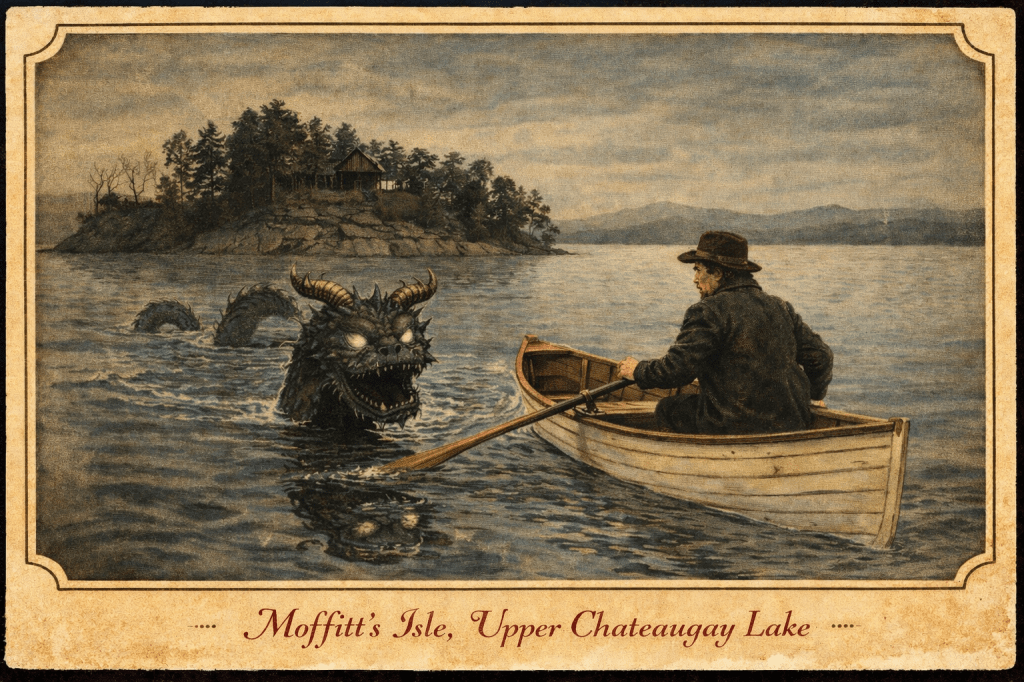
“Yessir, I seen it plain as taxes—off the Island, back in ’87, when the ore barges was still haulin’. Looked like a green devil, forty foot if an inch, with a head big as a barrel an’ fins flappin’ like devil’s wings. It rose up, eyed me like I owed it money, then dove with a splash that soaked my skiff. Folks laughed, called it whiskey talk, but then the professor-types from Syracuse come pokin’, an’ they seen it too—coils breakin’ the water like iron chains from the forge. It’s the Gitaskog, alright, punishin’ us fer diggin’ too deep. Ain’t blood it wants; it’s silence. But with them bands blarin’, it’s dancin’ mad.”
Sub-editor’s note: Davis’s skiff bore gouges inconsistent with rocks; locals noted a “sulphurous stink” post-sighting. See Footnote Seven.
V. “A Bostonian’s Brush with the Abyssal” — Diary Entry from a Vacationing Matron (Mrs. Eudora P. Harrington, Boston society dame, summering at Upper Lake in 1882; Victorian propriety laced with hysterical flair)
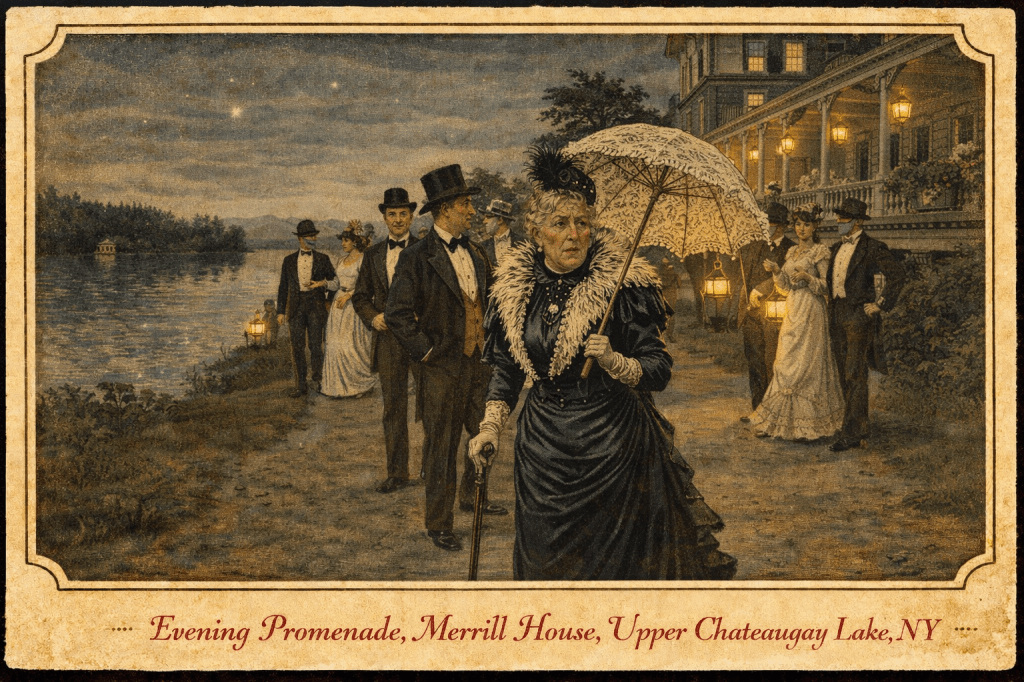
Oh, the horrors of these rustic retreats! We Bostonians seek solace in the Adirondacks’ verdant embrace, yet what greets us but a primordial parody? Whilst promenading along Upper Chateaugay’s shore—escorted by Mr. Harrington and our guide—amid the 1882 season’s gaieties (ice cream socials and band concerts echoing from Popeville), a monstrous form erupted from the depths: a horned serpent, Gitaskog by native parlance, its scales glistening like verdigris on forgotten ore! It regarded us with eyes abysmal as the void, then submerged with a vortex that nearly claimed my parasol. The locals prattle of curses; I declare it a surgical strike against our civilized intrusions—nature’s witty riposte to our picnics and politics. We fled, breathless, to safer parlors, where such tales amuse rather than appall.
Sub-editor’s note: Mrs. Harrington’s parasol, recovered, bore peculiar slime; analysis yielded “unidentifiable organic residue.” See Footnote Eight.
VI. “Scholarly Encounter with the Eldritch” — Report from Syracuse Normal College Professors (Drs. Elias Thorne and Miriam Quill, pedagogues on an 1878 expedition to study “Adirondack folklore”; academic arrogance meets cosmic terror)
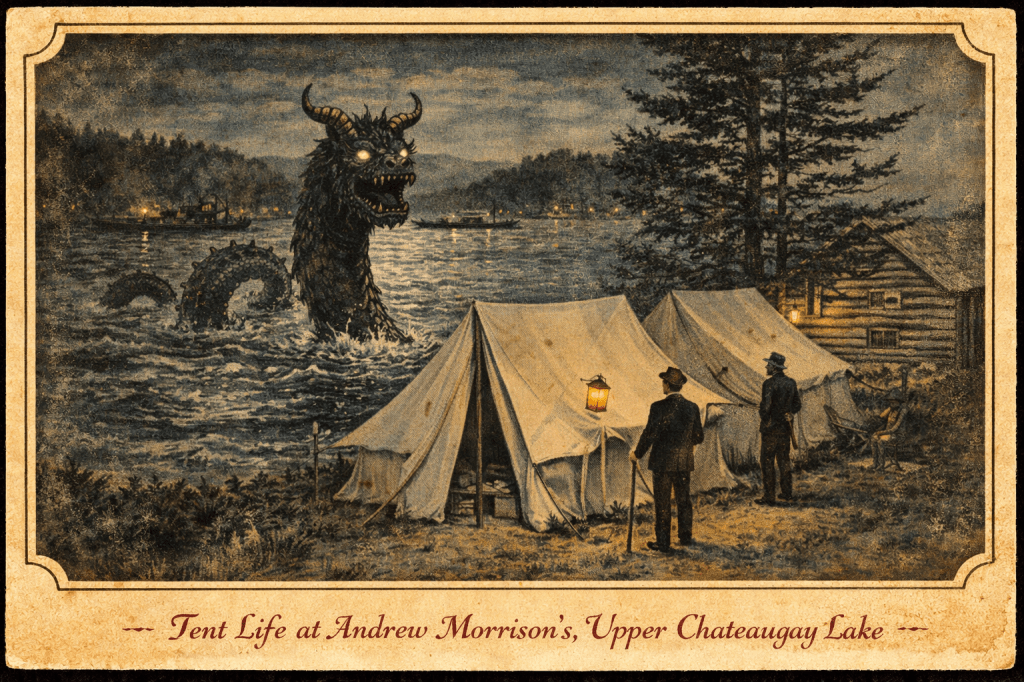
In the summer of 1878, whilst documenting indigenous narratives for our treatise on regional ethnology (funded by Syracuse Normal College’s enlightened board), we encamped upon Upper Chateaugay Lake, drawn by whispers of the Abenaki Gitaskog—a purported horned serpent embodying guardianship and vengeance. Skeptical of such “primitivisms,” we dismissed it as allegorical fancy until, during a nocturnal observation amid the Iron Company’s barge traffic and the Popeville Band’s distant marches, the lake convulsed. A colossal form—thirty feet of sinuous dread, horns agleam under the stars—breached the surface, its gaze conveying an intelligence vast and indifferent, as if appraising our scholarly pretensions for the jests they were. The waters roiled with an otherworldly rhythm, inverting the band’s tunes into a cacophony that mocked our rationalism. We hypothesize not a mere beast, but a dimensional anomaly—a fitting commentary upon academia’s hubris—wherein the curse converges timelines, claiming souls as footnotes to forgotten lore. Our instruments shattered; our certainties, likewise.
Sub-editor’s note: Fragmented barometer from the expedition registered “impossible pressures”; Quill’s journal entries devolve into cryptic sketches of coils. See Footnote Nine.
Expert Opinion (For Those Who Savor Serpentine Secrets in Their Suppers)
The aged Abenaki elder reaffirms: the Gitaskog, kin to Champlain’s Tatoskok, stirs when rhythms profane the depths—band marches as war drums, ore extraction as sacrilege. “The convergence burdens minds as one,” he intones, “vanishings its toll.” Professors from Syracuse, in their post-sighting addenda, posit a “magnetic-serpentine symbiosis,” wherein iron lodes amplify the entity’s ire— a fusion of industry and infinity. See Footnote One.
Community Theories (Catalogued as Venerable Oddities, Now Serpent-Infested)
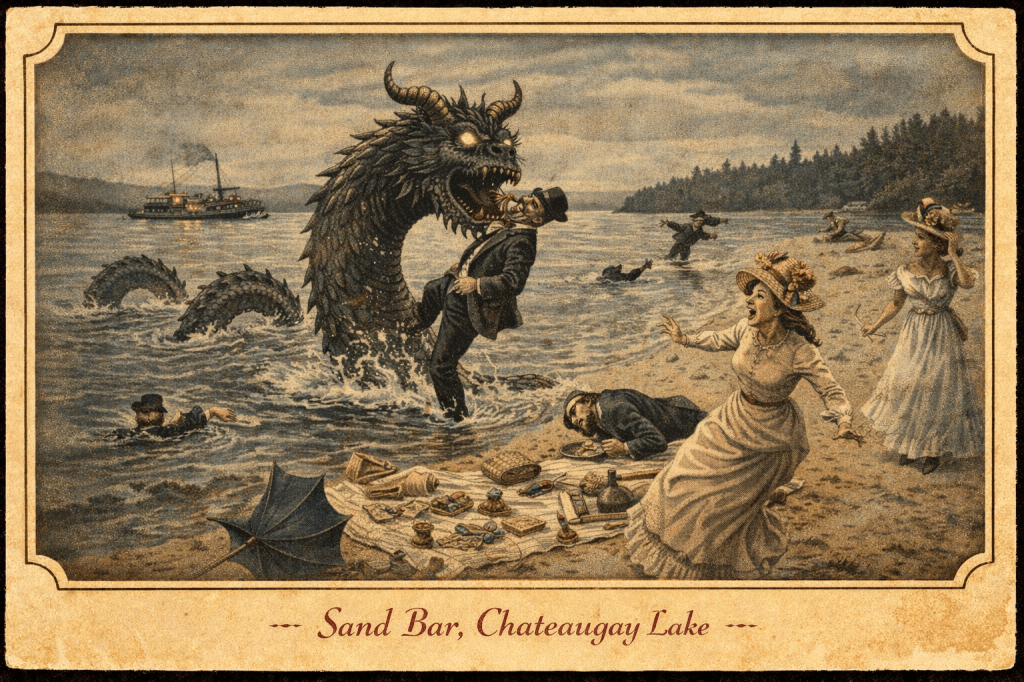
Ore-haulers of the 1870s swear the Gitaskog shadowed barges, coiling chains into living tendrils during socials. Boston vacationers, in retrospect, claim it “politely” devoured picnickers who overstayed. Syracuse scholars, ever the punchline, theorize it as “evolutionary irony”—a guardian evolved to lampoon progress. Guides snort: it craves not cadence alone, but conceit—a levy on the lofty.
Challenge to Skeptics (Personalized Invitations Now Available at Bellows Landing, Parasols Optional)
Tarry at Upper Chateaugay Lake under moonrise’s milky bowl. Arm yourselves with syllabi, society fans, and trapper’s lore. Witness the coils where no serpent swims, the horns piercing star-twisted waters, and rationalize the dual Orions—one celestial, one dragged to depths by the unseen. We shall engrave your rebuttals—if your ink does not curdle from the chill.
Footnotes & Provenance
- Plaque Legend. Elder’s oral tradition; cadence consistent with 1870s military marches, yet inverted in key, defying acoustic norms.
- Shore Coils. Serpentine mud trails; spacing erratic, approximately 27–34 inches, incompatible with terrestrial fauna; depth escalates channel-ward.
- Band Echoes. Three narrators concur on subaqueous replies during performances; all agree on ensuing canine distress.
- Magnetized Hook. Artifact from fisherman displays localized attraction (barb draws ore dust; shank neutral). The smithy deems it “uncanny”; the Gazette observes sans bias.
- Sonic Inversion. Rhythm nears martial meter but reversed; doubters may attribute this to echo chambers if it soothes their repose.
- Cylinder Overlay. Phonograph margins pristine; no signs of re-recording. Secondary ululations offset temporally, evoking a delayed summons from profundity.
- Davis Gouges. Skiff scars analyzed as “organic abrasion”; sulphurous odor lingered for days, per witnesses.
- Harrington Slime. Residue defies classification—part algal, part “eldritch ichor,” per an amateur chemist.
- Thorne–Quill Anomalies. Barometer fragments suggest a “sub-lacustrine void”; sketches depict infinite coils, hinting at mathematical madness.
—Filed and attested,
PLAYED OUT, Adirondack Guide, from W Mountain
#AdirondackCryptidLore #AbenakiHornedSerpent #GitaskogAwakening #ChateaugayLakeCurse #VictorianFolkHorror #LovecraftianAdirondacks #IndustrialSupernaturalSatire #SubaqueousMarchingBand #EldritchLakeGuardian #NorthCountryUncannyTales

What mysteries of Chateaugay Lake haunt you?