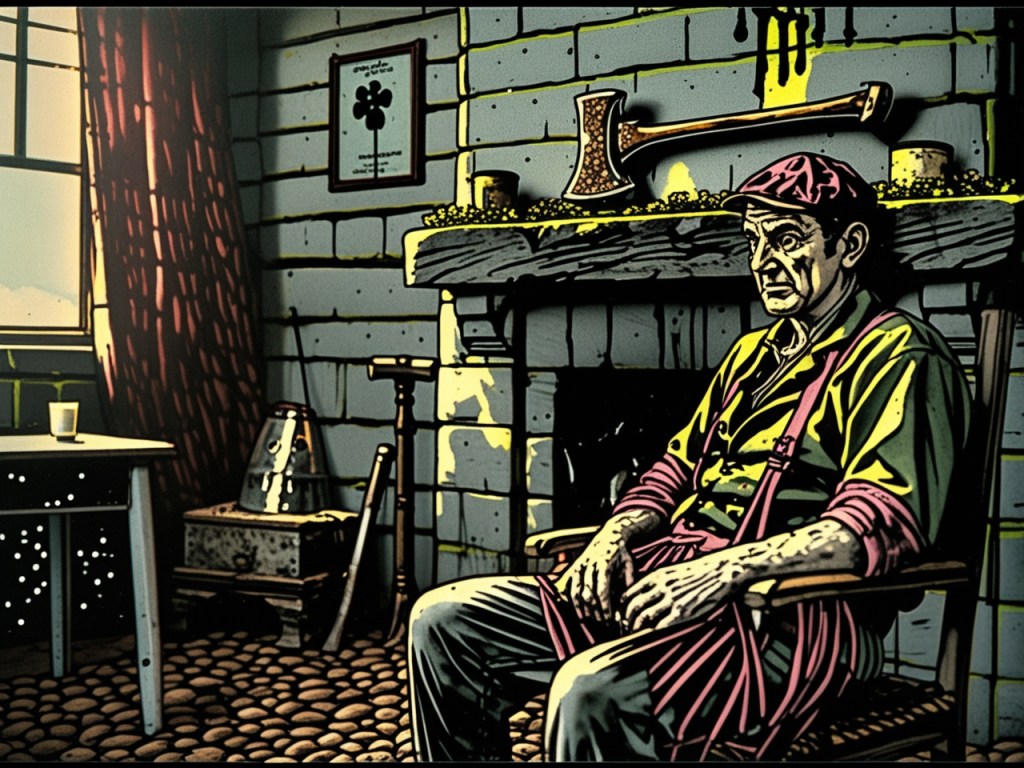
“Advertise not this Axe Rag tale to the nervous or the over-curious; it begins in harmless mimicry and ends with an axe over the mantel and tracks that double upon themselves in cedar swales.”
Old Popeville Axe Rag Still Talked Of Along the Lake
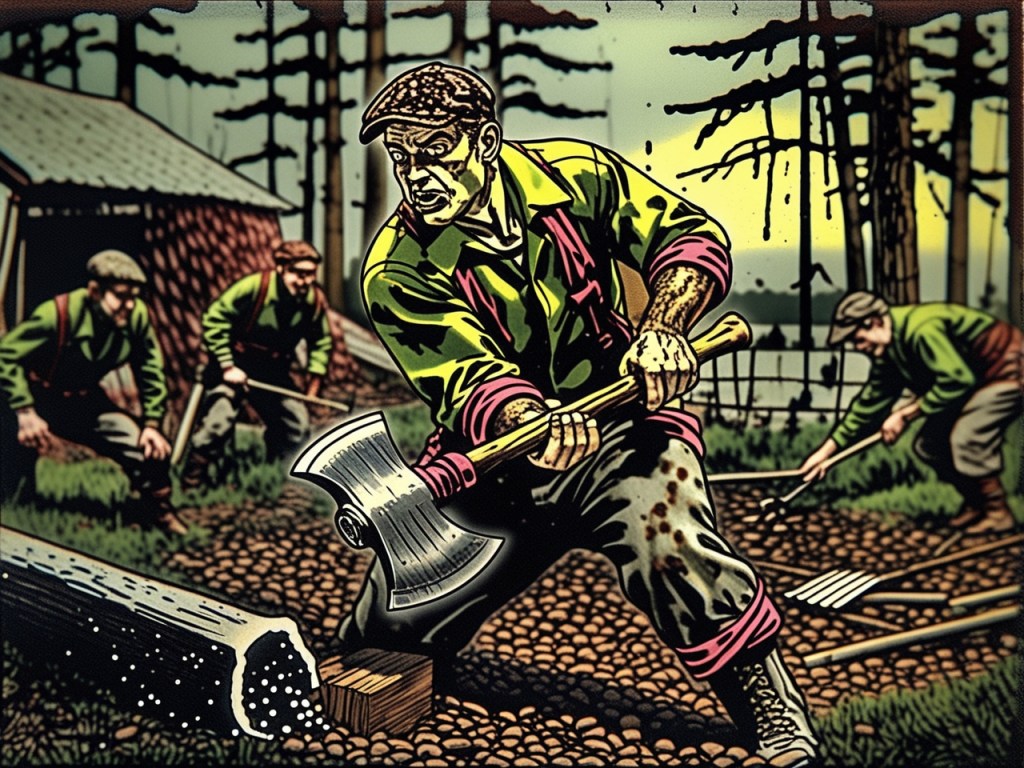
EAST BELLMONT, N.Y., 14 OCTOBER 1890.—There are some matters which come into a neighborhood with so much oddness about them that sensible people laugh at first and then, after a little, fall to repeating the story as soberly as if it were a tax notice or a church appointment, and among such there is none just now more frequently mentioned in these parts than the old Bargovent business, with the singular turn of motion, the camp outbreak near Popeville, and the queer dance air which has for some time gone under the title of the Popeville Axe Rag.—Those who like every thing plain, and would have a tale keep one shape from beginning to end, will not find much comfort here, for there are almost as many versions as there are men to tell them, though all agree that Justin Bargovent, in his younger days, was counted an uncommon neat axe-hand, strong in the wrists, exact in his stroke, and, as some say, more close and watchful in company than many cared for in a camp mate.—A number of old woodsmen still speak well of his industry, while admitting there was something in his eye and carriage that caused people to remember him after other men had been forgot, and one hand, very particular in such matters, was used to say that in recovering from a downward cut Bargovent had a slight check or feint to the left, not enough to call a miss, nor enough to be named a weakness, yet enough to trouble a by-stander without his well knowing why.—Out of this trifle, whether by mimicry, idleness, or some strolling fiddler’s invention, there came by degrees the dance step and tune before mentioned, which young folks took to performing at sociables and other gatherings with much spirit, though elderly persons were by no means agreed as to its merits, some pronouncing it lively and harmless, and others saying that to see a full floor of dancers all make the same sudden leftward hitch at once gave them as unpleasant a sensation as a flock of crows rising out of corn land toward dusk.—We do not pretend to decide who first set the foolish thing going, nor whether tune or motion came first, but only remark that there are jokes which, once started, seem to gather more meaning than was put into them, and so this one, instead of dying away in a season, has kept itself alive in hotel porch, boat house, and store corner in a manner very uncommon for any thing so ridiculous in appearance.
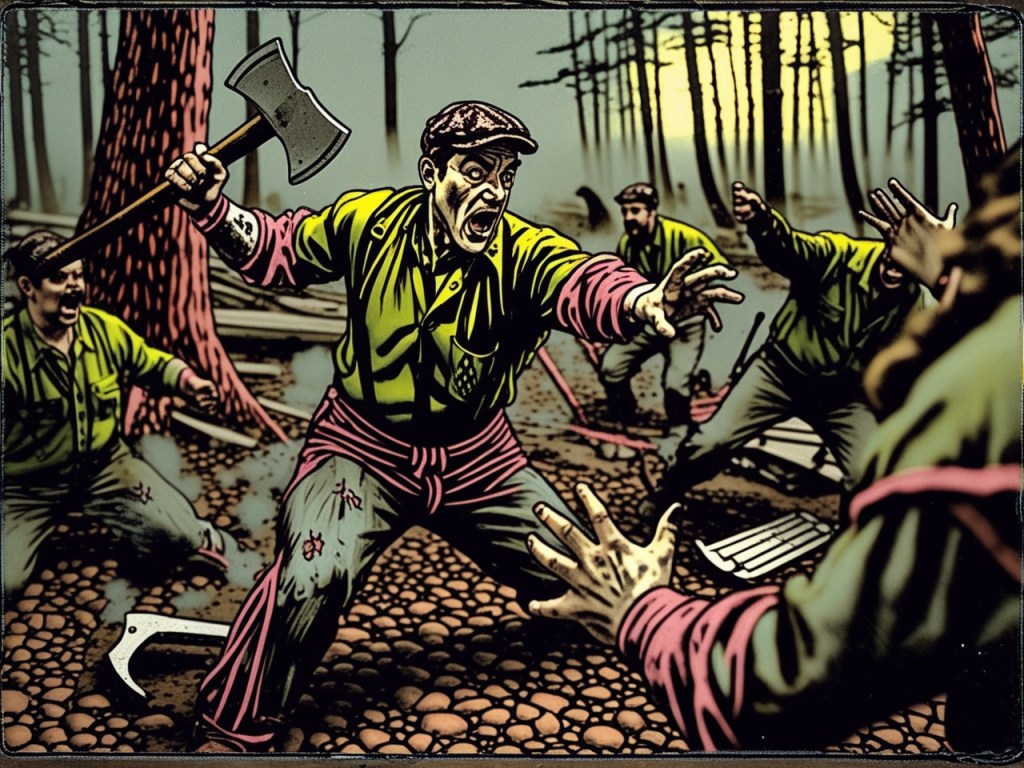
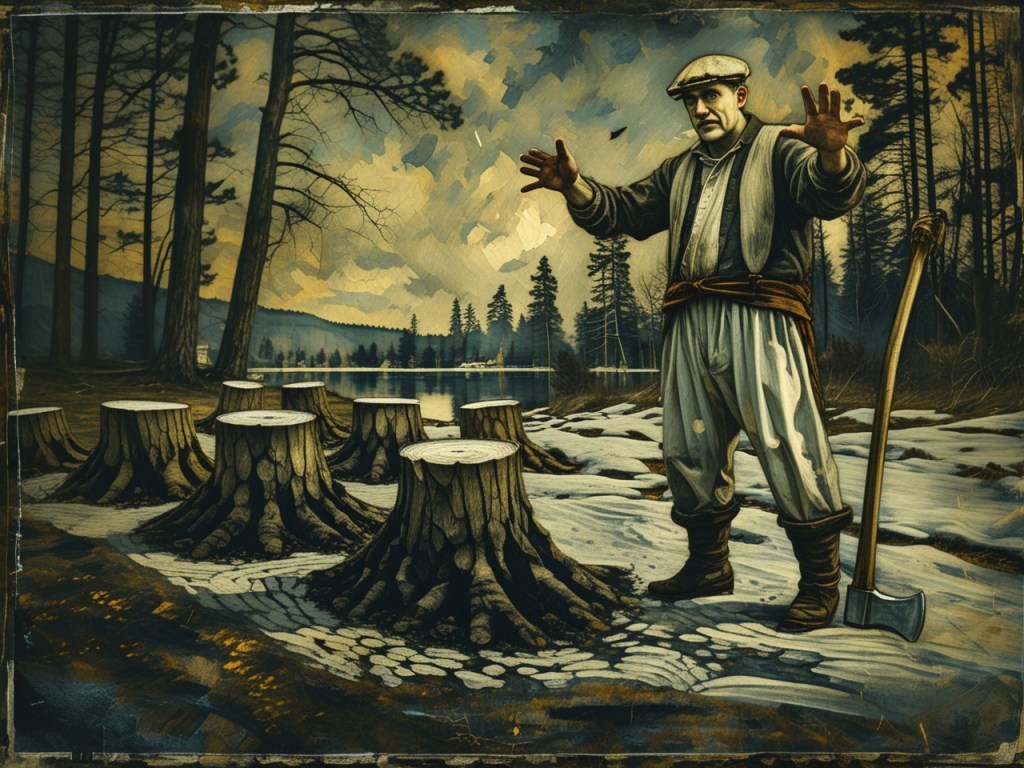
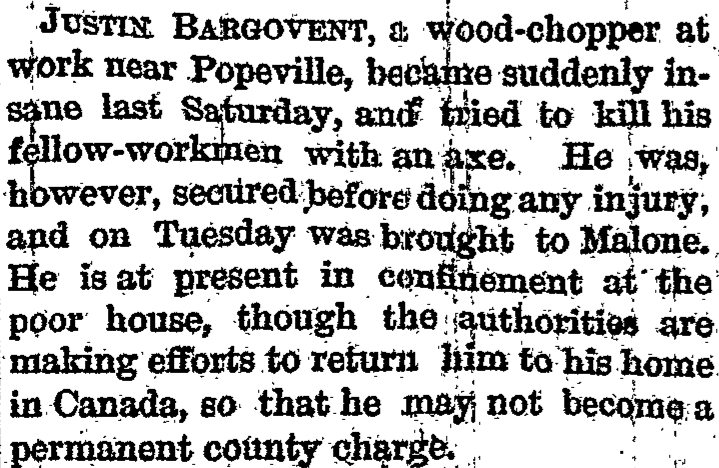
The story, however, would hardly have held the country so long had there not been behind it the earlier and more serious occurrence from which all the rest appears to have drawn its nourishment.—It is generally admitted that Bargovent, while chopping near Popeville on a Saturday, was seized with some sudden disorder of mind and turned with his axe upon his fellow workmen, though happily, by good fortune and nimble scrambling, no one was injured, a mercy for which many have since been thankful, as the alarm at the time was very great.—On the particulars, as often happens, the witnesses differ handsomely; one says he advanced in perfect silence, another that he cried out something about the trees having shifted places, while a third maintained to his last day that the man seemed rather to be warding off an enemy visible only to himself than seeking one among the camp, but all agree that he was secured and taken off to Malone, there being then much practical discussion as to what was to be done with him, whether he should be returned to his Canadian people, kept at public charge, or otherwise disposed of, and there were papers, delays, and enough concern about county expense to prove that official minds can discover arithmetic in the most unsettled cases.—Afterward he is said to have lived quietly for a time in a remote place, doing chores, speaking little, and keeping an axe over the mantel, which implement has been described by different respectable men in such contradictory forms that one is tempted to think there must have been several axes or several imaginations, though all agree that it hung there and that visitors did not fail to notice it.—The matter might even then have sunk away but for the later occasion, remembered by many, when the aging Bargovent was brought, or came of himself, into a room where the Axe Rag was being danced, the place being variously laid at a church entertainment, an upper hall, a regatta frolic, or a summer tent, according to the conscience of the narrator; yet here again testimony, after scattering wide, gathers itself upon one very inconvenient point, namely, that the old man stood looking on with a composure nobody liked, and when the leftward motion came round once more, said in a voice plain enough to be remembered by all, “I missed to the left on purpose.”
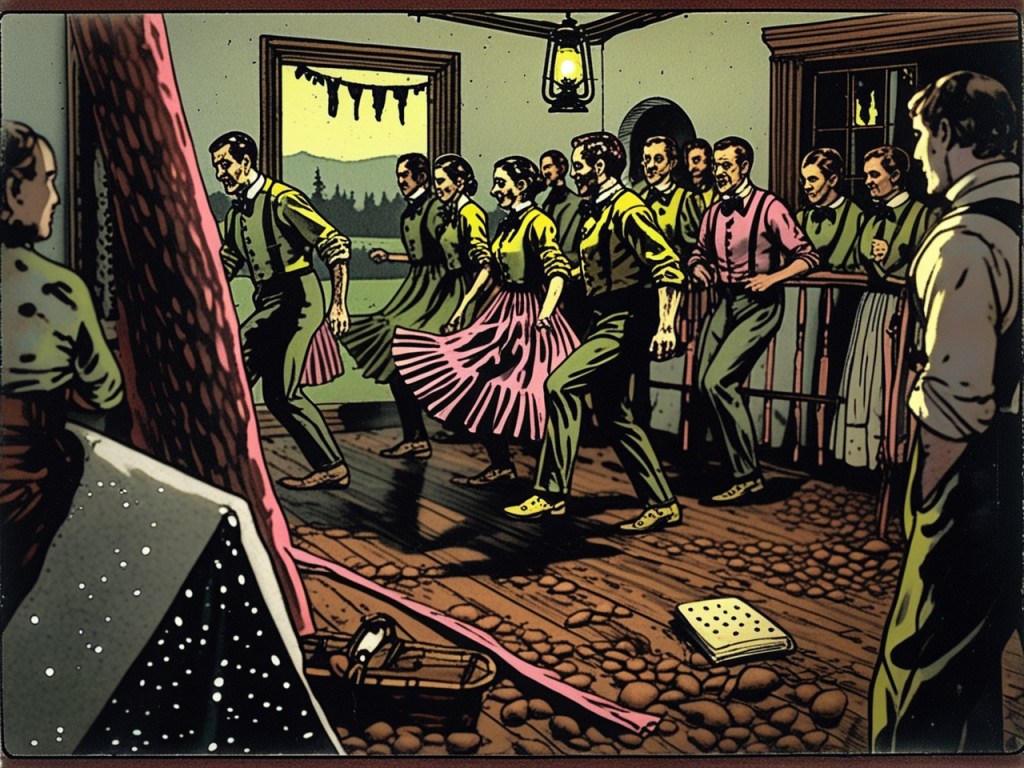
Since that sentence was uttered there has been no end of quiet argument over what it meant, whether it was a joke too dry for the room, a confession made late and without ornament, a sharp rebuke to those who had turned a once fearful business into a caper, or only the wandering speech of a man never wholly restored to himself; and persons otherwise of sound judgment have spent much ingenuity upon it with less success than on many matters of greater public value.—Some connect it with the old camp outbreak, some with the queer check in his chopping stroke, and some, who would rather not think too closely, say only that there are remarks which settle in a house and stay there like winter smoke, getting into every thing.—Then came later rumors, as rumors will, concerning a missing census taker, tracks in snow that doubled upon themselves, a neighbor who declared Bargovent borrowed salt pork and returned the pan cleaner than he got it, and, after all this, reports from cut-over land and cedar swales that the old fellow had been seen before a row of stumps, making motions as though teaching them a lesson or waiting for them to begin some dance already known to both parties.—We place no great reliance upon apparitions, especially those discovered by men after dark or by women who have heard too much before stepping outdoors, yet it is curious how steadily the principal uneasiness remains after one has brushed aside the embroidery, for there was certainly a real disturbance, a real man, a real phrase, and a real impression made upon the countryside which has not worn off with the years as many better things have done.—Sermons are forgot, hotels go down, roads slouch back into the woods, and worthy officials leave scarcely more trace than the whiskers they once carried, but “I missed to the left on purpose” still travels these waters as faithfully as an old tune, and with rather less comfort; so that, laugh as people may, the Popeville Axe Rag continues to puzzle lake folks and bids fair to do so for some time yet.
THE POPEVILLE AXE RAG
EAST BELLMONT was talkin’ again—
store-porch mouths, bench-board men,
fog in the cuffs and mud on the hem,
sayin’ Justin Bargovent—remember him?
Quick with the axe, quick with the eye,
all edge, no smile, and nobody knew why,
steady as winter, sharp as a spark,
walkin’ like he heard some off-road dark.
Then a stray tune come slidin’ through town,
a camp-made jig in a sawdust gown,
some ramblin’ song-man stole the swing,
hung it on a chorus and a boot-heel ring—
The Popeville Axe Rag, bright and fast,
young folks laughed and kicked it past,
but the step had a catch—just a little wrong,
like a grin held too long in a lantern song.
And the lake said, loop it—
and the road said, don’t—
and the floorboards answered
with a shiver in the throat.
Half cheerful, half unsettled,
that’s the way these old tunes drag—
oh honey, turn slow now,
through the Popeville Axe Rag.
He stood there quiet—docile, gray,
watchin’ the dancers throw it away,
left foot flash and the shoulder dip,
that old camp motion in a county hall skip.
He watched and watched like snow watches pine,
then turned his head at the end of the line
and said so soft it near split the room:
“I missed to the left on purpose.”
I missed to the left on purpose—
say it low, say it once, say it crooked for the circus.
I missed to the left on purpose—
now the fiddle won’t settle and the walls go nervous.
I missed to the left on purpose—
what was mercy, what was aim, what was joke, what was furnace?
I missed to the left on purpose—
and the night keeps the sentence like a nail in its mouth.
They said once, years before, near Popeville way,
he went wrong on a Saturday—
axe in his hands and a weather-turned stare,
swung at the camp like a crack in the air.
Nobody killed—thank God, not then—
they tied up the storm and hauled off the man,
Malone took him in, poorhouse cold,
county arithmetic, human freight, old story told.
Then time did its crooked domestic thing—
a potato farm, a mantel, a single blade hanging,
winter smoke, broth on the stove,
a life that looked almost healed from above.
Years of no chopping block, no fresh split pine,
just frost at the sill and a fence line.
Till a census man vanished into the drifts one year
and the whole white county leaned in to hear.
Some said showman. Some said escape.
Some said stumps in a row like an audience shape.
Some said he bowed to the pines at dusk,
performed for the knots and the bark and the husk.
Fact slept with fancy in the same iron bed—
that’s how these North Country lullabies spread.
You never get truth by itself up here;
it comes with sleet in its beard.
And the hamlets kept workin’—
good grit, good fire, good bread—
but one old camp story
put a bruise on the red
of the dance hall ribbons,
on the lamp-glow brag—
oh darling, don’t lean too hard
into the Popeville Axe Rag.
I missed to the left on purpose—
and the benches remember though the speakers are gone.
I missed to the left on purpose—
and the road keeps hummin’ the wrong half of the song.
I missed to the left on purpose—
like a love note written with the blade turned on.
I missed to the left on purpose—
and the town wears that whisper like a borrowed shawl.
So leave some things half-laughing,
leave some things half-bad,
leave the tune admired
and the dancers a little sad.
Leave the axe above the mantel,
leave the snow upon the track,
leave the census man uncounted,
leave the bright tune uncalled back.
Because Popeville is a chorus,
and Bellmont is a hum,
and every old bench-sitter knows
the darkest line goes numb
before it ever leaves you—
before it ever sags.
You can hear it in the heel-turn
of the Popeville Axe Rag.
#AxeRagFolklore #LumberCampMadness #ChopStrokeMystery #LeftwardFeintLegend #PopevilleMadnessOutbreak #BargoventConfession #DanceTuneHaunting #AdirondackAxeTale #MissedOnPurpose #LakeCountryUnease


What mysteries of Chateaugay Lake haunt you?