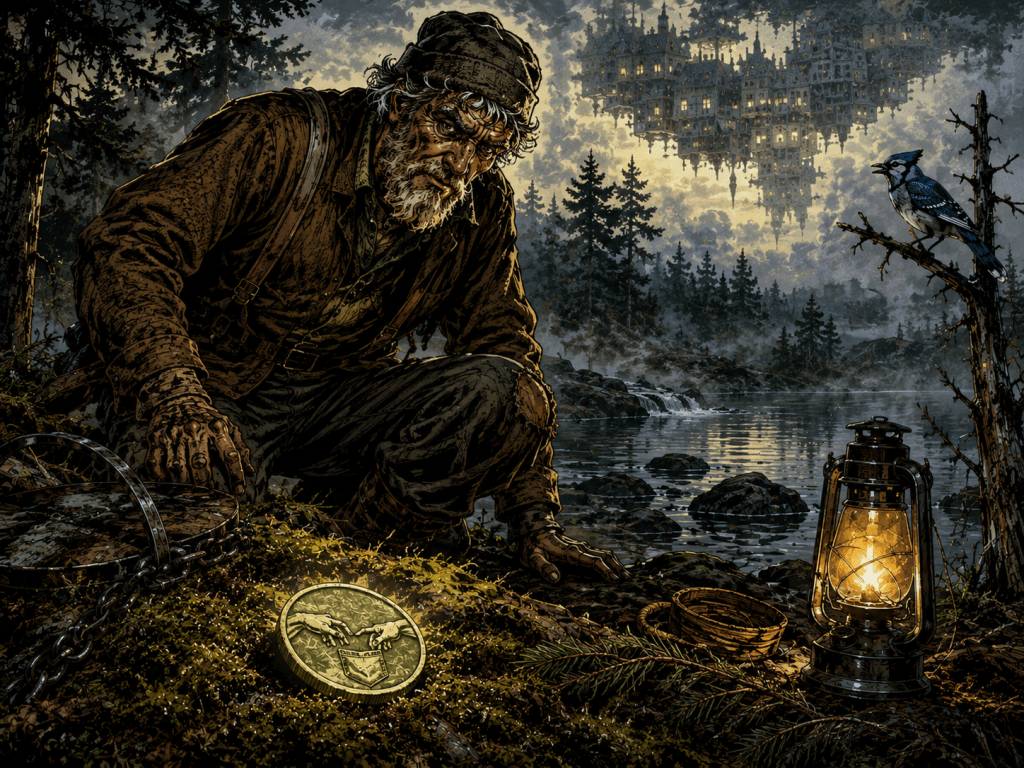
Advisory: Contains company-town sorcery, airborne ledgers, methane gentlemen, and progress sold by the breath; timid readers may experience ledger rash, map suspicion, and renewed distrust of anything named New after supper up yonder.
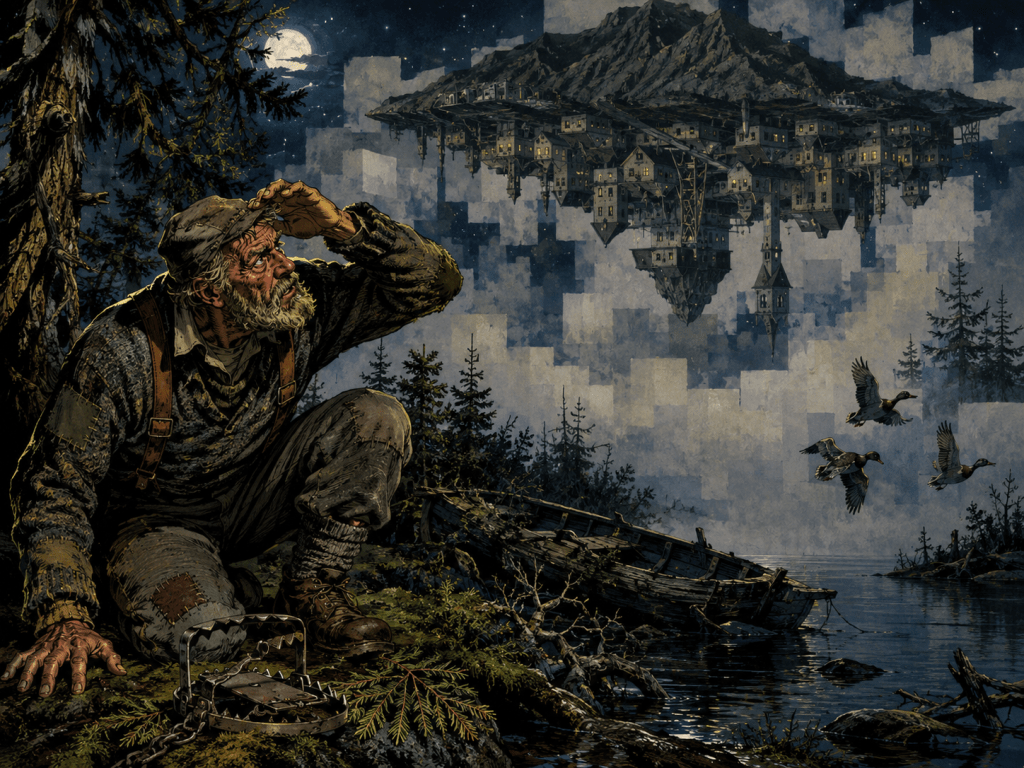
It has been remarked at the store, and denied at the mill, and then remarked again with improvements, that history don’t travel in a straight road, but goes round like a balky horse at a watering trough. A town may be built for iron, or timber, or starch, or salvation, and yet the same old bill comes due. The company comes first with a brass-buttoned man, then the surveyor, then the store ledger, then the preacher, then the poor fellow with three children and no say in the matter. Some call this progress. Old folks call it “another hook with fresh bait on it.”
There is, however, a class of tales older than what magazine editors have lately named Weird Tales. Our grandfathers hereabouts called them Shanty-Prophecies with Teeth, which is to say, foolishness when told by another man, warning when told by your own uncle, and gospel truth if the snow is driving hard enough against the windows.
For this week’s specimen I give over the floor to Peleg “Moon-Rust” Trumbull, once a guide on Chateaugay Lake, once a trapper in the Shatagee Woods, once a teamster at an iron diggings that failed so mean it would not even fail outright, but just lay down and groaned. Peleg declares he seen New Brainardsvilfle before it was born, and not on this earth neither, but up amongst them cold boulders in the sky where the green fellers breathe methane gas and keep books in a hand a man would mistake for boiled spruce root.
Peleg told it while mending a trap beside the outlet, with deerflies working on him like tax assessors.
“Well, now,” says Peleg, “you boys laugh caze I said asteroid, but I never set much store by a name that sounds like a stomach complaint. Rock is rock, whether it lays in Shatagee Woods, or under Chateaugay water, or rolls round the Almighty’s attic with frost on one side an’ fire-sparks on t’other. I wuz up to the old carry beyond the slews—no, not thet carry, the other, where Amos Drown lost his boot an’ found it three year later with a trout livin’ in it—when I fust heerd the company whistle.
“Now there wa’n’t no company there then, only cedar, balsam, a busted guideboat, two ducks carryin’ on scandalous, an’ a blue jay talkin’ worse’n a constable. But ez I wuz sayin’, I heerd a whistle, thin an’ far off, like a mill had been set up inside a star. Then the fog come down off Chateaugay Lake, only it didn’t come proper. Fog ought to crawl. This come in squares. Massy alive, there’s that deerfly agin—hand me that spruce bough, will ye? No, don’t slap the trap, ye’ll spring it. Some men can’t handle iron, nur line, nur gospel, nur no nothin’.
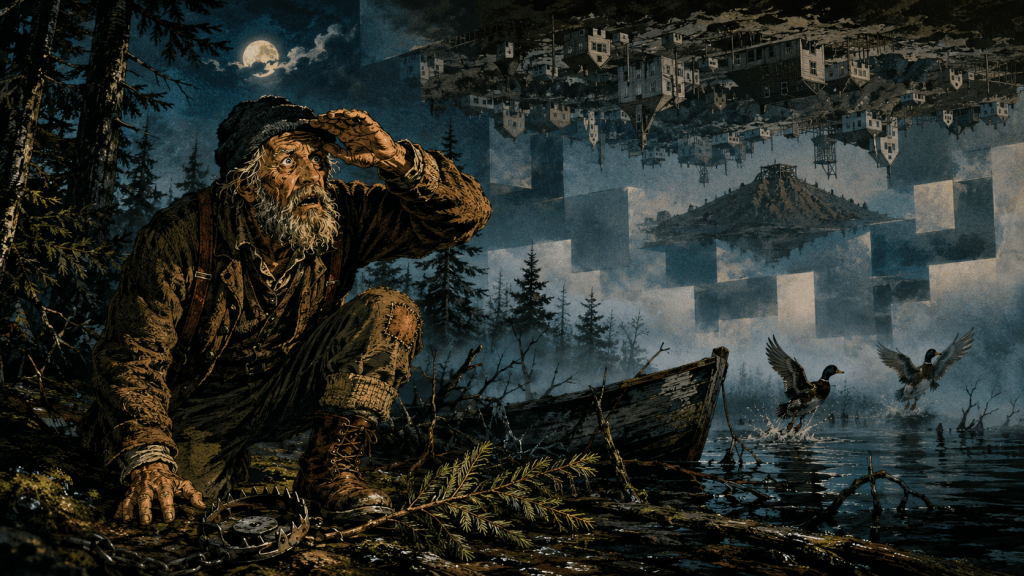
“So, ez I tell ed yer, I looked through that square fog and seen a town hangin’ upside-down in the sky. Streets laid out straight as a company man’s lie. Houses all one size. Store in the middle. Office with a clean sign. Schoolhouse. Chapel. Jail, though they called it a Regulation Hut. There wuz a mine-mouth in a black hill, only the hill wuz floatin’, mind ye, and all about it little lamps moved like fireflies with college education.
“‘What kinda town is thet?’ s’ze I, though there wa’n’t nobody nigh but a woodpecker, and he wuz busy makin’ a fool of a dead pine.
“Then a voice come out o’ the fog, polite as a bank note and twice as dangerous. It s’ze—well, I can’t give it to yer ez he said it, caze it had a hiss and a bubble to it, like a frog talkin’ through molasses—but the idee wuz, ‘Welcome to New Brainardsvilfle, established for the benefit of labor, industry, civilization, and such persons as owe money already.’
“I says, ‘That sounds like old Brainardsville with its hat turned inside out.’
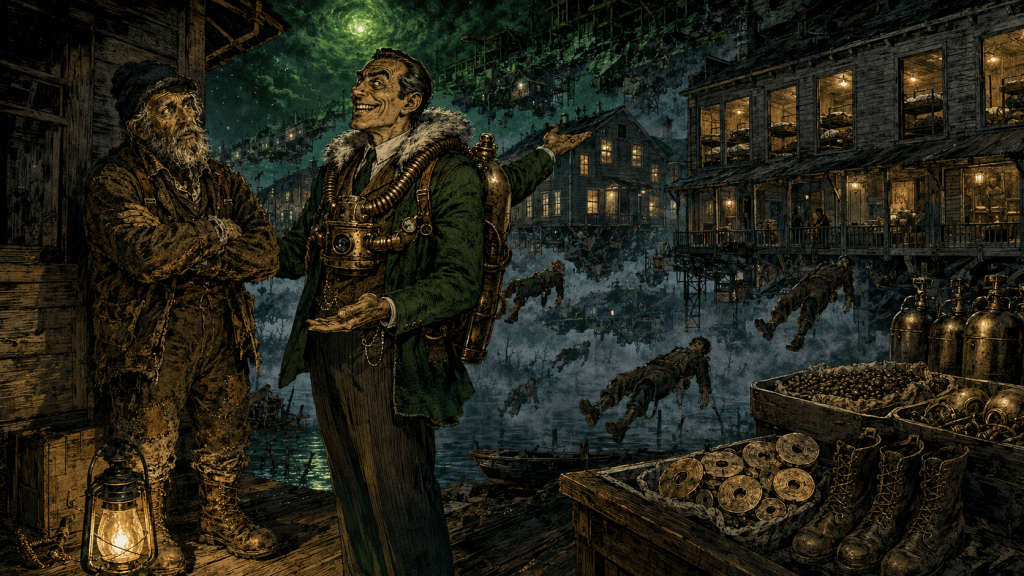
“Then I seen ’im. Green feller, tall, slick, eyes set sideways, breathin’ methane out of a brass contrivance strapped to his shoulders. Had a collar white as frost and a smile like a saw set for hardwood. He wa’n’t Injin, nor French, nor Canady, nor county officer, but he knowed debt by instinct.
“He says—no, not them words, but the p’int on’t wuz—‘We have brung opportunity to this rural celestial body.’
“I says, ‘Opportunity is what a mink gives a henhouse.’
“He didn’t mind. Company fellers don’t hear nothin’ that ain’t in their own circular. He showed me the boarding house where men slept in tiers like cordwood, only the beds had straps caze gravity wuz poor and apt to quit before payday. He showed me the store where a pound o’ beans cost two shifts, boots cost six, and air cost by the breath. Poor money, boys, poor money. I’ve seen scrip in iron towns, lumber towns, starch towns, and one sugar bush that tried to pay men in maple promises, but I never seen money so poor as methane-town money. It had a hole in the middle and a company rule printed round it: GOOD ONLY WHERE YOU CANNOT LEAVE.
“But ez I wuz sayin’—hold that line steady! There’s a trout under that alder root with more sense than the whole Legislature. No, ye jerked too soon. That fish is gone to tell his descendants there’s fools abroad.
“Well, finally at last, I asked the green feller where the folks come from. He points, and I seen a string o’ shanties with names painted over ’em: Old Iron, New Hope, Progress Row, Widow’s Comfort, and one called Ruin’s Annex, though they’d scratched that out and wrote Prosperity Court. Men come and went with lamps on their heads, faces gray as ashes. Some wuz from mountain farms, some from old diggings, some from villages where the mill had shut and the church bell sounded lonesome. There wuz women hangin’ wash in no wind at all, and children playin’ marbles with bits of ore that glowed when nobody looked straight at ’em.
“I says, ‘This here don’t smell right.’
“The green feller says, ‘Methane.’
“I says, ‘No, I mean morally.’
“He says, ‘Same contract.’
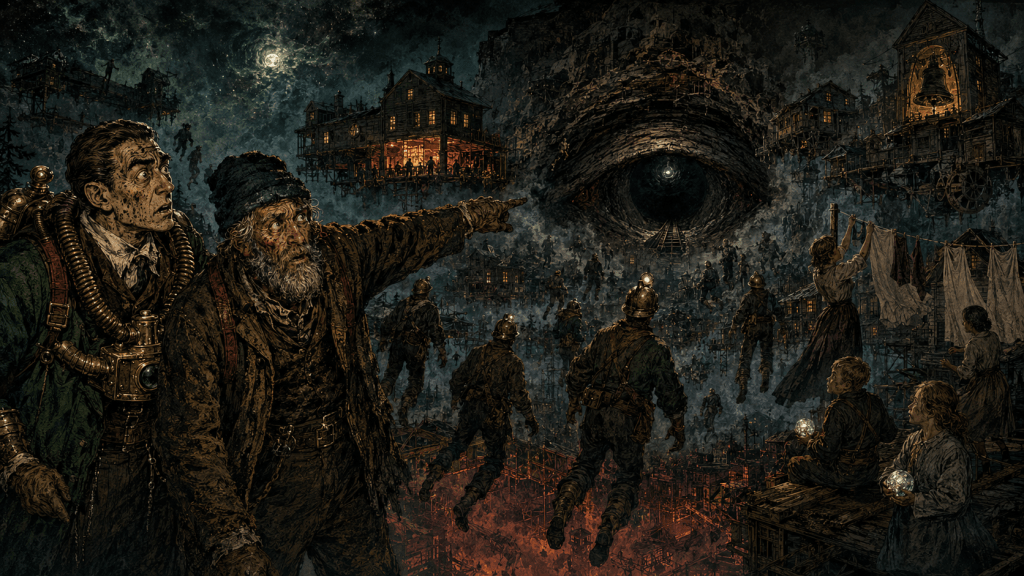
“Then the whistle blew agin, and every man turned toward the mine like he’d been pulled by the sculp. The rock opened. Not dug open, mind ye. Opened like an eye. Inside wuz iron, nickel, silver, copper, and suthin’ else that shone black. Black shine is no Christian shine. I told him so.
“He says, ‘That is the future.’
“I says, ‘I’ve trapped future. It bites through the basket.’
“Now here’s where you boys will say Peleg had rum. I did hev rum. That ain’t the question. Rum has been blamed for many sights it merely made more neighborly. The question is whether a man can see a thing clearer when the world takes the stopper out of ordinary. Lemme see—where wuz I? Oh, yes. The mine-eye.
“Out of it come a sound like chains dragged under lake ice. Then the whole town shifted, and I seen beneath the clean boards an old iron town I knowed from years back. Same ledger. Same cough. Same empty promises, only varnished brighter. The superintendent’s office turned into a forge. The company store turned into a jaw. The chapel bell rung, but it rung in the men’s ribs. Even them green fellers looked nervous, though they tried to keep committee faces on.
“One o’ the methane boys, younger than the rest and speckled like a frog in April, leaned close and s’ze—not exactly, but the idee wuz—‘Old guide, is this how Earth companies do it?’
“I says, ‘Son, they done it with iron, timber, coal, rails, dams, and likely with moon-cheese if they could git a lien on it.’
“He s’ze, ‘But they promised gardens.’
“I says, ‘They always promise gardens. Then they sell ye the shovel.’
“Just then a duck flew through the fog upside-down and hit a signboard. I don’t blame him. A duck is built for water and suspicion, not astronomy. The sign swung round, and where it had said NEW BRAINARDSVILFLE—clean letters, gold stripe, mighty respectable—it now said BRAINARDSVILFLE MINING & RESPIRATION CO., COMPANY OWNS ALL ROADS, ALL AIR, ALL SUNDAYS, AND SUCH DREAMS AS MAY BE FOUND LOOSE AFTER DARK.
“That’s a long sign, but companies hev paint enough when warnin’ folks not to breathe free.
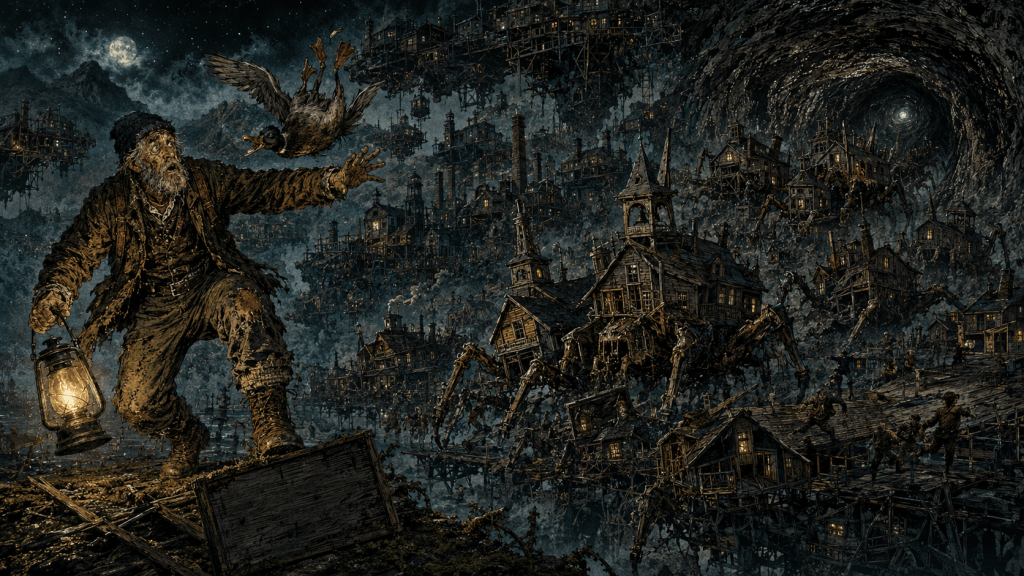
“Then come the strangest part. From the mine-mouth crawled old towns. Not people, towns. Little of ’em, like beetles made out of roofs and chimneys. One had a furnace stack for a horn. One had a church steeple stuck crooked like a broken tooth. One had a schoolhouse bell draggin’ behind. They crept across the asteroid and fastened onto New Brainardsvilfle, and every time they bit, a new street appeared with a familiar sorrow. Widow rent. Store debt. Bad water. Company doctor. Strike notices. Sheriff paper. Boys gone off and not come home. Girls lookin’ toward the road with their hands in dishwater.
“I says to the green feller, ‘There’s yer progress.’
“He says, ‘Can it be improved?’
“I says, ‘Not by callin’ it new.’
“Then that black-shinin’ ore begun to sing. Not music. More like when a sawmill gets out of true and the blade has murder in it. The men heard it, and the green fellers heard it, and I heard it through my rheumatiz clear to the buckle of my left snowshoe. It sung of every place that ever got built too quick by men who never meant to stay, and every road that led in fine and led out poor.
“The young methane feller says, ‘What shall we do?’
“I says, ‘Fust, don’t trust a town whose graveyard is planned after the pay office. Second, don’t let no man sell ye air by the breath. Third, if a company names a place New Anything, look sharp for what happened to Old Anything.’
“He wanted that wrote down. I told him I don’t write in methane.
“But ez I wuz sayin’, the mine-eye opened wider, and inside I seen Shatagee Woods, Chateaugay Lake, our own roads in mud season, and the old store stove with fellers arguin’ whether this happened sixty year ago, or a hundred and thirty, or next Wednesday. Then the fog folded up like a blanket, and I wuz back by the outlet with my trap in my lap, a blue jay hollerin’ thief, thief, thief, though what he ever paid cash for I’d like to know.
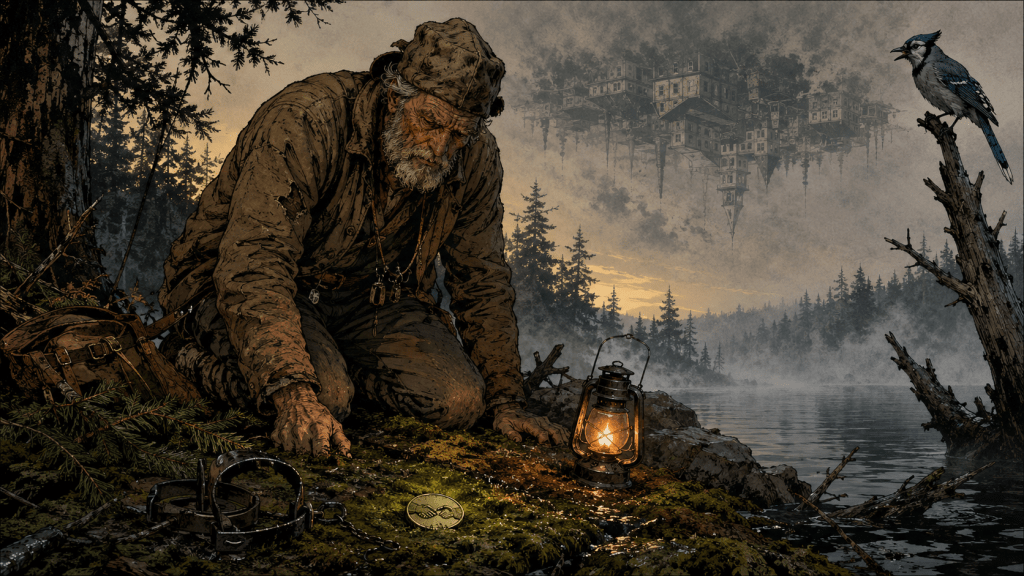
“On the moss beside me lay one coin from New Brainardsvilfle. Greenish. Light as a lie. Warm in cold weather. On one side it had the company seal: two hands shakin’, one hand human and t’other not, both reachin’ for the same pocket. On the other side it said PROGRESS.
“I tried to spend it at the store.
“They wouldn’t take it.
“Which proves,” says Peleg, “that our storekeeper has more wisdom than all the heavens, though he don’t give fair measure on crackers.”
Such is Peleg Trumbull’s account, and I print it with the ordinary cautions due to a man who has seen more weather than bookkeeping, and who regards prophecy chiefly as a thing that comes cheaper than flour. Yet there is marrow in his nonsense. When strangers arrive with smooth maps, polished signs, and a town already named before the first child laughs there, a prudent neighbor may ask who owns the road, who owns the store, who owns the air, and who is expected to call ruin progress because the lettering is fresh.
BELZORAM
#AdirondackGothic
#ChateaugayLakeFolklore
#ShatageeWoodsTales
#CosmicRuralMystery
#NorthCountryWeirdness
#CompanyTownSatire
#AsteroidFolklore
#StrangePeriodNews
#LakeCountryProphecy
#RusticCosmicFable

What mysteries of Chateaugay Lake haunt you?