Advisory for subterranean cities, boat bottom graffiti, critical lake folk, guide gossip, and sunsets subjected to professional review. Timid readers may inspect their skiffs, their socks, and their personal composition afterward rather closely.
It is not our habit to trouble the public mind with reports until they have been sifted, shaken, warmed beside the stove, contradicted by three responsible persons, and finally believed by the oldest man present. Yet there are matters below W Mountain that will not submit to common handling. They are too large for the wash-tub and too cold for the parlor. They rise, when they rise at all, on the bottoms of skiffs, in queer black-green writing no man claims, and in the dreams of guides who wake with their boots full of sand.
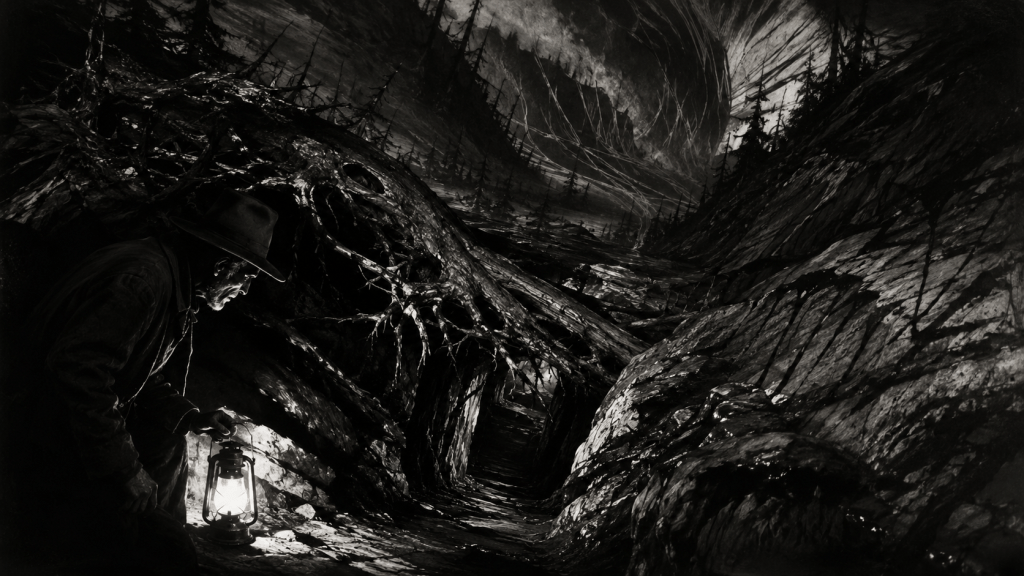
The discovery, if such it may be called, was made through the old westward cleft of W Mountain, behind a fallen hemlock whose roots hold more stones than honest earth. The passage runs first like a fox-hole, then like a cellar-way, then like the throat of some ancient mill-race gone dry and wicked. After sixty rods of stooping, a man hears water beneath him, wind above him, and a low sound like a thousand pencils worrying slate. The air smells of lake mud, iron, old smoke, and paint ground before Adam had a barn.
At the end of this descent stands, not a cave merely, but a city.
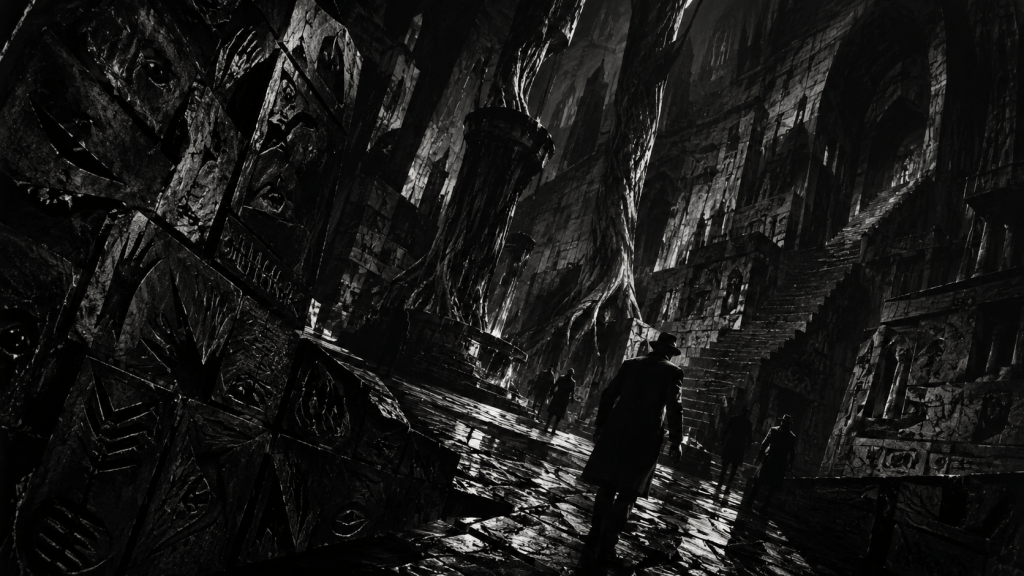
I use the word advisedly and under correction. Streets are there, though no wagon ever wore them. Steps are there, though no common foot could have planned their measure. Walls rise as high as the East Bellmont steeple and twice as solemn, built of black stones so vast no team in Franklin County could draw one, even if every ox from Brainardsville to Crompville were hitched to it and whipped by mortgage. The blocks are fitted without lime, yet so tightly that a jackknife blade cannot enter. Some are green with a glaze like deep lake ice. Some shine faintly when breathed upon. Some bear figures of skiffs, moons, fish-bones, long hands, and faces with too much brow and too little charity.
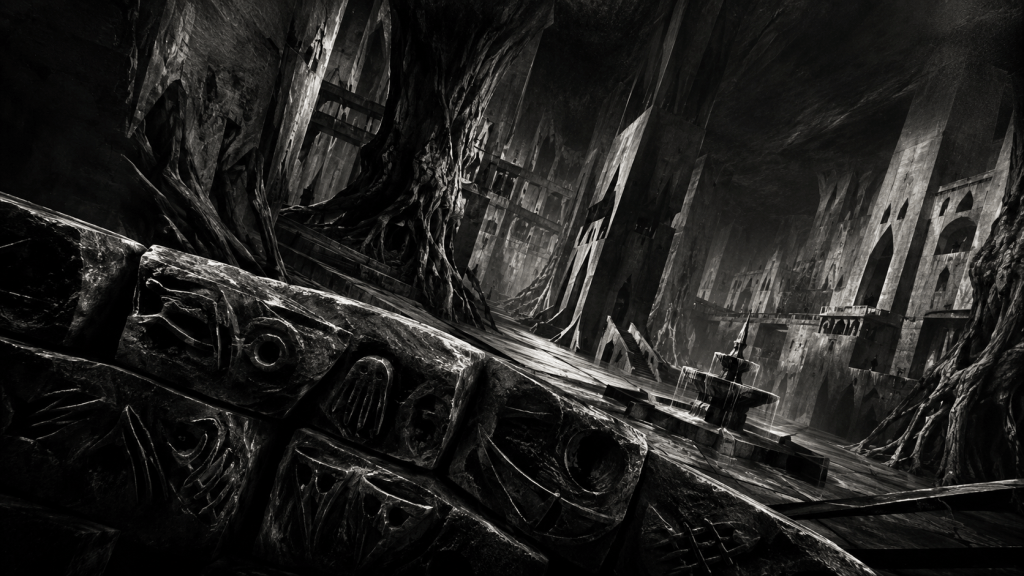
The principal avenue runs downward, not straight, but in a measured bend, as if the builders disliked lines and had corrected the mountain for being too plain. On either side stand low chambers, galleries, courts, and open squares roofed by the mountain itself. In one place there is a fountain without a drop in it, yet all who passed near declared their sleeves grew damp. In another stands a row of pillars, each made from a single piece and twisted as a cedar root twists in a blow-down. No chisel marks show, but the stone has the appearance of having been persuaded while soft, then insulted into hardness.
The old guides say this city is Lickwari work.
Of the Lickwari little has been publicly known, except that they are uncommon snappish artists of the Lower Chateaugay dark, coming up seldom for air and still less for conversation. Their paintings have been found under skiffs rented to summer people, likely because vacationers are the only class with leisure to turn a boat over, read what is written there, and carry nonsense into respectable towns. Their colors are said to be moonshine, eel-silver, bottle glass, fish-head bone, and a black mud fine as printer’s ink. Their chief amusement, according to Ransom Coots, is criticizing sunsets.
“Never knowed one to praise a July evening,” says Ransom. “‘Too orange,’ s’ze. ‘Cloud-work common,’ s’ze. ‘Reflections derivative.’ That is—not them words, likely, for they talk mostly in bubbles and ill-nature, but the idee was plain.”
We have the testimony of three persons, not counting one who now denies it, that Nat Collins went down into this place years ago and kept still afterward, which is the strongest proof in the case. Nat was never known to keep still over bear, trout, weather, politics, or poor money. If he said nothing of W Mountain, then W Mountain showed him something that shut the door of speech.
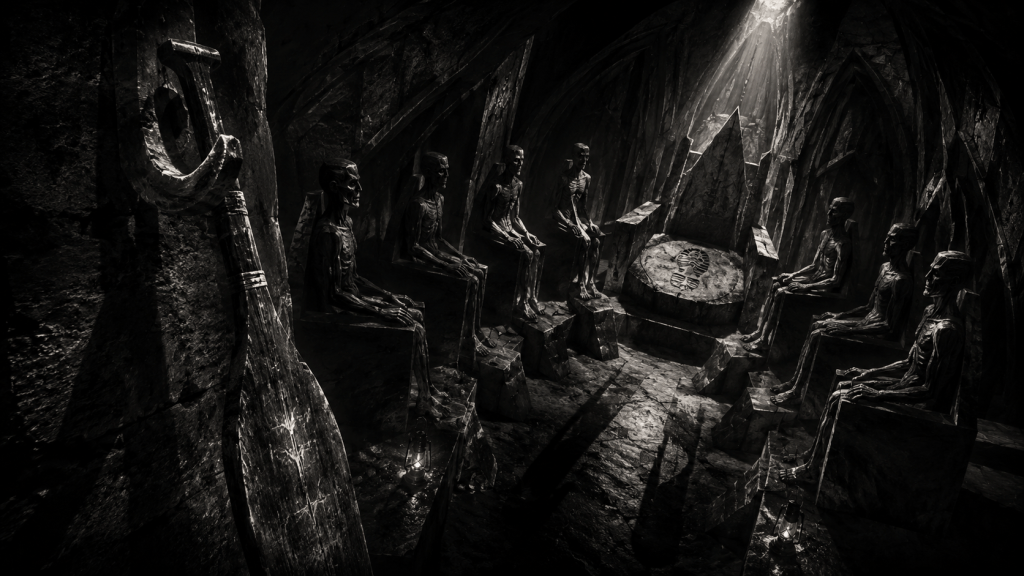
One mark of Nat’s visit remains. In a chamber called by the witnesses the Oar-Menders’ Court, there hangs from a hook of white stone a guideboat oar, old, patched, and worn at the grip. The initials N. C. are cut in it, not by knife, but by some burning blue pressure, as though a star had written them. Around the oar sit seven figures carved in black stone, each with long knees, narrow ribs, and hands laid upon invisible paddles. Their faces turn toward an empty eighth seat. On that seat rests a cake of dried lake mud, and in it the print of a human boot: square-toed, practical, and much repaired.
Near by are painted scenes no man can comfortably explain. One shows Nat Collins seated between two Lickwari under a vaulted roof, his hat on his knee, while they hold before him a flat pane of smoky crystal. Upon it appears Chateaugay Lake from beneath, skiffs floating overhead like dead leaves, with the names of certain boat owners lettered on their keels in crooked script. Another shows Nat eating trout beside three Lickwari, who appear to be correcting his arrangement of bones. A third shows him standing with his hand raised, while behind him an entire underground temple leans forward, as if listening.
The temple itself is the wonder of the city. It stands beyond the Broken Market, where stone stalls remain, each fitted with basins, troughs, and little shelves. Some say colors were sold there. Some say memories. Ransom Coots says a Lickwari would trade a man three shades of twilight for a brass button, then complain of the button’s composition. Past this market the floor drops by forty-seven steps into a nave so broad that a gun fired inside answers itself five times and seems ashamed by the last report.
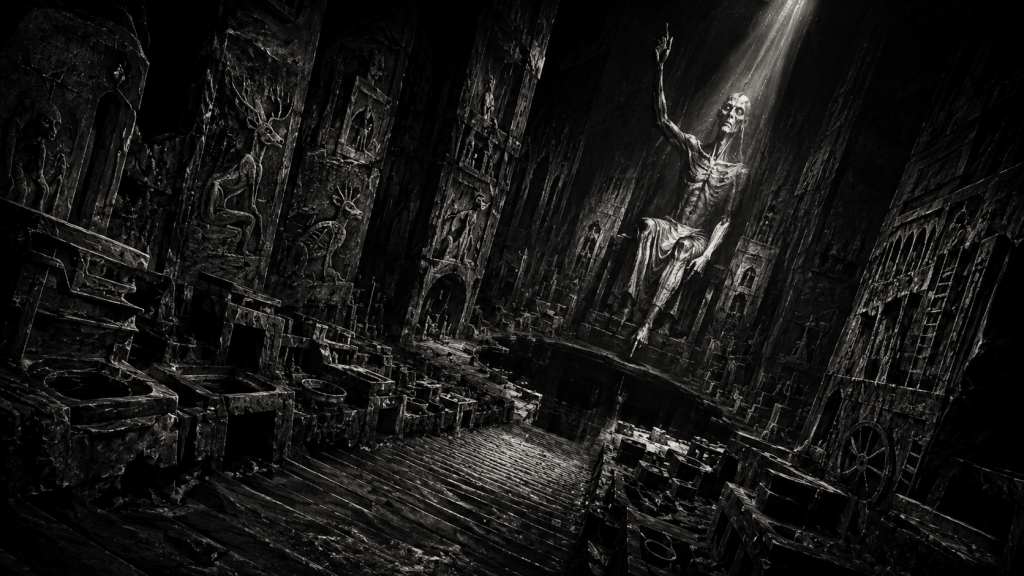
The roof is lost in blackness, but from it hang pendants like frozen thunder. The walls are carved from floor to height. There are processions of long-headed folk carrying palettes shaped like lily pads. There are deer with human eyes, trout with crowns, ducks arranged as judges, and blue jays stealing fire from a cracked moon. There are wheels with no hubs, ladders that climb into solid stone, and towers bending over lakes that run upside down. At the far end stands a statue of what must have been a Lickwari master: twelve feet high, seated, thin as a famine, with one hand lifted toward the mountain roof and the other pointing down to a black pool. Its mouth is carved partly open, not in speech, but in dissatisfaction.
On the pedestal, in strokes resembling frost on glass, appears an inscription. Parson Meacham would not translate it, saying first that he could not, and second that he would rather not if he could. Ransom gave the sense thus: “Creation tolerable. Execution hurried. Silence poorly distributed.”
There are lesser buildings without number. The Hall of Little Bones is paved with fish vertebræ set in silver clay, each bone no bigger than a shirt button, yet arranged in maps of waters not laid down by survey. The Gallery of Unfinished Dawns contains panels of translucent stone, behind which glows a faint rose light that never strengthens. In one court stand ninety-nine empty pedestals and one statue face-down, as if rejected by vote. In another, a flight of stairs climbs to a blank wall and continues painted upon it, smaller and smaller, until the eye aches and the mind starts after.
Under the north quarter lies the Labyrinth of Keels. Here the ceiling is low, and every stone overhead bears the reversed bottom-shape of a boat. Some are known craft: Sile Parks’s red skiff, the Banner House cedar boat, old Hiram Bell’s patched punt, and a narrow gray rental boat that has frightened more Boston people than any craft of its tonnage. On each is writing. It is no alphabet of ours, yet certain witnesses claim to understand portions when sleepy. The commonest message, agreed upon by several, appears to mean: “Your lake manners are observed.”
Mrs. Adelia Sprague says her cousin’s hired man once saw a Lickwari at daybreak, sitting under a skiff and painting with a fish-rib. It had eyes like wet coal and the expression of a school trustee examining bad penmanship. When the man coughed, the creature dipped its brush in the lake, wrote three swift marks, and slid backward into water too shallow to hide a frog. The hired man has since refused to sleep near oars.
Old Lemuel Pike contributes the wholesome advice that no person should whistle in a cave under W Mountain, because “what answers ain’t always the echo, and what is the echo ain’t improved by company.” Aunt Rosina Duley says never scrape Lickwari writing off a boat bottom with a table knife, as the knife will thereafter cut only shadows. Amos Witherell says one should carry salt, a hymn book, and a piece of chalk; but Amos carries those to town meeting also, so the rule may not be special.
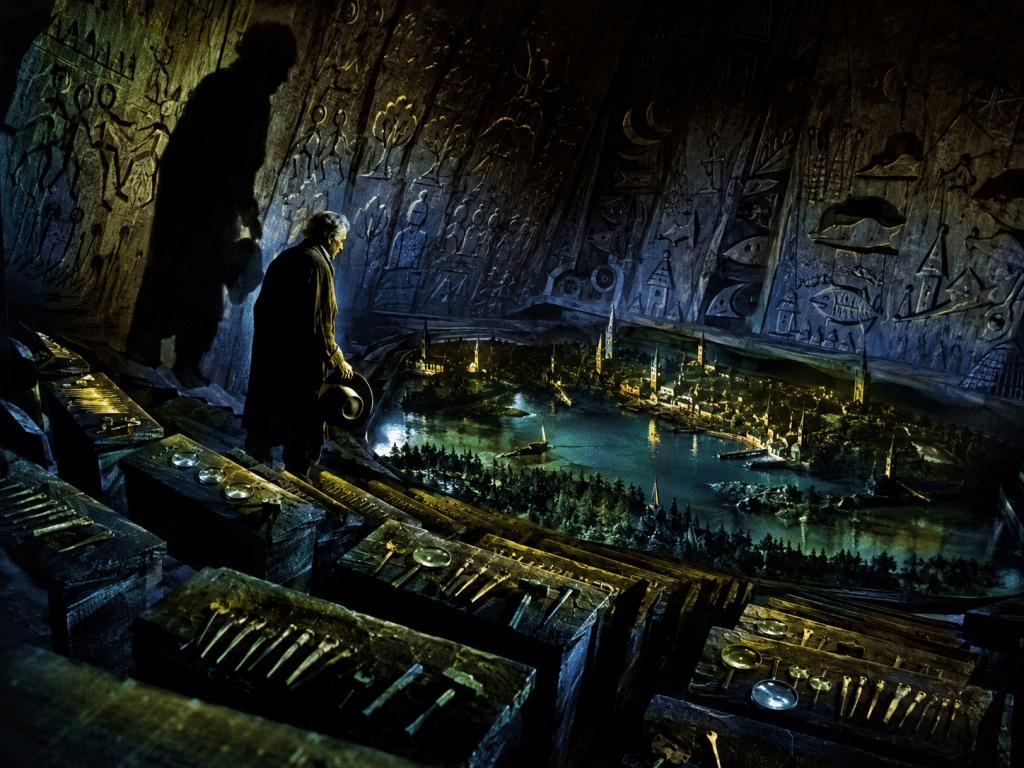
Most alarming is the chamber beneath the main temple, reached through a door so low that all pride must crawl. There, according to Nat Collins’s unspoken record and Ransom’s later peeking, the Lickwari keep their old academy. Rows of stone desks descend toward a pit of dim water. On the desks lie tools: needles of bone, little hammers of green metal, brushes made of mink whiskers, and round lenses cut from what looks like frozen air. Along the walls are children’s exercises, if children they had: first a crooked moon, then a corrected moon, then the same moon crossed out savagely, then a note which Ransom renders, “Too sentimental.”
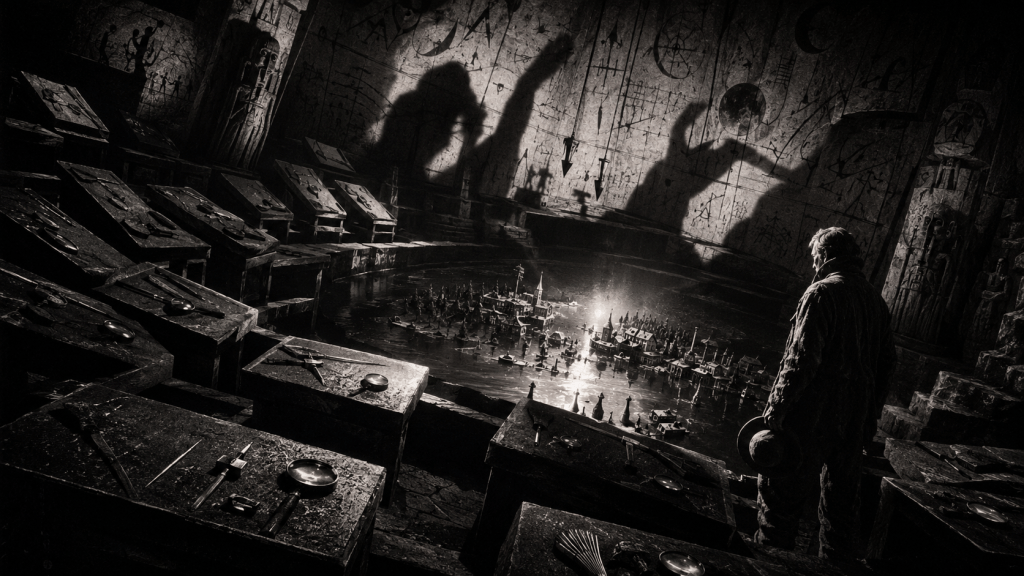
In the pit below that school floats a city in miniature. It is not carved, but alive with faint motion. Towers rise and sink. Bridges unfold. Streets fill with dots like citizens, then empty again. The model appears to show East Bellmont, Chateaugay Lake, the Shatagee Woods, and places not yet built, all being revised by invisible hands. One steeple moved three times while witnesses watched. A mill was erased. A road near Crompville was lengthened into a swamp. At this, one old guide swore softly and said he had always suspected as much.
Here, it is believed, Nat Collins met them.
The account is pieced from markings, guide talk, and one remark Nat made in his sleep at the Banner House, when he said, “No, gentlemen, I will not have the sunset altered.” It appears the Lickwari received him civilly but critically. They showed him their temples, their stone presses, their underground docks, and a black canal running northward under the mountain, on which floated narrow boats without oars. They asked him, by signs and scratched light, what men above most valued. Nat, being honest and tired, answered, “Dry socks, fair weather, good trout, and money that ain’t promised twice.”
This answer is said to have pleased them more than expected. They led him to the Chamber of Fresh Air, which contains none, and there displayed their ancient race-history. It was painted in a ring around a dome. The Lickwari, it seems, came from no star, as excitable persons allege, but from the first dark pocket under the first lake, before shores had learned to keep still. They were not miners, not ghosts, not Indians, not fairies, and not fish, though related disagreeably to all dampness. They built downward because the surface offended their sense of proportion. They worshipped no idol exactly, but maintained reverence for a Perfect Line that nobody had yet drawn; therefore all creation remained under criticism.
Their oldest kings were artists, their judges were art critics, and their criminals were condemned to praise sunsets in public.
At last they brought Nat before the central pool, black as stove polish and smooth as shut eyes. One Lickwari lifted a long finger and drew in the air a picture of a far city of smoke, bells, sorrow, and music played too many times. Ransom says it was London, though how London got under W Mountain is a question for men with more education and less caution. Across the picture moved words sharp as frost: “Premature monarchy. Weak composition. Poor use of silence.”
Nat said nothing, which shows his prudence. A lesser man might have argued monarchy with beings who had carved a city out of mountain-root and still disliked the workmanship.
When he returned, if he returned as we understand returning, his coat was powdered with green dust, his oar bore the blue initials, and the soles of his boots were stained with ink that no lye would lift. For three days he refused fish. For six weeks he would not look at a sunset except by reflection in a tin cup. Thereafter, whenever summer visitors praised the lake, Nat would only say, “It’ll pass, if they don’t hear ye.”
There remains the question of whether the Lickwari city is inhabited still. Testimony inclines fearfully toward yes. Lights have been seen under W Mountain on clear nights when no lantern could be there. Skiffs drawn up dry have been found wet underneath with characters newly painted. A rented boat last August bore, in a neat hand, a picture of its occupant falling overboard two hours before he did so. The man survived and called it coincidence, which is a useful word for those who have no other shelter.
I have not entered the city myself, owing to press duties, uncertain footing, and a proper respect for races that write criticism on boats. Yet I have seen a chip of the black stone, a brush no larger than a pine needle, and a scrap of rubbed tracing taken from the Hall of Little Bones. I have also seen Ransom Coots grow pale when a blue jay cried over his shoulder, and Ransom is not pale for ordinary lies.
The public is advised not to disturb the cleft under W Mountain, not to rent skiffs without inspection, not to praise sunsets too loudly near Lower Chateaugay, and not to assume that all old guides have told all they know. The world is wider underneath than above, and some neighbors, though ancient, damp, and severe in taste, may have been watching our brush-work for a long while. If they find our composition poor, we can only hope they remember that our roads are bad, our money scarce, and our intentions, in the main, kindly.
BELZORAM
#LickwariLore
#AdirondackGothic
#ChateaugayLakeMythos
#ShatageeWoodsFolklore
#WMountainMystery
#NorthCountryWeirdTales
#UndergroundLakeCity
#StrangePeriodNews
#CosmicRuralMystery
#UncannyGuideboatLore
Don’t Praise the Sunset
Verse 1
We don’t trouble public minds till the tale’s been shook,
Warmed by the stove and crossed in the book,
Three men denied it, one old man swore,
“That mountain’s got a city underneath its floor.”
Down by the hemlock where the roots bite stone,
Fox-hole, cellar-way, throat of bone,
Sixty rods stoopin’ where the cold winds crawl,
Then—massy alive—there’s a city in the wall.
Pre-Chorus
Black-green letters on the bottoms of boats,
Boots full of sand and midnight throats,
Moonshine paint and a fish-rib pen—
What’s been watchin’ us, gentlemen?
Chorus
Don’t praise the sunset too loud by the lake,
The Lickwari listen and they note each mistake.
They’ll write on your skiff where the dark weeds bend:
“Your lake manners are observed, my friend.”
Oh, row light, talk low, keep your oar in line—
They’re criticizin’ creation from a mine.
Verse 2
Their streets run downward in a crooked refrain,
Steps too tall for a farmer’s cane,
Walls fit tighter than a tax-man’s grin,
No jackknife blade can whisper in.
There’s a dry old fountain makes your sleeves turn wet,
A temple with a mouth that ain’t finished yet,
Ducks posed solemn like county judges,
Blue jays stealing fire while the mountain grudges.
Pre-Chorus
Ransom Coots said, “They don’t much care
For July gold in the evening air—
‘Too orange,’ says they, ‘and the cloud-work’s thin,’
Then they bubble back down where the black pools grin.”
Chorus
Don’t praise the sunset too loud by the lake,
The Lickwari listen and they note each mistake.
They’ll write on your skiff where the dark weeds bend:
“Your lake manners are observed, my friend.”
Oh, row light, talk low, keep your hat in hand—
There’s an art school hid under Clinton County sand.
Bridge
Nat Collins went down and came back still,
That’s proof enough from here to Merrill’s mill.
Blue-star initials burned into his oar,
Wouldn’t eat trout for three days more.
He saw East Bellmont in a little black pool,
Roads stretched wrong by an underground school.
One steeple shifted, one mill erased—
“Creation tolerable. Poorly placed.”
Final Chorus
Don’t praise the sunset too loud by the lake,
The Lickwari listen and they note each mistake.
They’ll sketch your tumble two hours ahead,
Then slide through water too shallow for a thread.
Oh, row light, talk low, let the dark stones be—
There’s more underneath than a man should see.
Outro
So inspect your skiff and don’t whistle in caves,
Mind the damp old artists in the underground waves.
If they find our composition poor,
Say, “Roads are bad—but our hearts are sure.”

What mysteries of Chateaugay Lake haunt you?