
Reader advisory: Contains prolonged iron clanging, rural secrecy, contradictory witnesses, suspicious strangers in dark coats, and one enormous frying pan whose dimensions remain sufficiently unsettled to disturb any reader expecting mathematics to behave itself properly.
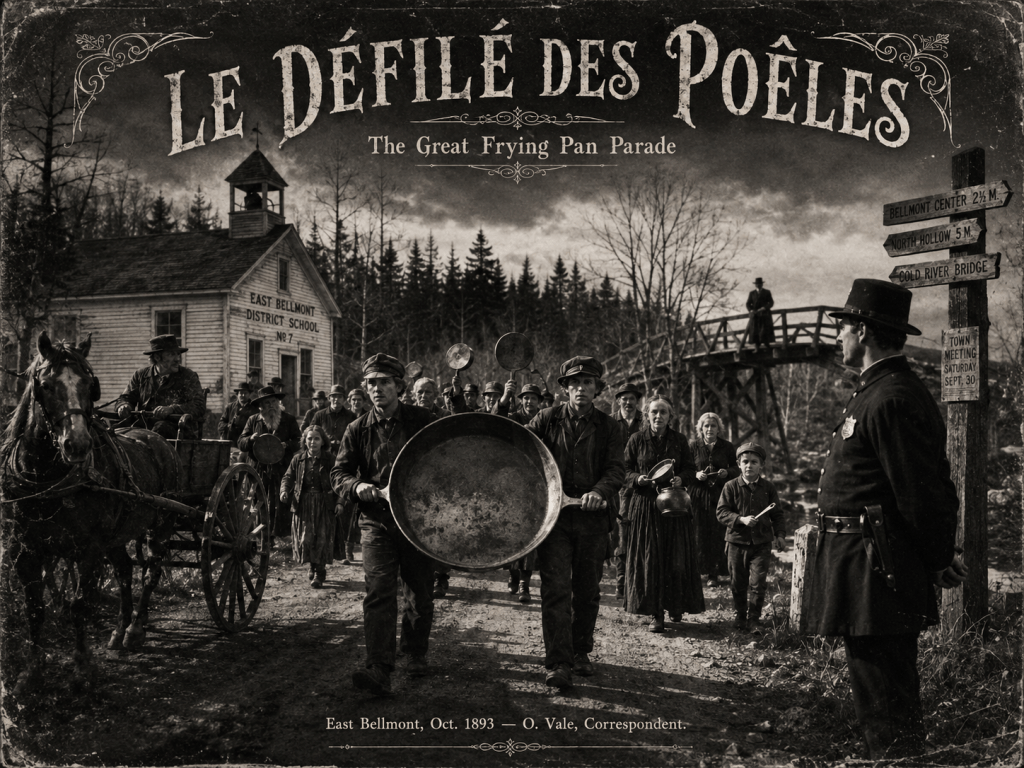
An August Observance near East Bellmont—Much Iron, Considerable Noise, and Certain Questions Yet Unanswered.
EAST BELLMONT, Oct. 1893.—There are customs which obtain their importance from antiquity, others from usefulness, and still others from the circumstance that nobody living appears willing to be the first person to discontinue them. To the latter class may fairly be assigned the annual procession locally known as Le Défilé des Poêles, or, in the English rendering generally employed by strangers, The Great Frying Pan Parade.
The demonstration was held this year on Saturday, August 19, beginning shortly after four o’clock in the afternoon, when a body of residents assembled near Mr. Young’s hotel establishment bearing frying pans, spiders, griddles, kettles and other implements of cast iron capable of producing a resonant sound when struck.
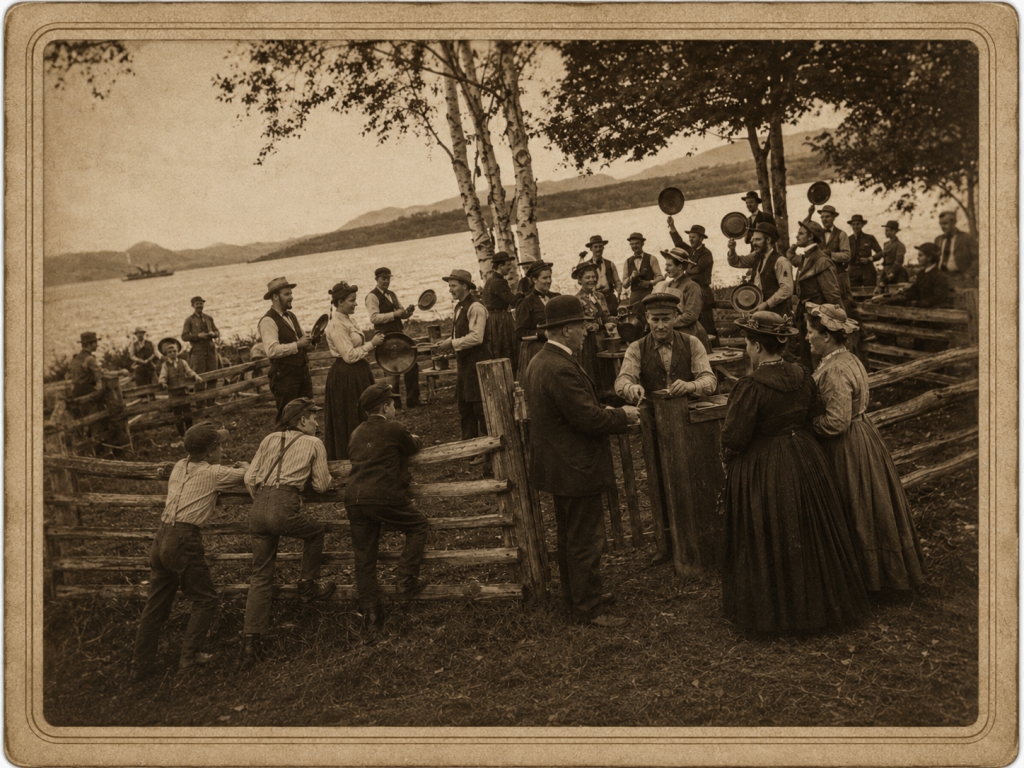
Admission to the enclosed portion of the grounds was ten cents for adults and five cents for children, the receipts being represented by Mr. Alphonse Trudeau, one of the committee, as intended principally for repairing the plank walk near the schoolhouse and meeting the expense of lantern oil. Mr. Trudeau produced a memorandum showing receipts of $18.65. Whether every person participating paid admission could not be learned, as the procession itself extended beyond the enclosure and several families joined from adjoining roads.
The origin of the custom is uncertain.
Mrs. Delia Pomeroy, aged seventy-one, states that she witnessed substantially the same proceeding before the War, though on a smaller scale, and that her father called it “the pan racket.” Mr. Joseph Beaudin remembers being told that the purpose was to discourage certain mischievous rampaging bears from approaching berry grounds during August. Mr. Eben Shutts says his grandfather understood the noise to be directed against “whatever was wandering where it had no business to wander,” but could give no more definite account.
A later explanation, now commonly repeated, is that the ringing of the pans was formerly intended to confuse certain supposed presences in the forest.
No evidence was furnished that any such presence exists, nor did any witness examined by this correspondent profess to have seen one.
There is also a more practical explanation.
Several residents stated that the parade acquired renewed popularity during disputes concerning timber, assessments and the inspection of private roads, it being believed that conversations conducted during the general clangor could not readily be overheard. Mr. François Laroche put the matter plainly. “A man might tell his neighbor the condition of his south fence,” he said, “and nobody twenty feet away would be the wiser.”

The statement was tested imperfectly. At approximately twenty-five feet, ordinary conversation became difficult to distinguish while eleven pans were being struck nearby. At forty feet it could not reliably be followed.
There were, however, considerably more than eleven pans in the procession.
Here the figures become troublesome.
Mr. Trudeau’s committee book records ninety-seven iron implements. Miss Clara Bellows, a skilled trombonist, for several years well-acquainted with our community, now leading Popeville’s Steamboat Cornet Band, who asserts that she personally witnessed the clangorous procession from the vantage of the hotel steps, gives one hundred and six. Mr. Charles Merrill insists upon one hundred and eleven, although he admits counting one large pan twice because it was carried around a wagon and appeared again on the opposite side.
The disputed measurement concerns the largest implement exhibited.
A broad iron frying pan carried by brothers Louis and Peter Charbonneau was advertised as measuring thirty-seven inches across the mouth. Mr. Amos Fields, who applied a carpenter’s rule after the procession, obtained thirty-four and three-quarter inches. Mr. Charbonneau objected that the measurement should include the flare of the rim and afterwards produced thirty-six and one-half inches by another method.
No agreement was reached.
The parade proceeded eastward to Shuttsville at a deliberate pace, turned around near the schoolhouse and returned by Tobacco Road. Participants struck their utensils with iron spoons, stove lifters, small hammers and, in two cases, lengths of hardwood. The resulting sound was heard at several farms outside the immediate settlement.
Mrs. Pomeroy described it as louder than in former years.
Mr. Beaudin thought otherwise.
A horse belonging to Mr. Silas Trombley became restless and was removed before the procession returned. No injury was reported either to persons or property. Two pan handles loosened, one wooden striking implement broke, and a boy temporarily lost his cap.
Constable Calvin Collins, who observed the gathering from the roadside by the Merrill Post Office, stated that he saw no violation requiring interference.
“So long as they keep the road passable and do not frighten teams deliberately,” the constable said, “I have no business stopping a man from striking his own frying pan.”
He nevertheless expressed the opinion that the procession should hereafter be announced in advance at both approaches to the settlement, so that persons driving nervous horses might take another road or delay their passage.
This recommendation appears reasonable and has reportedly been referred to the committee.
The suggestion that the parade was designed specifically to prevent Government officers from obtaining information is more frequently asserted than demonstrated. No Federal officer was identified as having attempted to overhear the procession this year. A stranger in a dark coat, noticed near the bridge, was variously described as a revenue man, insurance representative and traveling salesman. He departed before his identity was established.
It is worth observing that the people of Chateaugay Lake themselves do not entirely agree upon the meaning of the exercise.
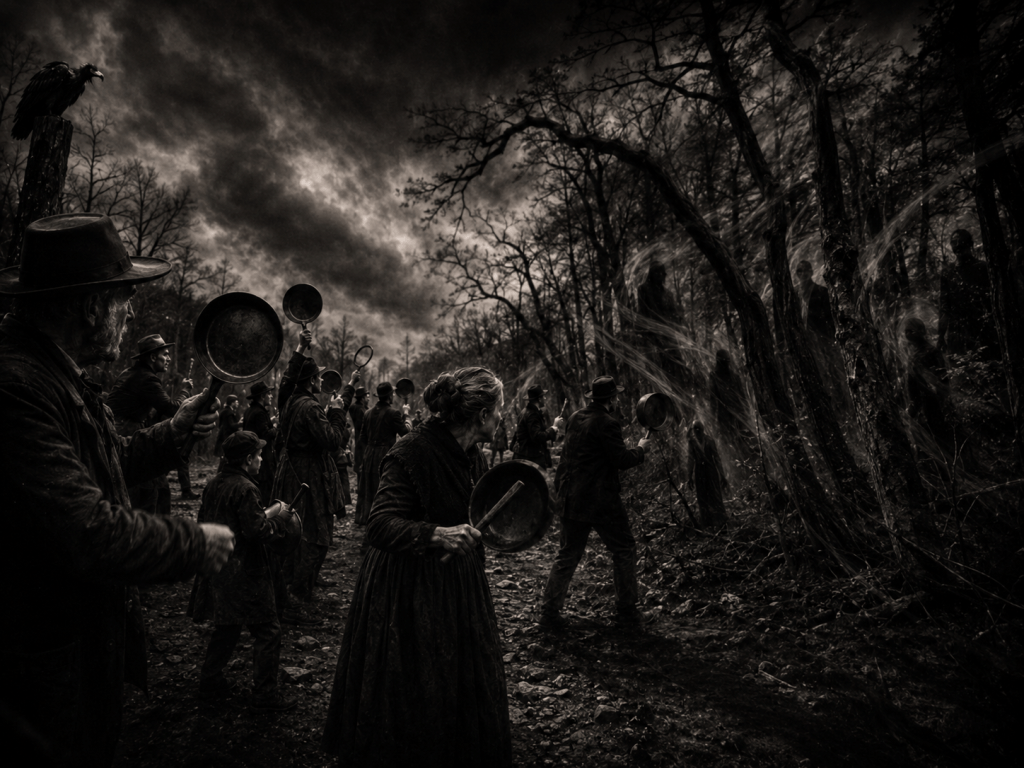
To some it is an inherited French-country observance; to others a neighborhood festival; to others a convenient occasion for public noise under respectable management. A few repeat the older account concerning spirits of the timber, although generally without claiming personal knowledge of them. Still others plainly value the custom because it permits an hour in which private remarks cease to carry farther than their owners intend.
The committee would improve the standing of the affair by keeping an exact register of participants, publishing its receipts and expenditures, measuring exhibited articles before advertising them, and giving due notice to travelers upon the highway. An old custom suffers nothing by being accurately accounted for.
A community may keep its traditions; it should also keep their books straight.
O. VALE, CORRESPONDENT

#AdirondackGothic
#NorthCountryFolklore
#StrangePeriodNews
#RuralSatire
#HistoricalMystery
#LakeCountryTraditions
#UncannyWilderness
#FolkloricProcession
#SmallTownOddities
#ChateaugayLakeLore

What mysteries of Chateaugay Lake haunt you?