
Advisory for the easily unsettled: prisoners are discussed in bookkeeping terms, hanging becomes a budget item, local government loses track of a man, and political debate proceeds with unusual courtesy beneath a barber’s razor.
EAST BELLMONT.—We ought first to distinguish economy from cheapness, since the two are commonly spoken of as though they were brothers, whereas in public affairs they are sometimes scarcely on bowing terms.
By economy we do not mean paying the least possible sum. We mean obtaining what is necessary without paying for what is useless, and receiving what has been paid for after the account has been entered. Cheapness is another matter. A thing may be exceedingly cheap and still become expensive if nobody knows what has been bought, where it is, or whether it exists.
This distinction has lately occupied Fort Covington.
The barber is partly responsible.
There has been an unusual amount of political agreement in his shop, and agreement, being generally counted among the blessings of republican government, might at first appear encouraging. Yet remember that agreement has more than one cause. A man may agree because he has been persuaded, because he has reflected, because he has changed his mind, or because another man is holding a razor immediately beneath his left ear.
Half the village agrees with the barber from conviction.
The other half agrees from necessity.
A wise man learns to distinguish the two.
The barber’s principal subject is public economy, upon which he possesses settled opinions and an unusually effective means of discouraging interruption.
The matter began with Sheriff Folsom, who remarked, in what he has since been careful to describe as a light moment, that the county could board a prisoner tolerably well for four dollars a week and hang him comparatively cheap besides.
Consider the difference between a remark and a policy. A remark may be made in three seconds and regretted for three months; a policy requires minutes, committees, stationery and somebody afterward willing to deny having proposed it.
Sheriff Folsom intended the first.
Unfortunately, the town board heard the second.
The board had already before it the celebrated Costafrolaz account, from which it appeared that an executioner had received five dollars for performing his duty and afterward been fined seven dollars in connection with the same general transaction.
This introduced arithmetic into public business.

One member subtracted five from seven.
The answer was two.
He did it again.
The answer remained two.
It was therefore established, so far as arithmetic is permitted to establish anything in government, that a man might under certain circumstances lose two dollars by executing somebody.
The board did not care for the conclusion.
No committee was appointed to investigate arithmetic, there being some doubt whether arithmetic, if summoned, would attend.
Nevertheless, figures have the disagreeable habit of traveling without official permission. By Thursday the calculation had reached the barber shop, where the barber, stropping his razor, declared that it showed what came of allowing politicians to conduct business.

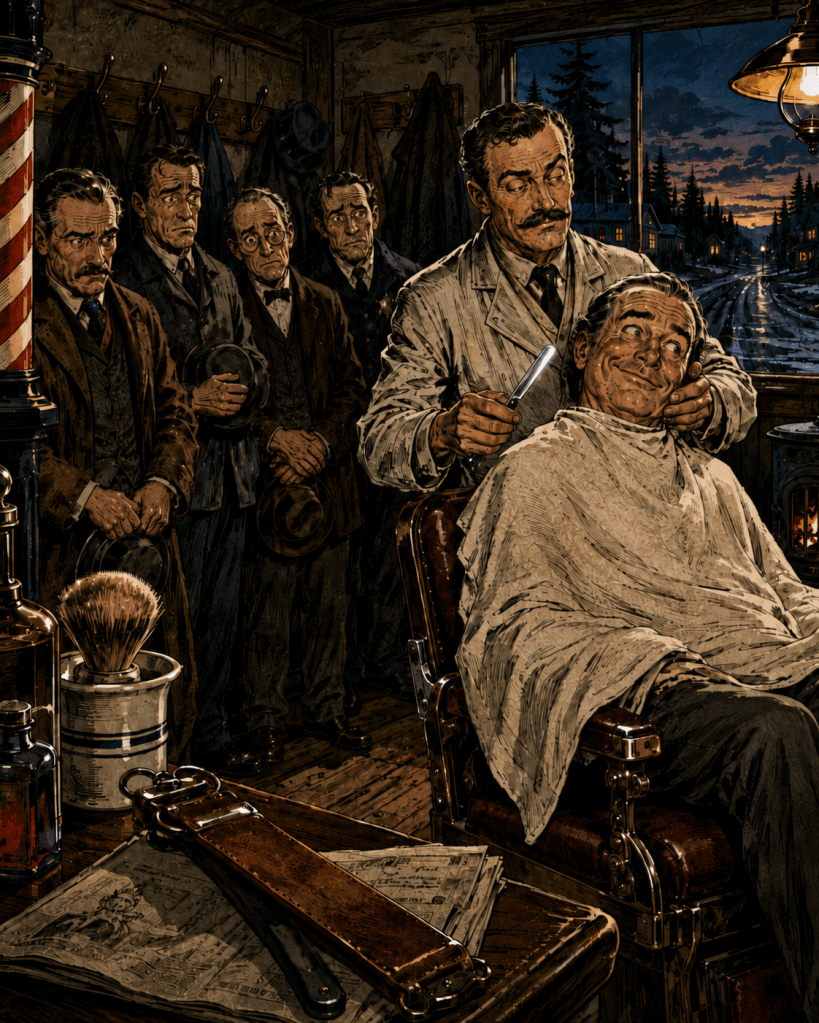
Mr. Hiram Peets was then in the chair.
His chin was elevated.
A towel was around his neck.
The razor was open.
“Exactly,” said Mr. Peets.
This requires mention because Peets is ordinarily a strong administration man.
The barber said no private citizen would conduct affairs in such a fashion.
“Never,” said Peets.
The barber further maintained that public work ought to be opened to honest competition, since competition would reveal what things were actually worth.
Peets declared that he had always maintained precisely that doctrine.
His friends say he had not.
We ought not judge him harshly. Political courage is easiest while standing, independence most comfortable in one’s own coat, and argument safest when no sharpened instrument is describing a thoughtful curve beneath the jaw.
The barber’s theory soon received an opportunity for practice.
On Friday the board received a written proposal from a public-spirited citizen offering to board the county prisoners for nine cents.
There was at first some disposition to regard the paper as frivolous.
The clerk, however, observed that nine cents was unquestionably less than four dollars.
Nobody succeeded in getting around this.
The difficulty lay elsewhere, for a low price is useful only after one knows what the price purchases.
Did the bidder mean nine cents per prisoner?
Per week?
Per meal?
Or did nine cents cover the entire criminal population for whatever period the law might require?
The proposal did not say.
One trustee thought specifications should be demanded concerning beans.
Another held that the town had no authority to introduce beans into a contract whose author had been silent upon them.
Thus the board encountered a familiar principle of government: when a citizen supplies too little information, officials commonly remedy the defect by supplying too much.
The proposal was tabled.
On Saturday another arrived.
The same citizen offered to plow every road for one dollar.
This received careful attention, since there are a good many roads.
The chairman suggested that the bidder perhaps meant one dollar per road.
The clerk read the language aloud:
To plow every road within the jurisdiction, One Dollar.
The words seemed plain.
Considerable satisfaction was expressed over the prospect of economy, together with some uneasiness concerning the horse.
The board requested particulars regarding equipment.
None came.
By this time the barber regarded events as a vindication of principle.
“Competition,” he said, placing his razor against the cheek of a gentleman who had vigorously opposed competitive bidding at the last town meeting, “will bring prices down every time.”
“That’s so,” said the gentleman.
Then, after a moment, and without moving his head:
“Always said so.”
On Monday morning a third proposal was found beneath the office door.
It offered to hang the whole county for nothing.
Here even the strongest friends of economy became cautious.
Nothing is certainly cheaper than something, but it does not follow that everything offered for nothing ought therefore to be accepted. Bread is good because hunger requires it, water because thirst requires it, and sleep because weariness requires it; but a man does not improve his health by eating when he is not hungry, drinking the well dry when he is not thirsty, or sleeping through seedtime because sleep costs nothing.
The same principle may reasonably be extended to hanging.
One trustee wished to accept immediately before the bidder reconsidered.
Another objected that the proposal contained no limitation upon the number of inhabitants and might consequently expose the contractor to hardship.
A third asked whether the county possessed legal authority to let such a contract.
The chairman replied that this was precisely the kind of question lawyers encouraged, and instructed the clerk to examine the bids instead.
The clerk placed the three papers together.

The nine-cent boarding proposal, the one-dollar road proposal, and the offer concerning the county were all in the same handwriting.
This altered the character of the business.
One joke may be idleness.
Two may be persistence.
Three jokes in one handwriting begin to resemble evidence.
The documents were accordingly spread upon the board table and inspected by two trustees, the sheriff, the clerk, a man searching for a lost mitten, and finally the barber, who was summoned because he claimed some acquaintance with handwriting from having watched a great many men sign shaving accounts.
The barber studied the papers.
“That fellow means business,” he said.
The board would have preferred a less definite expert opinion.
Sheriff Folsom was requested to examine his records.
After some searching he found the bidder’s name.
The man was already upon the county books.
More particularly, he was entered as a prisoner then being boarded at the established rate.
There was silence.
Here we must distinguish a prisoner in fact from a prisoner in account.
A prisoner in fact occupies a cell, eats food, requires a lock and may occasionally be looked at.
A prisoner in account requires only ink.
The county had therefore received an offer to board its prisoners for nine cents from a prisoner whom the county was itself paying four dollars a week to board.
The chairman said there was something wrong somewhere.
The clerk agreed, but wished it distinctly understood that the books were correct.
Sheriff Folsom examined the commitment.
Regular.
He examined the boarding account.
Regular.
He examined the weekly total.
Regular also.
Thus every part of the record was right, while the thing described by the record was wrong.
The barber, who remained because public business is easiest to understand when one is not responsible for it, observed that if the prisoner could board himself for nine cents while costing the county four dollars, there appeared to be a handsome margin somewhere.
Sheriff Folsom said:
“Find him first.”
They went to the jail.
The prisoner was not there.
Every man in custody was brought out and counted.
The count agreed with the jailer.
The jailer did not agree with the ledger.
They counted again.
Nothing improved.
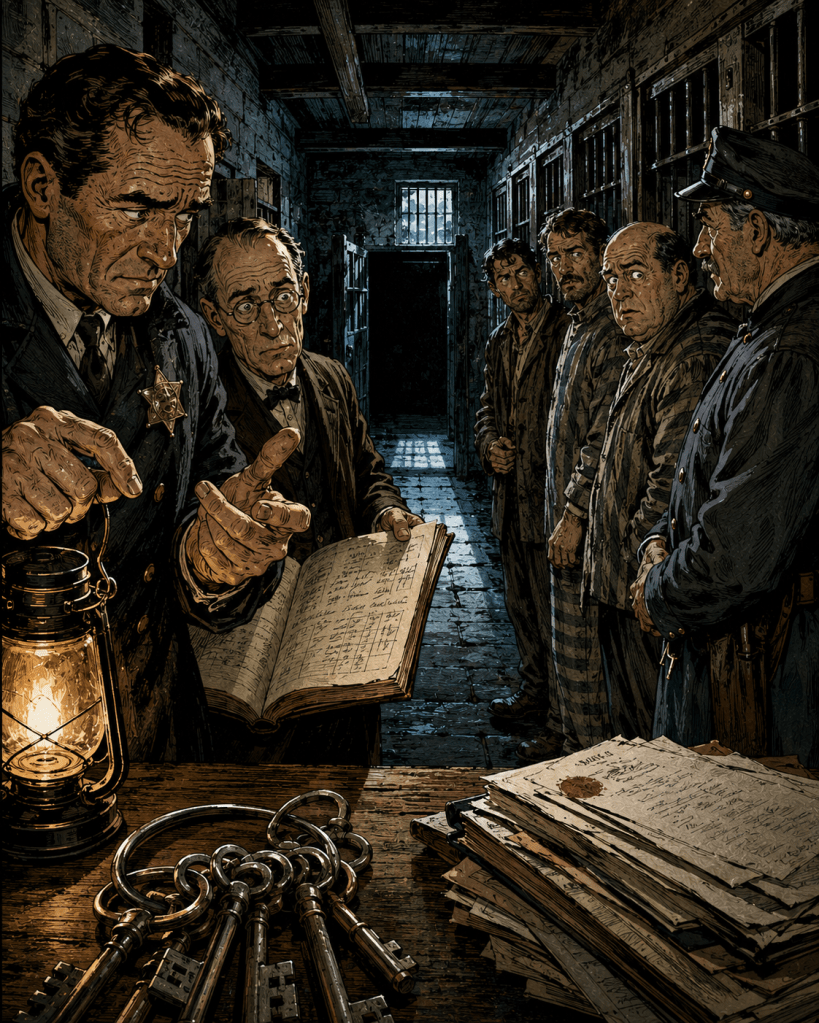
The sheriff inspected the cells, corridor, kitchen and yard. He examined commitments, discharges and transfers.
The commitment contained the bidder.
The jail did not.
No lock had been forced.
No officer remembered releasing him.
No transfer had been ordered.
No discharge appeared upon the books.
No escape had been reported.
Therefore, according to every official record, the missing man was at that moment safely confined, consuming county provisions at four dollars a week while simultaneously offering, from some unspecified position elsewhere, to furnish the same service to himself and every other prisoner for nine cents.
The board returned to its room.
It now possessed excellent paperwork and no prisoner.
This is the reverse of the customary municipal difficulty, in which the object itself is generally present and the proper paper cannot be found.
The chairman proposed suspending action upon the bids until the bidder’s custodial condition could be determined.
The clerk objected that delay might cost the town the one-dollar road contract.
Somebody asked whether a bid submitted by a prisoner who could not be produced was legally binding.
Somebody else asked whether a prisoner capable of submitting proposals from outside the jail ought technically to be considered outside the jail.
Sheriff Folsom said he did not care where the man was technically.
The barber remarked that the whole affair demonstrated the necessity of greater economy in public office.
Sheriff Folsom looked at him.
The barber, exercising the prudence by which philosophy avoids becoming martyrdom, changed the subject.
The three proposals remain on file.
The county continues to be charged four dollars a week for boarding the missing man.
No road has yet been plowed for one dollar.
Nobody has been boarded for nine cents.
And the county, after mature consideration, remains unhanged.
We may therefore distinguish several things which the multitude too readily confuses.
Cheapness is not economy when nobody can define what has been bought.
A correct account is not necessarily a correct state of affairs.
Competition may lower a price without increasing wisdom.
And political agreement is not always harmony, particularly when one party possesses an opinion and the other possesses a throat.
The barber continues to discuss politics.
Business is excellent.
Several prominent citizens who formerly differed with him upon nearly every question of public policy have lately discovered, while seated beneath the towel, that their principles and his are substantially identical.
This gratifying harmony generally lasts until the razor is folded.
Therefore accustom yourself to examining a conviction before necessity examines it for you. Consider what you believe while your coat is buttoned, your chin is free and no man is stropping an argument behind your ear; for an opinion which disappears beneath a barber’s towel may cost very little to maintain, but it is scarcely worth nine cents to board.
Malone Palladium, Thursday, January 2, 1879.
#NorthCountrySatire
#AdirondackPoliticalFolklore
#HistoricalNewspaperHumor
#MunicipalAbsurdity
#DeadpanRuralComedy
#FortCovingtonTales
#BureaucraticMystery
#StrangePeriodNews
#SmallTownPoliticalSatire
#ShatageeWoodsFolklore
THE SILK MERCHANT AT LACOLLE
A Trunk of Ribbons, a Country Road, and the Difference Between a Plain Story and a Proved One

EAST BELLMONT.—There are persons who suppose that murder becomes easier to understand when money is offered as the motive, and that if a dead man carried valuable property while another man accompanied him, the whole difficulty has been disposed of except the hanging.
This is not reasoning.
It is convenience.
Consider the case of Mathew Mathevon, the silk merchant killed near Lacolle last July, and of Cyprien Costafrolaz, otherwise called De Mirabel, who was afterward convicted of the killing and hanged for it.
Mathevon was about fifty years old, originally from Lyons, France, and was doing business out of Montreal. He dealt in silks, ribbons and similar goods, which have the useful commercial property of putting a large amount of value into a very small compass.
That is an advantage while the trunk belongs to you.
It becomes a disadvantage when somebody else wants it.
About three months before the murder Mathevon became acquainted with Costafrolaz, a man forty-one years of age who had been about Rouse’s Point and had conducted a small shop there for a time. Costafrolaz represented that there was business to be had in the Lacolle country and persuaded the merchant to go there with his goods.
Some have wondered why Mathevon went.
They should not.
A merchant must seek customers just as a farmer must seek a market, and there is no more foolishness in following a report of trade than in hauling potatoes ten miles because somebody says the price is better at the other end.
The distinction is that potatoes generally come home if they do not sell.
Men do not always.
On the 22d of July, Mathevon left Montreal carrying a trunk of silk and velvet ribbons valued at somewhere between eight hundred and one thousand dollars.
Costafrolaz accompanied him.
Two days later Mathevon was dead.
Here it is useful to distinguish circumstances from conclusions.
It is a circumstance that the two men traveled together.
It is a circumstance that Mathevon carried valuable goods.
It is a circumstance that Costafrolaz was understood to have been the last man known to be in his company.
These things matter because they direct the mind toward a conclusion, but they are not themselves the same thing as seeing the conclusion happen.
People often forget this distinction because uncertainty is troublesome and a conclusion is easy to carry.
The country about Lacolle is settled country, with roads, farms and houses enough, and some persons therefore imagine that nothing serious can happen there without somebody seeing it.
That is another error.
A man may disappear quicker upon a traveled road than in the woods, for in the woods a missing man is noticed, whereas upon a road every passer-by supposes another passer-by has kept account of him.
Mathevon’s body showed eight distinct wounds about the head, with injuries upon the hands which appeared to indicate that he had attempted to defend himself.
At the examination afterward, a splinter of wood was found in one of the wounds.
Hence the weapon was believed to have been a heavy piece of wood or some other blunt object.
There was enough violence in the case.
Violence was not the doubtful part.
The prosecution supplied the motive readily enough.
Mathevon had silk.
Silk had value.
Value could be turned into money.
Costafrolaz had brought Mathevon into the country.
Therefore, said the prosecution, Costafrolaz had brought him there in order to rob and kill him.
That is a strong arrangement of circumstances, and the jury evidently considered it strong enough.
But remember that a strong arrangement is still an arrangement.
The trial was held at Saint-Jean on October 14 and 15, 1878, and Costafrolaz was convicted and sentenced to be hanged on December 13.
By justice we ought not to mean punishment alone, nor by punishment merely the satisfaction of seeing a condemned man brought to an end. Justice, if it is to quiet the mind instead of exciting it, must mean that punishment follows proof, and that proof is examined carefully because the consequence cannot afterward be recalled.
A man may return borrowed money.
He may restore stolen property.
He cannot be unhanged.
Efforts were made to obtain a commutation of the sentence.
They failed.
When Costafrolaz learned that there would be no commutation, he declared that he had not murdered Mathevon.
He maintained the same thing when brought to the scaffold.
Some suppose that the scaffold compels truth because death is near.
Others suppose that every condemned man lies because life is dear.
Neither proposition will carry much weight.
Fear may produce truth in one man and falsehood in another. Hope may persuade a guilty man to confess, whereas pride may make him deny; innocence may make another man steadfast, while terror may make an innocent man say almost anything.
Therefore a last declaration deserves attention.
It does not deserve worship.
Costafrolaz told the assembled people that they were probably expecting a speech and confession from him.
He said he had no confession to make.
He declared that he was about to suffer the extreme penalty of the law for a crime of which he was entirely innocent.
Then they hanged him.
The hanging settled the sentence.
It did not settle the conversation.
Some along the border believed Costafrolaz had planned the affair from the beginning and used the promise of Lacolle customers merely to draw Mathevon and his trunk away from Montreal.
Others believed another person must have been concerned.
A few were prepared to believe almost any account except the one accepted by the court.
This habit is not peculiar to Lacolle.
Give the multitude three facts and one uncertainty, and by supper time it will generally have four certainties.
Here in East Bellmont we possess no evidence superior to that heard at Saint-Jean, and therefore it would be foolish to pretend that we can decide more wisely at a stove, a counter or a supper table than the jury did upon the testimony before it.
But it is useful to consider why the case continues to trouble people.
It is not merely because a man was murdered.
Men have been murdered before.
It is not merely because another man was hanged.
Men have been hanged before.
The mind catches upon the trunk of silk.
There is something unsuitable about it.
Eight hundred or a thousand dollars’ worth of fine ribbons belongs, according to ordinary expectation, in shop windows, wedding clothes, bonnet trimmings and parcels carried home beneath a woman’s arm.
It does not seem to belong beside a beaten man upon a country road.
But the world is under no obligation to arrange its events according to the appearance of its merchandise.
Silk may lead to blood just as money may lead to hunger, and abundance may produce want when the possession of one man excites the desire of another.
We should therefore be cautious when we say that a crime is too foolish to have occurred.
I have known a man to travel half a day through bad weather to collect three dollars and spend four before he got home.
Human conduct does not improve merely because the arithmetic is bad.
If crimes were required to be sensible, the courts would have a much shorter calendar.
Mathevon went toward Lacolle expecting customers.
Costafrolaz went there expecting something else, according to the verdict.
One carried silk.
The other carried his own account of what happened.
The silk disappeared into the case, and the account survived as far as the scaffold.
What remained afterward was the part no court can entirely dispose of: the duty of living people not to confuse suspicion with proof, proof with certainty, or certainty with the desire to be finished with uncertainty.
For judgment is not a faculty a man should begin exercising only after blood has been spilled.
Accustom yourself to it beforehand.
It is easy to reason carefully about a dead merchant and a hanged man.
The better practice is to reason carefully while everybody concerned is still alive.
BELZORAM,
East Bellmont Correspondent

What mysteries of Chateaugay Lake haunt you?