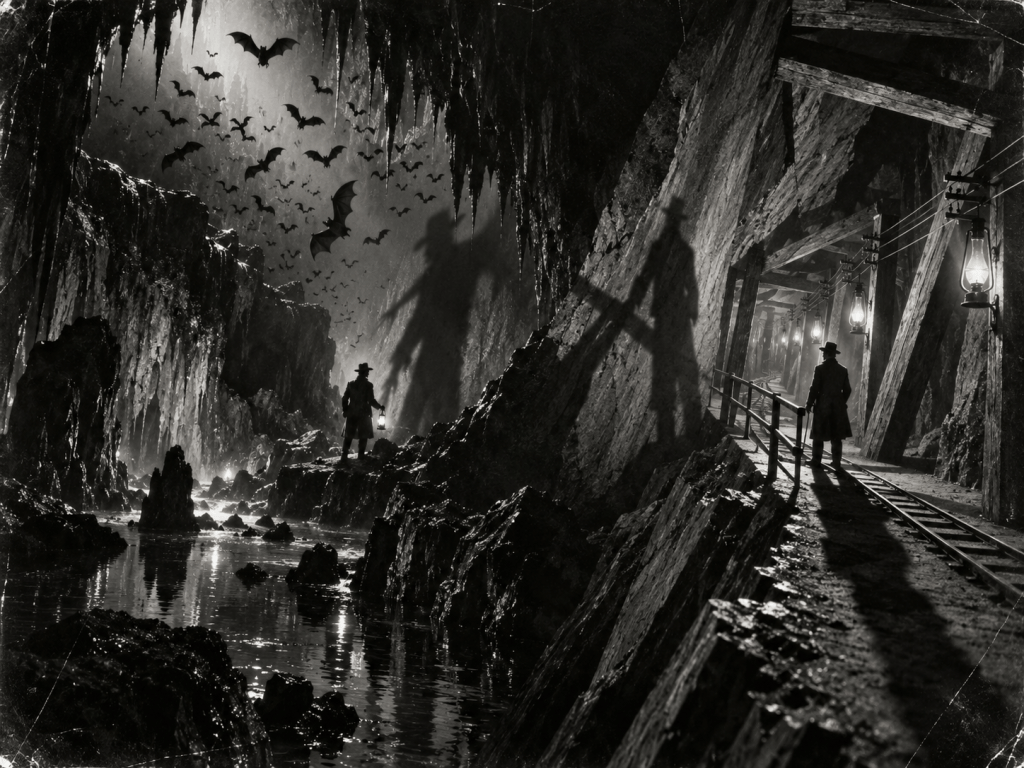
Persons troubled by caves improved for preservation may encounter wet passages, loose stone, displaced bats, scientific wages, artificial telegraphy, and a restoration problem that becomes less manageable the more carefully it is considered.
THE NATURAL WONDER IMPROVEMENT COMPANY
Brainardsville Institute CASE FILE WM–17
Locality: W Mountain, East Bellmont, New York
Principal Period: 1878–1879
Subject: Improvement and scientific examination of a natural cavern
Disposition: Work discontinued; findings disputed; restoration incomplete
Residual Question: Which condition of the cavern was the natural one?
The Natural Wonder Improvement Company survives in local recollection as an unsuccessful attempt by Hiram Bellows to put a handrail into W Mountain.
This is accurate in approximately the same sense that a railroad is an attempt to put two strips of iron across the countryside.
The controversy began after Bellows had observed the improvements then becoming common in mining: steam replacing older hoisting arrangements, timber supporting doubtful ground, pumps directing water, rails moving loads, and men descending with some evidence that their return had been considered beforehand. From this he drew a conclusion which Professor Hale Whitcomb afterward spent several months attempting to defeat.
If practical arrangements improved a hole made by men, Bellows saw no reason they should injure one made by Nature.
Whitcomb replied that a mine and a cavern were not the same thing.
The entire file proceeds from that distinction.
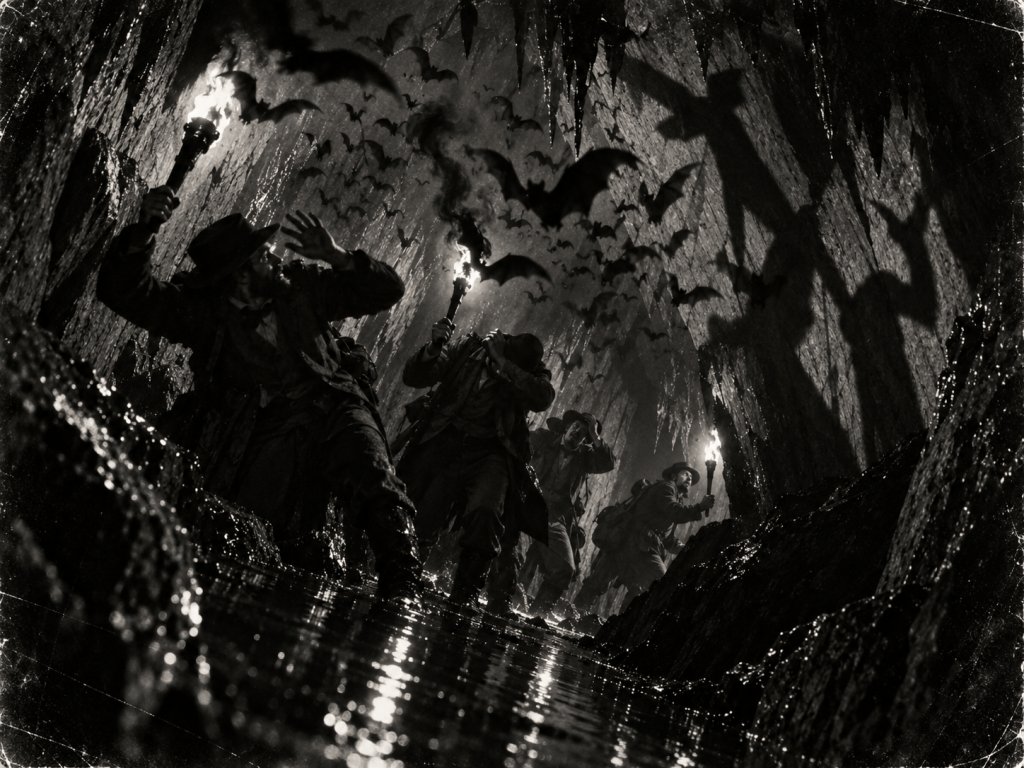
The W Mountain cavern was scientifically interesting partly because it was difficult to examine. Its entrance was cramped, the floor wet, portions of the roof uncertain, and one descent severe enough to require care. More important were the bats. Contemporary accounts agree that parties carrying torches could disturb them in such numbers that the rush of wings repeatedly extinguished the lights.
Bellows regarded this as an obstacle to observation.
Whitcomb regarded it as an observation.
The Company’s first surviving minutes divide the proposed work into three classes:
Necessary Improvements, without which a man could not safely enter;
Scientific Improvements, without which he could not properly observe;
and Public Improvements, without which respectable persons would have no reason to endure either of the other two.
The arrangement lasted one day.
Before Whitcomb could inspect the questionable roof scientifically, somebody had to determine whether it was safe for Whitcomb to stand beneath it. Bellows therefore sent Reuben Maneely, a carpenter, ahead with two laborers.
Whitcomb objected that Maneely would reach unexplored ground before the scientific party.
Bellows replied that this was unavoidable if the scientific party wished the unexplored ground examined for falling stone before arriving beneath it.
The minutes record the following exchange:
WHITCOMB: Maneely is not a scientific observer.
BELLOWS: What is he observing?
WHITCOMB: The roof.
BELLOWS: Then we are making progress.
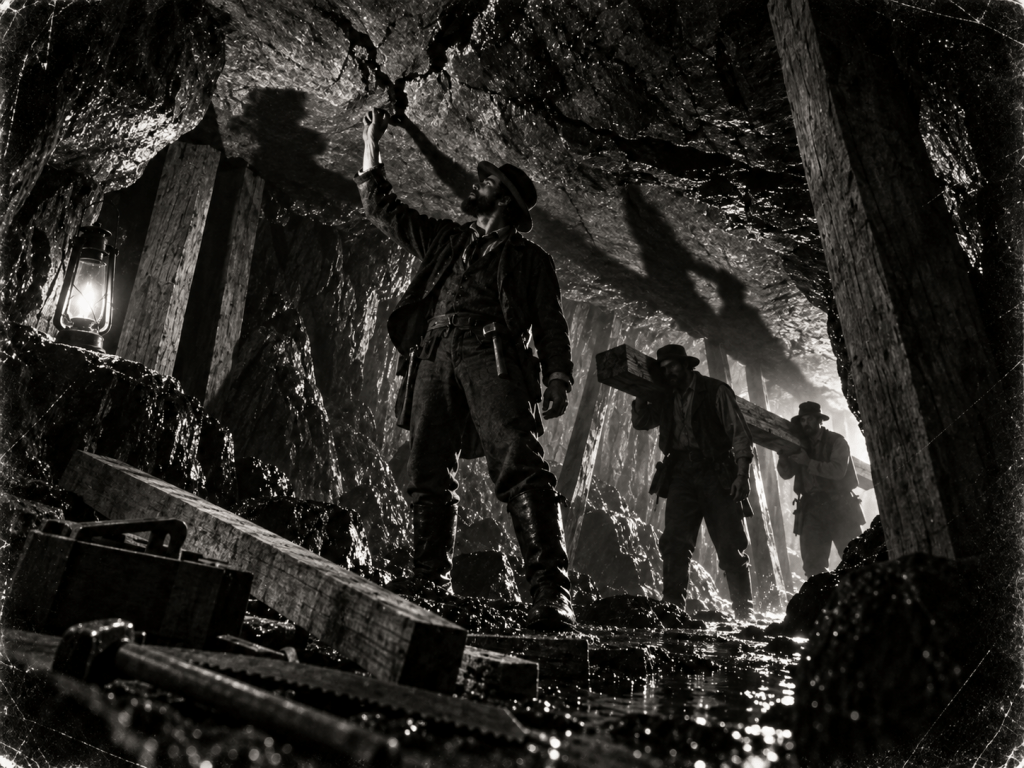
Maneely was subsequently entered in the work schedule as Temporary Structural Observer.
His wages remained those of a carpenter.
That produced a grievance from Caleb Shutts, who carried timber beyond the established safe point and wished to know whether he also belonged to Science while doing so. Bellows ruled that Shutts performed scientific duty while carrying material inward but ordinary labor while returning empty-handed.
Shutts requested scientific wages for half the journey.
The claim was denied.
The principle remained.
Within two weeks the improvement force included a Structural Observer, an Assistant Structural Observer, an Illumination Examiner, two Geological Access Laborers and Ephraim Nokes, whose employment consisted chiefly of laying rail but who appears once in the minutes as a Mechanical Transportation Naturalist.
Professor Whitcomb protested every title.
He used every improvement.
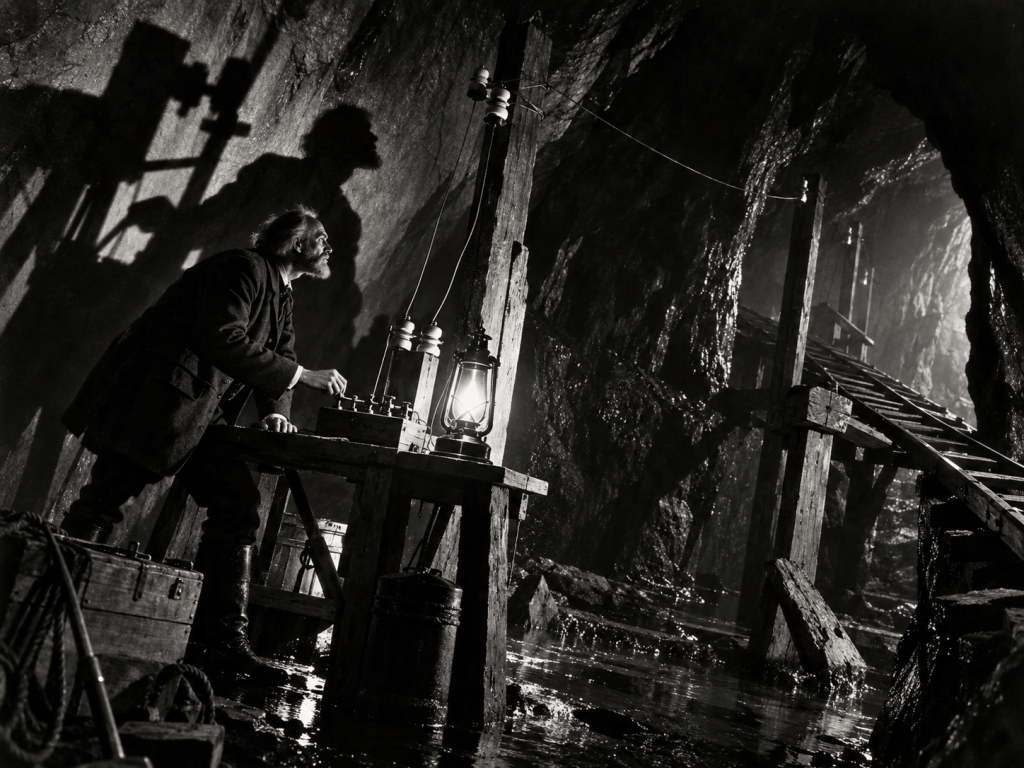
Jonas Drew’s telegraph created the next difficulty. Drew proposed stations between the entrance and lower chambers so that observations might be transmitted without somebody climbing out whenever Science learned anything.
Whitcomb objected that wire, insulators and signal boxes altered the cavern’s natural condition.
Three days later he transmitted from below:
MORE OIL. SEND MANEELY. RAIL UNSAFE BELOW THIRD POST.
Bellows preserved the message.
On the reverse he wrote:
Professor communicating objection to artificial rail by artificial telegraph. Classification requested.
No classification survives.
By December the minutes were referring to the larger problem as the Advancing Boundary.
Every improvement changed its character according to when and by whom it was used.
A first lamp was Scientific because without light nothing could be examined. A second was Public because the first had already made examination possible. If the first smoked, the second became Scientific. If both burned properly, one reverted to Public.
The handrail was Necessary while Whitcomb descended and Public when Bellows did.
The proposed incline car was Public until Whitcomb injured his ankle, after which it became Scientific for six days.
But these arguments concealed the more serious difficulty.
To permit scientists to examine an unaltered passage, workmen had to alter enough of it to get the scientists there.
Maneely inspected the roof before Whitcomb could inspect it.
The lamp crew entered darkness to decide where Science required light.
Nokes reached the lower chamber to lay the rail by which Whitcomb intended to become its first proper observer.
Bellows proposed that workmen’s observations be classified as preliminary.
Whitcomb asked what distinguished a preliminary observation from a scientific one.
“The wages, mostly,” Bellows replied.
By January 1879 the joke had acquired evidence.
Whitcomb’s earliest notes described heavy bat movement near the entrance, strong displacement of air when the colony was disturbed, standing water along the western passage and continuous dripping at two points below the first descent.
After the entrance had been cleared, drainage cut, lamps installed and men traveling regularly through the passage, the bats shifted their roosting places. The western floor dried. Air movement changed.
Nothing inexplicable had happened.
That was precisely the problem.
The cavern could now be examined far more accurately than before.
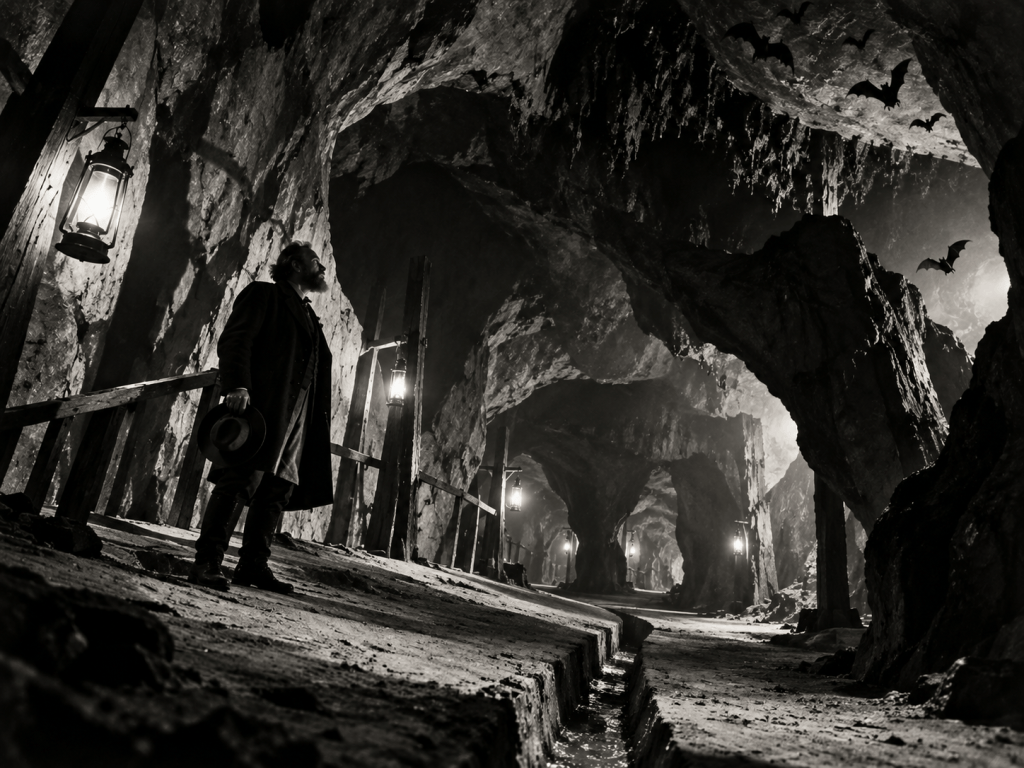
The cavern being examined was no longer quite the one described before the examination began.
Whitcomb accused the Company of destroying evidence.
Bellows replied that the evidence in question appeared to consist largely of darkness, mud, loose rock and bats striking gentlemen in the face.
Whitcomb answered that inconvenience did not make evidence worthless.
Bellows asked whether Science wished the mud replaced.
No procedure was agreed upon.
Work stopped in the spring.
The rail was partly removed. Some lamps came out. Much of Maneely’s timbering remained because nobody would authorize removing a support from a roof already declared unsafe. The drainage cuts proved still less reversible. Water continued to follow them after the Company departed.
Whitcomb returned once more and recorded that the bats had not resumed their former distribution.
This observation is important because nobody possessed an adequate record of that distribution before the first improvement party entered.
The final paper in the file is Bellows’s restoration memorandum.
It lists the work required:
Replace loose stone.
Close drainage cuts.
Remove timber.
Remove rail.
Remove telegraph wire.
Narrow entrance.
Extinguish fixed lamps.
Restore former bat distribution.
Beside the last item Bellows placed a question mark.
Below the list he wrote:
Professor wishes cavern restored to natural condition. Kindly determine date of condition to be restored.
No answer is attached.
The Natural Wonder Improvement Company did not prove that Nature requires improvement, and Professor Whitcomb did not prove that Nature can be examined without alteration.
What the file establishes is narrower and considerably less comfortable.
The first visitors entered W Mountain because they did not know what was there.
The Company entered because it wished to make knowing easier.
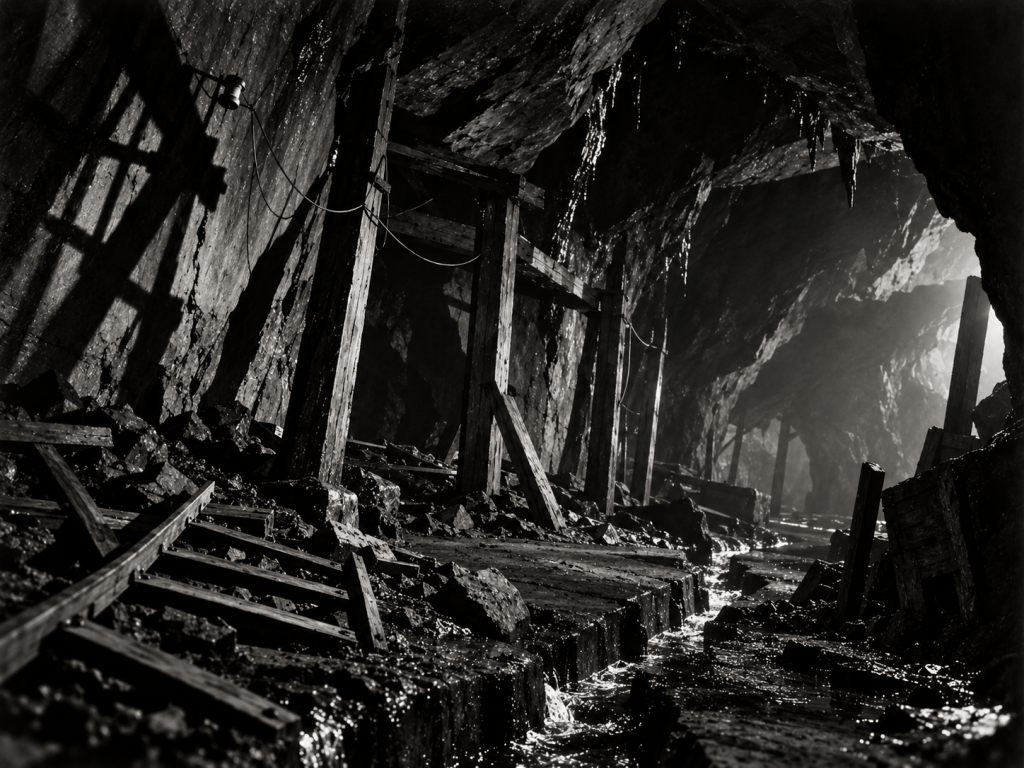
By the time Science could finally see the cavern clearly, nobody could say with certainty which parts of what it saw belonged to W Mountain and which belonged to the arrangements made for seeing it.
The lamps could be taken out.
The rail could be taken out.
The men could come out.
The examination could not.
#ShatageeWoods #WMountain #EastBellmont #AdirondackFiction #HistoricalSatire #CaveExploration #ScienceAndNature #IndustrialAge #ArchivalDossier #NaturalWonder

What mysteries of Chateaugay Lake haunt you?