No generalized nineteenth century is manufactured here; invention must show its ancestors in the record, survive questions of provenance and historical legibility, and resist the temptation to become cleverer than its documentary inheritance. Rejected candidates are never replaced, a policy summarized by the cheerful institutional maxim “never backfill rejected seats” and enforced through a hinged privy trapdoor whose doggerel has apparently reduced complaints from unsuccessful applicants.
Combinatorial Newspapers: The generate-shatagee-story-permuter as Archival Composition System
We have lately been engaged in an undertaking which, although it begins with old newspapers, has shown a remarkable unwillingness to remain there. The generate-shatagee-story-permuter is an experiment in computationally assisted historical imagination by which entire nineteenth-century Northern New York newspapers are scanned, OCR-verified, closely read, parsed, and treated as finite fields of compositional material. Advertisements, correspondence columns, civic notices, commercial language, accidents, entertainments, occupations, commodities, geographical references, peculiar turns of phrase, reported marvels, and those small local items which an editor of 1884 may have inserted chiefly because there remained three inches at the bottom of the column are all admitted as evidence. We call the resulting elements source atoms, and upon them rests the principal rule of the enterprise: preserve the source’s causes; permute its consequences. We are not attempting to manufacture a generalized nineteenth century, there being quite enough of the genuine article still lying about in the files. We are attempting instead to discover what further narrative arrangements may already be implicit in the objects, institutions, assumptions, language, quarrels, trades, entertainments, weather, and neighborhood intelligence preserved there.
The Permuter is consequently less a story machine than an archival combinatorial instrument. Its candidates must be descended visibly from the newspaper that produced them, yet must travel far enough from simple transcription to earn their keep. A story which merely copies the source has accomplished little; one which escapes entirely from it has accomplished something else. Between these two conditions lies the narrow road upon which the present apparatus conducts its business. Historical specificity is preferred to generalized cleverness, and no amount of ingenuity is permitted to naturalize an invention whose ancestors cannot be found somewhere in the record.
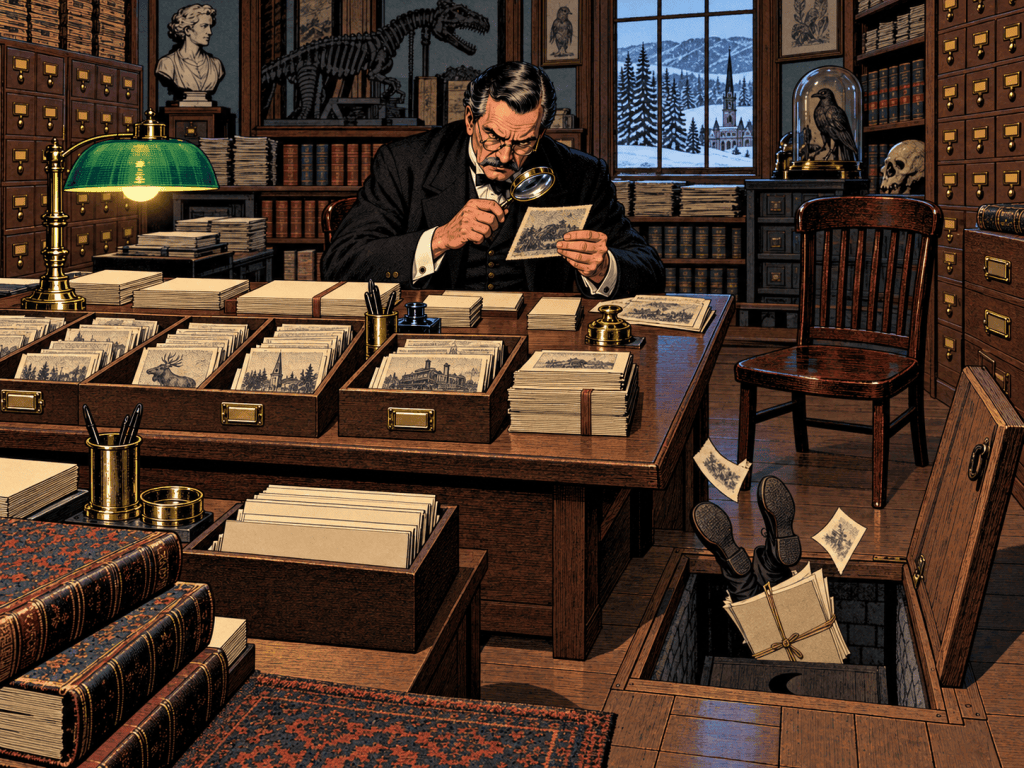
Here the Curator enters, and with considerably more authority than the name may at first suggest. He is not a proofreader stationed at the end of the line to improve whatever the machinery happens to deliver. He represents the archival authority of the Shatagee Woods Museum of Unnatural History, and his business is accession. Every candidate must therefore answer a question familiar to museums, libraries, historical societies, and suspicious North Country families: Where did this come from, and how do you know? Provenance, historical legibility, structural necessity, distinctiveness, and interpretive value are examined before anything is allowed into the collection. A candidate may be clever, plausible, ingenious, handsome in a new coat, and highly spoken of by its relations, and still be refused admission. Generation establishes existence; it does not establish title.
We have found this distinction salutary. Rejected places remain empty—never backfill rejected seats—and those failing examination are conducted without unnecessary ceremony to a hinged trapdoor opening upon the privy:
If pedigree fail when the papers are read,
Down goes the story, heels over head.
This arrangement has materially reduced correspondence from disappointed applicants.
Those fortunate enough to remain above the floor are ranked by standards developed through repeated calibration and by the accumulated judgment of what may properly be described as a standing committee of North Country witnesses. Source specificity, narrative fertility, historical usefulness, tonal distinction, resistance to cliché, and fitness for the Museum collection all bear upon the result. The successful specimens may eventually take their places among the institution’s remixed squibs, lies, true potions, documentary aberrations, and East Bellmont’s No. 5™ brand of pilloried preparations and sonatas. We regard this as a respectable collection and confidently expect it to improve as soon as the poorer material has been removed.
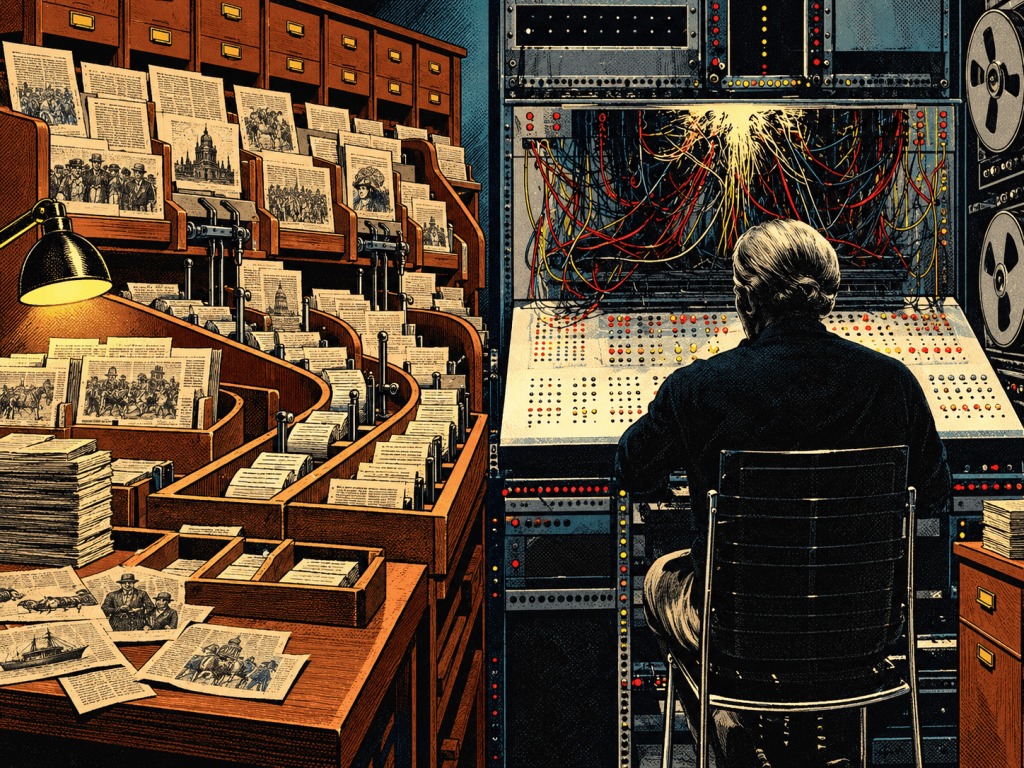
There is a useful musical precedent for the method in the twentieth-century concept of combinatoriality, particularly as it bears upon the work of composer and electronic-music pioneer Salvatore Martirano. In serial composition, combinatorial procedures allow ordered materials and their transformations to participate in larger structures while maintaining essential relations among their constituent elements. Martirano’s later electronic practice extended the principle into systems of selection, routing, transformation, storage, recombination, and performer intervention, most notably in the Sal-Mar Construction, where the field of available operations became inseparable from the composition produced within it. The interest lies not in suggesting that a Chateaugay correspondence column has secretly been twelve-tone all these years, but in recognizing a common compositional proposition: a work may consist not only of an artifact, but of the disciplined arrangement of possibilities from which artifacts can arise.
The generate-shatagee-story-permuter proceeds upon much the same ground. The historical newspaper supplies a bounded aggregate of materials; the Permuter discovers possible relations among them; the Curator determines which relations remain intelligible as transformations of the archive rather than departures from it. Combinatoriality thus means something more useful than simply producing a great many combinations. It describes the deliberate creation of difference under constraint, where novelty acquires force precisely because certain things are forbidden to change.
What emerges is neither transcription nor unrestricted fiction, but a historically traceable rearrangement whose novelty depends upon the continued audibility of its source. We therefore regard generate-shatagee-story-permuter as an archival composition system: a method for performing nineteenth-century Northern New York newspapers until relationships which had been present all along, though previously unheard as narrative, begin to sound. Considering what some of those newspapers have been waiting patiently to say for one hundred and forty years, we think it only neighborly to give them the opportunity.
#ShatageeWoods #UnnaturalHysteria #ArchivalComposition #CombinatorialNewspapers #DigitalHumanities #HistoricalImagination #NorthernNewYork #NewspaperArchives #SalvatoreMartirano #StoryPermuter

What mysteries of Chateaugay Lake haunt you?