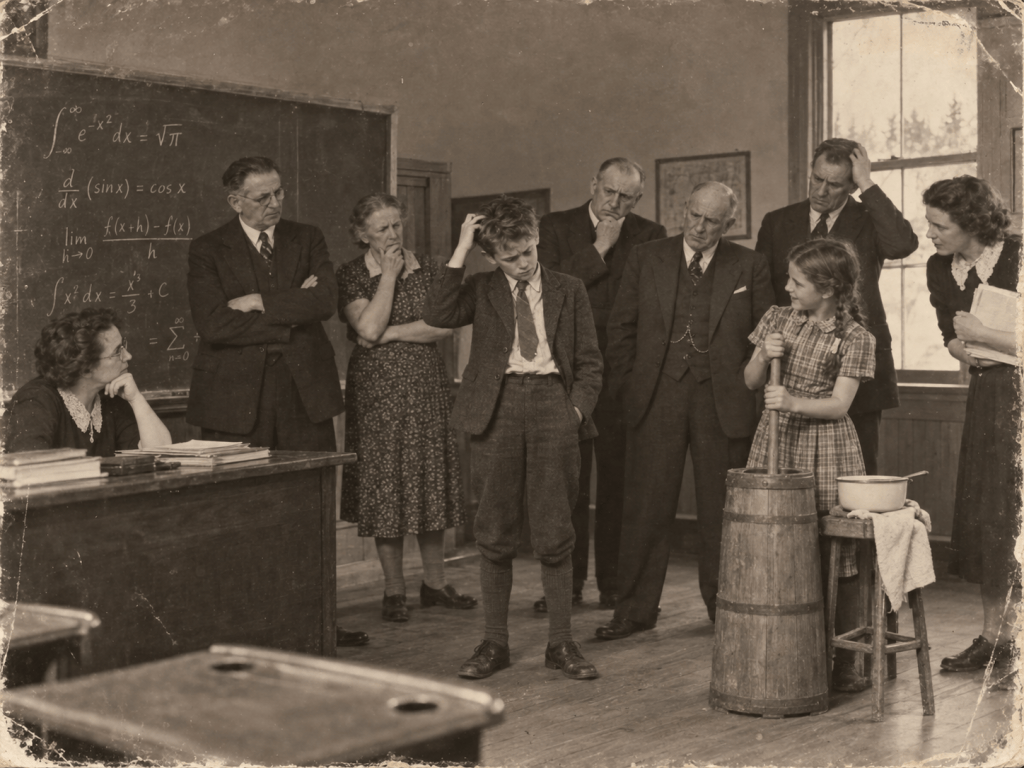
A twelve-year-old visitor from 2142 defeats every mathematics paper the school can produce, then meets an object more formidable than calculus: a butter churn, and an educational system determined to classify him anyway.
CALCULUS AND BUTTER
The Chateaugay Board of Education had already survived the question of how a boy born in 2142 could be twelve years old in 1937, and was therefore in no mood to be defeated by anything so ordinary as grade placement.
The answer, everybody agreed, was examinations.
This was received with relief.
Examinations were solid things. They had desks, pencils, margins, percentages, and correct answers. A birth certificate might become philosophical under pressure. An arithmetic paper generally did not.
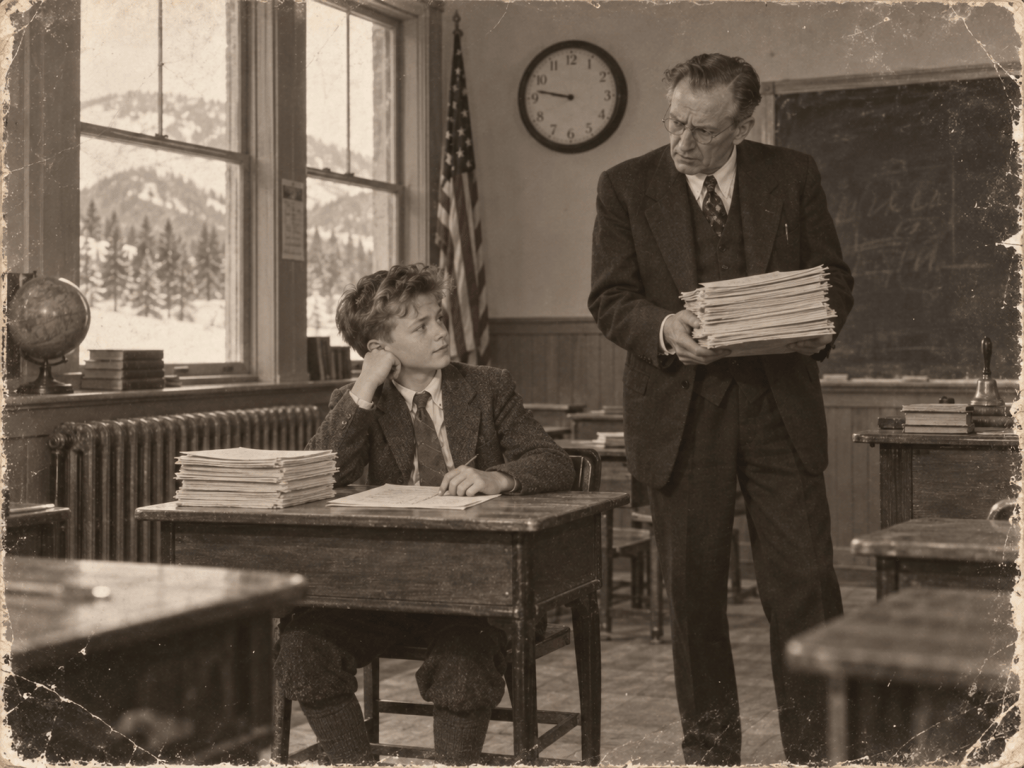
So the twelve-year-old boy from 2142 was seated at a school desk on Monday morning and handed the mathematics examination.
He finished it before the examiner had finished arranging the remaining papers.
The examiner looked at the clock.
“You may check your work.”
“I did.”
The examiner looked at the paper.
There were no erasures.
He brought another examination.
The boy completed that one.
A third was located in the principal’s office.
The boy asked whether he was permitted to use calculus.
The examiner said no.
The boy asked why.
The examiner said because there was no calculus on the examination.
The boy said that explained why it was taking so long.
By eleven o’clock the school had run out of mathematics it was officially prepared to ask a twelve-year-old.
This produced satisfaction.
The placement committee had been looking for a clean result, and here was one. Whatever century the boy properly belonged to, his mathematics was plainly advanced.
Then came the practical examination.
The domestic-science teacher placed a butter churn before him.
The boy regarded it carefully.
It was an upright wooden churn, clean, ordinary, and so familiar to every farm child in the district that nobody had thought to label it.
“What is this?” he asked.
The committee thought he was joking.
He was not.
The domestic-science teacher explained.
The boy became interested immediately.
“You produce butter manually?”
“Yes.”
“With that?”
“Yes.”
He crouched beside the churn and inspected the dasher.
“How long does it take?”
“That depends.”
“On what?”
“Cream. Temperature. How fast you work. Whether you know what you’re doing.”
The boy stood up.
“I do not know what I’m doing.”
This was the first answer he had given all morning which everybody in the room understood perfectly.
A girl from the fourth grade was summoned.
She was ten.
She looked at the future boy, looked at the churn, and said, “You hold it wrong.”
“I haven’t held it yet.”
“Well, you were going to.”
She showed him.
Within three minutes the committee had acquired its first educational result that could not be entered on the printed form.
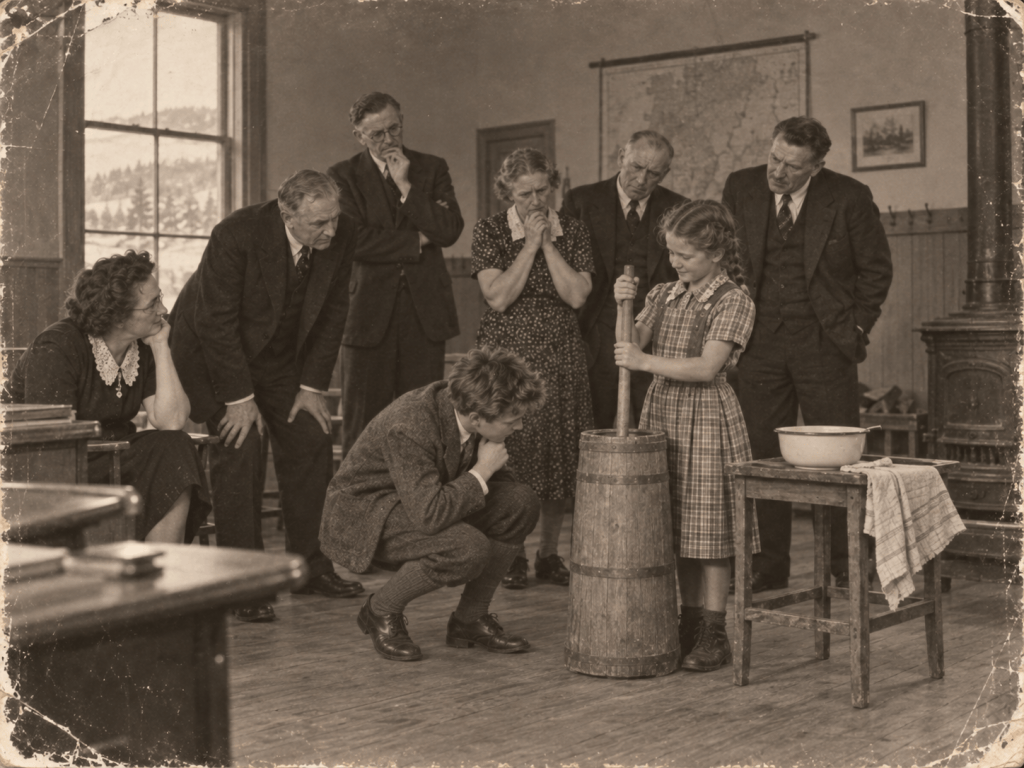
The boy who had exhausted the school’s mathematics curriculum was receiving remedial instruction from a ten-year-old in butter.
The committee adjourned for lunch.
By one o’clock it had decided this merely proved the wisdom of subject-by-subject placement.
The chairman wrote the phrase on the blackboard.
SUBJECT-BY-SUBJECT PLACEMENT.
There.
A policy.
The future pupils would attend the level appropriate to their demonstrated competence in each field. Mathematics might be advanced. Practical subjects might be elementary. History, language, science, penmanship, civics, domestic work, agriculture, music, and physical training could each be assessed independently.
This was modern.
It was flexible.
It lasted until Tuesday.
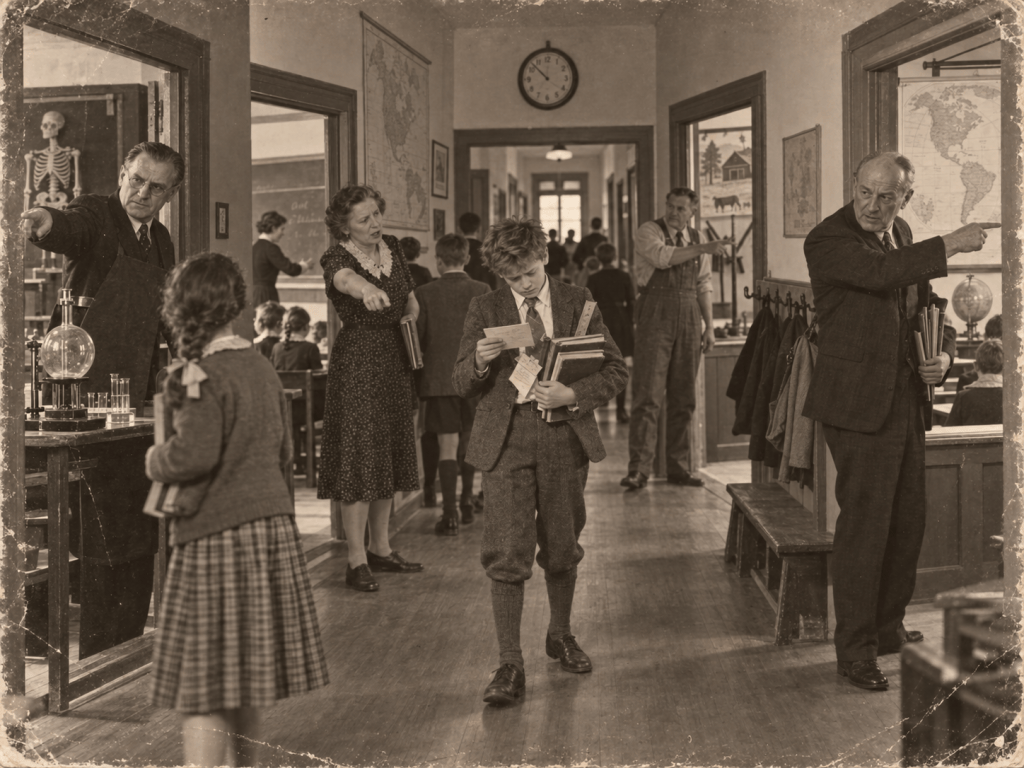
Tuesday morning the twelve-year-old began in the highest mathematics class the school could offer, remained seven minutes, was sent to the superintendent’s office for material the school could not offer, returned to a younger room for instruction in the use of a dip pen, crossed the corridor for elementary geography because he did not recognize several boundaries on the wall map, was promoted three rooms for physics, demoted two for local agriculture, excused from one history exercise because he knew too much, and detained in another because he knew the wrong centuries.
At 10:17 he appeared in the doorway of Miss Bell’s classroom carrying four books, two examination slips, a ruler, and an official routing card.
“Where am I now?”
Miss Bell examined the card.
“You’re here for handwriting.”
“I was here for handwriting at nine-thirty.”
“That was capitals.”
“What is this?”
“Lowercase.”
He sat down.
Another future pupil had already encountered the penmanship department.
She possessed a knowledge of biology which caused the science teacher to stop her twice and ask where, exactly, she had learned these things.
She could explain genetic mechanisms with alarming ease.
Her handwriting, however, caused the penmanship teacher to remove her spectacles, clean them, put them back on, and discover that the handwriting had not improved.
“This,” said the teacher, “is not an R.”
“It is where I come from.”
“It is not where you are.”
The girl considered this.
That distinction proved useful.
She spent the afternoon practicing R.
A third pupil produced still greater difficulty. He could discuss political arrangements, wars, inventions, economic crises, and migrations extending far beyond 1937. The history teacher finally stopped him.
“None of that has happened.”
“It does.”
“Not yet.”
“Oh.”
The boy looked genuinely embarrassed.
He had apparently never before been required to remember which facts were available.
His formal history grade was consequently excellent, impossible, and incomplete.
His practical examination was worse.
He could not harness a horse.
He could not prime the school pump.
He mistook a coal scuttle for a waste container and was prevented from demonstrating his theory only because a sixth-grade boy named Harold yelled across the room.
“Don’t put paper in that!”
The future pupil froze.
Harold showed him what it was for.
The committee took notes.
By Wednesday, the notes themselves had become the problem.
The principal called another meeting.
“We have children in five grades.”
“Each?”
“In some cases.”
The chairman disliked the tone of this.
“Five grades simultaneously?”
“Not simultaneously. We haven’t solved that.”
They had indeed not solved it.
The new timetable required future pupils to change classrooms so frequently that one teacher accused them of wandering in the halls.
“They’re not wandering,” said the principal. “They’re being placed.”
“They’ve been placed past my door six times.”
“That’s because of arithmetic, penmanship, science, local history, practical work, and arithmetic again.”
“Why arithmetic twice?”
“We ran out of arithmetic the first time.”
The board examined the schedule.
It resembled no educational program previously recognized by the district. Lines had been drawn, erased, redirected, and drawn again. One future pupil was expected in two rooms at 1:20. Another was required to leave agricultural instruction before learning the thing he had been sent there to learn because advanced science began four minutes earlier at the opposite end of the building.
Someone proposed that each child simply be assigned to the grade corresponding to age.
The room became quiet.
This was the tempting solution.
It was simple. It was legible. It fit the register.
The chairman asked, “Would it be accurate?”
Nobody answered.
He tried again.
“Would placing the calculus boy in the seventh grade tell us what he knows?”
“No.”
“Would putting him with older pupils tell us whether he can churn butter?”
“No.”
“Would putting him with younger pupils tell us what mathematics he ought to study?”
“No.”
“Then what would the grade mean?”
The superintendent looked at the register.
“It would mean where we put him.”
“That is not the same thing.”
This was the difficulty.
Once said aloud, it stayed said.
The board had begun by insisting that placement follow demonstrated knowledge. It could abandon that principle, certainly. Boards abandoned principles every day for perfectly practical reasons. But it could not abandon the principle and continue calling the result an examination system.
The pupils, meanwhile, had developed a system of their own.
This was discovered Thursday.
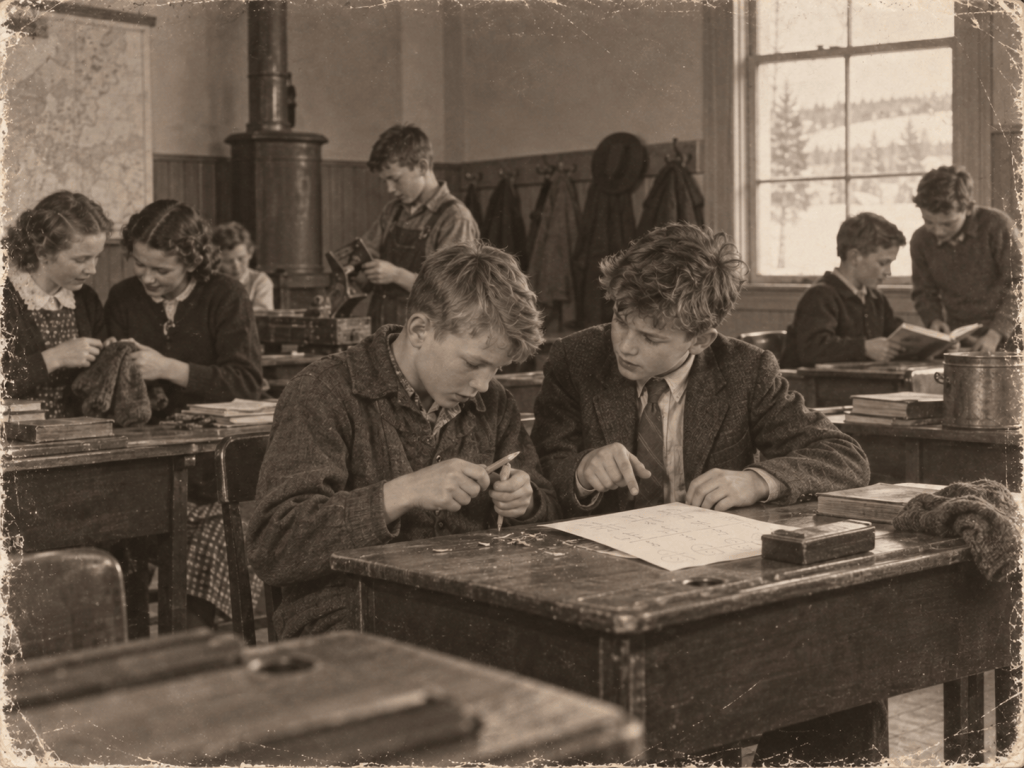
Harold, who had never been good at mathematics, was showing the calculus boy how to sharpen a wooden pencil properly with a pocketknife.
The future boy watched with complete attention.
“You turn the pencil,” Harold said. “Not the knife so much.”
“Why?”
“You get it crooked.”
The future boy tried.
He got it crooked.
Harold took it back.
“No. See?”
Five minutes later the future boy was helping Harold with fractions.
The exchange attracted others.
A girl who knew how to mend a torn mitten received help with algebra.
A boy who could identify nearly every farm implement in a shed obtained an explanation of electricity that left him walking around the schoolyard afterward looking suspiciously at the wires.
The pupil who had been corrected about the coal scuttle traded a lesson concerning some future branch of science for instruction in operating the school pump.
By Friday the informal exchange had spread throughout the building.
Teachers objected.
Not all teachers. Enough teachers.
“You cannot have pupils instructing pupils without supervision.”
“They are not exactly instructing,” said the principal.
“What are they doing?”
The principal had watched three sessions that morning.
“Trading.”
This was worse.
A committee was convened.
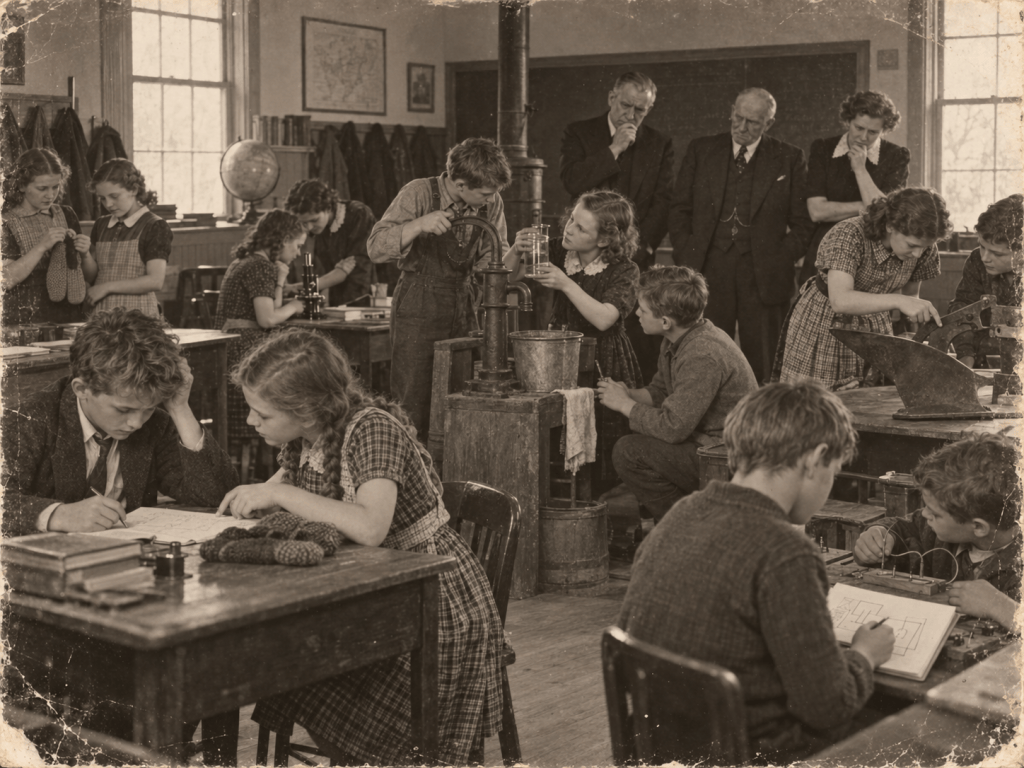
The future pupils were accused, in administrative language, of reorganizing the curriculum without authorization.
The twelve-year-old calculus student attended because he had learned by now that when adults used the word curriculum in his vicinity it usually meant he was about to miss lunch.
The chairman explained the concern.
The boy listened.
Then he asked, “Are we learning the wrong things?”
“No.”
“Are the other students?”
“No.”
“Are we teaching anything incorrectly?”
“That is not the question.”
“What is the question?”
The chairman looked at the superintendent.
The superintendent looked at the principal.
The principal, who had acquired respect for the boy’s ability to wait through silence, said, “Who is supposed to be teaching whom.”
“Oh.”
The boy considered this.
“In our case it changes.”
The chairman said, “That is precisely the problem.”
Harold had been waiting outside. Somebody brought him in, chiefly because his name had appeared repeatedly in the reports.
He stood before the board looking as though he expected punishment.
The chairman asked him what he had been teaching.
Harold looked astonished.
“I don’t teach.”
“You taught him to sharpen pencils.”
Harold shrugged.
“He didn’t know how.”
“You showed him the pump.”
“He didn’t know that either.”
“You showed him how the churn worked.”
“That was Mary, mostly.”
“And what has he taught you?”
Harold’s expression changed.
“Math.”
“Do you understand it?”
“Some of it.”
“More than before?”
“Yes.”
Harold had spent several years being the boy who did not understand mathematics.
Everybody in school knew it.
He knew it most of all.
Now, for the first time anyone could remember, there existed a recognized body of knowledge in which Harold was not behind.
The future boy could calculate things Harold could not name.
Harold could walk into a barn, classroom, woodshed, kitchen, or pump room in 1937 and know what half the objects were for before the future boy had finished examining them.
One had been educated for a world the other had never seen.
This did not make either one stupid.
It made the word advanced troublesome.
The committee returned to its original problem.
“What grade is he in?”
Mathematics supplied one answer.
Penmanship supplied another.
Science supplied a third.
Practical knowledge supplied several more.
History refused to cooperate altogether.
Age was no help.
Birth year had already disgraced arithmetic.
The chairman took the registration form and stared at the blank beside GRADE.
He had spent a week trying to make the child fit into that space.
Finally he handed the pen to the principal.
“Write what we know.”
The principal hesitated.
Then he wrote:
GRADE: VARIOUS
Nobody liked it.
Nobody could improve it.
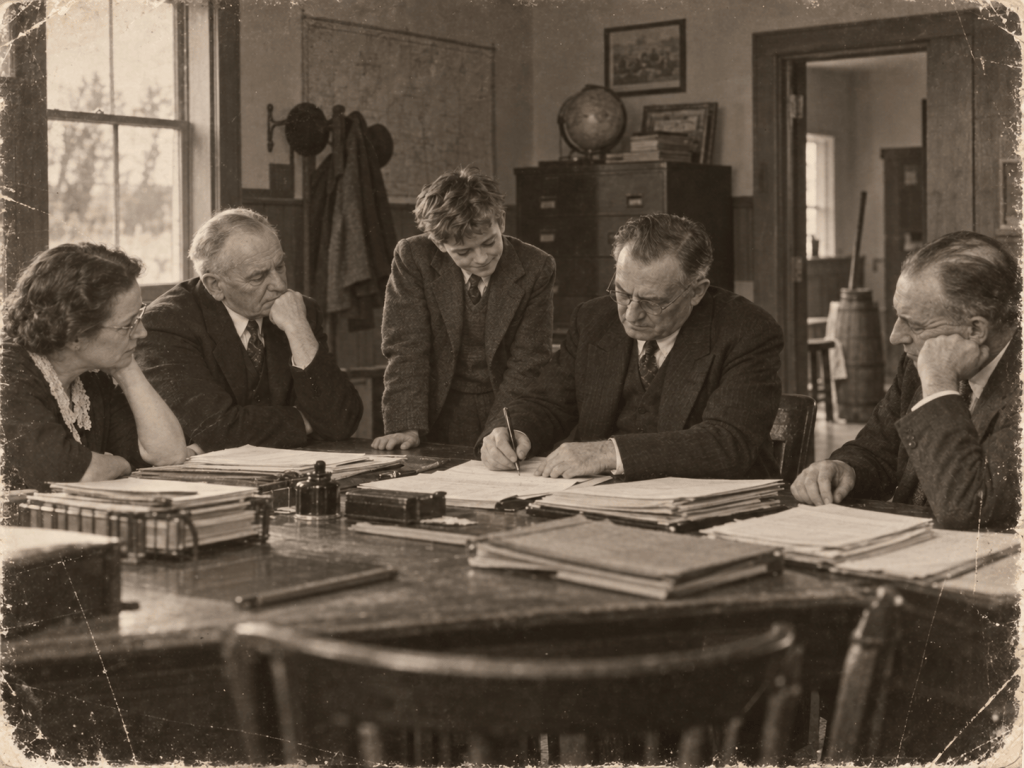
The twelve-year-old leaned over to read the entry.
“That’s accurate,” he said.
And after a week of examinations, conferences, schedules, transfers, objections, revisions, practical demonstrations, one ruined pencil point, and an unexpectedly successful quantity of butter, accuracy had become the one standard the Board was no longer willing to sacrifice merely for the convenience of the form.
#ShatageeWoods #CalculusAndButter #FutureStudents #NorthCountry1937 #SchoolhouseSatire #HistoricalFiction #EducationalComedy #TimeTravelFiction #MuseumOfUnnaturalHysteria

What mysteries of Chateaugay Lake haunt you?