
Advisory: Unsanctioned time-travel to 1924, rogue mechanical appendages, and unsettling aquatic abominations may cause intense bewilderment. Consult a metaphysical expert before engaging in historical eldritch speculation.
“We are such stuff as dreams are made on.” – The Tempest, Act IV, Scene 1
Upper Chateaugay Lake, Summer 1924

It was on a balmy summer evening in 1924 that the placid waters of Upper Chateaugay Lake became the stage for an event that defied both natural law and mortal expectation. Under a sky scattered with stars and bathed in the silver glow of a full moon, the quiet hamlet of Merrill prepared itself for a night of music and murmured legends—a night when the boundary between the known and the ineffable would blur.
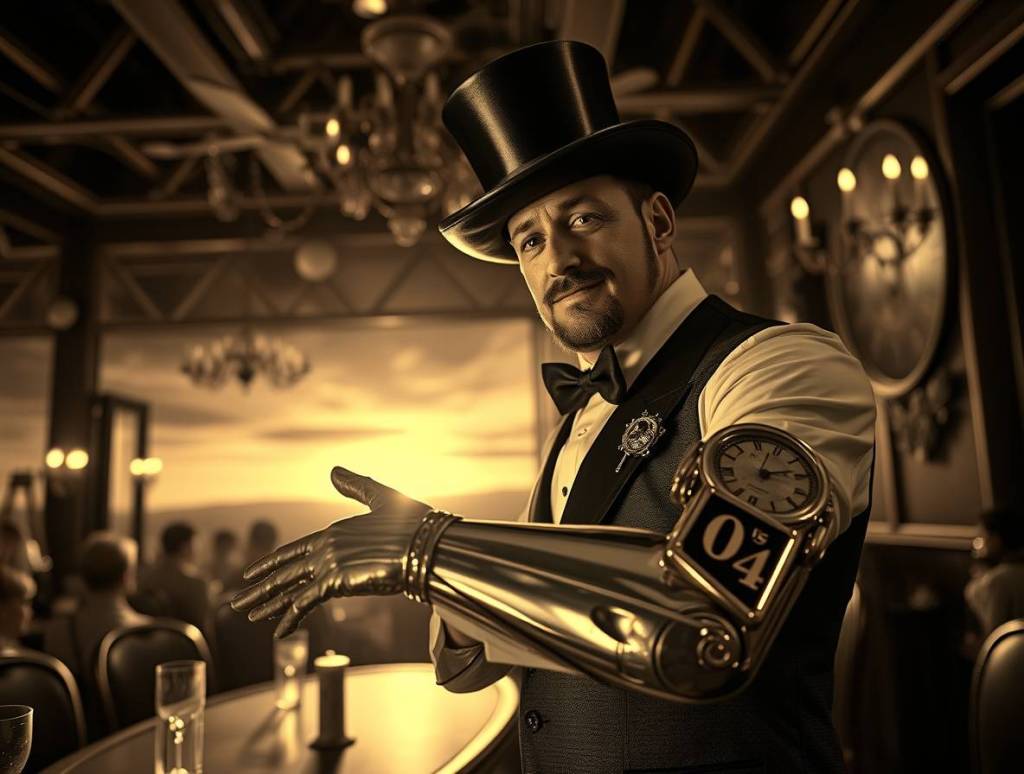
At the heart of this nocturne was Nuada Silver Spin, a man whose reputation had grown as mysteriously as the legends of the Shatagee Woods themselves. Nuada was a musician of singular talent, celebrated not for the conventional instruments of our age, but for the eerie, almost otherworldly contraption concealed within his gleaming silver prosthetic arm. Crafted by the ingenious hands of local engineer Dr. Emory Cartwright, this marvel of 1924 ingenuity was no mere replacement for a lost limb. It was an elaborate mechanical music box—its clockwork gears, delicate chimes, and meticulously balanced levers coalescing into a device capable of producing a melody that seemed to rise from the very ether.
That fateful evening, Nuada had taken to the modest stage at Morrison’s—a tavern known as much for its rustic charm as for its propensity to host the unexpected. With a measured calm and a distant, enigmatic smile, he set his silver arm to motion. As the gears clicked and the chimes resonated in a slow, rhythmic cadence, the sound carried far beyond the tavern walls. It was as if the music reached out to the lake itself, stirring secrets that had long lain dormant beneath its placid surface.

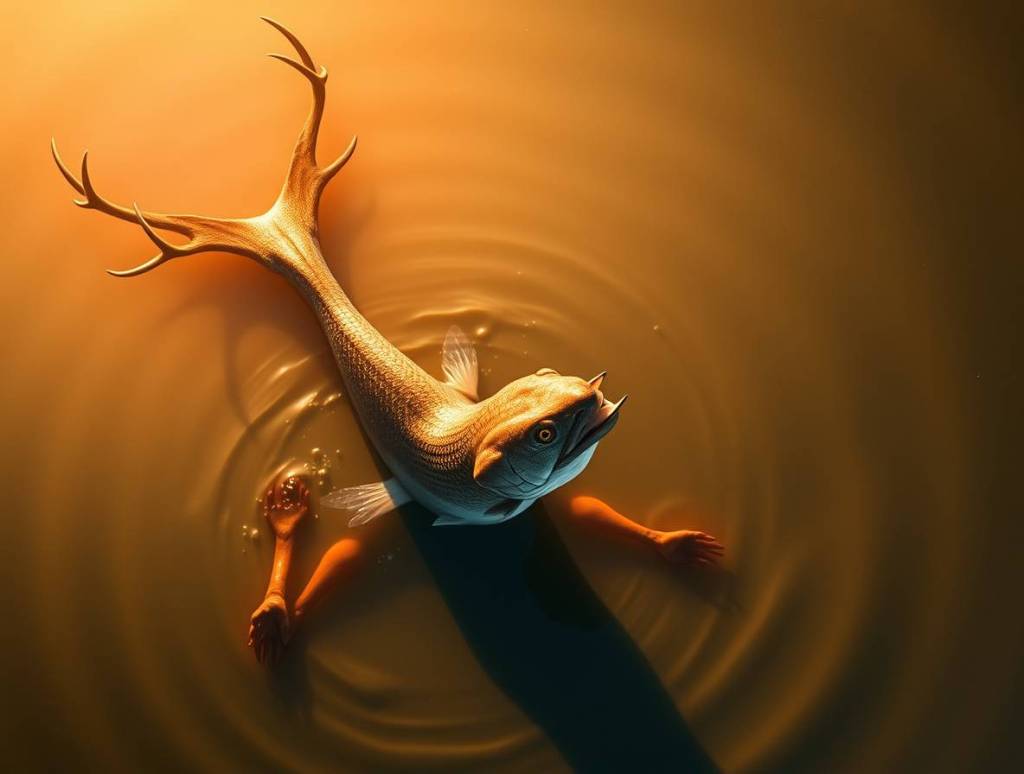
Not long after the first notes floated across the water, murmurs began among the gathered locals. Old Jack Davis, whose weathered face bore the marks of many hard winters and harder truths, was the first to speak. “I seen it with my own eyes,” he declared, voice trembling as he recounted his account. “A creature, like nothing our minds can rightly name—a thing with the sinuous head of a serpent, the lithe body of a fish, and, I swear, legs of a stag. It moved as if it were in tune with that unearthly music.”

Word of the apparition spread with astonishing speed. Among the crowd was Eugene Miller, a man of science and quiet contemplation, whose notebooks were filled with meticulous observations and sketches of local phenomena. Miller, ever the skeptic yet deeply intrigued by the night’s occurrences, hastened to the lakeshore. There, under the watchful gaze of the moon, he observed the water ripple in synchrony with Nuada’s mechanical melody. And then—amid a shimmer of luminescence—a creature emerged.

The being was at once wondrous and terrible. Its elongated, sinuous head bore the smooth, scaled texture of a serpent, its eyes glowing with a light that seemed not entirely of this world. The body, broad and streamlined like that of a fish, shimmered with an iridescence that caught every stray beam of moonlight. And beneath this uncanny form, four slender, graceful legs—reminiscent of a stag’s—carried the creature with a preternatural elegance. It paused at the water’s edge, as if listening, its gaze fixed upon the distant strains of Nuada’s performance.
In that suspended moment, Eugene Miller’s scientific mind raced. Could it be that the resonant frequencies produced by Nuada’s mechanical arm had, in some inexplicable fashion, tapped into a latent energy hidden within the lake’s depths? Miller recalled the latest theories on etheric vibrations and the potential for natural harmonics to reveal undiscovered realms. Perhaps, he mused, the music had acted as a catalyst—a key, unlocking a portal between our world and one beyond the ken of human understanding.
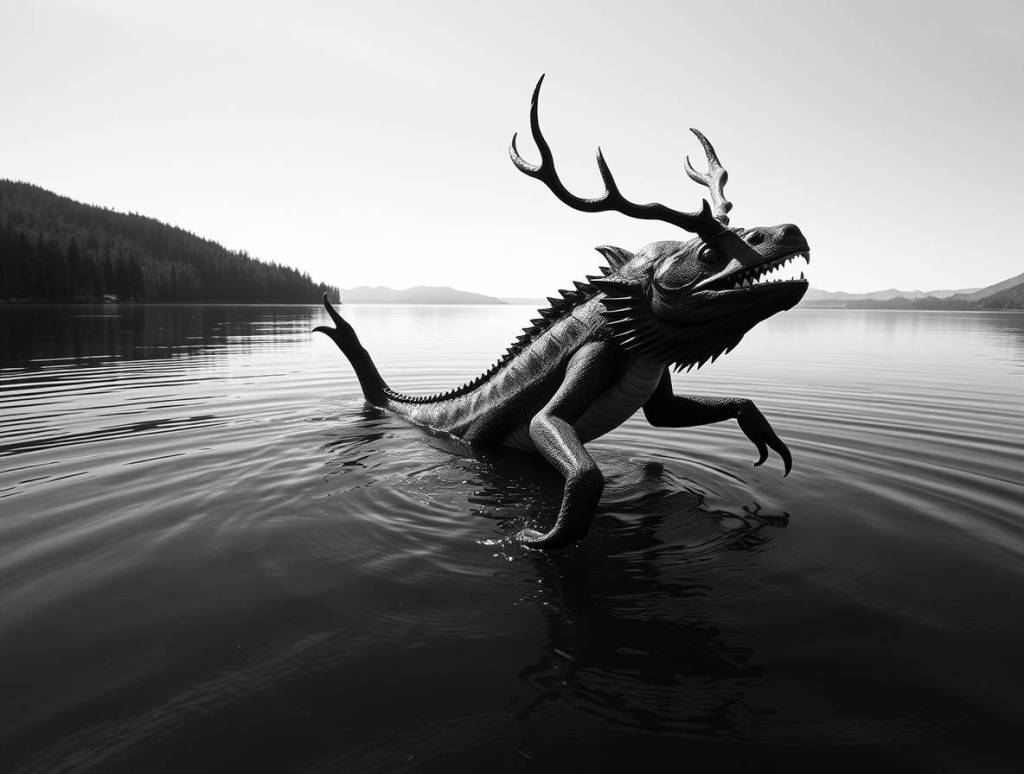
As Nuada’s melody reached its somber crescendo, the creature appeared to respond. Its movements, fluid and deliberate, seemed choreographed to the rhythm of the chimes. For several long, heart-stopping minutes, man and myth shared a quiet communion: the steady pulse of clockwork beats merging with the gentle lapping of the lake, the murmurs of a small crowd hushed in reverence and fear.
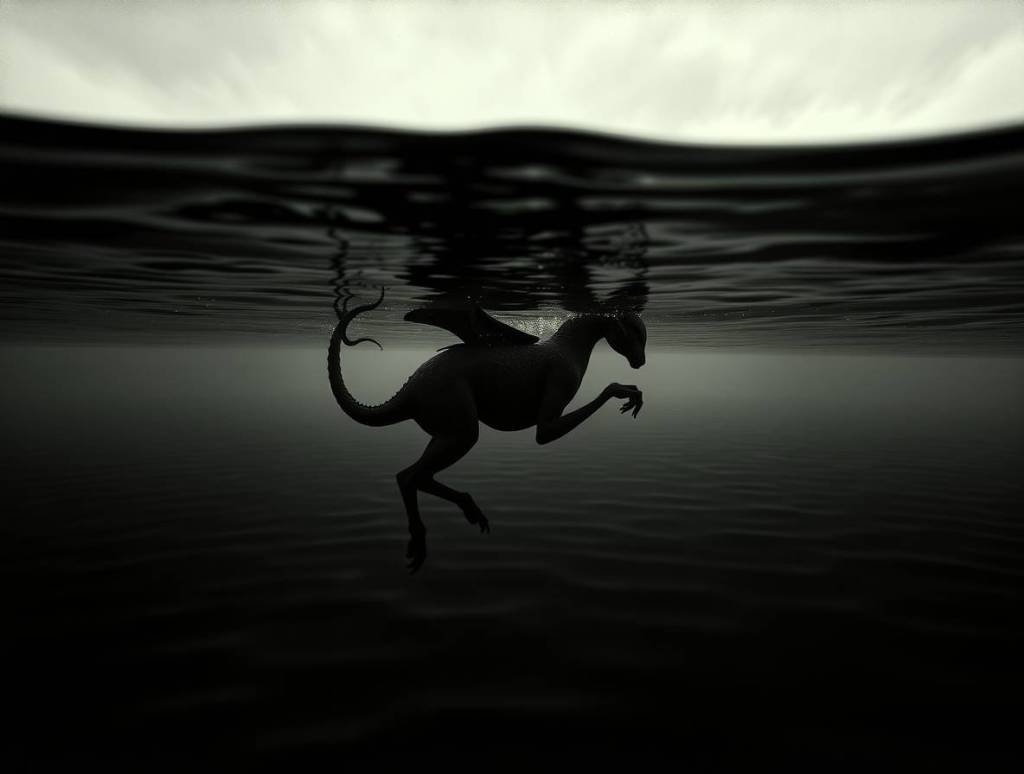
Then, as abruptly as it had materialized, the chimera began its retreat. With a final, lingering glance that bore the weight of untold secrets, it slipped beneath the water’s surface. The ripples it left behind gradually subsided, the night reclaiming its silence, save for the fading echoes of Nuada’s mechanical refrain.

In the days that followed, the incident at Upper Chateaugay Lake became a subject of both hushed local legend and earnest scientific inquiry. Nuada Silver Spin himself offered no explanation—only a quiet nod, as if privy to mysteries that words could scarcely capture. Eugene Miller continued to pore over his notes, grappling with theories of resonance, natural harmonics, and the possibility that music might indeed bridge the gap between the seen and unseen. And Jack Davis, though his account was met with skepticism by some, remained convinced that the lake had revealed a fragment of its ancient soul that night.
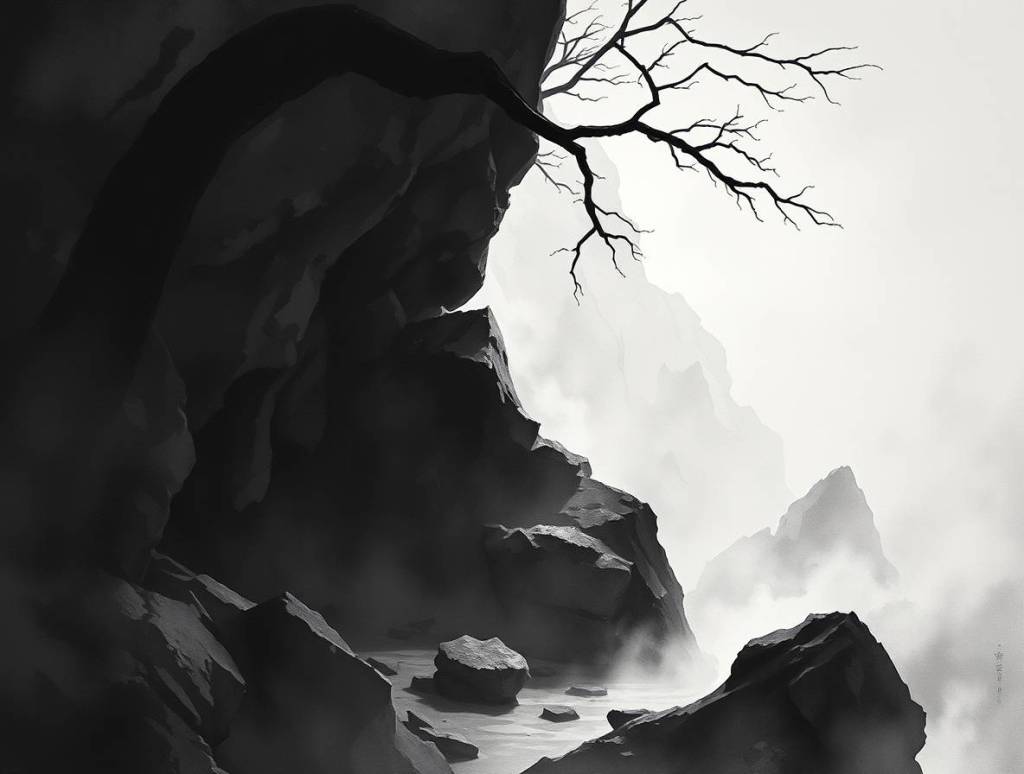
Thus, in the quiet depths of Upper Chateaugay, a singular truth was born: that the forces governing our world might be stirred by the simple act of creation, by the deliberate striking of a chord that resonates with the cosmic heartbeat. And in that thought—both thrilling and terrifying—resided a promise and a warning. For in a universe where even dreams may take tangible form, one can never be sure which melodies are meant to be heard, and which are better left unsung.
—A Chronicle of the Unexplained at Upper Chateaugay Lake, Summer 1924

What mysteries of Chateaugay Lake haunt you?