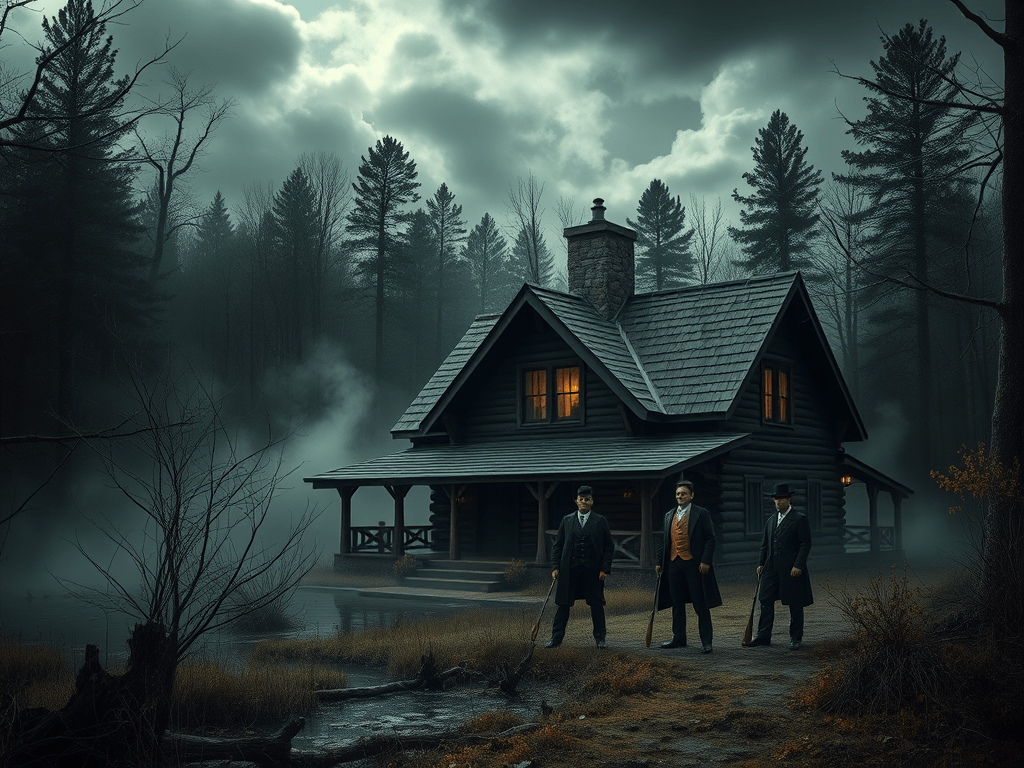
The Fencreeper does not forgive trespass. Boston’s finest learned too late. Their fate—swift, silent, unspeakable—became legend. Dare to read what happened when civilization met the ancient horror of Bluff Point.
The Fencreeper of Gunn’s Retreat

It was a blustery autumn in the year of our Lord 1857 when the first of the Boston gentlemen arrived at Gunn’s Retreat—a new sporting lodge on the western shore of Upper Chateaugay Lake. They came in high spirits, lured by the promise of rustic adventure, fresh-killed venison, and a reprieve from the clatter of the city. The lodge, a stout timber edifice with a rude stone chimney, had been erected just that summer, set on a narrow spit of land jutting into the fen—a “prime location for sport,” as advertised in the circulars distributed at the Parker House in Boston.
But the local folk, whose tenure in those woods stretched back a generation or more, did not share in the excitement. They called that tract Bluff Point Swamp, and those who still hewed to the old ways whispered darkly of the thing that dwelt there—the Fencreeper.
A Festive Arrival, A Grim Omen

The Boston men, some nine in number, arrived by way of the new railroad to Chateaugay village, then took a bouncing stage ride through rutted roads to the lake. They were a cheerful lot, dressed in fine woolen coats and carrying rifles polished to a mirror’s gleam. Their host, one Captain Nathaniel Gunn—an enterprising fellow who had abandoned the sea for the North Woods—met them at the landing with a team of bay horses and a store of whiskey.
The lodge was well-stocked with provisions: a bushel of late apples, several hams cured in maple smoke, and a fresh-killed buck hanging from the rafters. Their evenings were spent in revelry—pipes aglow, bottles passed round, voices raised in tales of adventure. A great many jokes were made at the expense of the local settlers, who, it was said, feared their own shadows and filled the air with queer superstitions.
Yet, for all the merriment, there were signs that something was amiss. The game was scarce, as if the forest itself held its breath. The few deer they encountered bore strange wounds, their flesh covered in deep, bubbling sores. And, on their second evening, when the company ventured out to try their luck at hunting, they returned with uneasy faces, speaking in low tones of something they had seen beyond the fen—a shape low to the ground, moving with an unnatural speed.
“It was likely a panther,” said Mr. Dunham, the most experienced sportsman among them. “Or perhaps an Indian, lurking about to spy on us.”
“More likely a drunken settler stumbling home,” scoffed another.
Yet Captain Gunn said nothing.
A Reckoning in the Swamp

It was on the fourth night that the thing came.
A storm had rolled in from the west, and the wind howled through the timbers of the lodge, rattling the windows in their casings. A lantern was set upon the table, its flame flickering, throwing great wavering shadows across the walls. The men sat deep in their cups, laughing over some crude jest, when a noise broke through the storm—a thin, wailing cry, like a man calling from a great distance.
Then came a thump against the door.
The men fell silent.
Another thump.
Then, a slow, scraping sound, like claws raking across the wood.
“Who goes there?” called Captain Gunn, rising from his chair. No answer came. He took up his rifle, stepped to the door, and, after a moment’s hesitation, threw it open.
A great gust of wind blew in, scattering the papers from the table. The lantern guttered. For an instant, nothing could be seen but the swirling dark. Then—something moved.

It was low to the ground, long-limbed and hunched, its dark, glistening skin stretched tight over an unnatural frame. Its eyes—red as hot embers—flashed in the firelight. And the stench that rolled in with it was of something long dead and sunk in the mire.
One of the gentlemen gasped, another gave a strangled cry, and then the thing was gone—vanishing into the storm as suddenly as it had come.
For a long moment, no one spoke.
Then Dunham, his face pale, muttered, “God preserve us.”
Departure and Ruin

At dawn, they departed. The hunt was abandoned. The lodge was left shuttered and still, the hearth gone cold.
They told no tales of their encounter when they returned to Boston. To do so would invite ridicule, for who among their number would dare confess to being driven from the woods by a shadow? But they never returned to Gunn’s Retreat. The lodge sat empty through the winter, and by spring, the roof had begun to sag, the timbers to rot.
The locals were unsurprised. They had known all along.
It is said that the Fencreeper does not take kindly to trespassers.


What mysteries of Chateaugay Lake haunt you?