
Venture cautiously into the haunted environs of Chateaugay Lake, where spectral Swamp Augers prowl through murky wetlands. Local lore warns of eerie mimicry and ghostly voices echoing in darkness—beware, shudder, and tremble.

Swamp Augers and the Foolish Wisdom of Chateaugay Lake
“The fool doth think he is wise, but the wise man knows himself to be a fool.”
— As You Like It, Act 5, Scene 1
Let us begin with a confession: the learned men of the valley—surveyors, geologists, amateur historians, and that one fellow who claims to have a direct line of correspondence with the Smithsonian—have all, in their collective wisdom, failed utterly to explain the Swamp Augers of Chateaugay Lake. They have mapped every creek, drained every bog, and catalogued every bird call, and yet, still, one hears it. That low, rattling, warbling screech—half owl, half delirium—the sound of something that sees, but should not be seen.
Now, if you ask George Shutts, he’ll tell you the Swamp Augers are nothing but an old man’s tale. If you ask him after sundown, however, when the mist rolls in off the lake and the loons go quiet for no good reason, he’ll tell you something different altogether.
The Lean-To Incident

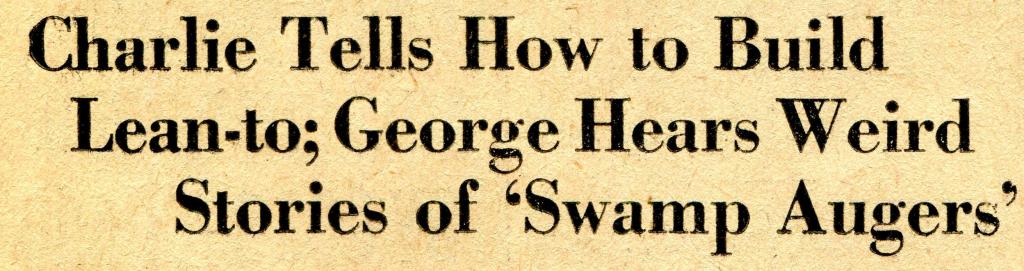
It was Charlie who first noticed the pattern, though he never claimed to. He had simply built a lean-to along the Salmon River one season, and settled in for the night with his fellow trapper Lee, expecting nothing more than the usual nocturnal chorus—bullfrogs, crickets, maybe the distant hoot of an owl. But just as the fire dimmed and their eyelids drooped, there came a sound that did not belong in any respectable bestiary.
A hollow, almost questioning wail, followed by an uncanny mimicry of their own voices, as if something in the dark had been listening too carefully and, in an effort to be neighborly, had decided to join the conversation.
Lee swore it was a screech owl. George, hearing the tale the next morning, disagreed.
“Ain’t no screech owl that,” George muttered, chewing on his pipe. “That’s a Swamp Auger.”
Charlie raised an eyebrow. “A what now?”
George continued to grin but said nothing further, merely looking from one to the other as if expecting them to understand. It was old man Pascall, self-appointed custodian of Adirondack folklore and occasional whiskey enthusiast, who finally explained it.
“Swamp Augers,” he said, with the air of a man recalling something best left forgotten. “They don’t hoot. They don’t squawk. They… discuss.”
What is a Swamp Auger?
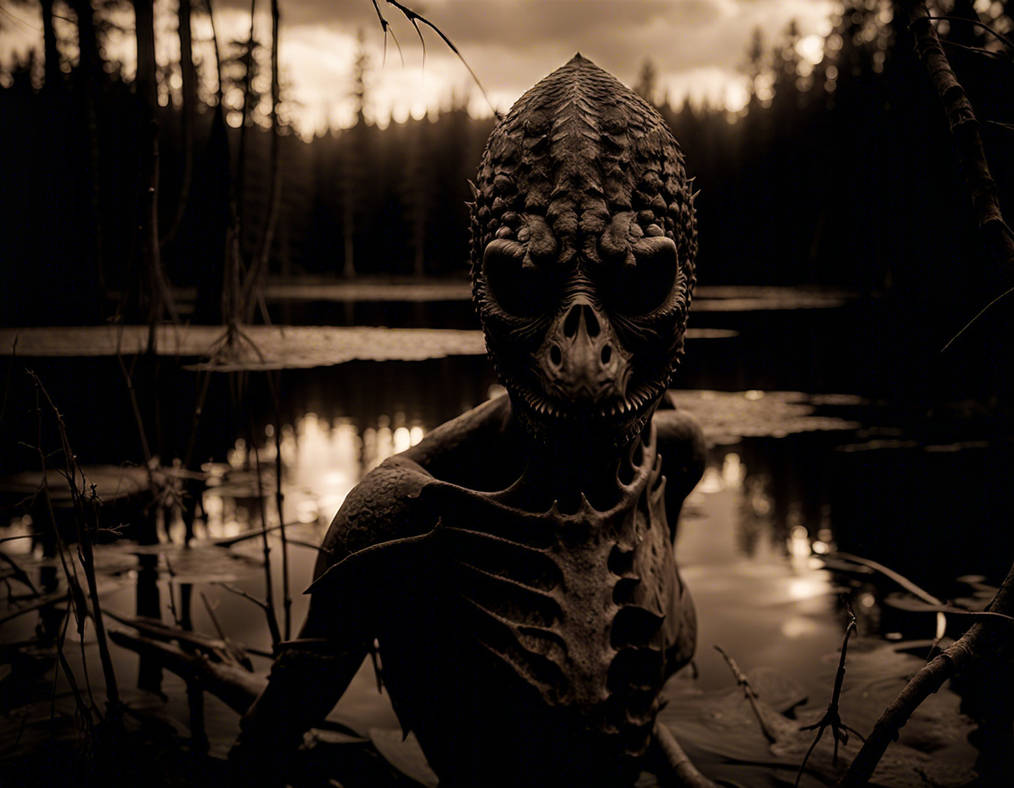
A reasonable question. The trouble is, the answer depends on who you ask.
Some say they are birds. Very large, very ugly birds. Birds that learned to speak from lonely trappers and, having acquired language, found they preferred questions to answers.
Others claim they are not birds at all but spirits—remnants of those who drowned in the lake and now wander the reeds, calling out with the stolen voices of the living.
And then there are those who insist that the Swamp Augers are simply echoes—tricks of the wind bouncing off the water, given meaning only by our own foolish ears. These people tend to leave before sundown.
A Foolish Experiment

Emboldened by nothing more than stupidity and borrowed provisions, Lee and Charlie resolved to investigate. If the Swamp Augers were nothing more than birds, well, there was no harm in getting a closer look. And if they were something else—well, best to know sooner rather than later.
They set out west, following a trail of half-sunken logs and moss-choked water. The terrain grew stranger as they went—thickets that rustled though no wind blew, pools that reflected nothing, silence where silence had no right to be.
And then, as the last light drained from the sky, they heard it again.
“Charlie,” came a voice from the reeds.
A perfect imitation of Lee’s voice.
“Charlie, you hear that?” Lee whispered.
From somewhere ahead, the voice echoed back.
“Charlie, you hear that?”
The words were the same, but the cadence was all wrong. Too slow. Too deliberate. As if spoken by someone who had learned the language secondhand, who understood the words but not the meaning.
Charlie, being a man of action rather than reflection, did the only reasonable thing. He took off running.
Lee, being slightly less reasonable, stayed just long enough to see a shape move in the reeds—a long, stooped figure, neither man nor bird, standing knee-deep in the water. It tilted its head, and for a brief, terrible moment, it opened its mouth as if to speak.
Lee did not wait to hear what it had to say.
The Moral of the Story

Some nights, if you sit close enough to the lake and listen, you might hear them too—the strange, stilted voices calling out over the water, searching for someone foolish enough to answer.
There is wisdom in mystery, the old folks say. A wise man does not question the Swamp Augurs. A fool, however, might lean in too close, trying to make out the words.
And in the end, the fool and the augur are not so different.
Both, after all, are only looking for a conversation.


What mysteries of Chateaugay Lake haunt you?