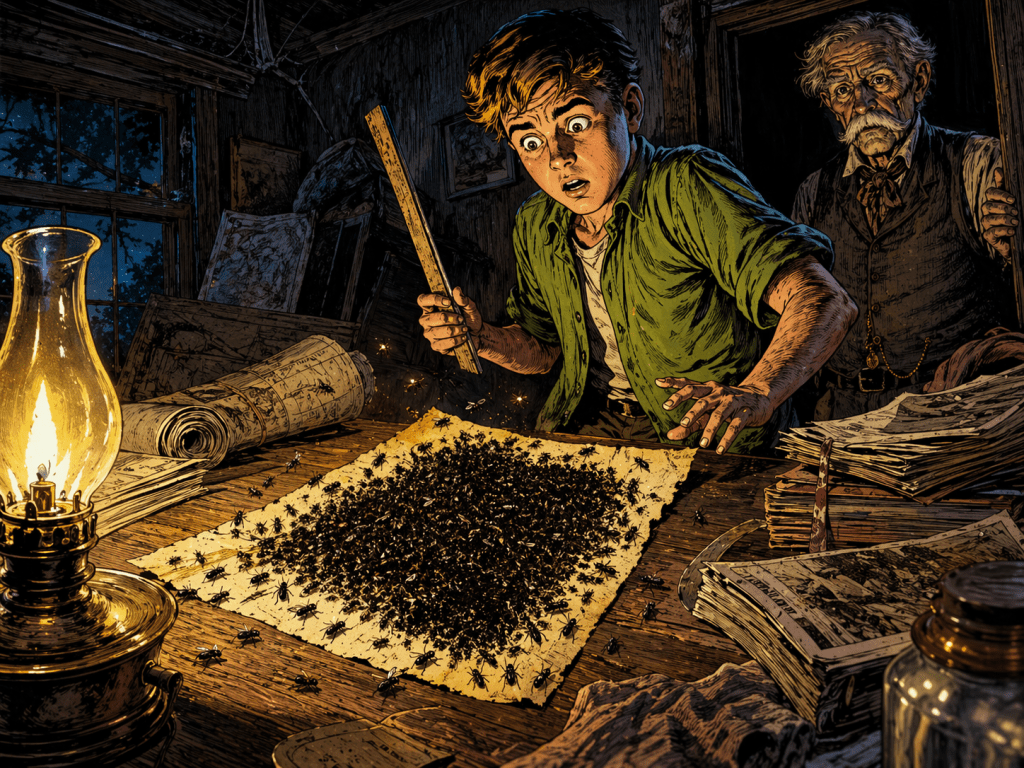
Heed the consarned flies coverin’ the old Bloomingdale handbill in summer of 1878. They swarm with purpose markin’ where the countryside opened too wide under durned heat. Beware their buzz near the lake.
The Second Mouth of Bloomingdale
That was one of them summers when the heat seemed to hang over Upper Chateaugay Lake like a wet horse blanket, sagging low and heavy till even the trees along shore stood as if they hadn’t strength enough left to stir. The flies had gone queer too. They kept butting at the museum windows from sunup till near dark, buzzing and rattling on the panes as though they had business indoors and meant to see it through.
I was fifteen that season, old enough, as folks said, to be trusted with keys, errands, and a dust rag, but still young enough to feel that any plain little task might open out, all of a sudden, into something worth remembering. That was how I came to be upstairs with Mr. Vale in the Shatagee Woods Museum of Unnatural Hysteria, sorting a freight of old papers that had lately drifted in from Malone and from a lawyer’s office over to Bloomingdale that had been cleaned out at last.
The museum name had started, so Mr. Vale always said, as a joke too stubborn to die.
“Round here,” he told me more’n once, “a joke gits set still long enough, folks begin to treat it like gospel history.”
At first them papers looked no better than sweepings. Church notices, trade cards, handbills, newspaper clippings, funeral scraps, poems, accident reports, little announcements for meetings no living soul remembered anymore—all tied up in string and smelling of dust and attic boards.
I was laying them out by town when Nell came along. Nell had a gift for arriving to return one borrowed book and somehow winding up in the middle of a mystery before supper.
She let her satchel drop on the floor and looked over the table.
“Wal now,” she said, “what all’s this?”
“History,” I told her.
“Looks more like junk.”
“That too.”
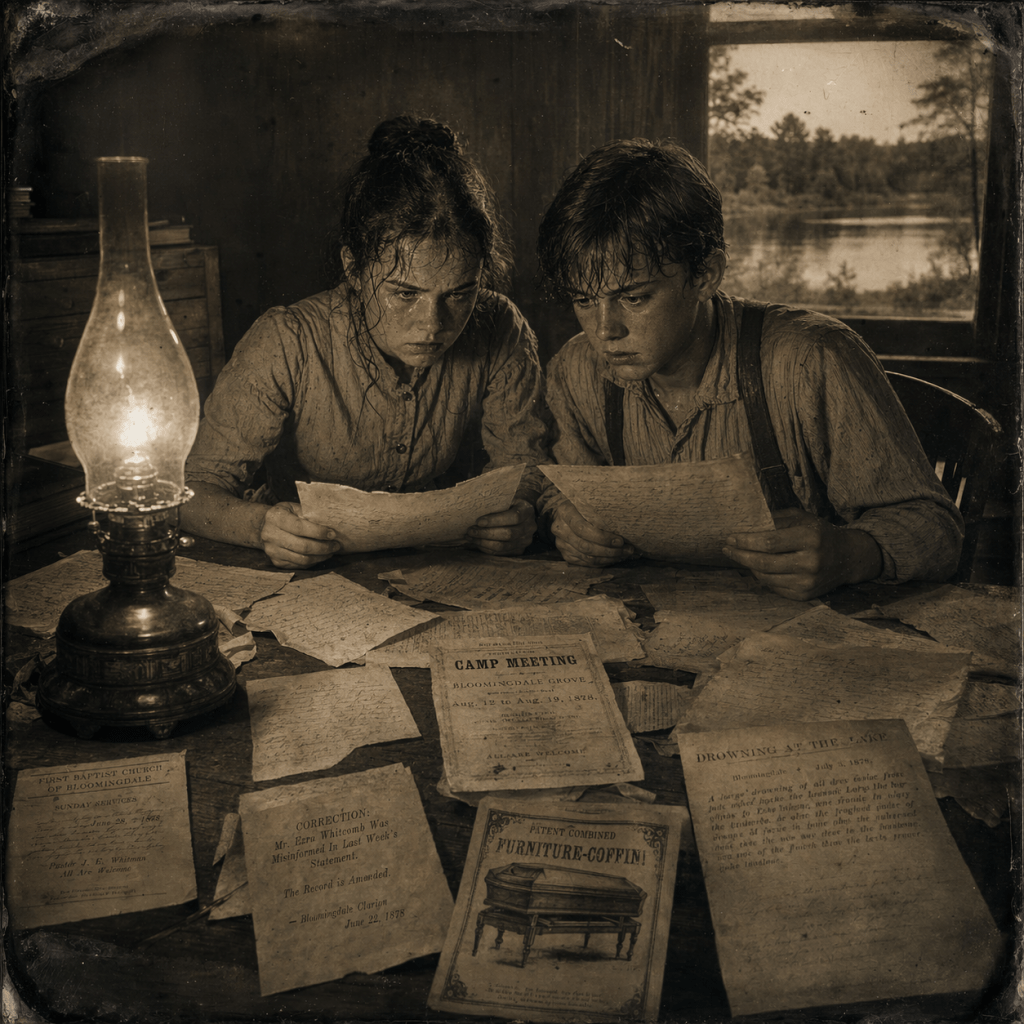
She grinned at that and fetched herself a chair. We went at it steady for ten minutes or so, saying little, till she held up a flyer and read off from it.
“Camp meeting in Hayes’s grove near Bloomingdale. Exercises to continue so long as weather an’ enthusiasm permit. Sounds cheerful enough.”
“Read them next,” said I, handing her a crooked little stack I’d set aside.
She took them one by one.
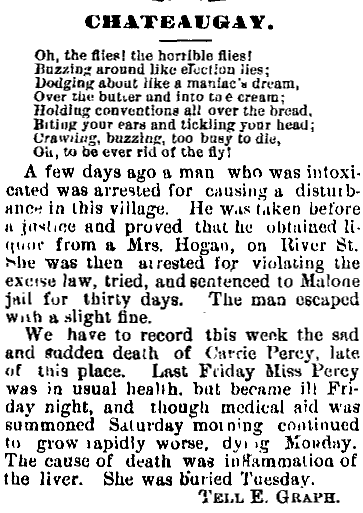
First there was a foolish poem about terrible flies.
Then a newspaper correction to some wild town scandal that, according to the item, hadn’t happened half the way folks said it had.
Then a report of a family drowned in the bog on a pleasure trip.
Then an advertisement selling furniture, mirrors, baby carriages, coffins, and burial robes out of one and the same concern.
Then a court scrap about trouble down on River Street.
Nell lowered the last clipping and sat looking at the lot of them.
“Wal,” said she, “that’s an odd mess.”
“That’s what I thought.”
“No,” she said, slower this time. “I mean it’s all the same kind o’ odd.”
And there she had it.
Every scrap in that pile told of something that had somehow got bigger’n it had ought to be. The flies weren’t merely bad—they were everywhere. The camp meeting wasn’t merely lively—folks seemed to lose hold of themselves. The rumor had turned out grander than the truth, and the truth itself looked half ashamed for not keeping up. Even the common notices had a jammed-up, overheated feel, as if the whole country round Bloomingdale had spent one season wound too tight.
When we laid it before Mr. Vale, he folded his arms and studied the table.
“So,” said he, “you’re telling me a whole summer had a disposition.”
“Yes,” I said.
“That,” said he, “is not the approved language of historians.”
“No,” Nell answered, quick as a whip, “but it’s how a mystery starts.”
That fetched a tired little smile out of him.
“Fair enough,” he said.
The next day Nell and I rode over to Bloomingdale on our bicycles. The road shone white in the heat, and the timber edging the fields stood motionless as painted scenery. We found the old Hayes grove by asking round, and by doing a small chore first for a woman named Mrs. Tibbets, who made us carry in a basket of kindling from her porch before she would settle to answering questions.
She remembered the revival preacher mentioned in the papers.
“Mis’ Hammond,” she said. “Little woman. Big voice.”
“What was she like?” Nell asked.
Mrs. Tibbets thought on it a spell.
“Serious. Kind. Sharp as a tack. She could straighten a whole crowd just by peering over them spectacles.”
“Did she stir folks up?” I asked.
Mrs. Tibbets shook her head.
“No, that warn’t the queer part. It was more as if folks was stirred up already, an’ she knowed it.”
She set down her teacup careful-like.
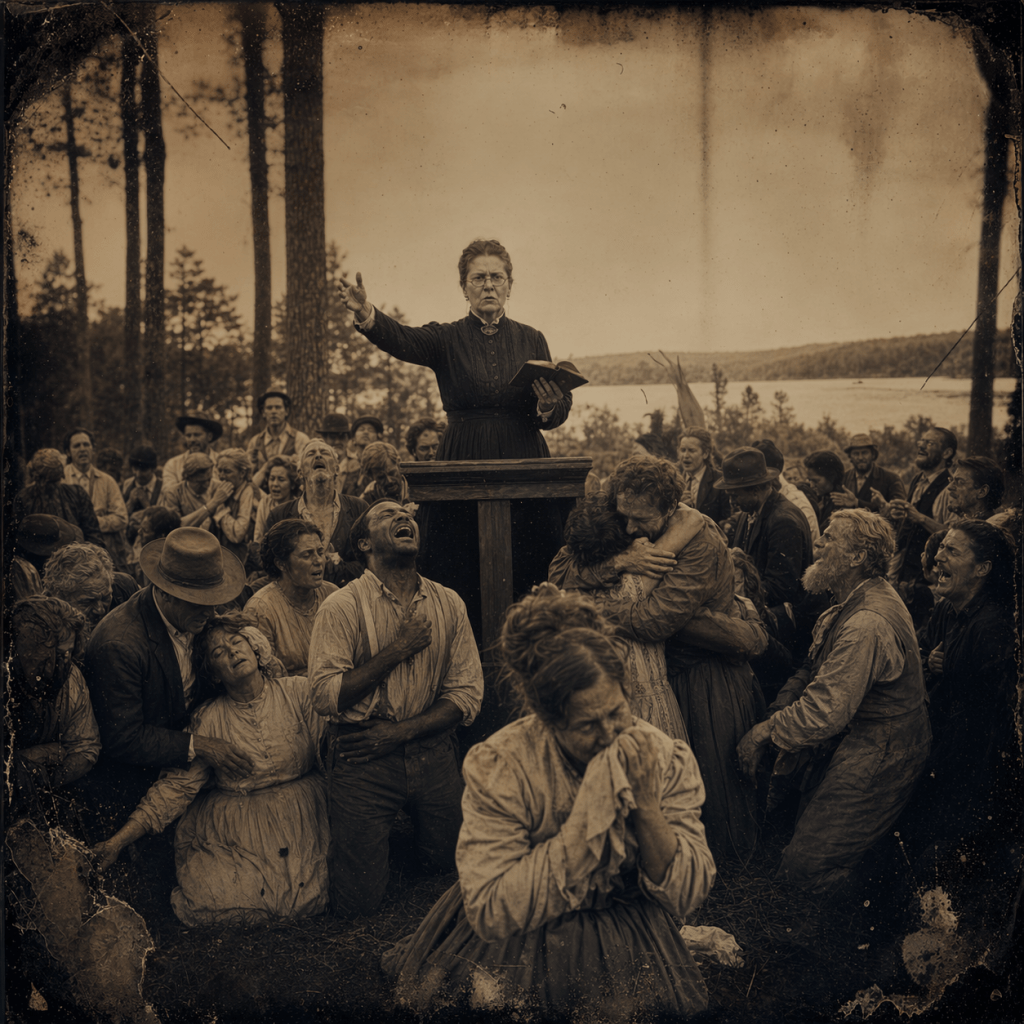
“They cried an’ laughed an’ argued an’ forgave one another, sometimes all in one afternoon. Too much feelin’ in one place, that’s what it was.”
“Why?” I asked.
She looked out the window a long minute before answering.
“Hot weather,” she said at last. “Crowds. Old frets. Old grudges. Or maybe jest one o’ them seasons.”
It wasn’t much for an answer, but it had some use in it. Often enough in those parts a person got nearer the truth by hearing what old folks would not quite say outright.
On the ride home Nell said, “You know what I think?”
“What?”
“I think everybody in them papers acted like they was standin’ too close to somethin’.”
“Too close to what?”
She frowned at the road ahead.
“Don’t know yet.”
Back at the museum we kept on digging.
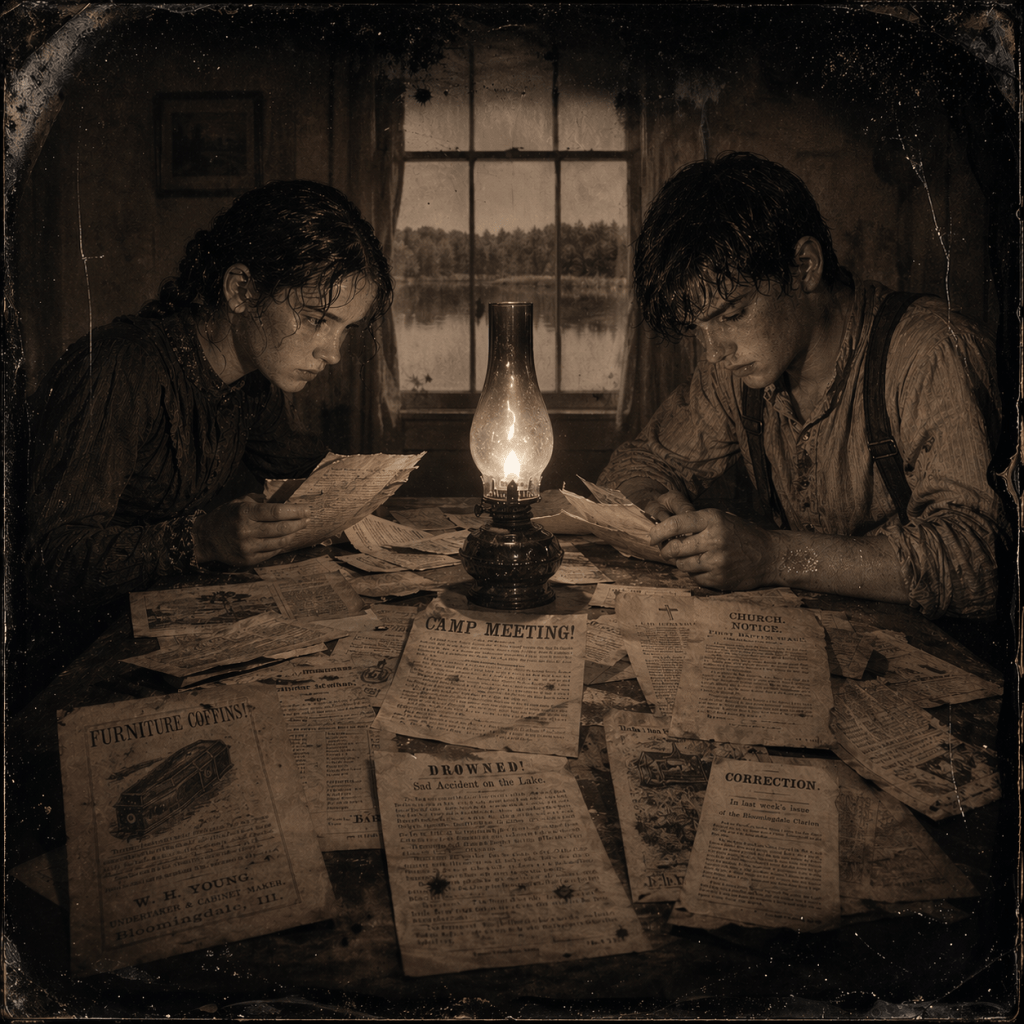
After a time we came across a clipping by a Bloomingdale correspondent who signed herself Addie Rondack. It was set up as a correction to some scandal that had run loose through town. But the correction never sounded sorry. Far from it. The writer admitted the exciting version of the tale wasn’t exactly true, then seemed tickled pink that such a fine poem had come from it anyway.
“It likes the made-up story better,” Nell said.
“Who does?”
“The town.”
I read it over again and saw she was right.
That was when the business shifted for me. Up till then I had thought the papers were only queer. From that point on I began to suspect they belonged together.
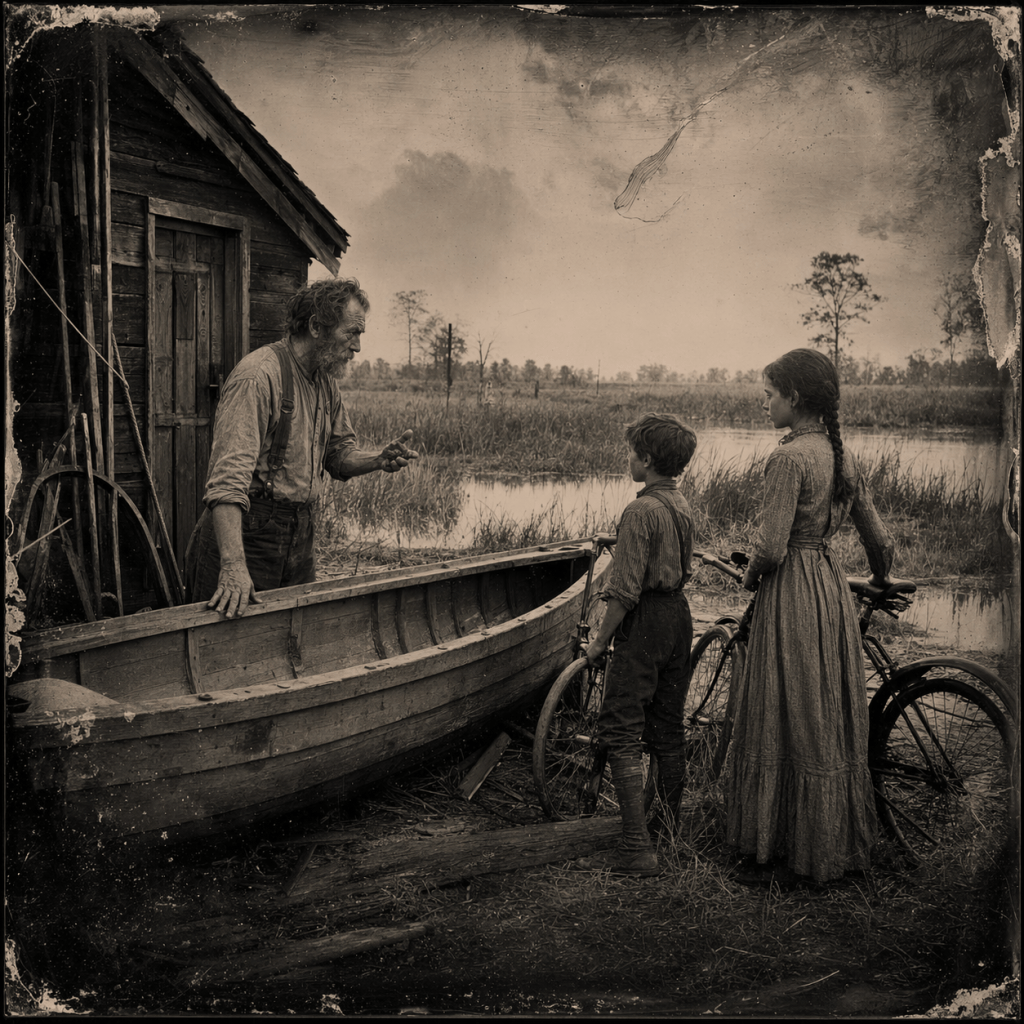
Later in the week we rode out toward an old bog carry and found a carpenter, Mr. Parkhurst, patching a skiff beside his shed. He had heard tell of the drowning.
“Terrible business,” he said. “Folks take a bog for water with grass on it. It ain’t. It’s got its own notion how things move.”
Nell cut her eyes at me over that one.
“Did your folks hear anything about the recovery?” I asked him.
“Only what comes down the line,” he said. “People said the bodies was found uncommon near to one another.”
“Caught in roots, maybe?” Nell said.
“Could be.”
“But you don’t sound certain.”
Mr. Parkhurst rested one hand on the skiff and studied the patch he’d laid in.
“The bog draws things together,” he said. “That’s all I’ll say.”
That night Nell and I made up a list.
The camp meeting.
The excitement.
The false rumor.
The flies.
The drowning.
That same heavy feel running through all the papers.
“It’s like the whole countryside caught hold of one idee,” Nell said.
“Or one mood,” said I.
“Or one trouble.”
Then I found the map.
It was shoved in the back of a drawer that always stuck halfway, behind a stack of old merchant cards. It had pencil marks on it—circles around Bloomingdale, Hayes’s grove, the Upper Lake, the bog carry, and River Street.
“Come look at this,” I said.
Nell was at my elbow in a jump.
On the back, in faint, rubbed-off pencil, somebody had written four words:
Too much opening tonight.
We both stood and stared at it.
Finally Nell said, “Wal, that’s a mighty unhelpful message to leave for decent people.”
We carried it straight to Mr. Vale. He read it twice and laid it down very gentle.
“I’ve heard that phrase before,” he said.
“You have?” I asked.
“A little. Not often. Might be an old local saying. Folks used it when a gathering got too worked up. Or when a place seemed to be takin’ in more noise, more temper, more talk, more excitement than was good for it.”
“Takin’ it in where?” Nell asked.
Mr. Vale lifted one shoulder.
“That depends whether you want the practical answer or the old one.”
“We want both,” I told him.
“The practical answer is nerves, weather, crowd behavior, and people bein’ people.”
“And the old answer?”
He looked toward the museum window, where a pair of flies were drumming against the screen.
“The old answer,” he said, “is that some places open wider’n they should.”
That evening I stayed late to help him shut up the museum. The downstairs reading room had gone dim and yellow under the lamp, and the whole building had that close, hollow sound old places get after everybody’s gone home. I was headed for the door when I happened to look back and saw something dark on the table.
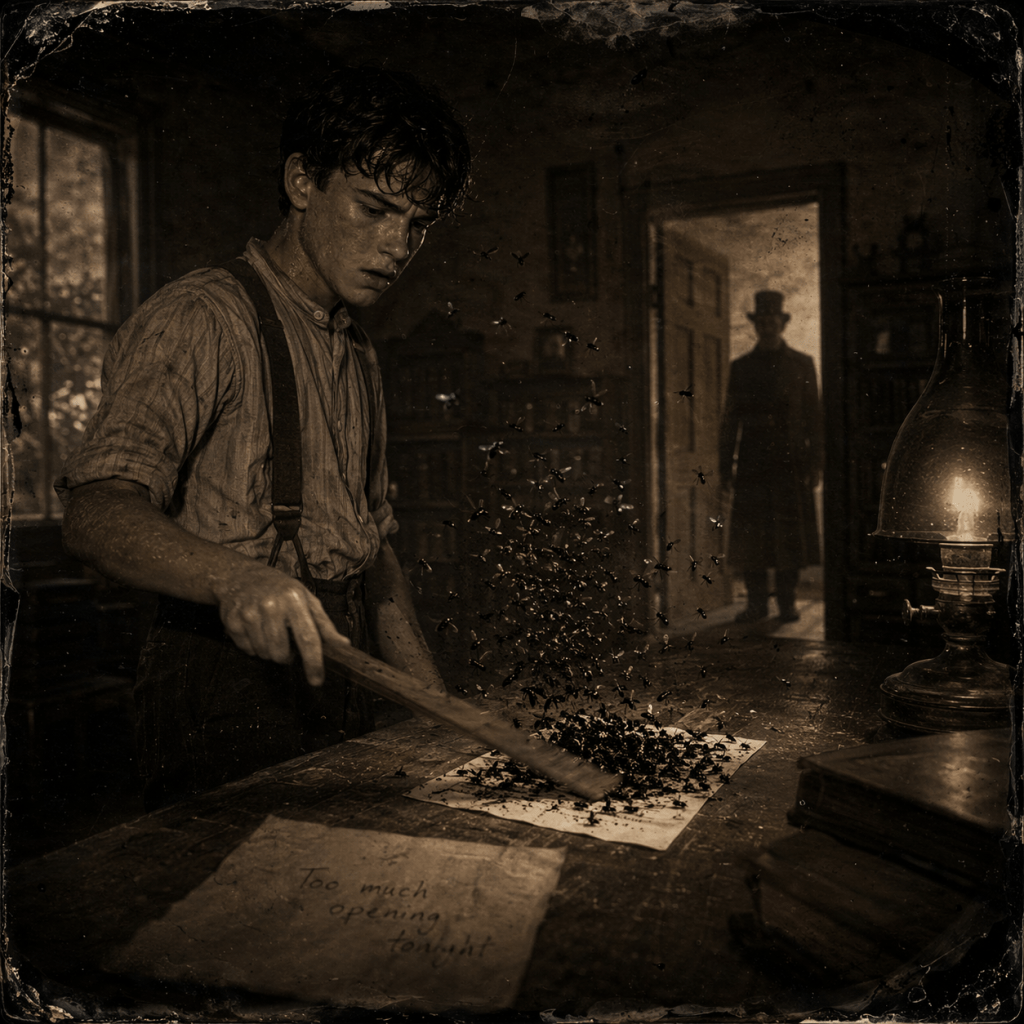
A swarm of flies.
Not all over the room, mind ye. Not at the window, nor the lamp, nor the wastebasket.
They were thick on one single object.
The old Bloomingdale handbill.
Every hair on my arms riz at once. I snatched up a ruler and swept at them. They lifted in a black buzzing cloud, circled the room once, and broke apart.
The handbill lay there, bent at one corner.
I turned it over.
On the back, in faint pencil, was the very same message we’d found on the map:
Too much opening tonight.
The floor creaked behind me and I near jumped out of my skin. It was only Mr. Vale.
“You look peaked,” he said.
I held up the paper.
He did not laugh.
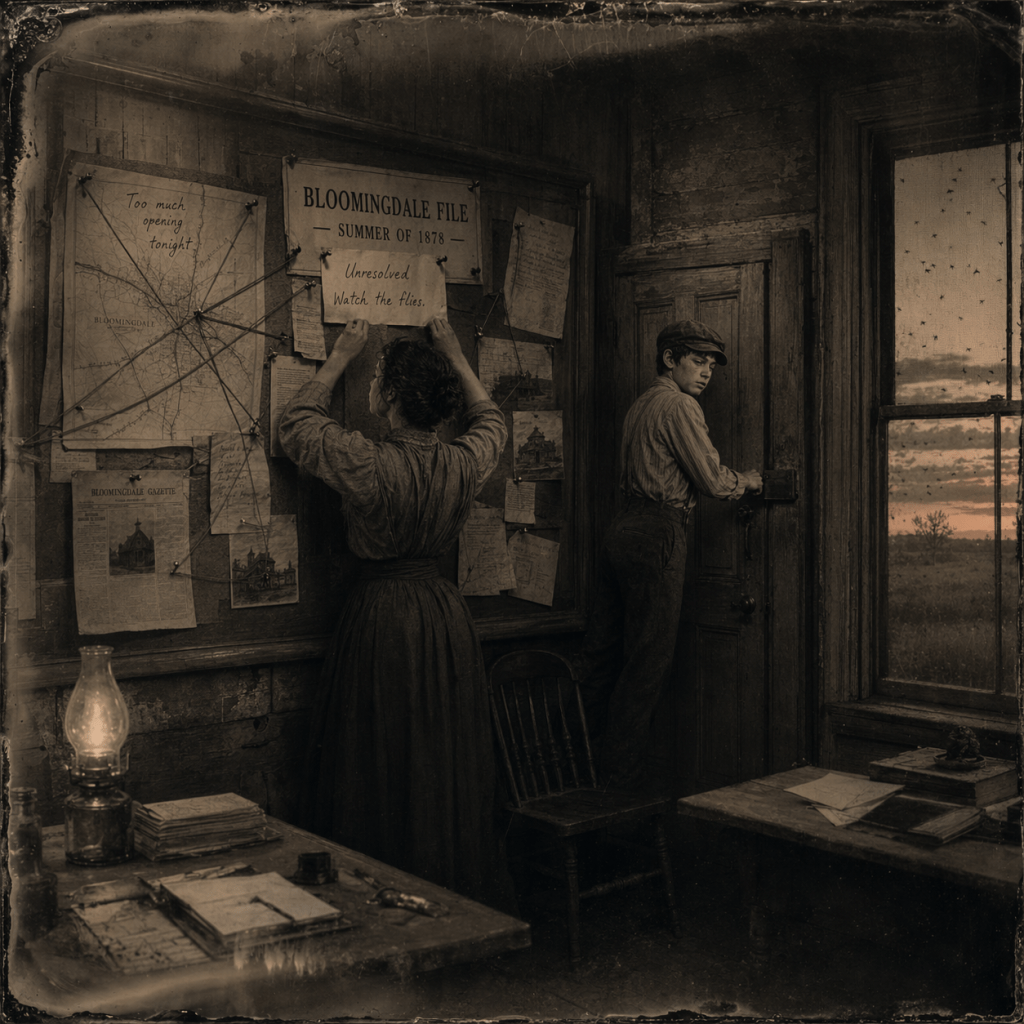
Next morning Nell and I pinned the whole business to a board upstairs. We stretched lines between the places marked on the map—Bloomingdale, Hayes’s grove, the bog, the Upper Lake, Malone—and under them we fixed every scrap that seemed to bear on the thing.
Too much excitement.
Too many flies.
Too many rumors.
Too many things swelling beyond their proper size.
“It’s as if the whole country was listenin’ to itself,” Nell said quietly.
That was the best phrase yet, and I knew it the minute she spoke it.
For the rest of August we kept our eyes open.
We went to a prayer gathering near the old Hayes land and watched people sing longer and louder than anybody expected.
We checked the windows mornings to see how early the flies would come.
We asked guides and farmers questions that sounded foolish in the asking and got answers queerer still.
Then one evening, standing by Upper Chateaugay Lake while the light went out over the water, we heard something carry across from the dark.
It was a sound.
Not loud.
Not plain.
Only enough to stop us where we stood.
Nell turned to me. “Did you—”
“Yes,” I said.
Neither one of us tried to put words to it, and somehow that seemed the right course.
When we got back to the museum we tied the papers into a fresh bundle and set them in the upper cabinet with the local marvels, disputed accounts, and matters no one had ever properly explained. On the label I wrote:
BLOOMINGDALE FILE — SUMMER OF 1878
Unresolved
Nell leaned in and added one more line beneath it:
Watch the flies
Mr. Vale read that, nodded as if it were sound museum practice, and locked the cabinet.
I locked the front door.
And though I told myself it was only on account of the hour, I noticed I was right glad we’d done it before dark.
#AdirondackGothic
#FolkHorrorMystery
#SmallTownUncanny
#CosmicRegionalWeird
#MuseumMystery
#BoglandDread
#OccultArchiveFiction
#HistoricalWeirdTale
#RuralSupernaturalSuspense
#ShatageeWoodsHorror

What mysteries of Chateaugay Lake haunt you?