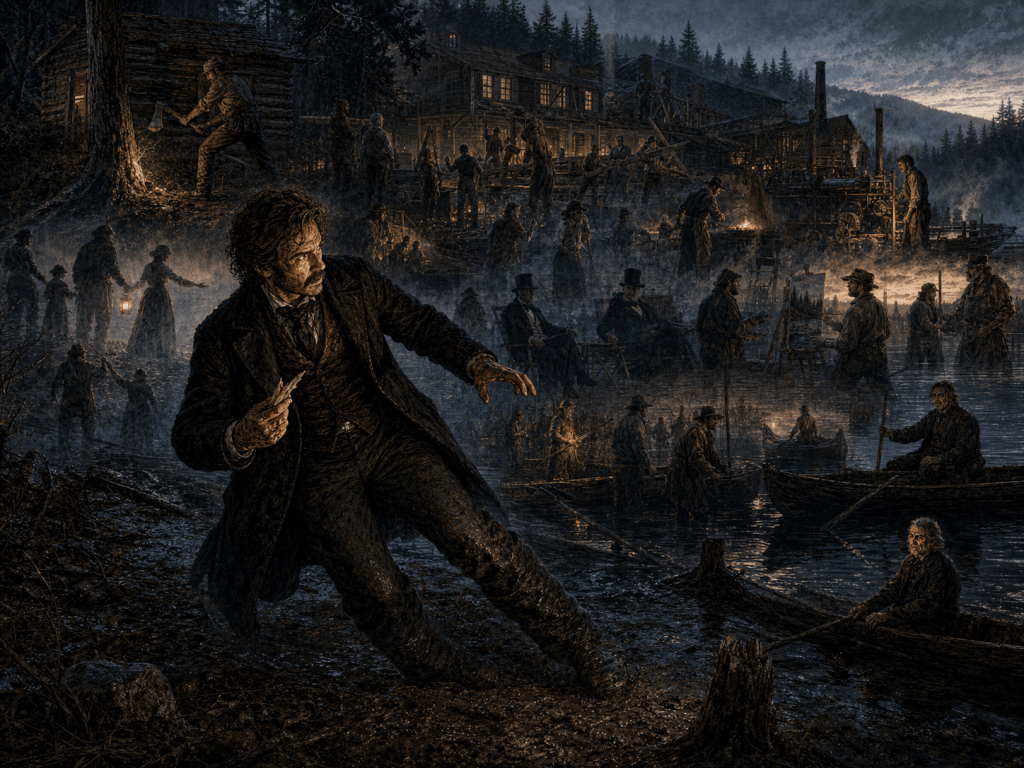
Readers are advised this Banner House item contains lake fog, old ledgers, untimely axe-work, and such ancestral bookkeeping as may trouble sleepers lodged too near Lower Chateaugay’s earlier arrangements.
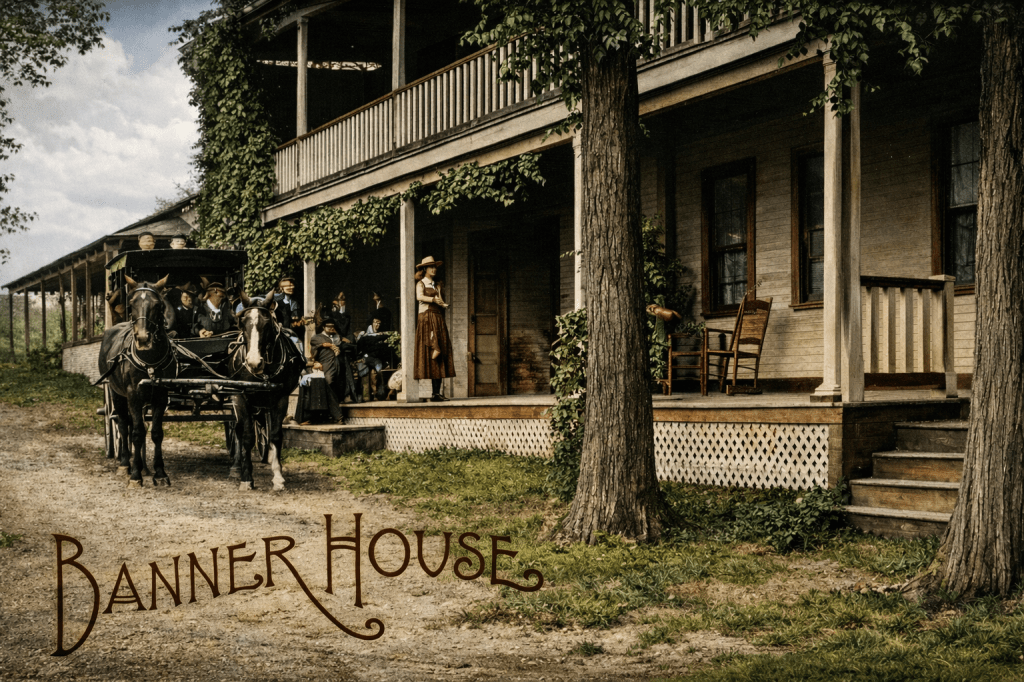
THE THREE AXE-BLOWS AT BANNER HOUSE
Dear EDITOR:—
There is, I think, no pleasanter deceit among us than the belief that an old country hostelry must be wholesome because it is old, or innocent because it stands remote from the feverish vanities of towns. A lake, a line of blue hills, a good table, an obliging landlord, and a piazza where one may hear the evening insects tune themselves in the grass—these things breed in the common mind a faith almost theological. Yet there are houses in the North Country whose beams are too seasoned with memory for comfort, and whose hospitality is so antique and layered that one may be lodged not by one generation only, but by all who have entered there since the wilderness first learned to receive a guest.
I had this reflection last autumn at the old Banner House on Lower Chateaugay Lake—that venerable resort which began, as every schoolboy in Bellmont knows, in Gates Hoit’s rude hunter’s shanty occupied by the Drews before Jonathan Bellows found it on his trap-line and made of it, by degrees, a house fit for sportsmen, painters, and those British officers who once summered there in tents with an appetite for potatoes, peas, trout and venison no less complete than their gravity. By daylight the place offers all that might content the stoutest lover of the homely Adirondack order: woods sloping to still water, long modest mountains beyond, and a rural quiet that seems less a silence than a compact among pines, shores, and old furniture. One remembers, too, the artists who visited in earlier years—Tait and Harding and the rest—and is tempted to believe that a house so often studied by painters may, in time, acquire an unwholesome consciousness of its own aspect.
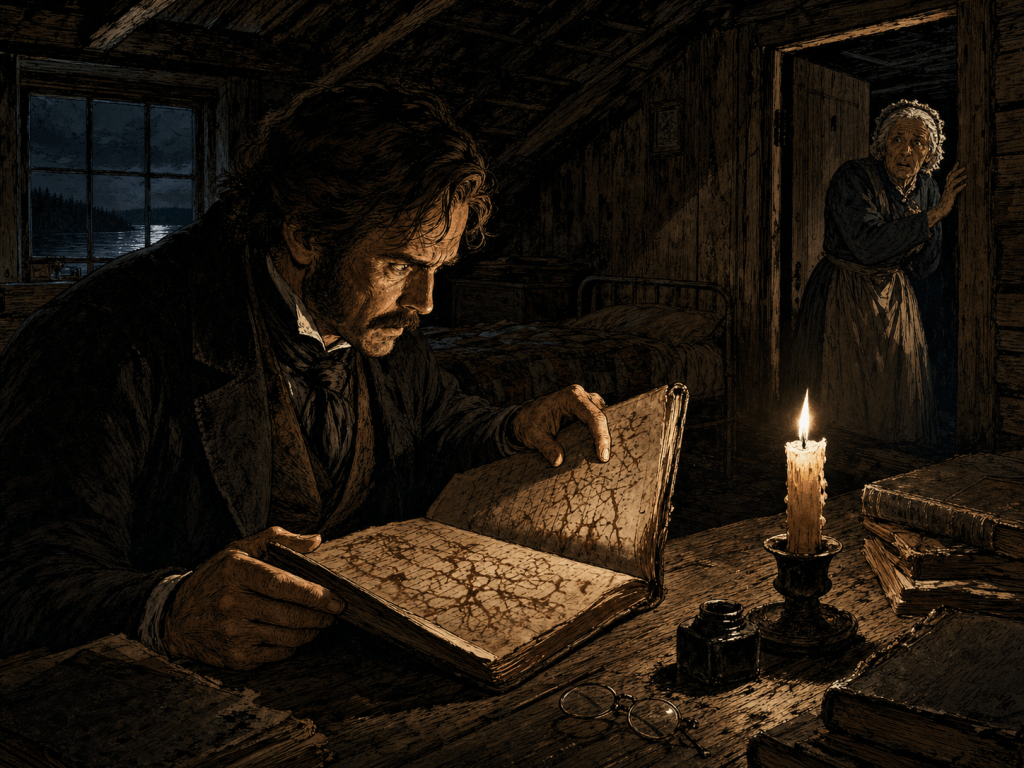
My room lay in the older part, beneath a roof that had certainly heard more histories than the county records preserve. Because I had gone there in a mood of idle antiquarianism, I amused myself the first evening with old ledgers and registers brought down at my request from a closet smelling equally of camphor, dust, and lake damp. There were entries of sportsmen from Springfield and Montreal, of guides, merchants, and a divine or two; and on some pages, curious memoranda in several hands touching weather, trout, road conditions, and the state of the haying.
But beneath these honest, perishable signs of mortal travel appeared, at long intervals, another hand—thin, cramped, brownish, and so indistinct at first that I mistook it for water-stain. It repeated no commonplace surname of the neighborhood, but a single Christian name, written once only on a page and never twice in the same year.
The name was Moyes.
You may say I should at once have remembered the old woodsman and guide of that name—the St. Germain or Sangemo of northern lake gossip, whose queer woodland fame, medicinal lore, rough cookery, and almost fabulous cries in the forest have drifted from Chazy to the Upper Chateaugay like smoke from a smouldering brush-pile. So indeed I did remember him, though vaguely. Yet the oddity lay here: one entry stood under a date preceding the enlargement of Bellows’s house, and another appeared on a page which, by all internal marks, belonged to the period before any house stood there at all, save the original shanty. More than this, one note set down beside the name in a different ink, perhaps by some jocose guest, read: “Came over the water without boat or wetting.”
A foolish pleasantry, no doubt; but to a mind already infected with old paper and autumn dusk, it possessed a disagreeable vitality.
The landlord, whom I shall spare by withholding his name, laughed with that guarded provincial laughter which neither admits nor denies, and said only that old books gather old nonsense as barns gather bats. Yet an elderly servant-woman, hearing us from the door, crossed herself in a manner not wholly Roman and asked whether I had also found the page where the strokes were marked.
On my professing ignorance, she would have said no more. But later, after supper, when the lamps were lit and the lake had begun to turn from grey to dark metal beyond the windows, she told me in fragments that certain sleepers in the old part of the house—especially in weather close and still—had heard, toward two o’clock, three axe-blows from the shore below. Always three, slow and full, as though laid into green timber by a man who knew the grain. Then, if one were foolish enough to listen further, one might hear a fourth sound which was no blow at all, but rather the soft rush, or inward sigh, of something immense consenting to fall.
“Mrs. Drew asked for three,” the woman said. “Them that hear four had best not answer.”
That night, being in the temper of all meddlers who call themselves merely curious, I sat later than prudence advised with the register, a candle, and a small local history. The pages touching the first settlement, Bell’s gift of land, the lake crossing in the canoe, the Bellows enlargement, and the later forge, mills, and ore-talk all contrived by their sobriety to render the place more singular rather than less. For what is more terrible than a wilderness that receives law, householding, religion, commerce, and summer boarders without ever surrendering its prior title?
I had not gone far in these reflections when there came from the lakeside a sound so exact in its measured force that every fibre of my body recognized it before my mind gave it a name.
It was an axe.
After a pause, it came again.
Then a third time—heavy, resolute, and somehow dutiful, as if sent as a sign to someone waiting in another age.
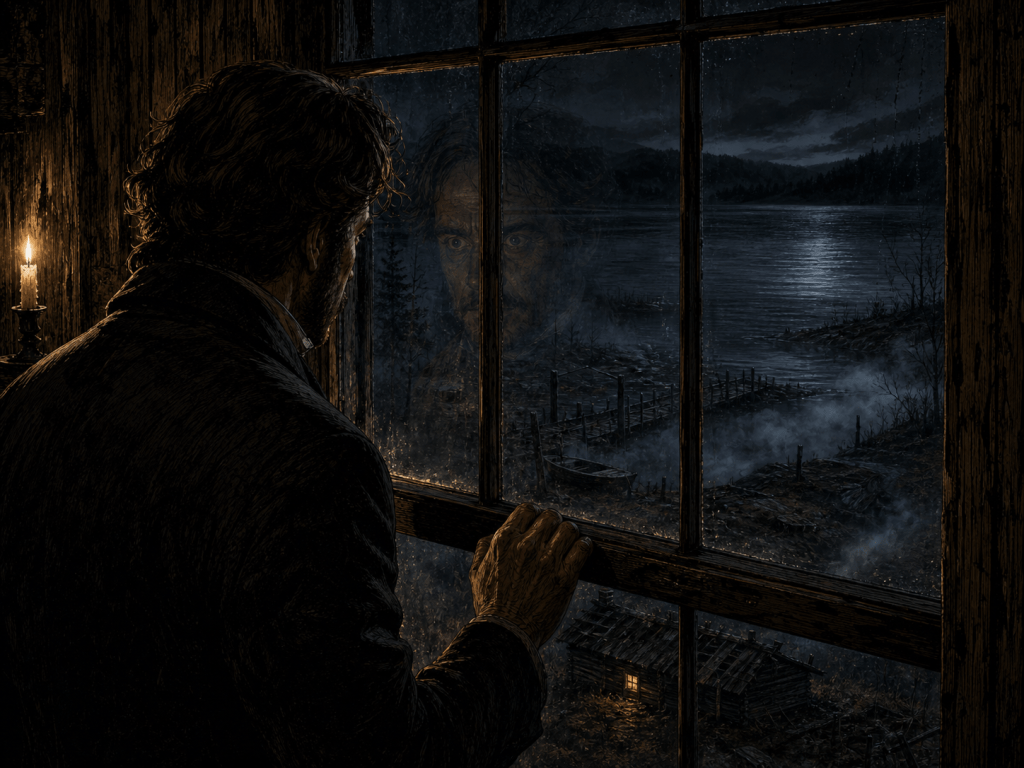
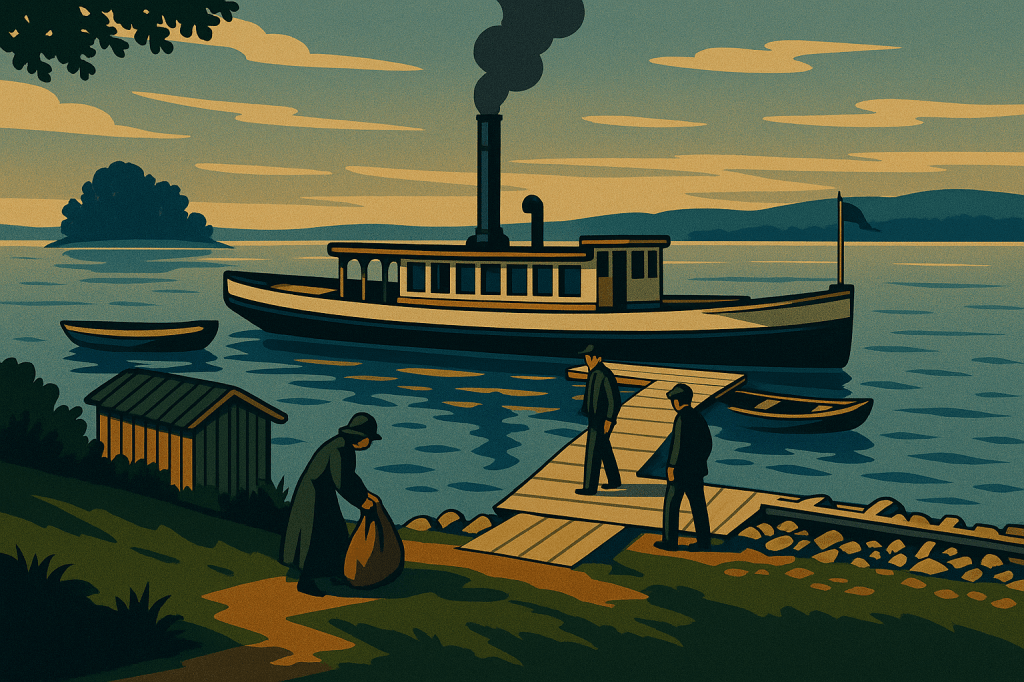
I rose, though not with courage, and went to the window. The night was moonless, yet possessed that dim northern transparency in which water, sky, and mountain are not seen so much as guessed by degrees of blackness. At first there was nothing save the shore, the outline of a landing, and the long vegetal gloom of the margin. Then, a little to the left of the dock and lower than the present lawn, I perceived what no topography of the place should have contained: a single warm square of light, low to the earth, as from the window of a cabin half-sunk in the ground.
Around it the trees were fewer than now, and beyond it the lake seemed broader, more savage, and not yet disciplined by repeated visitation. The structure did not come into view as apparitions do in romances, abruptly and theatrically. Rather, the present scene thinned away from it, as mist thins from a stump, disclosing what had been there all along beneath the more recent arrangement of porches, sheds, paths, and respectable improvements.
While I gazed, torn between the rustic explanation of sleep and the more dangerous one of sight, there came from somewhere inland that cry which older travellers ascribe to Sangemo’s woods, and which no combination of panther, donkey, wolf, Okwari, and devil’s trumpet has ever adequately rendered. It was not a cry moving through air in the ordinary sense. It seemed instead to shake the very categories by which one distinguishes near from far, throat from horn, beast from man. When it ceased, the little light by the shore went out—not suddenly, but as if a hand had been drawn slowly across it from within.
I know not by what idiocy of resolve I dressed and went below. The house was wholly quiet, though not naturally so; for old corridors in such places harbour innumerable timbers, fabrics, and fittings which creak, settle, mutter, and confess themselves to the night. Yet all these proper murmurs were absent, leaving an expectancy worse than sound.
At the back door I found, not my boots alone, but a second pair of tracks in the damp earth beyond the step—bare, narrow, and deeply cut, as of a man accustomed to carries, bog edges, and frozen bark. They led past the present boathouse and ceased at a patch of older ground where no grass grew evenly. There the air was tinctured with an odour I could not at first place. Then, with a disgust more intellectual than sensory, I knew it: the mingled breath of fresh chips, cold hearth-ash, rotting deer-hide, and something metallic, such as clings to worked ore or the damp stones near an abandoned forge.
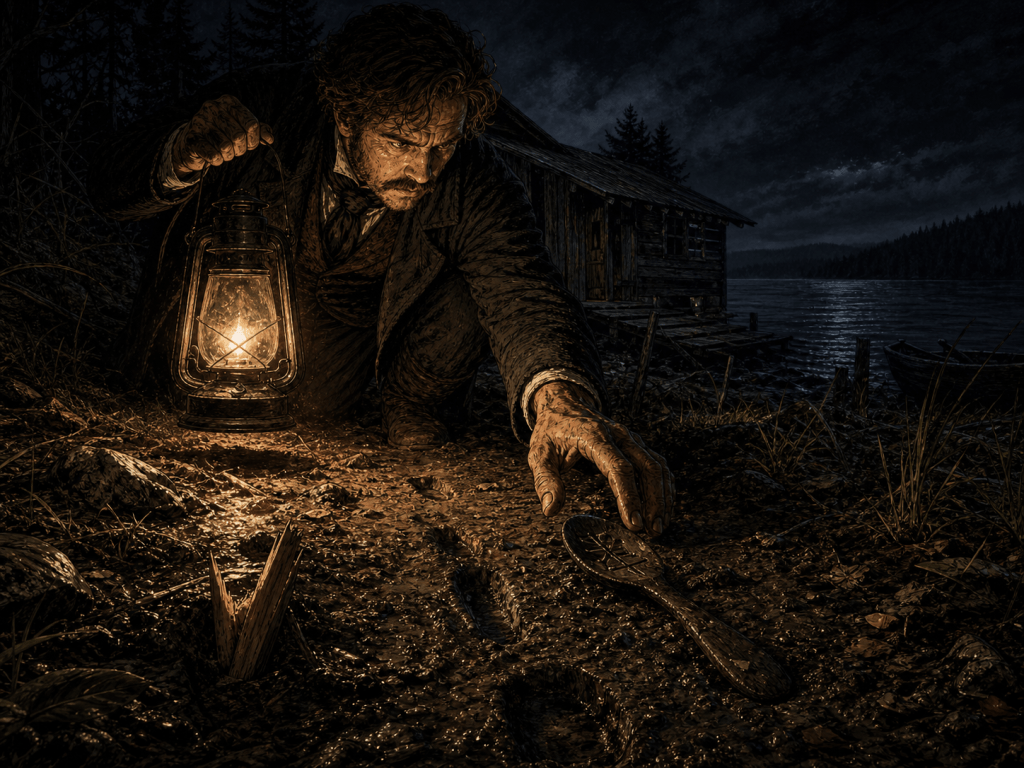
At my feet lay a chip of white ash newly severed. Beside it, half-sunk in the mould, was a thing I brought up only because the hand had obeyed before the mind could forbid. It was a spoon, rude but shapely, dark with age and handling; and on its back was cut, in a stiff and clumsy manner, the letter B crossed through with three short notches.
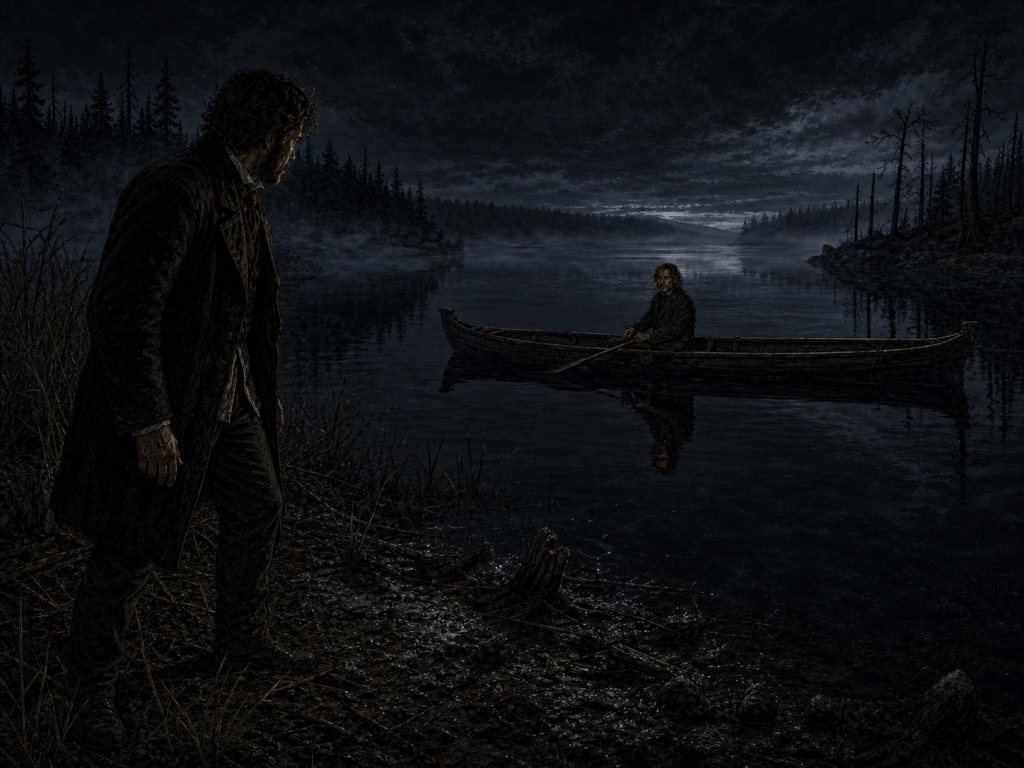
I had scarce turned it in my hand when the cry sounded again, not now from inland but from out upon the lake itself—if lake it still was. For the black water before me had assumed an extension no modern chart would sanction, and the far hills had withdrawn to distances vastly exceeding their daylight contract. A long, narrow craft moved there without ripple, and in it sat, or seemed to sit, a man of singular slightness, with hair blown forward though the trees were windless, and a face not old, not young, not wholly of any fixed blood, yet stamped with an immemorial familiarity. He did not beckon. He only watched, as guides watch city sportsmen deciding whether they possess legs enough for the carry they have bragged about.
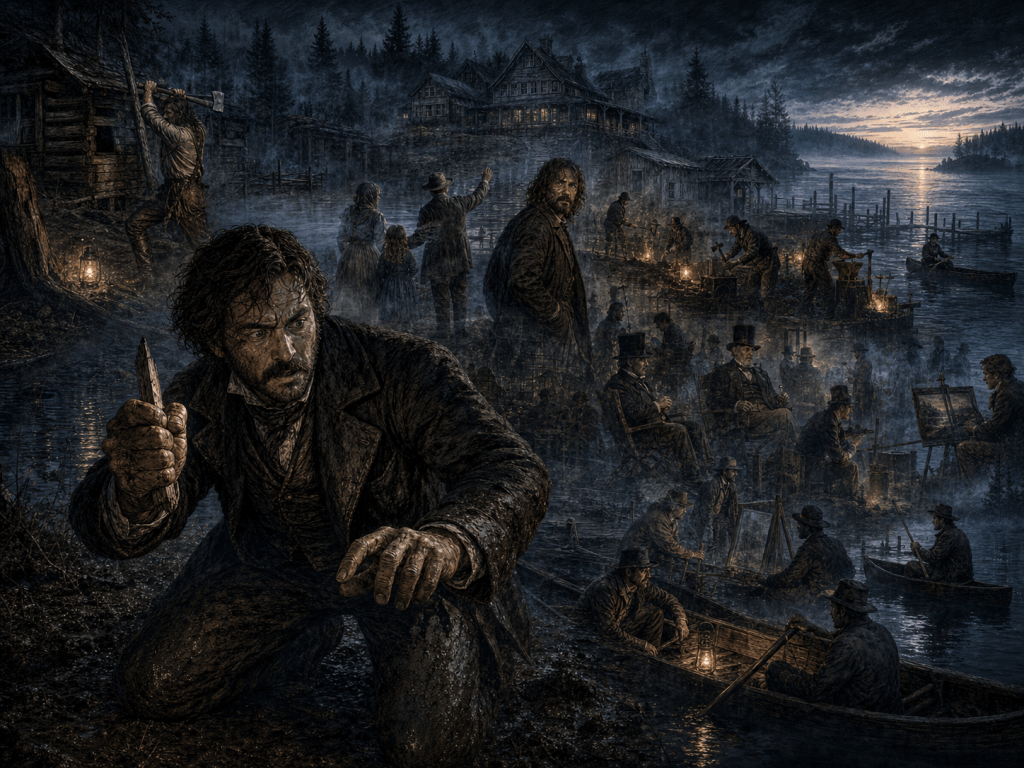
What followed I relate with shame, for there are thresholds honest men ought not to test. I advanced one pace toward the water, and in that instant saw behind the seated figure—not in sequence, but all at once—the several occupancies of the place: Drew striking his signal blows to comfort the wife across the dark water; Bellows enlarging the old refuge into hospitality; the tenting officers from Montreal; painters fastening some fugitive line of shore to canvas; mill-men, ore-men, and forge-men black with industry; and, between these human layers as fungus lies between bark and wood, the older tenancy of something that had not been displaced, but merely instructed in patience.
It was the same thing, I think, which listens while we name roads and lots, and which afterward uses our names as a man uses borrowed tools. In one appalling flash, the local histories, guide-books, guest registers, and recollections of old servants seemed not records of possession, but receipts—small, vain acknowledgments issued by transients to an owner who never signs.
Then, as if some rustic grace still lingered over the household, there came again the three axe-blows from behind me—full, dutiful, reassuring—and with them the entire prospect broke like April ice. The lake contracted. The boat vanished. The common shore returned. I found myself upon the damp ground at dawn, chilled, unbecomingly muddy, and clutching the ash chip until it had cut my palm.
The spoon was gone. Of the tracks there remained only my own confused stamping. But in the register, on the page where I had last seen the brownish name, there now stood beneath it a fresh entry in my own hand, though I swear to Heaven I never wrote it:
“Slept light. Heard answer. Stayed ashore.”
I left the Banner House that same day under pretext of business in Malone, and have since taken pains to sleep elsewhere when in that district. Yet I cannot free myself from the conviction that the old hostelry, so commendably civil by sun and supper-lamp, contains in its lower timbers an arrangement of memories less domestic than architectural. One need not deny the excellent table, the admirable view, or the long and creditable local history of the place. Indeed, these may be the very means by which the older claim is masked and perpetuated. The wilderness, like certain ancient landlords, prefers regular payment in courtesy.
Should any of your readers sojourn there in close autumn weather and hear, beneath the customary nocturnal sounds, three measured strokes of an axe from the lakeward side, I counsel them to be grateful for the number and remain where they are. For there are signs which mean merely that all is well, and there are others—always one more than needed—which signify that what was first there has turned, at last, to see whether its guests are still awake.
BELZORAM
P.S. Since writing the above, I am told by a perfectly sober old gentleman from the Chazy direction that there once were guides who could make such a cry in the woods as to spoil the courage of dogs, sportsmen, and even the hills for up to half a minute at a time. If so, I trust they did not also keep registers.
#ChateaugayLakeFolklore
#AdirondackWeirdTales
#NorthCountryGothic
#ShatageeWoodsMystery
#HistoricalFolkloreHorror
#BrainardsvilleStrangeHistory
#LakeCountryHauntings
#AdirondackFolkHorror
#RegionalMysteryTales
#BackwoodsHistoricalSatire

What mysteries of Chateaugay Lake haunt you?