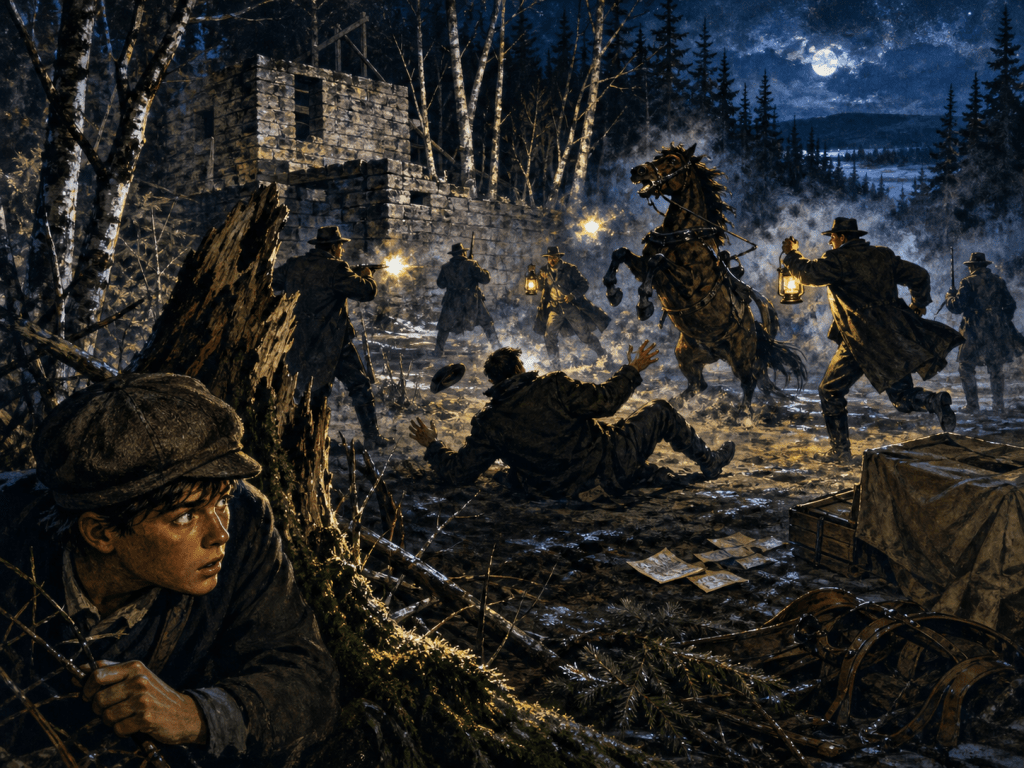
Advisory: This East Bellmont account includes rumored gunfire, broken brush, shells, dark-coated public business, compass tricks, and the dreadful possibility that one’s firm opinion arrived earlier than the facts, wearing borrowed boots.
SHATAGEE GITASKOG’S INN, UPPER CHATEAUGAY LAKE, N.Y., 14 MAY 1969.
The Cold May Exercises at East Bellmont
I HAVE been asked more than once about the queer doings reported at East Bellmont in May, 1895, near the old mill clearing and the lower road. The matter interested me because my father knew several of the men who spoke of it, and because the story has been improved so much by later talk that a plain account may be useful.
The spring of that year was a backward one. The frost came in May after many gardens had been put in, and I have heard my father say that wash froze on the line as stiff as shingles. Hiram Cooley, who was a good man to sit by a stove with, said this proved that the weather was managed by men who owned more pamphlets than potatoes. He was thawing his boots at the time, which gave his opinion weight.
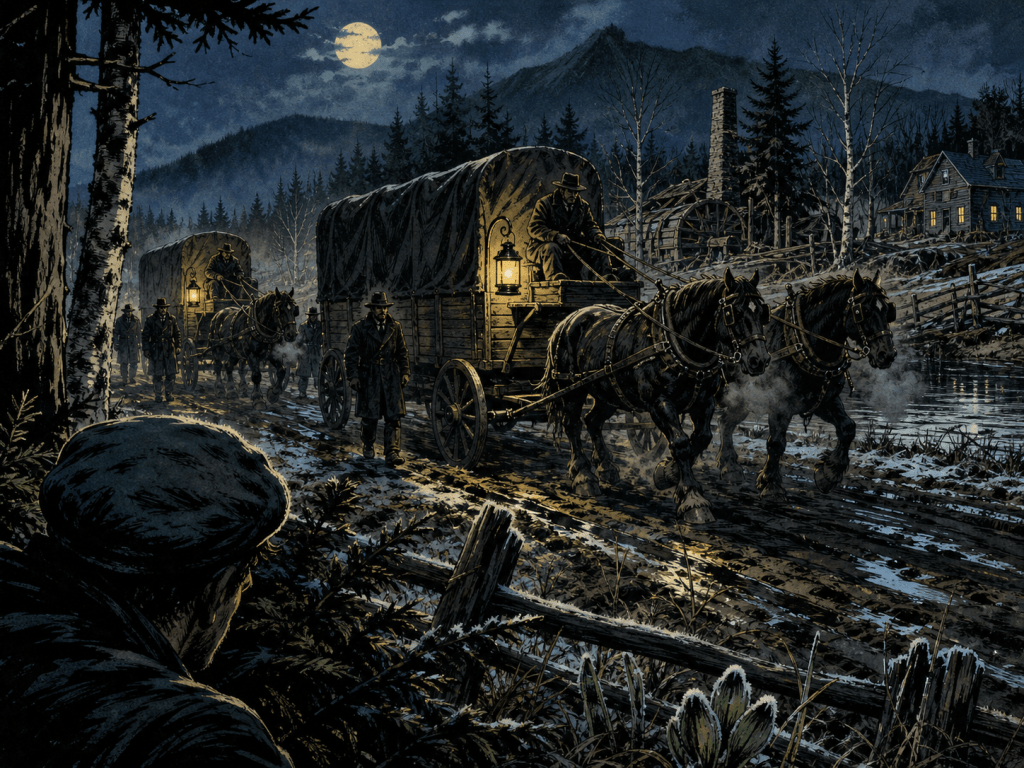
About then there was talk of teams going by after bedtime with covered boxes, too large for common store goods and not shaped like church repairs. Several men in dark coats were seen about the clearing. They had the appearance of being engaged in public business, though nobody could learn what public it belonged to. It was given out that some sort of official exercise was being held there.
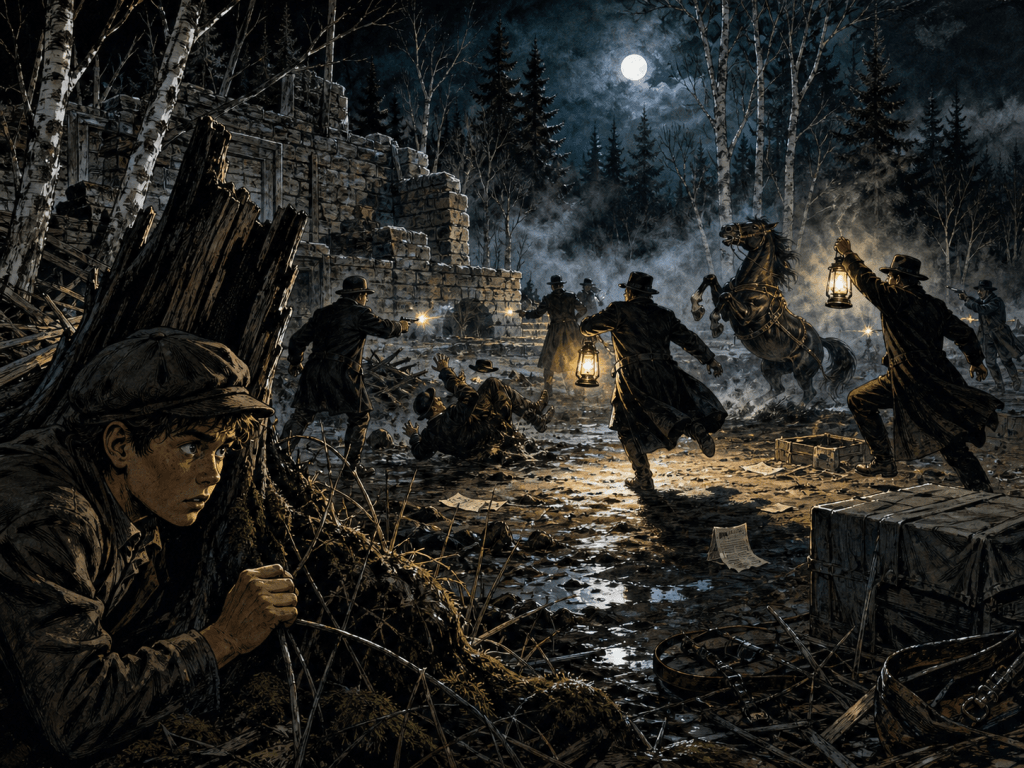
Young Ezra Pike, who had a talent for being where older people wished him not to be, claimed he saw part of it. He said there was shouting, running, falling down, and what sounded like gunfire, but everything happened so regular that it lacked the natural disorder of trouble. One man fell before Ezra thought he had reason to, and even a loose horse, according to Ezra, behaved as though it had been rehearsed.
My father said the old folks at the store were divided about it. Some thought it a trap for lawbreakers. Some said it was a demonstration of new methods. Others, who had more imagination than rest, believed the whole thing was arranged so that honest witnesses would later swear it happened of itself. This made conversation careful for a spell, for a man does not like to find that his own opinion may have been brought in with the freight.
Deacon Wells gave the best judgment I ever heard on such matters. He said a man had better look at what is before him and not go hunting for what he has already made up his mind to find. That saying should have been painted over several doors in this county. Many a fellow has found evidence in his own pocket and then blamed Providence for putting it there.

There was also some talk that compasses behaved poorly around the clearing. The guides said paths doubled back, bearings repeated, and a man walking straight might come again to the same leaning birch. Silas Drown, who had guided more summer men than most of us have had Sunday dinners, said the woods always told little lies, but in those days they seemed to be lying with a purpose. Silas was not a man to dress a tale for company.
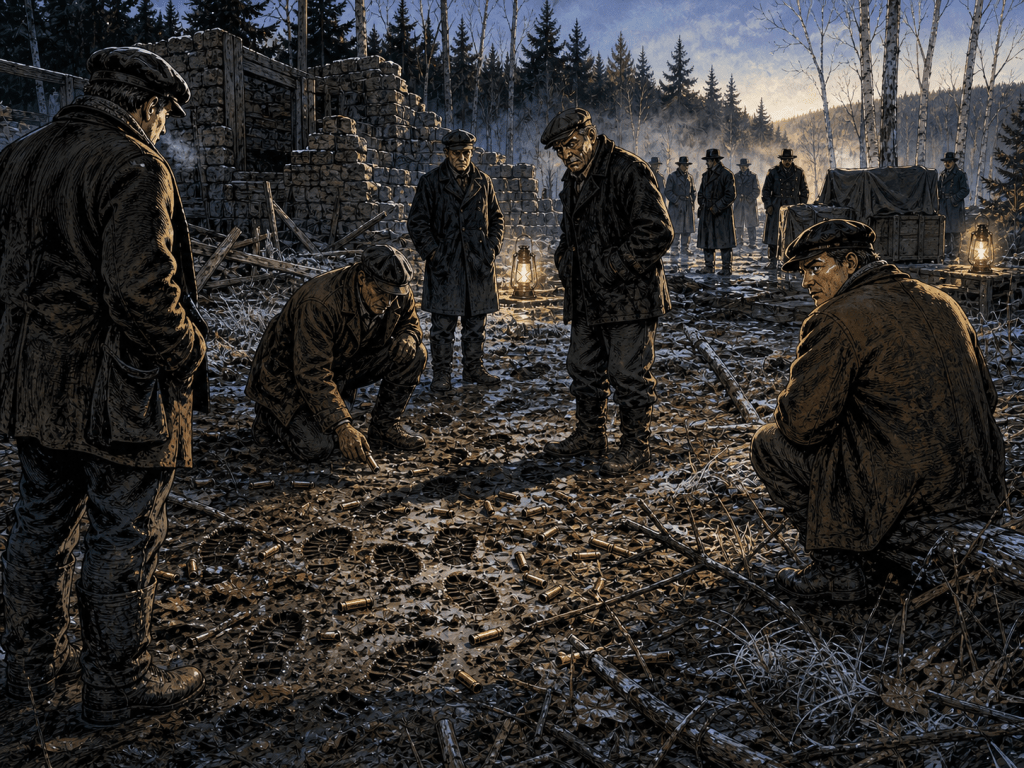
After another night’s disturbance, there were many marks on the ground: tracks, broken brush, shells, and places where men had stood or fallen. Some thought there were too many signs, as though whoever made them feared one good sign would not convince the neighborhood. When inquiry was made, the answer was that all was under control. That phrase never comforted country people much, for a thing under control may be made to look like some other thing.
Mrs. Eliza Pritchard said afterward that the strangest part was not what she saw but what she felt. She said certain conclusions seemed to be waiting for her before she had heard enough to reach them. That is a sharp observation for any age. I have known men to be persuaded first and informed afterward, and they were the last to notice it.
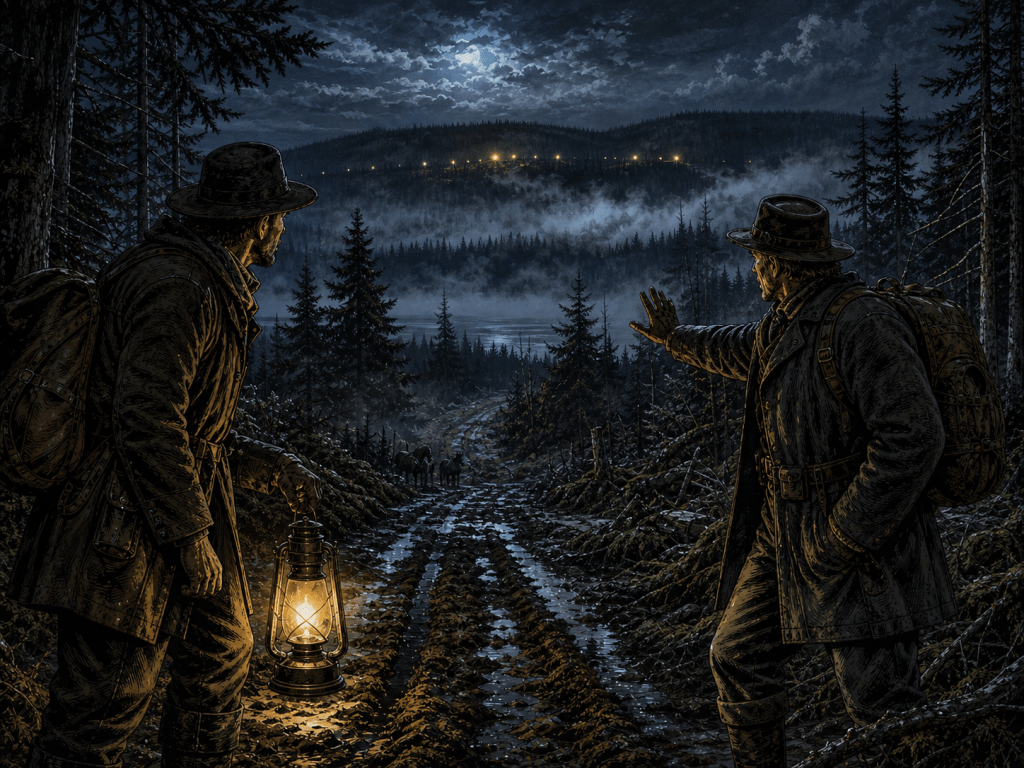
Lights were seen beyond the ridge for several nights, steady and then shifting, though no one admitted sending or receiving them. The guides would not follow them. One of them said they did not belong to any road that brought a man home, and such remarks from woodsmen are worth preserving.
I do not pretend to solve the East Bellmont affair. It may have been official practice, a foolish alarm, a trap, or only a piece of county mystery with frost on it. I only know that in May, 1895, the gardens waited, the store stove was busy, and the old mill clearing gave the people more to think about than was good for sleep.
Mordecai Vilecreek
Route 2
Chateaugay, N. Y. 12920
Lil’ Nippers’ Lake Traditions
Spring, 1969, 6-7.
#EastBellmontMystery
#ColdMayFolklore
#AdirondackGothic
#ChateaugayLakeLegends
#NorthCountryWeirdness
#ShatageeWoodsLore
#RuralCosmicMystery
#OldMillClearing
#StrangeCountyHistory
#UncannyWilderness
Correspondence from East Bellmont
Lower Chateaugay Lake has of late been favored, if that be the proper word, with a kind of argument that usually belongs to cities, lecture-rooms, and persons who carry long opinions in short valises. Certain parties from the down-state counties, being well furnished with notices, objections, and an appetite for public correction, have set themselves to asking whether art is real unless it comes with a pedigree tied to its neck like a fair-ground calf. They appear to think a tune must show its grandfather, and a contrivance of sound must produce baptismal papers, or else be turned out into the road.
This has made no little amusement here, where a man may play a battered fiddle till it sounds like judgment morning and still have three neighbors declare it finer than a conservatory, provided he keeps time and does not saw with his elbow. Others, to be fair, hold that if a Stradivarius be put into the hands of an unskilled lout, the violin remains noble but the performance becomes a public affliction. There is reason in that. Yet another class says the age is changing, and that an array of oddly built devices connected by wires to speaking-trumpets and sounding-boxes may do as much toward moving the soul as horsehair and spruce ever did, if only the thing be honestly made and not puffed up by pretenders.
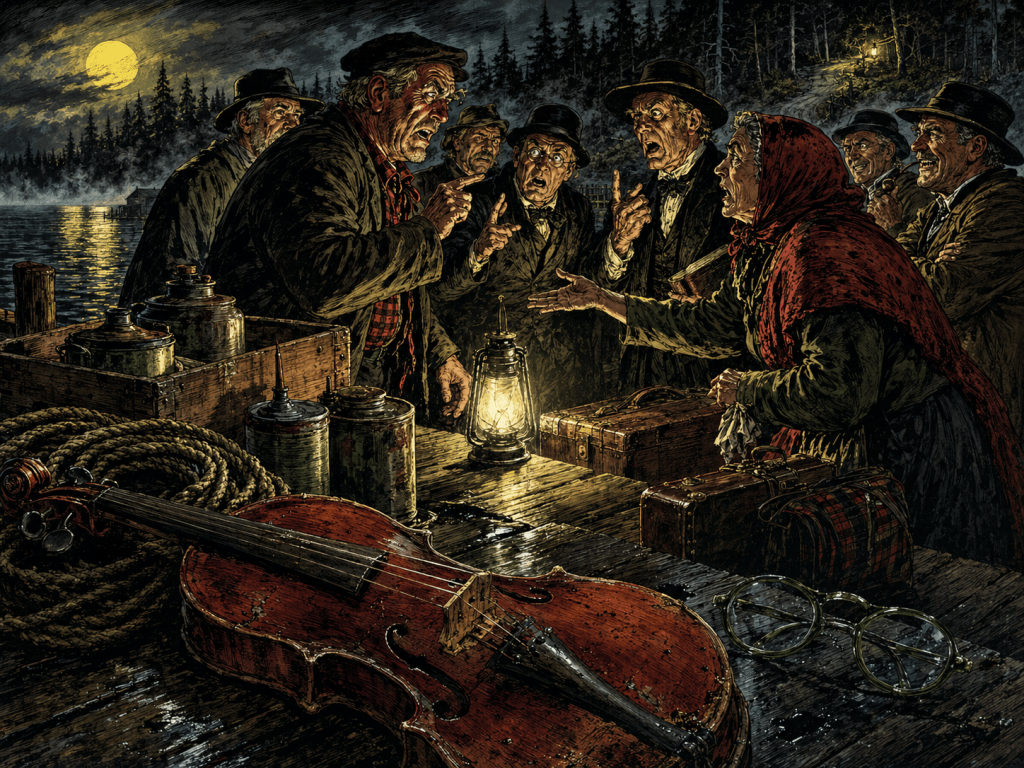
It was at the store, and afterwards at the lower landing, that most of this was argued. Mr. Hiram Bellows said, in his dry manner, that a new sort of art seems always to arrive with two wagon-loads of explanation and very little melody. Deacon Wells, who is not hostile to improvement when it minds its manners, replied that folks ought not to “find facts they done already cooked up,” which was his way of warning both sides against being over-ready. Mrs. Pritchard, who has a quicker instinct than many scholars, declared the mischief in these matters is not the music but the insistence that everybody admire it correctly, like a lesson at school. Silas Drew, standing with one boot on the meal chest, observed that the woods tell lies sometimes, but city men tell them on paper, which gives them a harder look.

Into this discussion there came, by the post and in much haste, a packet of notes meant, as the sender plainly stated, to settle the matter of “real art” once and for all. It concerned one Johqu Bogart, well known to some of our readers by reason of his connection with the Museum of Unnatural Hysteria, and was offered up as proof that his work was no sham, no airy counterfeit, no second-hand fraud dressed in borrowed dignity. The note-writer, being much heated in spirit, set down that Johqu had not only done the whole labor with his own hand, but had copied the complete score in pencil after an surgeon performed an operation on his finger earlier that very day, the very manuscript showing actual blood where the wound had opened again. He sat up all night, so the account runs, by candle-light; and when the pencil failed him or the temper of the hour demanded something sterner, he wrote with a sharpened quill plucked that same evening from one of his own bronze turkeys, a creature he had raised from a chick. To strengthen the case beyond the power of denial, it was added that Johqu had, in those former years at the foot of Lower Chateaugay Lake, taken a toothbrush and carefully and most artfully, cleaned the turkey-poop from the feet of those poor poults, twice daily. “That,” wrote our informant, “is how real this actual art is.”
There are those who will smile. I merely report.
35 Years Ago Today
The papers accompanying this testimonial contained, besides many tedious pages on the “meaning” of the original work in this documented pedigree, a remembrance headed “35 Years Ago Today,” wherein Johqu Bogart was described as an eager student, following in the footsteps of East Bellmont’s own Ralph Hoy as a Crane School of Music young university student, playing his honking saxello at night at questionable establishments while poring over the contrivances of one Igor Stravinsky and that singular affair called L’Histoire du Soldat—or A Soldier’s Tale, as one sheet had it in haste. Johqu, it appears, undertook the usual exercise of composing something in the style of that foreign artificer, imagining, as near as I can make out, a lopsided soldier of the Great War limping over the broken fields of Europe, half tragedy and half grotesque parade. So far the matter might have remained among musicians and other troubled persons.
But time, which meddles in every pond and pantry, did not leave it there.

A few years ago, according to the packet, the lads and lassies of the Popeville Circular Funk Cartel gang discovered a bundle of original Edison cylinders wrapped in tinfoil and hidden among old materials from the ruins of the Popeville forge. How these came there is disputed. One tramp swore he had seen two others collecting iron rods, cracked valves, and bent wheels in that neighborhood with the intention of erecting what he called a “sound sculpture.” Mr. Ezra Kirby, who was near enough to hear more than he cared to, said the thing looked less like sculpture than a blacksmith’s dream after bad pie. A visiting gentleman from Albany, claiming acquaintance with academies, pronounced it “post-industrial acoustic reclamation,” which only made old Abel Weed ask whether that meant it had been dug up or exorcised.
At any rate, those Popeville young people, by means of a stochastic contrivance said to be set partly “up in the clouds,” drew from the old cylinders a new composition. This curious result was then said to have been delivered by what the packet soberly names the Flying Heads to the band in Popeville, who rehearsed it till the piece took a shape fit for human endurance. The score itself was full of directions that caused much mirth and some uneasiness among the sensible: “Moog sequencer ostinati,” “ARP2600 noise swell,” “DX7 glassy clusters,” “Mellotron shadow pads,” and other such expressions, which read like a druggist’s shelf after lightning struck it.
Yet when the performance was attempted near Lower Chateaugay Lake, several witnesses agreed that the thing had force.
Young Cale Merrihew, who can seldom be trusted beyond the first sentence, swore that the bass-clarinet began with a crooked riff like a man descending a stair he could not see. He said the tuba and contrabass held the ground beneath it like a cellar stone, though I must note there was no cellar concerned, nor any disturbance under any floor, and no report of such. Mrs. Pritchard said the melody had an odd gait to it, as if one part of the tune knew where it meant to go and the other had been misinformed. Deacon Wells admitted, against his habit, that the refrain lodged itself in the mind with uncomfortable ease.
The refrain, if report be true, was “It’s under control, boys, under control,” repeated with such assurance as to set everybody doubting what exactly was meant by control, and by whom exercised. A number of those present laughed, but not all at the same places. Hiram said it was a satire on public assurances, and no more. Silas said it sounded like a warning delivered in the form of a joke, which is often the cheapest way to send a serious thing into a crowd. One down-state lady with green spectacles, who had come expressly to inspect the authenticity of the undertaking, insisted the whole business was derivative, but went home before the end, leaving behind one glove and a memorandum-book in which she had written, four times over, “compass spins and cold winds roll.”
Now it is here the matter grows a little singular.
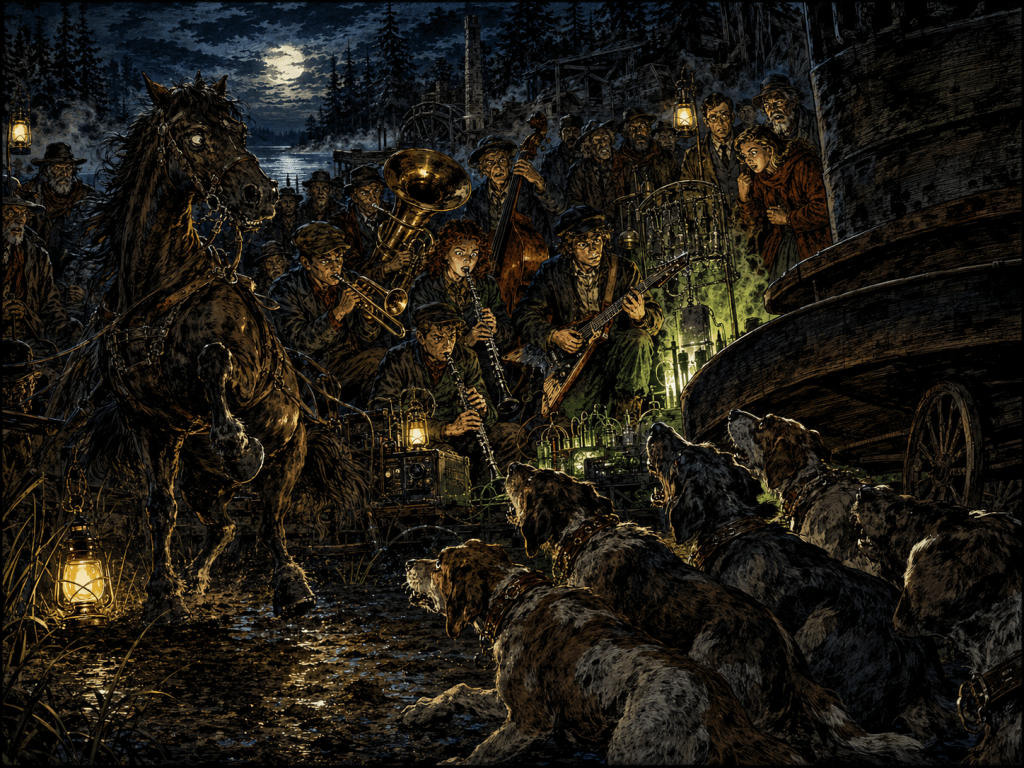
Two guides from the Lower Lake, men not much subject to musical ravishment, testified separately that when the band reached the part about “dark coats near the old mill ground,” the dogs lying under the wagon drew up all at once and faced west. A horse belonging to Mr. Peabody stepped sidewise three times in exact measure, then refused the road by the church and would only stand looking toward the old forge tract. A boy fishing near the reeds said the trout rose twice to a phrase where no fly was on the water. He is a boy, and therefore doubtful; still, he stuck to his story.
Professor Larkin, a visiting musical expert from Plattsburgh, explained these effects by vibration, expectancy, and the contagious instincts of assembled minds. Mr. Abel Weed replied that expectancy never yet taught Peabody’s mare to keep time. Miss Sabra Tenney, who instructs in drawing and has a calm head for oddities, thought the performance less a concert than a device for bringing hidden notions to the surface. “Everybody heard his own fear in it,” said she. “That is either very fine art or very bad weather.”
As to Johqu’s explanatory papers, there were hundreds of words among them respecting irony, structure, communal hooks, satirical undertow, speech-rhythm delivery, and the rearrangement of facts once they have dressed for the show. These were read aloud in part at the store, to the great delight of the loafers and the evident fatigue of the lamp. One phrase pleased old Rufe Robinson mightily: “If your own opinion comes freight-paid through, check both pockets.” “That,” said Rufe, “is the first line of criticism I ever understood.”
Since then, the quarrel over pedigree has not ceased, but it has changed its hat. The down-state complainers still ask whether the thing is legitimate. The local answer grows plainer every day: if a man bleeds on the score, writes it by candle with a turkey quill, saves every page of his meaning, and then builds such a racket from forge-ruins, cloud-machinery, cylinders, brass, reeds, and public alarm that half the town argues over it for a fortnight and the other half cannot keep the chorus out of their heads, then it is real enough for Lower Chateaugay Lake, however thin its ancestry may appear in Albany.

For my own part, I do not pretend to settle whether the new art is noble or only busy. I merely say that after the rehearsal at Popeville, several persons walking home by the lake-road reported hearing no tune whatever, yet stepping, for some distance, in a crooked common measure not their own. The night was still. The stars were plain. And more than one sober man, on reaching his gate, found himself pausing before he lifted the latch, as if waiting for some unseen conductor to bring his hand in on the beat.
BELZORAM

What mysteries of Chateaugay Lake haunt you?