
Advisory: Presents Shatagee Woods rumors involving stolen powder, cold springs, secret societies, guide-law enthusiasm, and one serpent declining public certification. Best read near a stove, with no barrels behind it.
Brief Disclaimer:
A bit of fictional Shatagee Noir—drawn from local history, old report, and the usual growth of a good tale. Original place names and historical references are used for color. It is no affidavit, no accusation, and no cause for public distress.
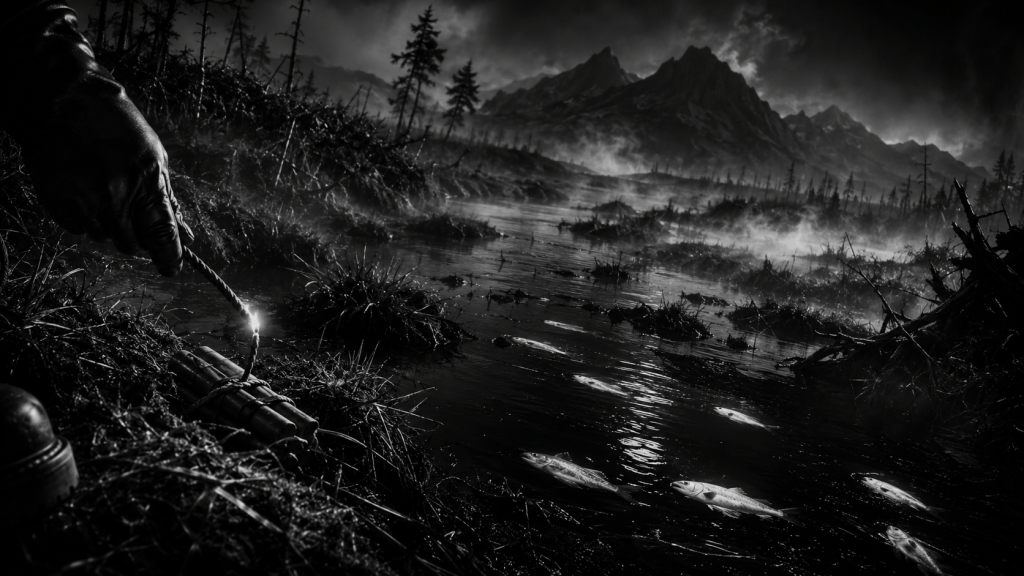
The late accounts of the sea serpent, the blasting of trout in South Inlet Springs, the explosion at Feinberg’s saloon near the Owlyout, and the cheerful progress of the Rogersfield Cornet Band along the lake have been treated as separate curiosities. We are not so sure. A man may call one bee a bee, but when he finds twelve in his hat he begins to suspect a hive.
It was first given out, in the old playful fashion, that the monster of Chateaugay Lake had been seen by Jack Davis, Andrew Baker, Eugene Miller—otherwise called Old Veritas—and other competent men whose eyes are not known to quarrel with daylight. Then came the learned talk. One said the creature had entered by a fissure from Lake Champlain. Another had Dr. Buckland and subterranean rivers at his elbow. A third, having read Jules Verne, declared the beast no serpent at all, but some natural Nautilus of the hills. Uncle Dick Shutts allowed that he had seen stranger things come up in dark water and go down again without asking human leave. Nat Collins would neither deny nor affirm, which is the safest position for a guide, a juryman, or a married man.
All this made good porch talk, and the hotels were not injured by it. A sea serpent that behaves at a proper distance is as useful to a resort as good butter, clean sheets, and a sunset.
But the trout at South Inlet Springs were not frightened by poetry. They were killed by dynamite. There is no Shakespeare in that. There is only a cartridge, a fuse, a cowardly hand, and dead fish rolling white where living trout ought to have been laying their shadows under cold water. Soon after, we hear of a proposed society of guides to enforce the game laws. Very proper, says the public. Very sudden, says the suspicious man. Very necessary, says the lake.
Then Peets Settlement spoke up with a blast of its own. At Feinberg’s saloon, where men came and went, and barrels enjoyed all the respectability barrels commonly enjoy, an alcohol vessel took fire while Alport was handling it. The flame ran, the barrel answered, the room went to pieces, and twelve men discovered at once that tavern conversation is mortal. In the same building, by an oddness too large to be laughed away, was stored a considerable quantity of dynamite.
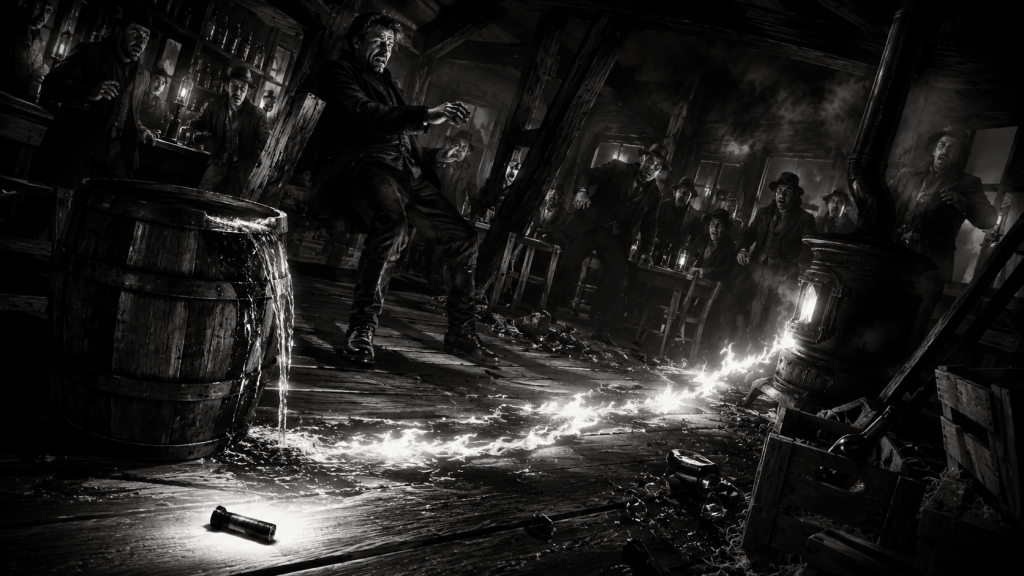
Now, why should a saloon near the Owlyout be nursing dynamite at the very season when trout are being murdered with dynamite at South Inlet Springs? Why should company powder, lake traffic, night boats, guide gossip, hotel provisions, and musical excursions cross one another like fox tracks on new snow? We do not say they prove one crime. We say they make a shape.
A saloon is a useful place for hiding what no man wishes to own. Teamsters stop there. Guides stop there. Band boys stop there. Men with money, men without money, men with crates, men with valises, men with wet boots and dry lies—all stop there. A heavy box excites no more wonder than a light conscience. Cash changes hands, glasses are filled, a fiddle scrapes, somebody laughs too loud, and nobody remembers who set what behind the stove.
The Chateaugay Ore & Iron Co. must be brought into the matter, not as a villain in a cheap drama, but as a great iron beast with many hands and more pockets than eyes. Dynamite used in honest blasting may disappear in small lots without alarming any superintendent at first. Damp cartridges, bad counting, careless crews, mine waste, returned stores, forge freight, road material—these are broad words, and much rascality can sleep inside a broad word. From Lyon Mountain to Merrill, from Popeville to the lake landings, there are routes enough for powder to travel under a sober name.
There has been whisper of a loose gang, called by some the Cartridge Boys, by others the South Inlet Crowd, and by one elderly lady the Blue-Fuse Gang, which is better naming than they deserve. Their alleged trade was simple: a few cartridges shaved from company stores, a little illegal liquor for courage and silence, blasted trout sold quietly to camps and boarding houses, and lake transportation covered by honest traffic. Fish murder is not sport. It is meat-racket work with a coward’s thunder at the bottom of it.

What of the Rogersfield Cornet Band? We would be unjust to accuse music merely because it travels in cases. Cornets have cases, and so have innocent men. A bass drum is not criminal because it is roomy. Yet the public account praised the band for driving straight past Mrs. Barror’s, and that sentence has stuck in our mind like a burr. Why mention Mrs. Barror’s? Why give credit for passing a place unless passing it had become notable? We put no chain on any band boy’s ankle. We only say that a horn case is a good size for more than a horn, and one smiling fellow who “helps load the instruments” may make a whole band look guilty while the trombone knows no more than a cow.
The old society called Scale and Oar now comes forward in rumor, wearing two faces. Summer people have been told that it guards the ancient secrets of Chateaugay Lake: the Little Nippers below the weed-line, the old guide pacts, the hidden fissures, and certain cold promises made before hotels had piazzas. That may be hotel-porch embroidery. The practical account is plainer. Scale and Oar began, so we are informed, as an understanding among guides to protect fishing grounds, routes, clients, and silence. Keep the fish biting and the tourists ignorant is a motto not printed in hymn-books, but it has served several professions well.
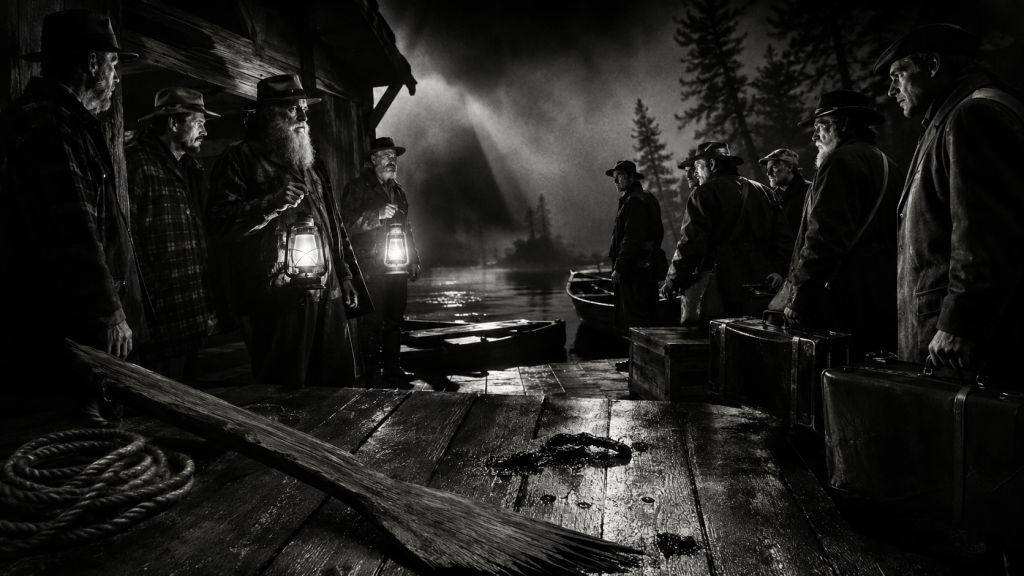
Yet even such a society may split. The older men, whom we shall call Old Scale, appear to have wished the lake kept decent, the fish protected, and fools warned away from places where water has a bad memory. Another faction, now named Broken Oar by the store philosophers, is said to have sold landing times, spring channels, hiding spots, and guide knowledge to men who paid better than the law. If this be true, the worst treason on the lake was not against the game statutes, but against the old understanding that certain waters are not to be disturbed after dark.
For there is an older part to this tale, and we give it without endorsing more than is wholesome. Long before the cartridges, the band, and the Peets explosion, guides spoke of Little Nippers in the shallows, meaning either young serpents, bad currents, or secrets that nibble at a man’s nerve until he leaves the lake alone. The great serpent, if there is one, was never the whole story. It was the signboard. Beneath were springs, black pockets, undercut banks, old ore-drains, root-holes, boathouse cellars, and perhaps natural channels large enough for the imagination and small freight. A smuggler can do much with a submerged barrel, a hollow float, and knowledge of where cold water rises.
But a strange thing follows wickedness in old woods. Men begin by using folklore as cover. They end by finding the cover occupied.
After the South Inlet blasting, dead trout were found not only where the water had been torn, but near an outlet where no shot had been heard. Their gills were clean. Their eyes had that pale look fish get when drawn from deep, cold places. A guide swore he saw no wound on them. Another told him to hold his tongue if he wanted winter work. A third said trout killed unjustly do not always stay where they are killed, which is either nonsense or knowledge, according to the man speaking.
At Peets Settlement, after the saloon blast, one scorched cartridge was found near a rear sill where no cartridge ought to have rolled. The official account says the alcohol fired first and all else followed. Likely enough. Yet two witnesses insisted the flame did not spread like common flame, but went searching along the floor, thin and blue, as though it had business. One said there came a knocking from inside the barrel before it burst. He may have heard staves cracking. He may have heard his own heart. He has since removed to Malone and is a poorer witness every time he tells it.
Most curious was a strip of fuse later found in a boathouse below the Owlyout, wet through, blackened at one end, and smelling not of powder only but of pond mud. Nobody claimed it. Nobody would swear it had burned underwater. Nobody would put it back where he found it.
By this time our question is not, Why was dynamite at Feinberg’s? That answer is plain enough. It was waiting. The better question is, For whom?
Was it waiting for the trout killers, who meant to carry it to South Inlet Springs? For a company clerk trying to gather up stolen powder before inventory? For a hotel provisioner who dealt in illegal fish and strong drink? For a Broken Oar guide who cried out for law while selling the lake by lantern-light? For one of those musical gentlemen whose tune came bright over the water while heavier business moved in the dark?
Or was it waiting for nobody that walks upright?
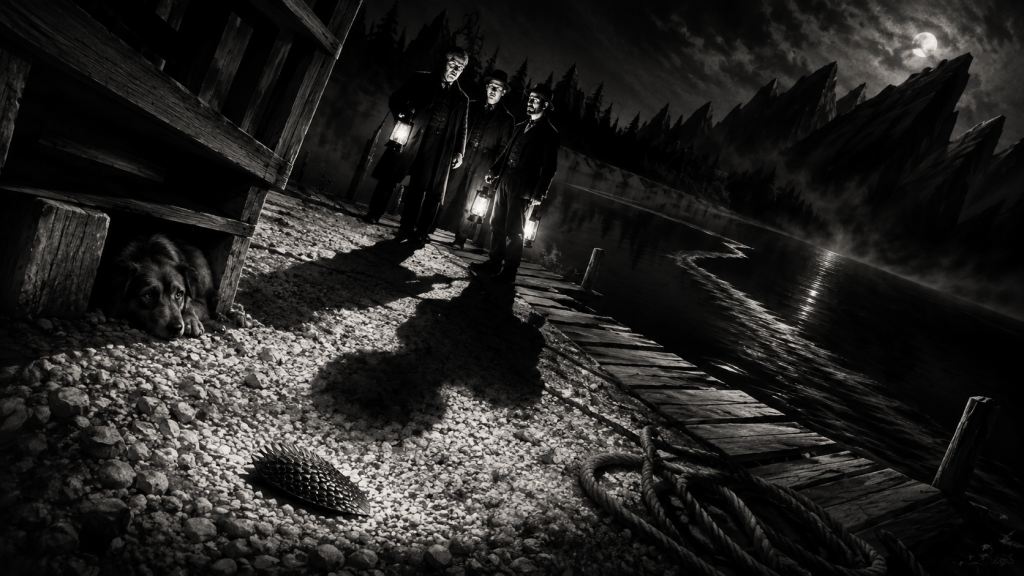
We put that last notion in only because Old Veritas, who is less foolish than his nickname suggests, says the lake had already marked the shipment. He claims that on the night before the Peets explosion, when the air lay close and the frogs were making poor music of their own, a long swell moved across Chateaugay Lake without wind behind it. It passed the landing, struck no boat, broke no chain, and went on toward the blacker water. A dog under the hotel steps whined until morning. At sunrise there was a scale on the gravel, if scale it was, dark as stove iron and big as a child’s hand. Andrew Baker saw it. Jack Davis handled it. By noon it was gone, and by evening every man had improved its size according to his character.
We do not ask the public to swallow sea serpents whole. That is bad for the public and worse for the serpent. We merely observe that where stolen powder, murdered trout, hidden liquor, frightened guides, company silence, and lake legends all meet, the matter has passed beyond common mischief. It has entered that older country where crime and omen travel in the same wagon.
The ruins at Peets Settlement should be visited in daylight, and then only by persons with chores elsewhere. A man who goes there after sundown to prove his courage will likely prove nothing useful. The charred sill remains. The ground still shows where the barrel stove was thrown. Boys have found bits of green glass, iron hoops, and once a brass button that may have belonged to a band uniform, a guide coat, or nobody worth naming. Such relics encourage theories, and theories encourage trespass.
We await the proposed guide society with interest. If it is Old Scale, let it come with law, lanterns, and clean hands. If it is Broken Oar, let it remember that a lake is a poor place for secrets. Water has no tongue, but it has a patient way of giving things back.
As for the serpent, we neither certify nor deny him. There are more things under Chateaugay Lake than are set down in any company ledger, and more debts in Shatagee Woods than can be paid with trout money. The old guides did not invent monsters to frighten tourists. They invented stories to keep fools from meeting what was already there.
BELZORAM
#ChateaugayLakeFolklore
#ShatageeWoodsFolklore
#AdirondackGothicMystery
#NorthCountryWeirdTales
#LakeSerpentLore
#DynamiteAndDeadTrout
#BrokenOarConspiracy
#PeetsSettlementMystery
#ShatageeWoodsOmen
#RuralCrimeFolklore
#BelzoramChronicles


What mysteries of Chateaugay Lake haunt you?