Advisory: contains lake-serpent suspicions, exposed toes, and dockside philosophy liable to trouble delicate readers/listeners who prefer Nature properly booted, bottled, and unwilling to conduct personal interviews after sundown near Chateaugay Lake’s Narrows thereabouts.
SHATAGEE GITASKOG’S INN, UPPER CHATEAUGAY LAKE, N.Y., 25 JUNE 2026.
The Toe-Nip Witness of Chateaugay Lake—Strange Narrows Testimony, Gelatinous Proof and the Old Lake Serpent
Every thing passably lively up here.—“Toe-Nips” in Chateaugay Lake. Mr. Editor, if the philosophers of Concord have truly taught us that Nature is not dead matter but the visible garment of spirit, then there is no sufficient reason why Chateaugay Lake should not wear, upon occasion, a garment with scales to it, or why that garment should not take liberties with the exposed extremities of a careless fisherman. I am aware that some of our more economical citizens consider all supernatural testimony a poor investment unless it can be salted, barreled, or sent to market, but the present affair has been so generally spoken of at the Inn, the landing, the Narrows, and over toward East Bellmont, that silence would look like partiality to the serpent.
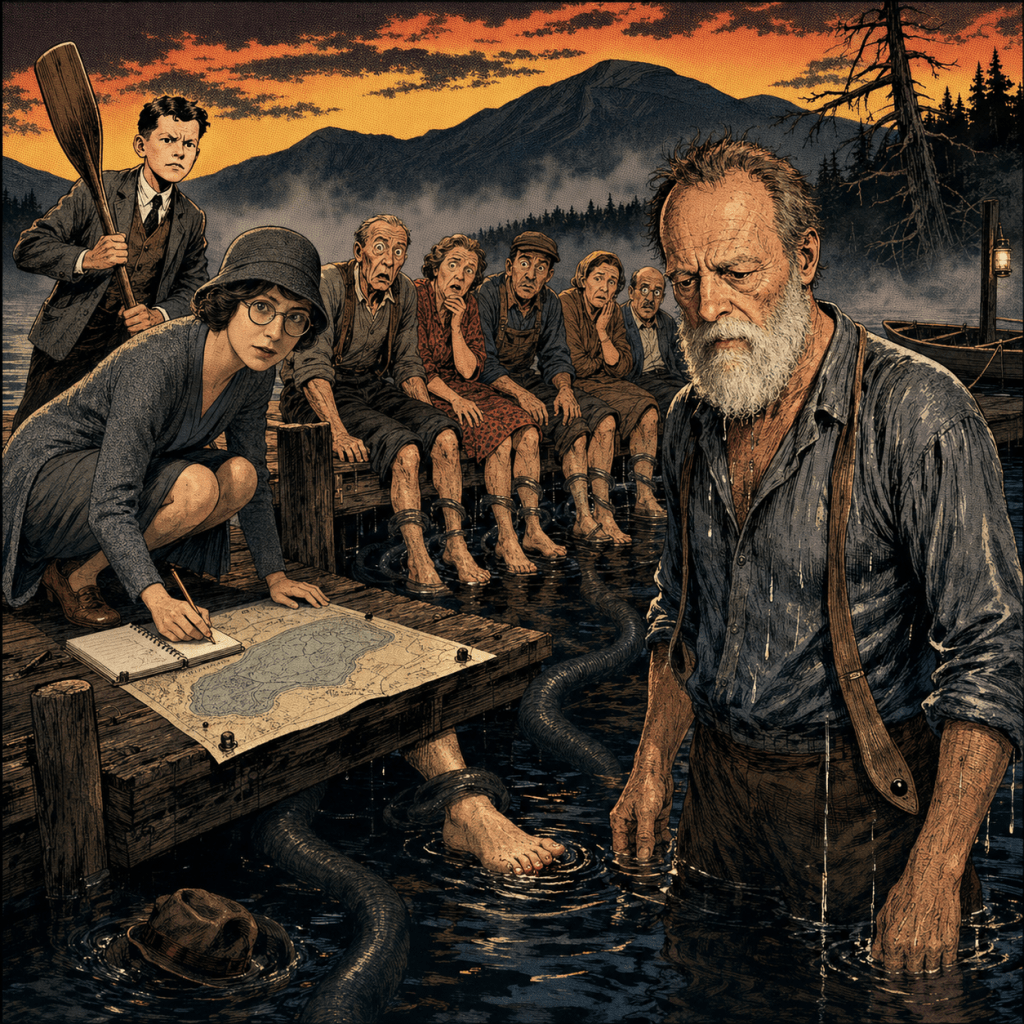
The matter came before us through Ralph Hoy, who lately opened what he is pleased to call the Steamboat Gazette line from East Bellmont, a contrivance of voice, wire, receiver and local confidence, by which intelligence is made to travel faster than judgment. Ralph says the stove smoked backward the evening the report was first taken down, and the ink upon the table gathered into a blot shaped not unlike a small eel, though others maintain it resembled merely the county treasurer’s signature after town meeting. Miss Gloria Fernsworth was present with her pinned maps of Chateaugay Lake, the Narrows, Shatagee Woods, Bellows Bay, the old guide routes, and certain dotted lines running under ground where no honest road has ever paid tax, and she maintained, with much quiet firmness, that the evidence should not be laughed out of the room until it had at least been allowed to dry.
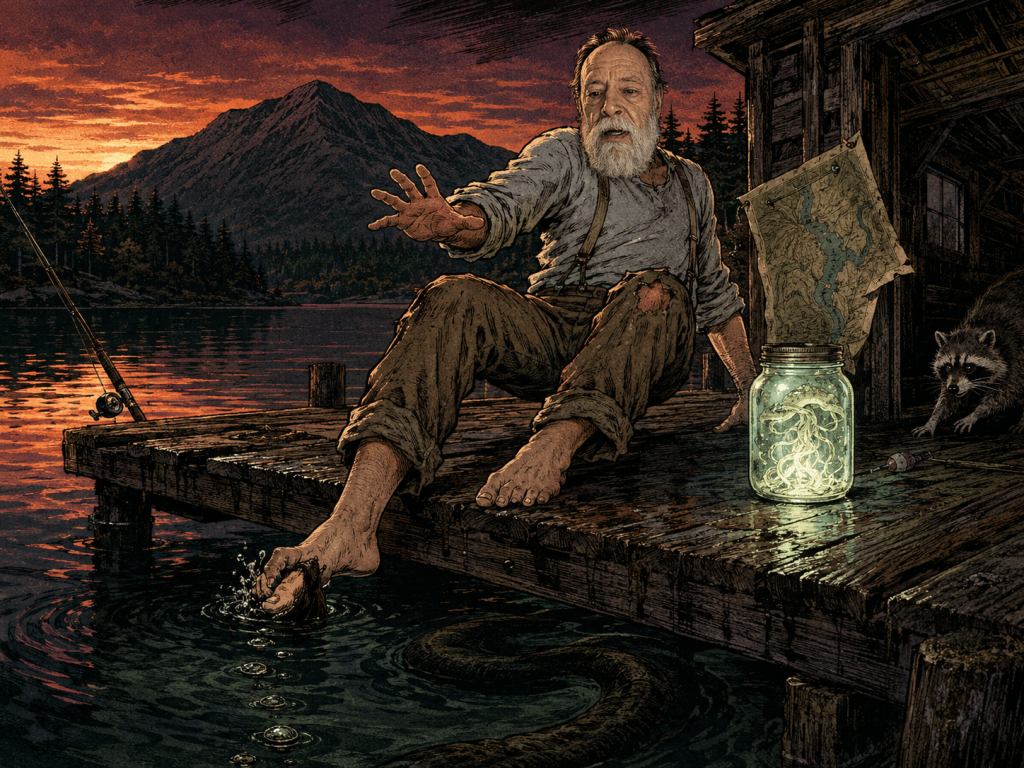
Roy Cootey, whose reputation for exactness is fair when the wind is north and his boots are not wet, gave the leading account. It appears that a fisherman, name withheld by request and also because three different names have already been supplied for him, sat upon a dock near the Narrows at a late hour, with his shoes off, his line out, and his mind in that large, innocent vacancy which Providence has kindly provided for anglers. The lake was smooth, but not with that wholesome smoothness one sees after a clear day. It lay as if some great thought were under it, too large to rise and too old to sink. There were serpent-like shadows moving under the boards, and the man, supposing them to be suckers, pickerel, black bass, or politics, paid them small attention until he received upon the great toe of his right foot a nip so sudden, personal and judicial that he abandoned both his fishing and his dignity.
It is not claimed that the toe was removed, nor materially injured, nor rendered incapable of future usefulness, and I state this plainly lest the Burlington papers, which are sometimes given to ornament in lake matters, should enlarge the circumstance into an amputation. The witness only asserts that the toe was taken notice of by something in the water, and that the thing took notice in a manner foreign to minnows. Roy Cootey, when questioned closely, said the remark made by the injured party was: “A toe ain’t a biography.” This saying has been much admired by those present, though no two persons agree upon its exact application. Miss Fernsworth says it means that a man’s extremity cannot testify for his whole life. Ralph Hoy contends that it means the lake desired only a sample and not a volume. Old Merritt, from below the outlet, says it means a man had better keep his feet in his boots when the Almighty has gone to the trouble of making leather.
The evidence does not rest wholly upon words. There was upon the table a jar marked in Miss Fernsworth’s hand, “No. 7—Gelatinous Proof.” This object, I confess, had an appearance not calculated to strengthen the appetite. It contained a substance of a pale, tremulous and undecided nature, neither fish, flesh, nor honest jelly, and smelling faintly of pond, stove polish, and November. It was stated that the same had been scraped from the under side of the dock after the disturbance. Certain boys believed it to be frog spawn. Ralph Hoy held it to be epidermis from some unknown lacustrine visitant. Roy Cootey said he would not swear to it, but he had seen less convincing proof sent to Albany and printed in a report. A raccoon of unusual judgment, having entered by the woodhouse door, approached the jar, examined it, withdrew without haste, and has not since been seen in the neighborhood, which many consider the soundest testimony yet obtained.
Some have tried to explain the whole affair by common fish, and indeed there are fish enough in these waters to bear blame for much wickedness. Dick Shutts, who never permits a mystery to remain idle when a theory can be harnessed to it, declares that the Toe-Nips are a small but ill-bred migration out of Lake Champlain, having come by the same ancient passage so often mentioned in connection with suckers, serpents, and other immigrants. He says there is, or was, a canal, fissure, culvert, flume, or irresponsible vein of water running from Bradley Pond to the Chazy, thence by misbehavior of nature to the East Inlet, and so into Chateaugay Lake. Geo. Cook says this is not impossible, but would require very thin serpents. Jim Smith says the old guides always knew there were under-water roads there, but that they did not use them because the footing was poor. Nat. Collins, if living, would no doubt have enlarged the passage into a cavern capable of accommodating a church sociable, a pair of oxen, and the entire Champlain monster standing upright.
For myself I am not disposed to crowd the matter too closely with explanation. There are facts that lose their bloom when handled like potatoes. The lake at evening, especially near the Narrows, has a fashion of looking back at one. The mountains stand around it with the air of elders who know the family disgrace and will not speak until properly summoned. There are currents not marked on Miss Fernsworth’s maps, and winds that come over W Mountain with no more relation to the weather bureau than a blue jay has to church music. Mr. Emerson, who had a considerable eye for the divine handwriting in woods and water, might have said, had he been sitting at Ralph’s that night with his boots off, that the Over-Soul itself sometimes pinches a man into attention. I do not say the Over-Soul nipped the fisherman. I merely remark that the universe has many methods, and some of them are damp.
There is also talk of old guide routes beneath Shatagee Woods, by which hunters formerly passed from pond to pond in a manner never satisfactorily explained. These routes, according to store memory, were known to certain men now dead, and to several now living who cannot remember them until cider is introduced. One route is said to begin under a cedar stump back of the old camp above the slews, pass beneath two brooks, cross a bed of white sand where no sand ought to be, and come out under a flat stone near the Narrows. Another begins nowhere in particular and ends in a sound like paddles under the floor. Miss Fernsworth has marked them all with pins of different colors, though she admits that some pins represent testimony, some suspicion, and one, stuck near Bellows Bay, was put there because she had dropped it and disliked waste.
Several persons of weight now say they have observed disturbances in the water during the present season. Andrew Baker reports a long, narrow darkness moving parallel with his boat, against the wind and with an air of private business. Will Reynold saw bubbles rise in a row as straight as fence-posts and then turn at right angles, which bubbles, if natural, had better manners than many boys. L. D. Morrison heard, near midnight, a sucking sound under the dock, followed by a tap, tap, tap, as of something counting toes through the plank. Johnny Goodrich, who has been reading beyond his strength, says the phenomenon may be psychical, and that the lake, being a large mirror to the moral sentiment, merely reflects the inward animal of the observer. To this Roy Cootey replied that if his inward animal ever took hold of a man’s toe, he hoped somebody would shoot it.
The town, as towns will, calls the affair foolish. But it is noticeable that those who laugh loudest keep their feet farthest from the water. Since the report spread, boys who formerly went in swimming with a boldness more anatomical than graceful, now enter with circumspection and come out upon the slightest rumor. At the landing last evening two men sat discussing the matter with their boots tucked under them upon the bench, though the night was warm. A lady from the lower road, being asked whether she believed in Toe-Nips, said she did not; but she would thank Providence not to be convinced. There is philosophy in that answer, and more religion than some sermons.
I do not wish to excite alarm among summer visitors, whose presence is always welcome, especially when accompanied by good manners and ready money. Chateaugay Lake remains as beautiful as ever, the air bracing, the prospects noble, the boating excellent, the table commendable, and the scenery full of that high and solemn gladness which improves both digestion and character. The hills lift themselves nobly about the water; the pines stand dark and wholesome against the sky; the loons laugh as if they knew the whole case and had retained counsel; and at sunset the Narrows shine with a strange, coppery peace, very suitable to the improvement of the mind. Only let no gentleman make an unnecessary exhibition of his bare foot over the edge of the dock after dark. Nature is a good mother, but she has queer children.
The latest report is that Ralph Hoy will continue receiving testimony over the W Mountain line, provided the stove draws proper and the ink behaves. Miss Fernsworth has prepared a fresh map with a separate pin for each nip, shadow, bubble, and doubtful odor. Roy Cootey declares that the first man who brings in a Toe-Nip alive shall have his name preserved, though not necessarily believed. Jar No. 7 remains under observation, and the raccoon’s absence grows daily more significant. Whether the disturbance proceeds from fish, folklore, subterranean routes, or some old testimony kept under the floorboards of Shatagee Woods, I leave to wiser heads and colder feet. The lake has not signed the town’s denial, and until it does, common prudence is the better part of metaphysics.
We were also informed that Mrs. Hiram Bellows has been afflicted with a severe cold, though hopes are entertained of her speedy recovery, the weather being more settled. The farmers are busy with their late work, and the road toward Brainardsville is much improved by recent attention. A pleasant company gathered at the Inn Tuesday evening, where the above matter was discussed with spirit but without injury to friendship. We counsel our readers to receive all lake marvels with cheerfulness, all evidence with patience, and all exposed toes with caution. There are more things in heaven and earth than are dreamed of in our philosophy, and some of them, apparently, are not above beginning at the foot.
#ChateaugayLakeFolklore #AdirondackGothicSatire #NorthCountryWeirdness #ToeNipTestimony #LakeMonsterLore #StrangeNarrowsMystery #ShatageeWoodsMythos #RuralCosmicMystery #PeriodNewsFolklore #GelatinousProof

What mysteries of Chateaugay Lake haunt you?