Temperance, medicinal spirits, suspicious prescriptions, and supper-hour ailments abound. Readers may encounter committee logic, pharmacy ethics, acquisitive gossip, itinerant hunger, a scholarly mare, and the unsettling possibility that some diseases keep excellent time.
The East Bellmont Committee Encounters a Question of Dosage
—
Seven Hundred Hear Father O’Rorke
—
Medicine Retains Its Spirits
—
Several New Diseases Reported Before Supper
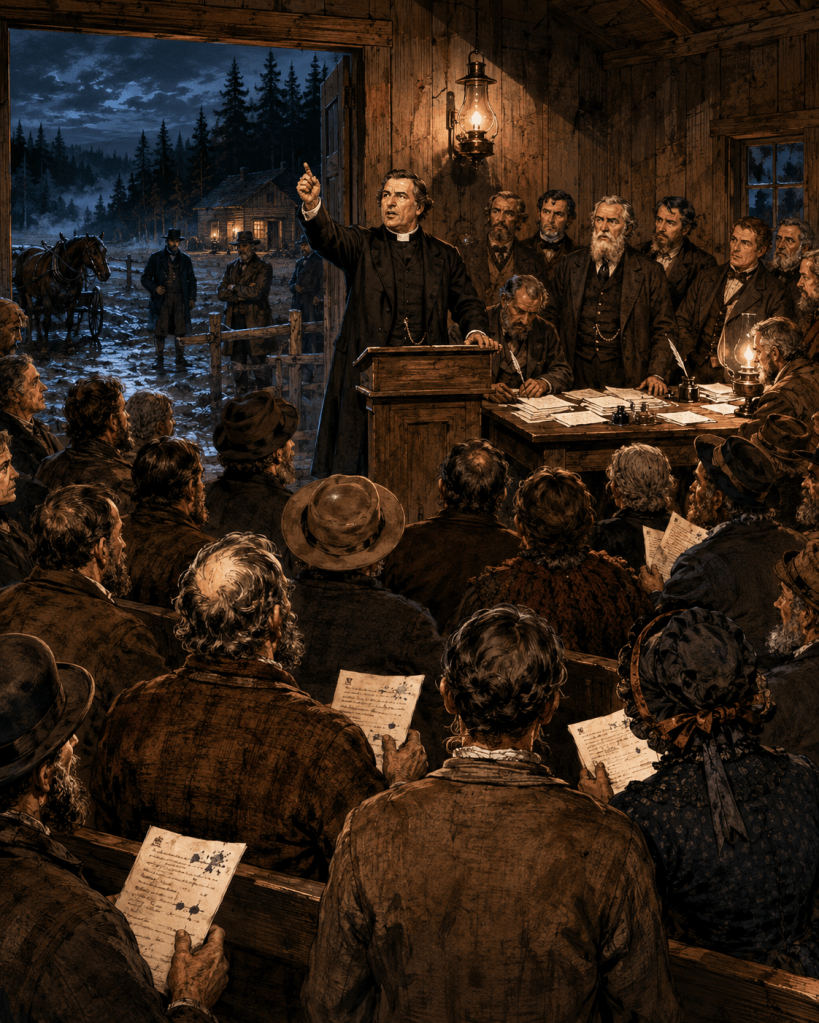
EAST BELLMONT, October, 1878. — The temperance movement has at last reached us in full public strength. Father O’Rorke lately addressed an assemblage estimated at nearly seven hundred persons, with such effect that pledges were signed in considerable number, saloons came under observation, and several household cupboards were subjected to examinations before their owners had been properly consulted.
The proceedings were orderly, earnest and highly respectable.
Mrs. Almira Phelps counted twenty-three men, none previously conspicuous for abstinence, placing their names upon the pledge. Mr. Enoch Darrow reports that two saloons were afterward watched until nearly midnight by citizens determined that nobody should enter them, although three of the watchers were eventually obliged to go inside to ascertain whether anybody already had.
No difficulty of consequence arose until Tuesday, when Abel Breed’s drug-store advertisement was produced before the Committee.
It announces, without apology:
DRUGS, MEDICINES, LIQUORS.

The same advertisement assures the public that Breed’s preparations are compounded from pure stock, according to approved formulas, for the express purpose of supplying full strength and unadulterated medicines.
This latter assurance has caused more agitation than the liquors.
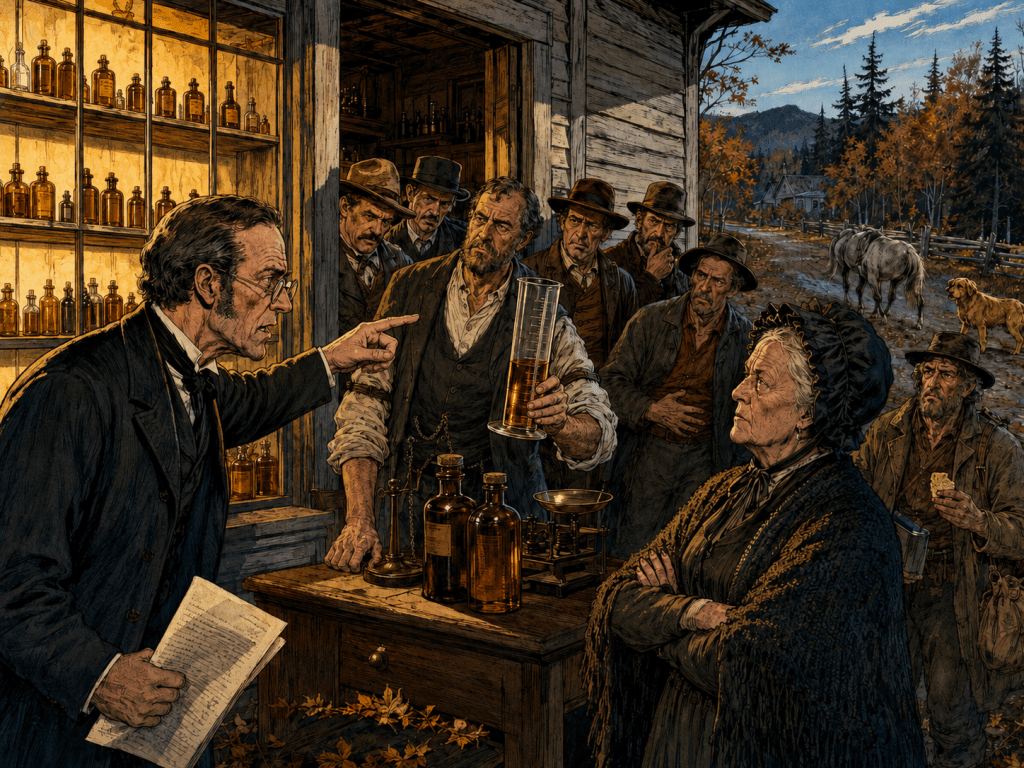
Mr. Phineas Cobb, Secretary of the Temperance Committee, accordingly waited upon Breed and requested to know precisely how much liquor might lawfully occur in a medicine before the medicine became drinking.
Breed replied that it depended upon the preparation.
Mr. Cobb said he desired a principle.
Breed offered ounces.
Mr. Cobb declined ounces as morally insufficient.
Breed then produced his prescription book, several pharmacopoeial authorities, two graduated measures and a measuring glass, after which the interview became considerably less satisfactory than before.
The neighborhood has consequently divided into what are already being called, with unfortunate exactness, the Full-Strength and Dilution parties.
Dr. Silas M. Pomeroy maintains that reducing the proper alcoholic constituent of a recognized preparation solely to improve its moral appearance constitutes adulteration and may impair its medicinal action. Deacon Asa Brackett replies that whiskey cannot become virtuous merely because a physician has written Latin in its neighborhood.
Both statements have now been repeated so frequently that each possesses the appearance of statute.
The practical consequences are remarkable.
Within four days Breed reports a heavy increase in prescriptions. Men previously supposed capable of surviving haying, logging, frozen roads, runaway teams and prolonged family discussion have developed neuralgia, dyspepsia, weakness of the circulation, chill of the kidneys, nervous exhaustion, sinking sensations and several complaints known chiefly by the remedies ordered for them.
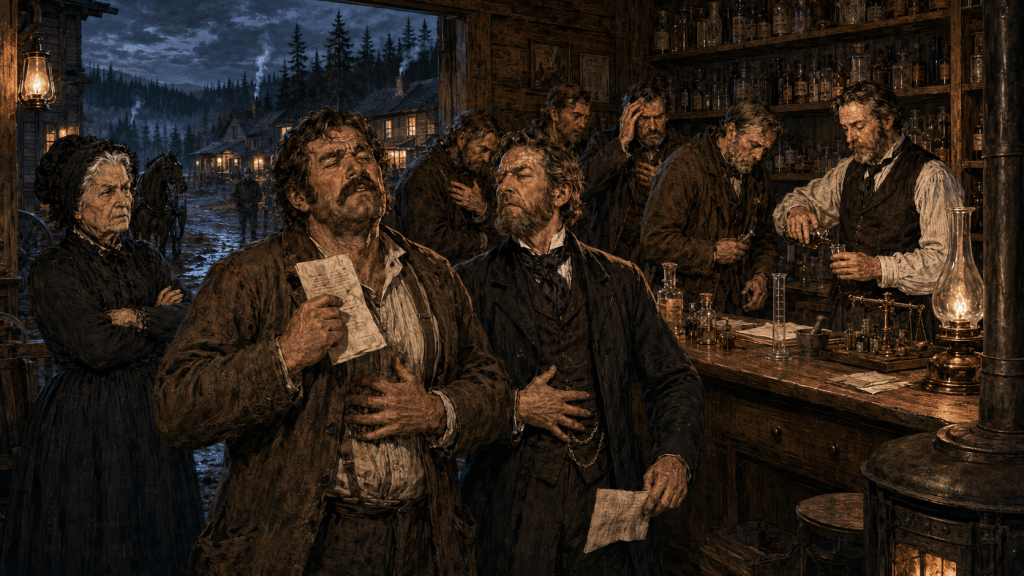
A curious proportion become acute between five and six o’clock.
Mrs. Charity Loomis, widow of the late Abner Loomis and a woman whose opinions are generally received after every effort to avoid receiving them has failed, states that in seventy-eight years she has never encountered an ailment which invariably commenced when a man could smell supper.
“I do not deny disease,” said Mrs. Loomis. “I only observe that some diseases own watches.”
The Committee has meanwhile undertaken an examination of cases.
Hiram Slade was required Wednesday to explain why his prescription for “general weakness” had been renewed three times in one week. He answered that the weakness was general and therefore covered considerable territory.
Josiah Bell produced a physician’s certificate for distress of the stomach, but objected when asked whether the distress preceded or followed Breed’s cordial. He considered the inquiry an improper penetration into matters between a patient and his constitution.
The Committee has not yet determined whether frequency of illness constitutes evidence against illness.
Rumor, however, has already outrun investigation.
Flying squirrels are carrying reports along the cedar lots at top speed; bluejays have distributed improved editions through the clearings; and the whip-poor-wills, apparently receiving the matter after dark, repeat accusations which no responsible committee has yet ventured to put in writing. Whatever afterward reaches the stove-side neighbors is altered again within half an hour, partly through zeal and partly because several of our most industrious repeaters are hard of hearing.
Thus Breed’s statement that six ounces might occur in a particular preparation reached the north road as intelligence that Breed had prescribed six bottles to the congregation.
Before Wednesday night it was confidently reported that Father O’Rorke himself had opened a pharmacy.
He has not.
A collateral difficulty has arisen concerning itinerant persons.

Three tramps calling themselves Boston Jim, Narrow Pete and Mr. Alexander declined the biscuits offered them Thursday evening by a temperance household, declaring themselves thoroughly sick of the proposition that biscuits, cold water and moral encouragement constitute the equivalent of a decent supper.
Boston Jim afterward presented himself at Breed’s complaining of exhaustion.
The Committee regarded this as suspicious.
Breed regarded it as a symptom.
Boston Jim regarded both parties as delaying supper.
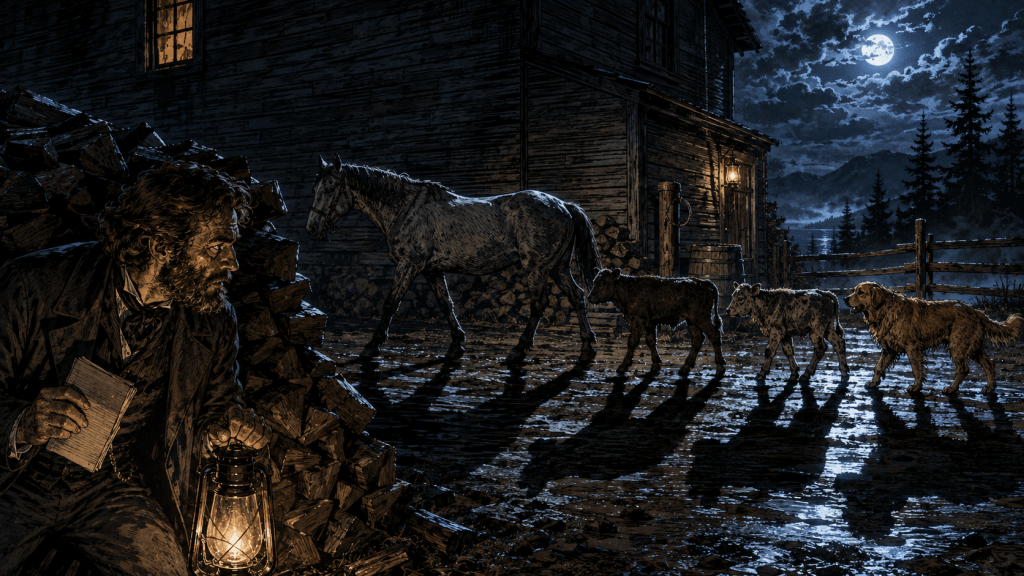
Professor Erasmus Wycliffe Crane, a visiting scholar from Albany, has added little light to the question. After observing Breed’s premises one evening, Professor Crane announced that he had witnessed a clandestine procession of patients circling the building three times before entering at the rear.
His testimony enjoyed considerable standing for approximately eleven hours.
It was then discovered that the procession consisted principally of Breed’s old gray mare, which has acquired the habit of walking loose around the building when troubled by flies, followed at uncertain intervals by two calves and a large yellow dog.
Why the dog likewise made three complete circuits remains unexplained.
This circumstance has not restored the Professor’s reputation.
Two theories of a less ordinary nature are now privately disputed.
The first holds that liquor long employed medicinally may, through repeated respectable service, acquire some tendency to seek out illness, thereby accounting for the sudden abundance of complaints in the vicinity of Breed’s store.
The second theory, preferred by several older residents, reverses the matter entirely. Certain complaints, it is argued, may remain dormant in the constitution until they receive intelligence that liquor has become available for their treatment.
Dr. Pomeroy rejects both propositions.
Breed refuses to discuss them.
Mrs. Loomis says she has known men capable of either.
The Temperance Committee meets again Saturday to determine whether medicine shall hereafter be judged by its ingredients, its intention, its dosage, the authority of the prescription, the handwriting upon it, or the condition of the patient twenty minutes afterward.
There is already disagreement as to whether a man who takes spirits because he is ill differs morally from a man who discovers he is ill because spirits may be taken.
No reform has been proposed concerning biscuits.
For the present, therefore, East Bellmont remains substantially temperate, though unusually unwell; and it may perhaps be observed that when principle and appetite are each prescribed at full strength, the hardest ingredient to dilute is generally the explanation.
O. VALE, CORRESPONDENT
#AdirondackGothic
#NorthCountryFolklore
#TemperanceEraSatire
#StrangePeriodNews
#RuralSocialSatire
#MedicineAndMorality
#DeadpanHistoricalFiction
#SmallTownRumorMill
#ChateaugayLakeFolklore
#ShatageeWoodsChronicles

What mysteries of Chateaugay Lake haunt you?