Advisory: references to homicide, a wanted man mistaken for firewood, public embarrassment, animal folklore, and one professor confidently misreading raccoon behavior. The greater peril is local memory supplied with insufficient supervision after dark.

An Old County Blunder
Produces a Fresh Crop of Reports
in East Bellmont
EAST BELLMONT, Oct. 18, 1893.—There are certain public mistakes which, having once been committed, ought in decency to remain committed and not require the assistance of a second generation. The old WOOD WANTED affair, however, has again obtained circulation in East Bellmont, where persons otherwise capable of attending to their potatoes, fences, taxes and immortal prospects are discussing whether the county, sixteen years ago, accidentally advertised for a murderer as fuel.
The facts beneath the embroidery are familiar. In 1877 a reward of three hundred dollars was offered for the apprehension of Joseph Woods, suspected in the killing of Stephen Barbour. At nearly the same time the county poor authorities advertised for WOOD WANTED. One unfortunate citizen, reading both notices with more confidence than discrimination, brought Woods in a wagon and demanded payment.
That should have exhausted the matter.
It did not.
Mr. Hiram Peets, of East Bellmont, says his father was present when some portion of the dispute was repeated at Malone, and remembers particularly the declaration that “a man could not be entered against the fuel appropriation.” Mr. Peets is unable to say who made this declaration, but is confident it was “somebody authorized.” This is approximately the degree of documentary certainty upon which several neighborhoods are presently conducting their researches.

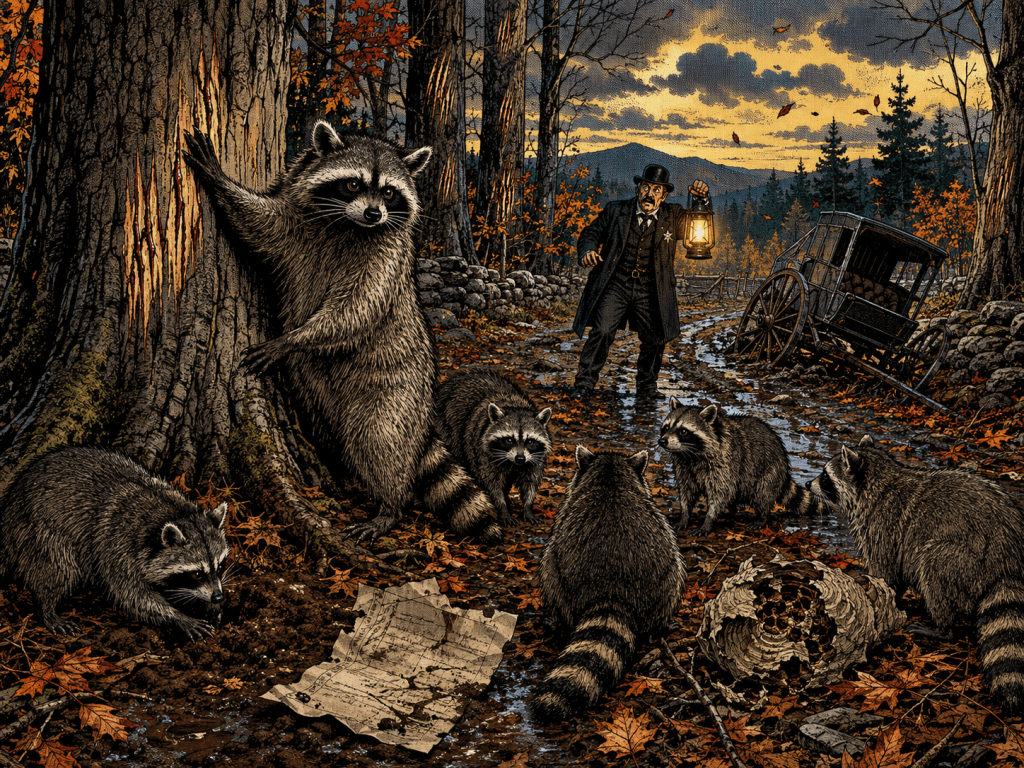
The renewed excitement began last Thursday after Ephraim Loomis, returning from the Moody Road, reported that a number of raccoons had been seen gathered near a hemlock while one unusually large animal struck the trunk twice with its forepaws.
By breakfast the report had reached three farms.
By noon it had reached Brainardsville.

The agencies of transmission appear to have been flying squirrels, bluejays and whip-poor-wills, which carry all matters of importance at top-speed and without accepting responsibility for punctuation. Their efforts were immediately surpassed by stove-side neighbors suffering various degrees of defective hearing. Within half an hour the raccoon had struck twenty trees, overturned a wagon, swallowed a Methodist tract and summoned the deceased Mr. Barbour by his Christian name.
Mr. Loomis denies every particular except the raccoons.
Mrs. Almira Phelps, widow of the late Deacon Phelps and a lady whose age, property and habitual disapproval entitle her views to respectful consideration, says the whole difficulty proceeds from allowing “a foolish notice to remain alive longer than the fool who printed it.”
Mrs. Phelps nevertheless refuses to pass the Moody Road after sundown.
When this circumstance was pointed out, she replied that good judgment and superstition are not the same thing, and that only a very careless person requires them to be.
Considerable confusion was added by Professor Erasmus W. Bletchley, a visiting scholar from Albany who is spending several weeks examining what he calls “survivals of primitive juridical symbolism among Adirondack mammals.”
Professor Bletchley announced Saturday that the raccoons were plainly assembling in imitation of the County Board of Supervisors. He further stated that the largest animal represented the Chairman and that smaller animals seated in a semicircle represented subordinate officers.

His theory suffered an immediate inconvenience when, during his observation, the supposed Chairman abandoned the meeting, climbed into Professor Bletchley’s buggy, removed a paper parcel containing two sandwiches and carried one into a culvert.
The remaining “Supervisors” followed.
Professor Bletchley has since modified his interpretation to include ceremonial confiscation.
Local opinion is now divided between two explanations, neither of which possesses evidence sufficient to trouble a magistrate.
The first is the old Judge theory. According to several persons of advanced years, the large silver-muzzled raccoon occasionally reported along the Bellmont roads belongs to a woodland tradition in which animals are said to hold proceedings concerning cruelty, waste and breaches of ordinary conduct. Those favoring this account maintain that the disturbances of 1877 were not directed against Woods personally, but against whatever offense had traveled with him.
The second theory is less zoological and more disagreeable. Its adherents contend that the original error was not in the woods at all, but in the printed word WOOD; that the county, by confusing a man and a commodity upon paper, produced an uncertainty which has never been properly corrected. They point out that surviving accounts disagree upon capitalization, that a fuel ledger reportedly contained the entry “Woods—received, disputed,” and that one fragment of the reward notice was found with the final letter missing.
Under this doctrine, the raccoons are merely incidental.
This theory has the advantage of requiring no extraordinary animal.
It has the disadvantage of requiring extraordinary stationery.
Mr. Silas Green, who has kept the East Bellmont store for twenty-two years, wisely advises that neither theory be encouraged until somebody produces something better than recollection, rumor or a raccoon behaving with the independence ordinarily associated with that animal.
We concur.
A community which mistakes repetition for evidence will presently discover evidence everywhere. The Woods affair began with an advertisement lacking sufficient particulars. Its surviving offspring now consist chiefly of people supplying particulars that were never there.

Nevertheless, several residents who ridiculed the reports on Monday were observed Tuesday carrying lanterns home by the longer road.
The distinction between belief and precaution has consequently become somewhat delicate.
There remains no proof that anything judges men in the Bellmont woods, and still less that printed errors acquire a life beyond the printer’s shop. Yet an old public blunder, like an old fence-post, may rot above ground while retaining enough beneath it to trip a man years afterward.
O. VALE, CORRESPONDENT
Perhaps the safest moral is that what a county fails to distinguish in type, its neighbors will eventually distinguish in imagination—and the woods, having no newspaper, may keep their own opinion.
#AdirondackGothic
#NorthCountryFolklore
#HistoricalNewspaperParody
#RuralBureaucraticSatire
#UncannyWilderness
#StrangePeriodNews
#FolkloricLegalism
#WoodlandCourtTradition
#RuralRumorLore
#ChateaugayLakeWeirdness

What mysteries of Chateaugay Lake haunt you?