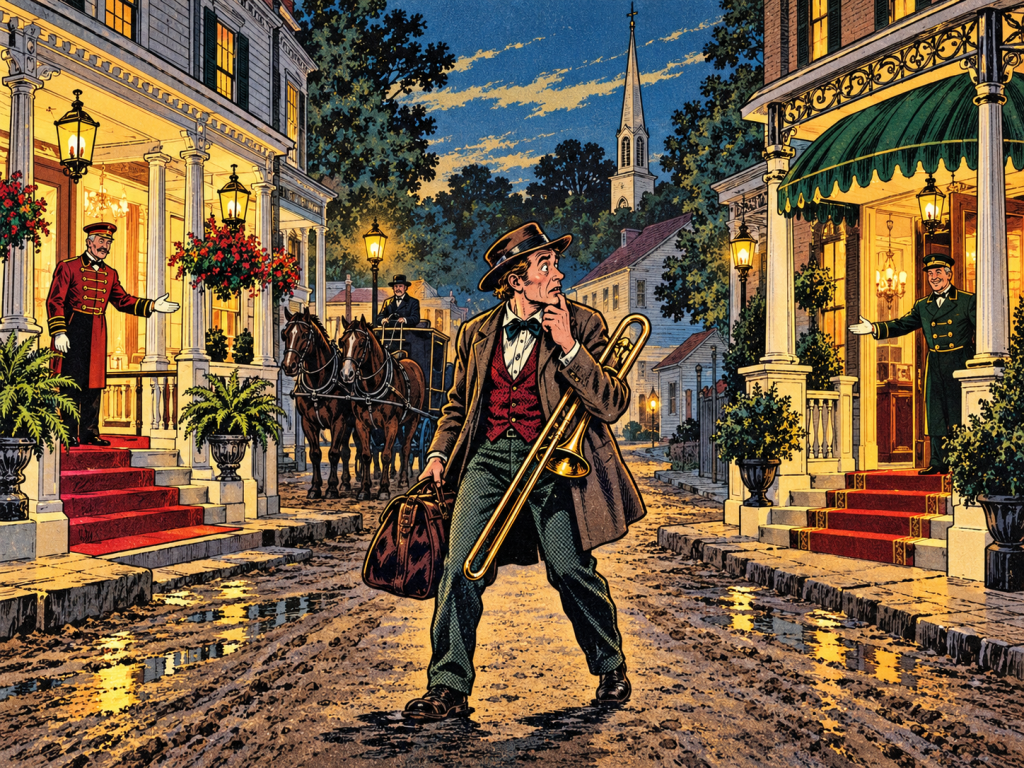
Reader discretion is advised for competitive hotelkeeping, weaponized compliments, excessively responsive baggage service, comparative lamp polishing, and one Albany trombonist whose innocent question threatens to improve two excellent establishments beyond all reasonable necessity.
THE TWO BEST HOTELS IN THE COUNTRY
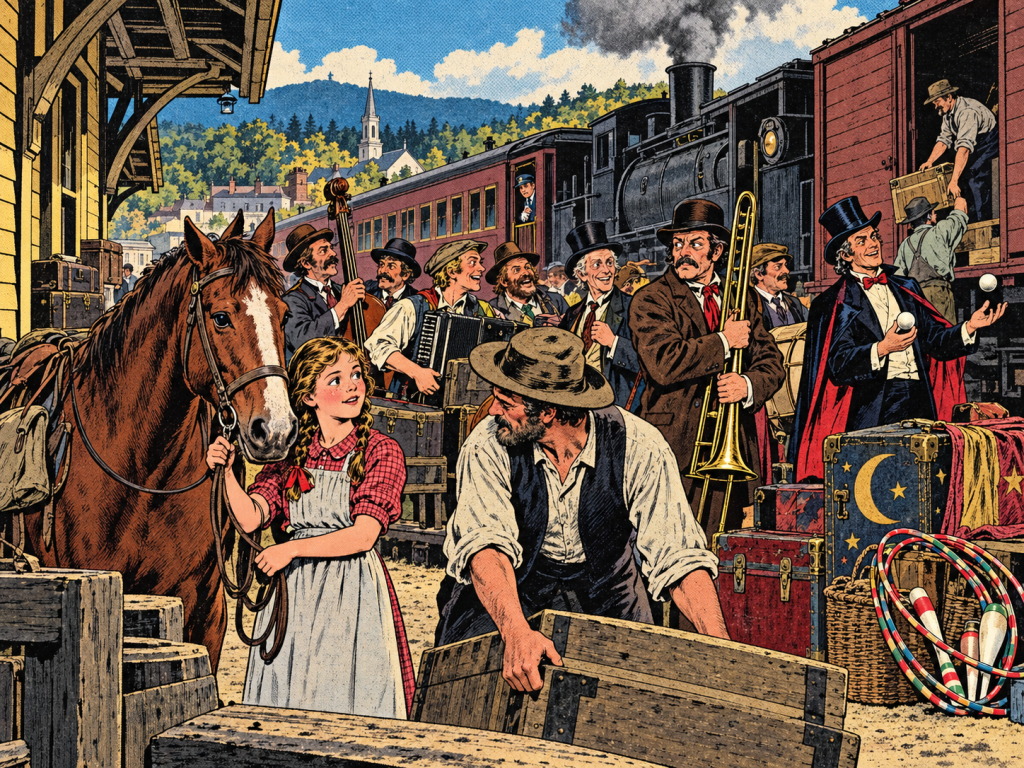
When I was twelve Father took me into Chateaugay and left me holding the mare at the depot while he attended to a freight box. She would have stood without me. I had the reins looped over my arm when the Albany train came in. Eight musicians got off, besides a man who performed magic and juggled, with instrument cases, two trunks of apparatus, painted hoops in a basket, and a long brass trombone which its owner would not let anybody else carry.
The trombone player asked me which was the best hotel. I had read the paper, and told him Chateaugay had two of the best hotels in the country. The Union House of Morgan and Duffie was first-class in all respects, and Roberts and Ladd kept a house comparable with any hotel in the country. Those were the editor’s words, or very nearly. I have seen the notice since, but at twelve I understood it to mean that a stranger could choose either road and not make a mistake.
“Yes, miss,” the trombone player said, “but which is the better best?”
I thought he was making fun of the paper. He was not. A traveling show had to consider meals, beds, horses, lamps, early calls, and property which could not all be put under one man’s arm. If Chateaugay possessed two of the best hotels in the country, he said, a man from Albany had a right to know by what remaining part one surpassed the other. Father’s business kept us in the village that night, and after he put the mare up I could go with the show people so long as I carried no instrument. That is how I heard so much of the question.
The question reached both houses before the trunks did. I do not remember who carried it. News in the village generally arrived without its baggage. Morgan and Duffie accepted the compliment, and Roberts and Ladd accepted it too. None said the other house was poor, or even second-rate. That would have settled matters cheaply. Each said the newspaper was correct and welcomed an examination.
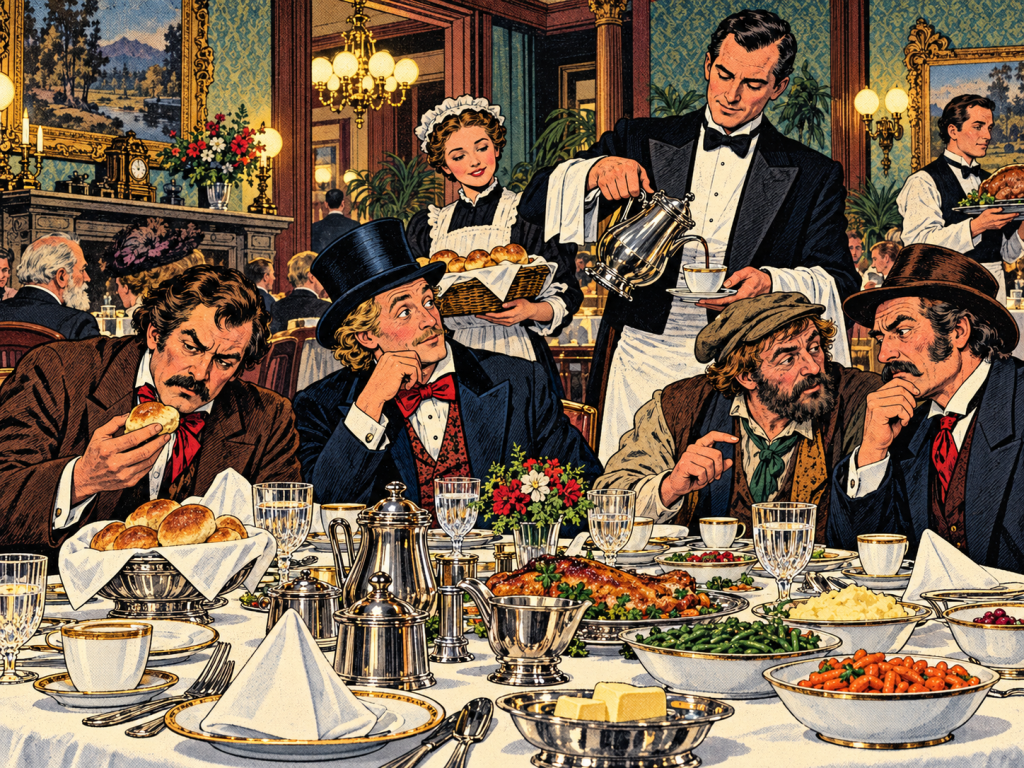
The trombone player first proposed that the best hotel must have the best table. Four musicians dined at the Union House and four at Ladd’s, while the magician ate part of his dinner at each because there was no proper way to divide him. Both tables were abundant and well served. One party praised the coffee at Ladd’s, and the other praised the Union House rolls. At the next meal Morgan and Duffie used covered coffee pots, and Roberts and Ladd brought rolls from the oven in smaller lots so none cooled in the basket.
“Then the table does not decide it,” said the trombone player.
“Not yet,” Mr. Ladd said.
“And perhaps never,” said Mr. Duffie, though he said it pleasantly.
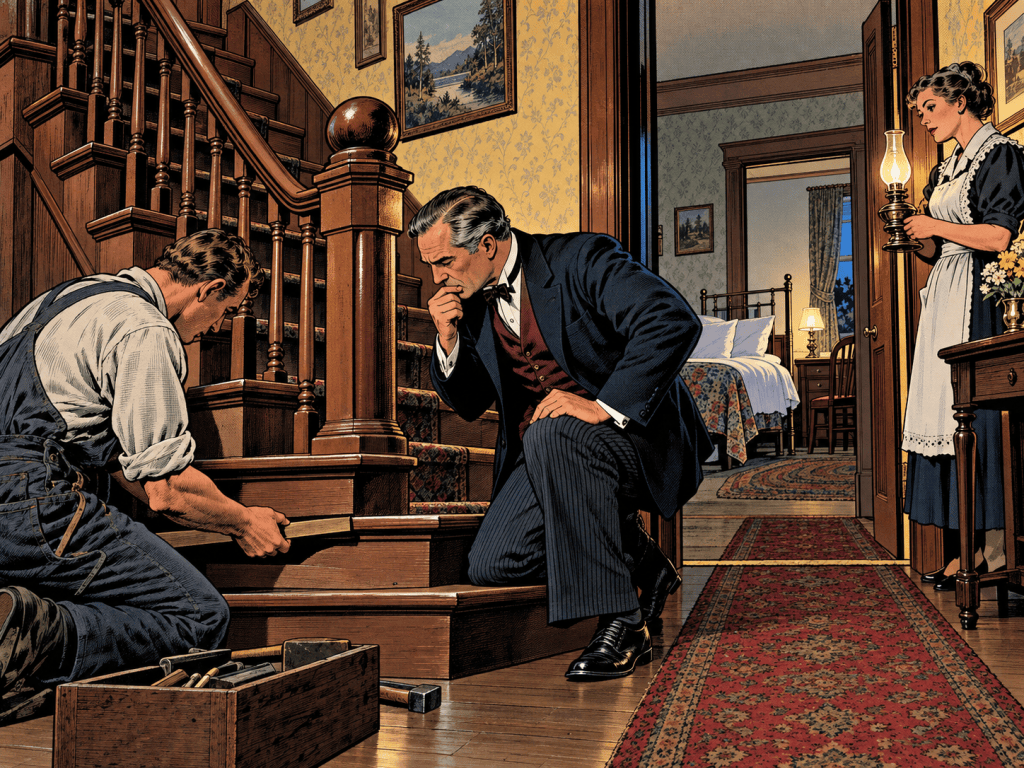
The next definition was sleep. A hotel was best if a traveler slept best there. The bass player said he had slept at Ladd’s without once hearing the stairs. Before night the Union House had examined every stair tread and put a strip beneath the one board that gave a sound. Then a guest said the Union House pillows suited him particularly, and Ladd’s offered a choice of two sizes. Neither house had possessed a bad bed. The trouble was that every praise became an instruction.
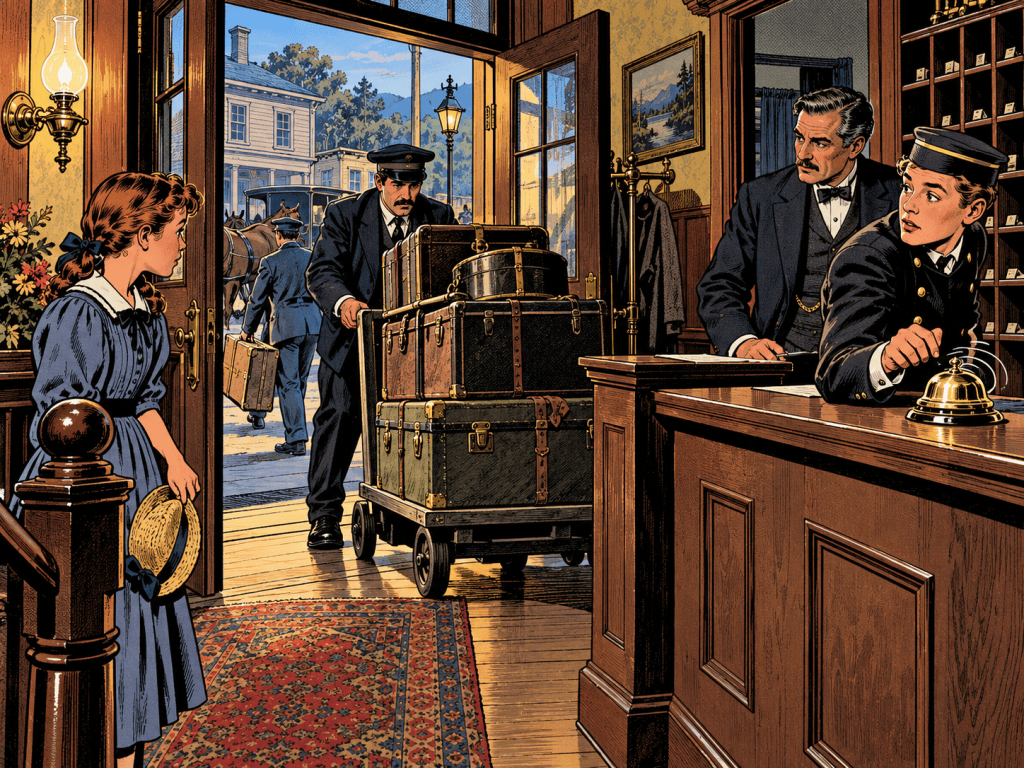
I discovered that part myself. I remarked that Ladd’s boy had carried two valises together without striking either against the door. That afternoon the Union House brought out a narrow baggage truck which went through its doorway exactly. I then said the Union House office bell was answered before it had stopped trembling. At Ladd’s they placed the boy where he could see the bell as well as hear it. After that I kept my opinions to myself, for I had begun to feel that a preference was something like ordering work and ought not to be done by a child without money.
Other guests learned the same caution. A gentleman praised Morgan and Duffie’s team at the harness shop, and Roberts and Ladd had their freshest horses brought around before the words reached the barber’s. A woman said at the post office that Ladd’s parlor was agreeably light, and by supper the Union House lamps had newly trimmed wicks and polished chimneys. Then Ladd’s polished theirs. Both houses had always cared for their lamps and horses. They now cared for them comparatively.
The trombone player next said the better house might be the one that knew what a guest wanted before he asked. This sounded sensible until Mr. Roberts asked whether a hotel ought to know that the guest wished to be left alone. The musician admitted it should.
“And if we leave him alone,” Mr. Morgan asked, “how is he to observe that we knew it?”
The trombone player said he did not know.
“And if he wishes to discover which hotel is best?” Mr. Ladd asked.
“Then each must assist him,” said the musician.
“But assisting him has so far made us equal.”
“It appears so.”
The argument had not become angry. It had merely found a chair and refused to get up.
The show itself supplied the final trial. Its people had to be taken to the hall, fetched after the performance, awakened for the morning train, and reunited with every trunk, horn, hoop, club, coat, and music roll. The eight musicians divided evenly between the two hotels. The magician took his supper at one and his bed at the other, so neither house could claim him entire. Each proprietor wrote down the requested waking times. One musician wanted six o’clock, another ten minutes after six, and the trombone player asked to be called at six and again at a quarter past in case the first call did not persuade him.
Every call was made. Every breakfast was ready. Both teams came at the appointed times, the baggage was checked by piece, and the long trombone remained in its owner’s hands. Nothing was lost, delayed, chilled, overcooked, or forgotten. This was excellent hotel keeping, but it was poor evidence.
At the depot Mr. Duffie asked whether the better best had now been found.
The trombone player said, “If best means without a fault we encountered, both are best.”
“Then what does better mean?” Mr. Roberts asked.
“That one has something the other lacks.”
“And when we discover such a thing?”
“The other supplies it.”
“Then must one of us refuse improvement so the editor may be proved exact?”
The musician considered this and said that refusal would prevent that house from being first-class in all respects. Everybody agreed, though the agreement helped nobody. Father came from the stable with the mare and asked why half the village was needed to see off an eight-piece orchestra.
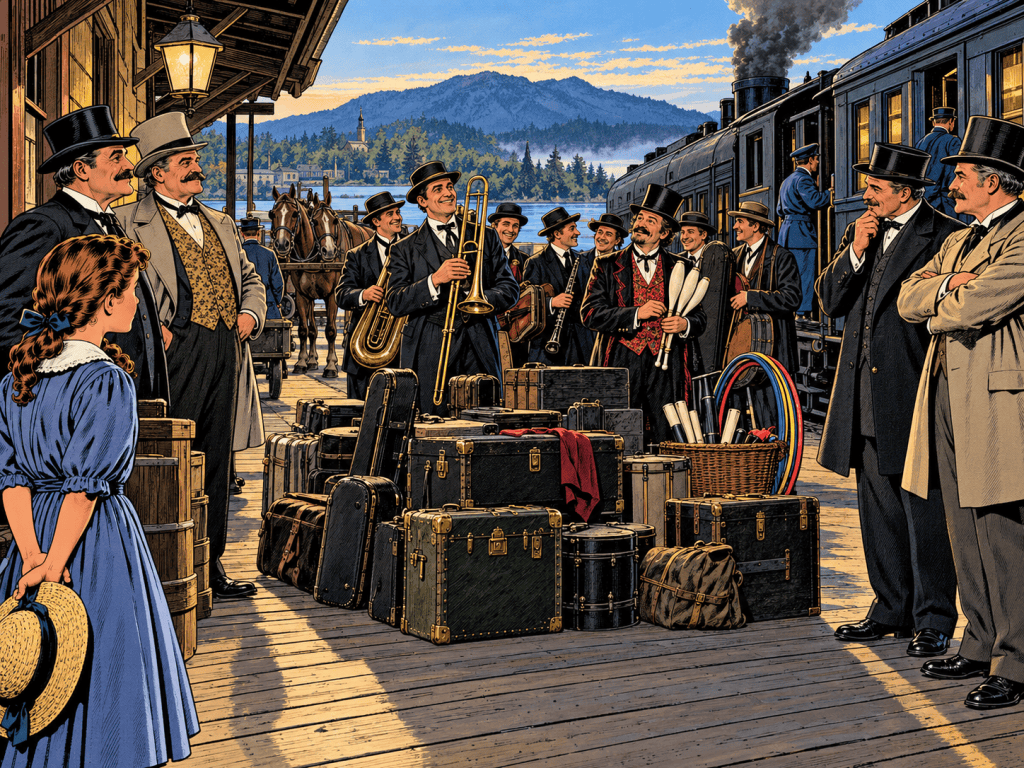
The show went back toward Albany without choosing. Afterward people praised the Union House or Ladd’s with greater care, and commonly mentioned the other before the sentence ended. The editor also became exact. In the next notice Morgan and Duffie received the same number of printed lines as Roberts and Ladd, with the names set in type of the same size. I remember counting the lines twice. There were eleven for each.
#Chateaugay #HistoricalFiction #AdirondackFiction #VillageComedy #TravelingShow #HotelRivalry #PeriodHospitality #NorthCountryStories #DryHumor #ShatageeWoods
QUIET IS LOGISTICS
Twenty pieces for the 1870–1900 Hotel Era
- The Gaslight Orchestra — “After the Ball” — 2:57
Start inside the respectable 1890s hotel rather than outside it: waltz time, polished floors, social order. This is the mask. - Charles Ives — “Putnam’s Camp, Redding, Connecticut” — Seattle Symphony / Ludovic Morlot — 6:15
The first fracture. Public music starts behaving like your rival hotels: several perfectly competent things insist on occurring simultaneously. The waltz gives way to marching-band memory, competing meters and incompatible perspectives. - Conlon Nancarrow — “Study No. 3a” — 3:09
Human civic bustle becomes mechanism. Repetition ceases to mean stability and starts producing acceleration and temporal disagreement. - Pierre Schaeffer — “Étude aux chemins de fer” — 2:53
The mechanism suddenly reveals its source: railway. This is The Ticket to Chateaugay Lake transition—the apparently ordinary transport network becoming an acoustic object with rules of its own. - Harry Partch — “The Wayward: III. The Letter” — 2:52
Machinery yields to documentary speech. Partch makes mundane language strange by preserving its inflection instead of “setting” it conventionally. Excellent territory for newspapers, correspondence columns, hotel notices and accidental documentary authority. - Robert Ashley — “The Park” — 21:44
Now information becomes environment. Ashley’s conversational narrative feels almost like somebody reporting local facts until syntax, accompaniment and attention begin separating from one another. This is where the annual notices, guidebooks, proprietors and correspondents really enter the sequence. - Alvin Lucier — “I am sitting in a room” — 45:24
The absolute center of The Phrase That Went Around the Lake. A statement is repeated through a system until the system becomes more authoritative than the statement. It also literalizes the Merrill House premise: architecture determines what communication eventually becomes. - Pauline Oliveros, Stuart Dempster & Panaiotis — “Lear” — 24:56
Lucier’s room expands into an enormous resonant cavity. Recorded in the famous cistern, this is the musical equivalent of entering W Mountain after discovering that the space itself participates in every measurement. - Hildegard Westerkamp — “Gently Penetrating Beneath the Sounding Surfaces of Another Place” — 14:02
A crucial change of listening behavior: instead of imposing music upon landscape, recorded environment becomes compositional evidence. It fits the project’s repeated question of whether observation reveals a place or reorganizes it. - George Crumb — “Vox Balaenae: I. Vocalise (…for the beginning of time)” — Conchord — 5:06
After environmental actuality, something unmistakably composed begins impersonating an impossible aquatic natural history. Lake, loon, animal call and human instrument become difficult to separate. - Sofia Gubaidulina — “De Profundis” — Elsbeth Moser — 13:31
Downward. Accordion respiration becomes cavern pressure, bellows, weight and vertical depth. The shift from Crumb works beautifully: watery suspended sound becomes subterranean breathing. - Helmut Lachenmann — “Pression” — Lauren Radnofsky — 9:10
The project’s “pressure” finally becomes physical technique. The instrument is no longer primarily a note-producing device; scraping, friction, bow pressure and resistance become the composition. Very close to the way your stories turn infrastructure into plot. - Colin Stetson — “Among the Sef” — 4:36
Lachenmann’s friction suddenly acquires pulse, lungs and machinery. It sounds simultaneously animal, industrial and human—which is useful Shatagee Woods territory without having to announce a supernatural creature. - Morton Feldman — “Rothko Chapel: 5th Movement” — 2:53
After that density, almost nothing. But it is structured nothing: the kind of quiet Shepard would discover cannot actually be defined by absence of activity. - John Cage — “In a Landscape” — 9:08
Feldman’s suspended interval opens into a landscape whose apparent serenity depends on repetition and harmonic ambiguity. This is the lake advertised as restorative wilderness—beautiful, orderly, and not quite as innocent as the brochure suggests. - William Basinski — “Dlp 1.1” — 63:36
The longest descent. Repetition now physically erodes its own recorded source. This connects beautifully with the project’s newspapers, remembered sayings, revised guidebooks, retrospective records and stories in which circulation changes the status of evidence. - Sarah Davachi — “Magdalena” — 10:20
Basinski’s deteriorating archive resolves not into silence but into slow architectural sonority. It feels like entering an old hotel after the people have left while the proportions of the rooms remain. - John Luther Adams — “The Wind in High Places: I. Above Sunset Pass” — JACK Quartet — 7:25
We finally climb out. This is The Good Citizen’s Ascent with the certificate removed: altitude expressed as bowing, breath, exposure and slowly shifting air rather than heroic summit music. - R. Murray Schafer — “Epitaph for Moonlight” — Vancouver Chamber Choir — 4:09
The human voice re-enters the wilderness, but now it has become acoustic phenomenon. Moonlight, lake surface, distant calling and communal ritual all appear without needing conventional horror scoring. - Charles Ives — “The Unanswered Question” — Gerhard Samuel / Cincinnati Philharmonia Orchestra — 5:56
And this is why I wanted Ives at both ends of the strange part of the journey. Sustained landscape, repeated inquiry, increasingly incompatible answers. Nothing attacks anyone. Nothing is solved. The environment simply outlasts the explanation.
The sequence has a deliberate large-scale harmonic/timbral logic: waltz → colliding band music → player mechanism → recorded machinery → speech → recursive speech → room resonance → environmental sound → invented nature → depth → friction → breath-machine → organized quiet → landscape → material decay → architectural drone → altitude → nocturnal voices → unanswered signal.

What mysteries of Chateaugay Lake haunt you?