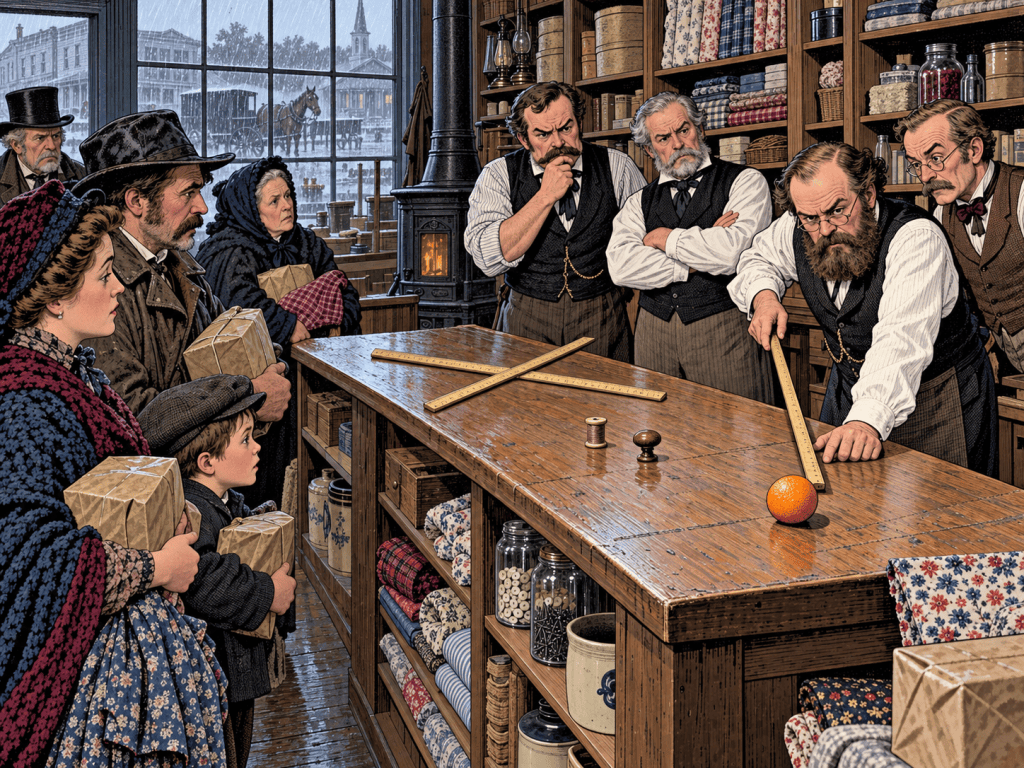
Readers sensitive to blurred distinctions between shopping and recreation may encounter oranges in active play, soap awarded as stakes, folding rules, improvised pockets, and merchants whose busiest week produces remarkably little actual selling.
We have always maintained that Chateaugay is abreast of the age, and if at any time the age gets ahead of us it is generally because the roads are muddy.
The late wet spell afforded another proof.
Our readers will remember the account recently printed concerning the origin of billiards. A London hatter named William Kew, finding business dull in wet weather, amused himself by taking three balls from his stock and punching them about his counter with a yardstick. Side pockets followed, the cue received its name, and from this modest commercial beginning arose a recreation enjoyed wherever men possess tables, leisure and somebody willing to lose twenty-five cents.
The story was read here with unusual attention.
It contained three things every Chateaugay merchant understood perfectly:
A counter.
Dull business.
Rain.
By Tuesday nearly every store on Main street had discovered billiards.
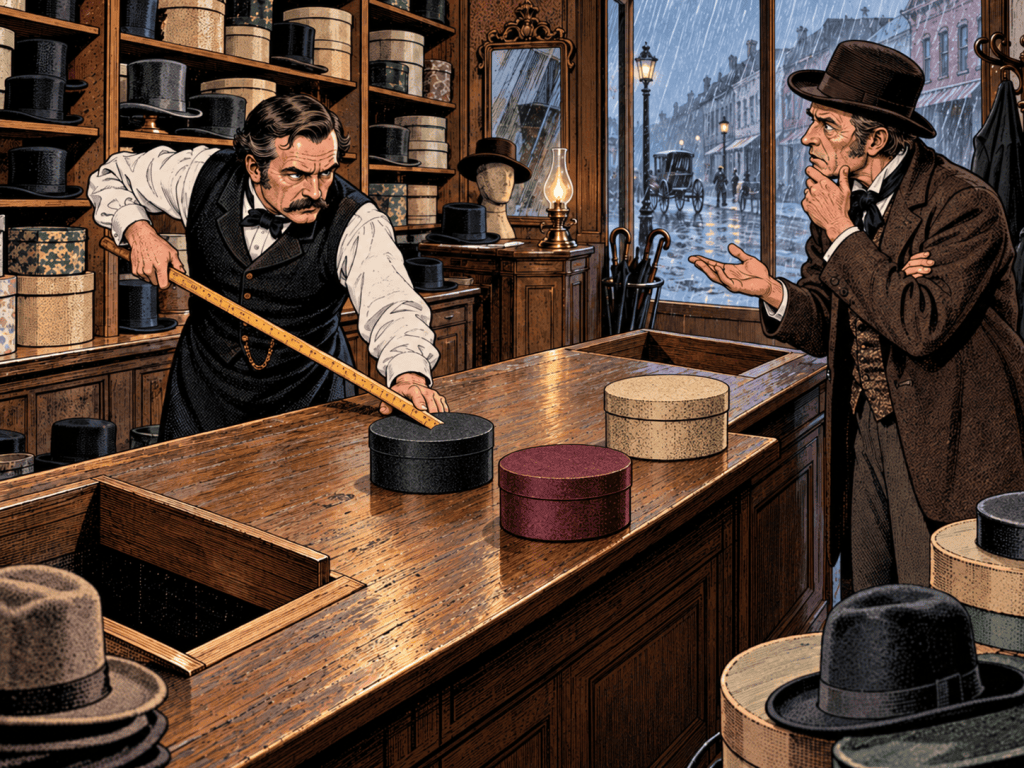
Calvin Bellows, who kept hats, naturally claimed priority. He placed three round hat-box knobs upon his counter and drove them with a yardstick toward two openings made by removing the end trays.
“This,” said Bellows, “is practically Kew’s original game.”
Orrin Shutts, next door, objected that knobs were not balls.
Bellows replied that if London hatters had possessed better knobs the history of recreation might have been different.
Shutts kept groceries. He selected three oranges.
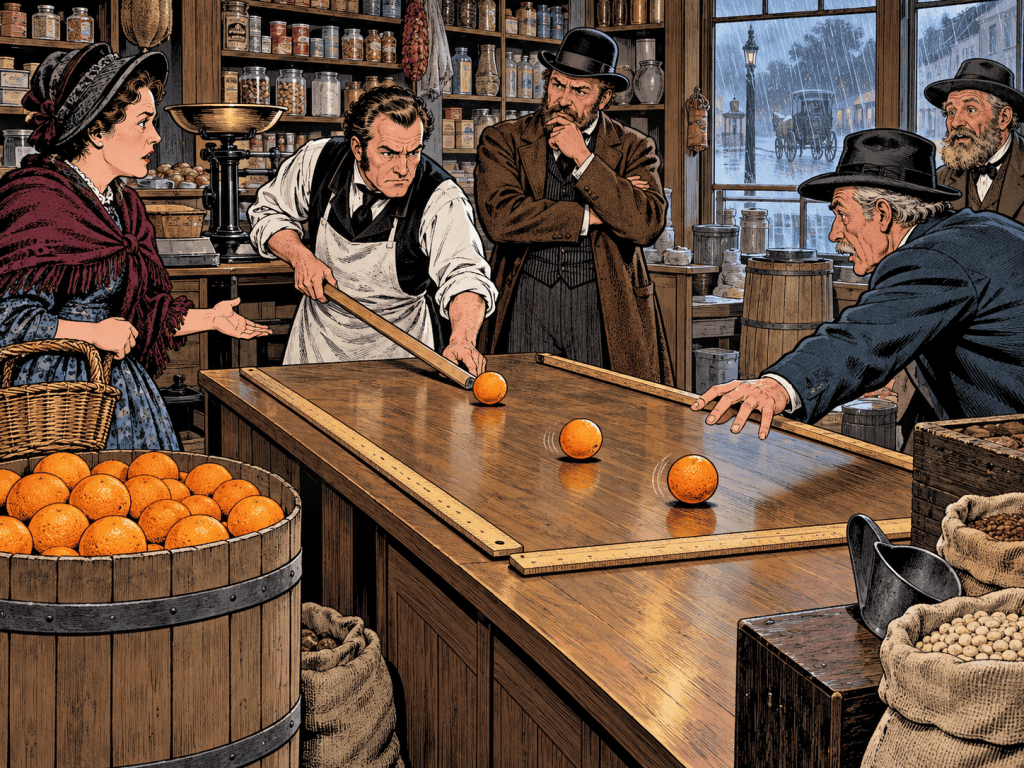
This was immediately popular because an orange rolls better than a hat-box knob and smells better after being struck.
Unfortunately, the game ended whenever anybody bought one.
Shutts therefore established the first local rule:
ARTICLES IN ACTIVE PLAY ARE TEMPORARILY WITHDRAWN FROM SALE.
A customer protested that he had entered specifically for oranges.
Shutts sold him one from the barrel.
The distinction was important. An orange in the barrel was merchandise. An orange on the counter between two yardsticks was recreation.
There was no trouble until Lyman Trombley purchased one while it was still moving.
By Wednesday the thing had spread.
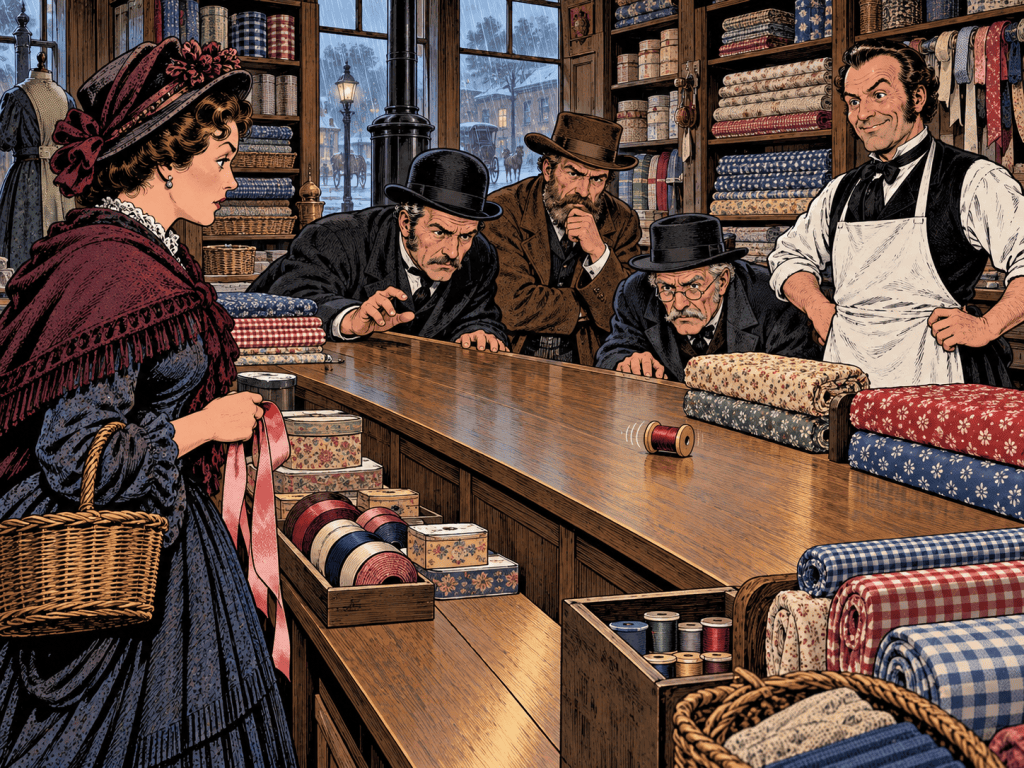
At Abel Merrill’s dry-goods store the balls were wooden thread spools, the pockets were gaps between folded cloth, and a gentleman scored by driving the red spool beneath a bolt of calico without disturbing the display.
At Silas Drew’s hardware establishment the game was played with three drawer knobs and a carpenter’s rule.
Drew claimed the rule was historically superior to a cue because Kew himself had used a yardstick.
Bellows protested that a carpenter’s rule folded.
Drew replied that progress must be permitted somewhere.
The druggist used pill boxes.
The harness shop used three brass rings, which would not roll at all and therefore required an entirely new game based upon sliding.
A young clerk at the meat market proposed potatoes but was overruled on grounds of dignity.
We visited every establishment in the interest of journalism and found trade greatly improved, although commerce itself had become difficult to identify.
At Merrill’s, six men stood before the counter watching a spool travel slowly toward gingham while a lady with two yards of ribbon in her hand waited to be served.
“Business appears lively,” we observed.
“Never better,” said Merrill.
“Have you sold much?”
“Not since eleven.”
There is prosperity, and there is the appearance of prosperity. Our merchants are capable of supplying either.
The Wet-Weather Billiard Association was organized Thursday evening after a dispute at Drew’s concerning whether a man might play with merchandise he had already purchased.
Drew said no.
Once purchased, the knob ceased to belong to the store and became private property.
Private property upon a commercial counter, he argued, constituted trespass.
Trombley maintained that if he bought all three knobs the game should become more legitimate, not less.
The matter was referred to committee.
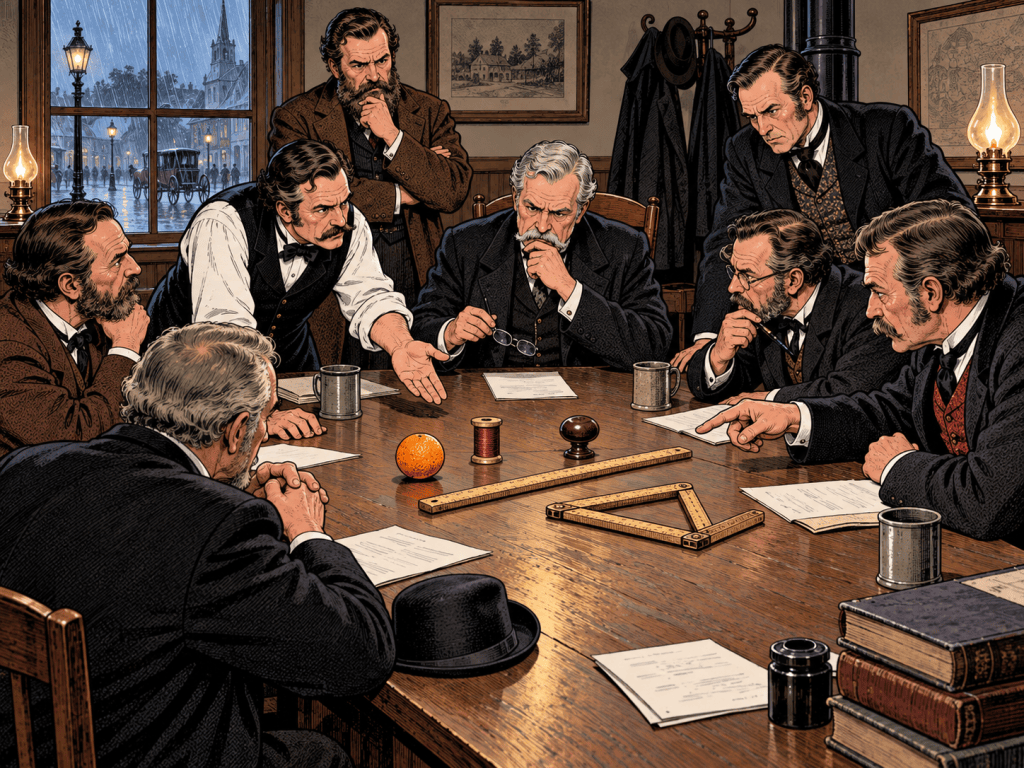
The committee consisted of five merchants, one hotel man, a justice of the peace, and ourselves, journalism being the only calling accustomed to deciding questions after learning very little about them.
Our first duty was to define billiards.
This proved impossible.
If balls were essential, Merrill’s spools were excluded.
If a yardstick was essential, Drew’s folding rule was excluded.
If pockets were essential, Bellows’s removable trays qualified but Shutts’s flour-bin game did not.
If a cloth-covered table was required, William Kew himself became ineligible, having played upon a hatter’s counter.
Nobody was willing to expel the inventor.
We therefore adopted the following definition:
BILLIARDS shall consist of merchandise, or reasonable substitutes for merchandise, propelled across a commercial counter by a linear measuring instrument during weather sufficiently unfavorable to ordinary trade.
This passed unanimously.
Then the sun came out.
For twenty minutes the entire recreation industry of Chateaugay became illegal.
A special meeting amended during weather sufficiently unfavorable to read originating during weather sufficiently unfavorable.
Business resumed.
The gambling question came Friday.
Until then no money had changed hands except across the counters in the customary direction.
But young Rufus Bellows wagered a nickel that Trombley could not send an orange between two coffee canisters without striking either.
He succeeded.
The nickel passed.
Shutts objected immediately.
He maintained a respectable grocery and had no intention of operating a gambling establishment merely because London once had rain.
Rufus said the nickel was private.
Shutts said the counter was public.
The committee assembled.
We found the distinction delicate.
If a man paid five cents for an orange, that was trade.
If he paid five cents to strike the orange, that was recreation.
If he paid five cents because another man had struck the orange, that appeared to be gambling.
Suppose, however, the winner took his prize in merchandise?
This was tried experimentally.
Trombley won a bar of soap.
The committee ruled it gambling.
Suppose the soap had first been purchased?
Still gambling.
Suppose two gentlemen bought one bar jointly and the winner merely became sole owner?
The justice removed his spectacles.
“We are getting close to law,” he said, “and had better stop.”
A schedule was therefore posted:
PURCHASE OF ARTICLES — MERCHANDISING.
STRIKING PURCHASED ARTICLES FOR AMUSEMENT — PERMITTED.
PAYMENT FOR PRIVILEGE OF STRIKING — QUESTIONABLE.
MONEY DEPENDENT UPON RESULT — GAMBLING.
MERCHANDISE DEPENDENT UPON RESULT — ALSO GAMBLING, EVEN SOAP.
The last words were added for Trombley.
Saturday brought side pockets.
Every merchant wanted them because the newspaper account said pockets had developed later, and nobody wished his establishment accused of primitive billiards.
Bellows cut semicircular openings in two cardboard trays.
Merrill merely separated his calicoes.
Drew hung three leather nail pouches beneath the counter edge.
Shutts drove a rolling orange through an open flour scoop and claimed a funnel should count.
The Association ruled that a side pocket must receive an article without requiring the proprietor to leave his position behind the counter.
This was a fine definition and immediately caused trouble at the harness shop, where the brass rings fell into a box on the customer’s side.
We were asked to decide whether that was a front pocket.
We declined.
An editor has duties to the public.
By Monday the rain had stopped entirely, but the Wet-Weather Billiard Association was flourishing.
Bellows advertised THE ORIGINAL HATTER’S GAME.
Shutts offered CITRUS BILLIARDS—NO BRUISING CHARGED UNLESS PURCHASED.
Merrill announced that ladies waiting upon dress goods might enjoy the spool table without obligation.
Drew displayed a placard reading:
THE MOST SCIENTIFIC COUNTER
IN NORTHERN NEW YORK!
We consider this probable, although science has not yet been consulted.
The effect upon trade is disputed.
More people enter the stores.
Fewer can reach the counters.
Goods are handled constantly but purchased irregularly.
Yardsticks, once employed in measuring what a customer wanted, are now occupied pushing what he does not.
Still, we are glad to report enterprise wherever found.
Our merchants are prosperous men,
In sunshine, storm or drizzle;
If trade won’t come across the counter,
They’ll knock it there with a missile.
The Association met again yesterday to consider a final complaint.
A stranger had entered Bellows’s establishment during a shower, bought a hat, declined to play billiards, and departed.
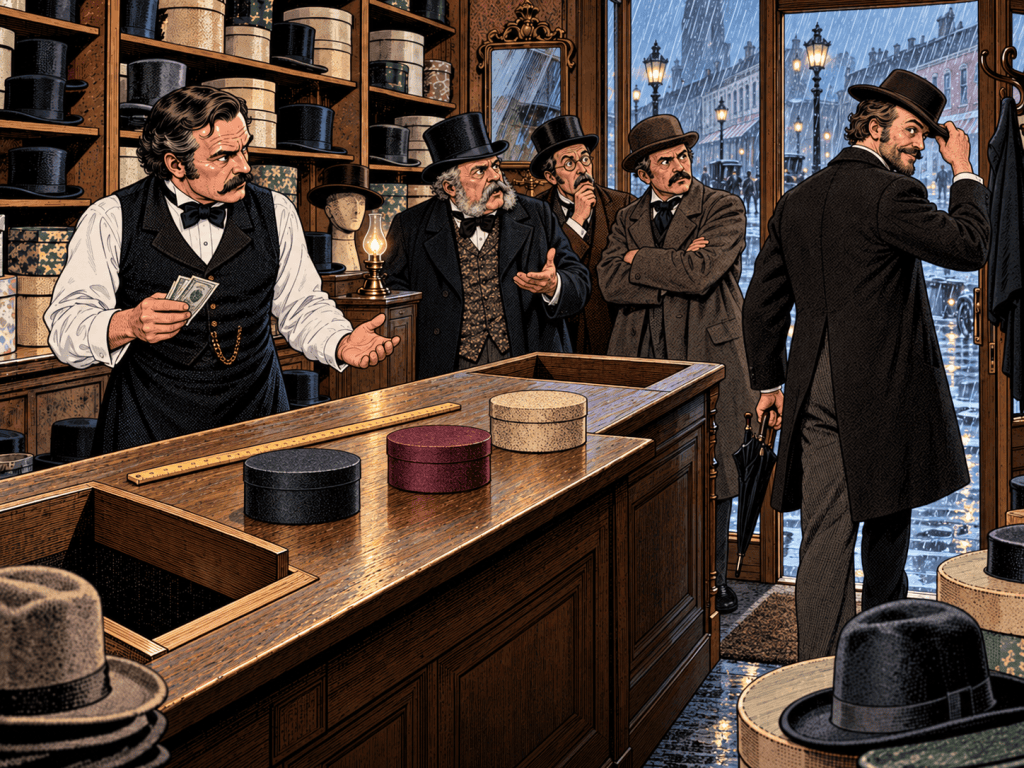
Several members wished to know whether this constituted ordinary merchandising and, if so, whether ordinary merchandising should be permitted during Association hours.
The question was laid over until the next wet day.
Meanwhile we advise our readers to patronize home industry.
If you require hats, groceries, cloth, hardware or harness, Chateaugay merchants can furnish them.
If you require billiards, they can furnish that also.
Only be particular when laying down your money.
The Association has spent a week determining whether you are buying the ball, striking the ball, betting on the ball, or merely standing at the counter while somebody else prevents you from buying anything.
In dull weather, every distinction helps business.
#ShatageeWoods #ChateaugayNY #AdirondackHistory #HistoricalSatire #MercantileFarce #BilliardsHistory #SmallTownNewspaper #VictorianCommerce #NorthCountryHumor #MainStreetHistory
THE WET-WEATHER BILLIARD ASSOCIATION
An American Mercantile Tone Poem in Twenty Movements
01. Stormy Weather — Lena Horne
Harold Arlen — Stormy Weather (Remastered) — 1954
Narrative / conceptual function: The governing condition before anybody has invented a solution: rain suppresses ordinary traffic and leaves the merchants staring across their counters.
Musical reason: Horne’s measured vocal line floats over an orchestral atmosphere in which weather feels less meteorological than psychological. The tempo leaves genuine commercial dead space.
Transition: Its lingering, suspended melancholy is suddenly answered by the dry attack of a single piano—the merchant has found something to do.
02. The Easy Winners — Joshua Rifkin
Scott Joplin — Scott Joplin: Digital Ragtime / Wall Street Rag — 1985
Narrative / conceptual function: The first harmless counter game, and with it the story’s boosterish assumption that ingenuity naturally becomes competition.
Musical reason: Joplin’s strict phrase architecture contains constant syncopated displacement: respectable order with mischief occurring inside every measure. Rifkin’s unsentimental precision makes the mechanism especially audible.
Transition: Ragtime’s regular grid develops a numerical kink as Brubeck begins reorganizing the beat itself.
03. Three to Get Ready (Live) — The Dave Brubeck Quartet
Dave Brubeck — At Carnegie Hall (Live) — 1963
Narrative / conceptual function: Three balls are now on the counter, and somebody has begun asking what constitutes a legitimate shot.
Musical reason: Brubeck’s alternation of metric groupings makes counting itself playful. The listener can follow the rule, but following it changes how every subsequent accent is heard—the exact beginning of the Association’s trouble.
Transition: The quartet’s rhythmic game acquires an industrial caricature in Raymond Scott: play becomes machinery.
04. Powerhouse — Raymond Scott
Raymond Scott — The Music of Raymond Scott – Reckless Nights and Turkish Twilights — 1937
Narrative / conceptual function: Every shop on Main Street suddenly invents its own version: oranges, knobs, spools, folding rules, brass rings.
Musical reason: Scott constructs activity from repeating modules, abrupt gear changes and obsessively efficient ensemble synchronization. It sounds like a commercial district operating several ingenious contraptions simultaneously.
Transition: Strip away the cartoon machinery but retain the striking, knocking and calibrated motion: the counter itself becomes percussion.
05. Third Construction — Third Coast Percussion
John Cage — Cage: The Works for Percussion, Vol. 2 — 2012
Narrative / conceptual function: Merchandise ceases merely to be merchandise and becomes material for games. Physical objects acquire new functions according to how they can be struck, slid and counted.
Musical reason: Cage organizes heterogeneous percussion into an exact temporal structure without requiring traditional instrumental hierarchy. Ordinary material becomes disciplined musical apparatus—the counter-game principle almost literally translated into composition.
Transition: Having multiplied the objects, the sequence now removes all of them except the rule.
06. Clapping Music (1972) — Steve Reich & Russ Hartenberger
Steve Reich — Early Works — 1987
Narrative / conceptual function: The Association writes its first definition. A simple procedure is expected to settle matters.
Musical reason: One identical rhythmic pattern against itself produces complexity solely through systematic displacement. Nothing new needs to be added; the rule manufactures the difficulty.
Transition: Reich’s accents remain in the ear while Monk transfers procedural displacement onto piano, bass and drums.
07. Evidence — Thelonious Monk
Thelonious Monk — Thelonious Monk Live At the It Club – Complete — 1964
Narrative / conceptual function: Is a knob a ball? Is a folding rule a cue? Must there be pockets? The committee begins deciding cases.
Musical reason: Monk’s tune behaves like testimony under cross-examination: clipped motifs, withheld resolutions, hard accents and strategic gaps repeatedly make apparently obvious rhythmic evidence questionable.
Transition: Individual disputes are absorbed into a larger collective rule system.
08. In C — Bang on a Can All-Stars
Terry Riley — Riley: In C — 2001
Narrative / conceptual function: Every establishment now plays a recognizably related game while exercising considerable freedom about how to do it.
Musical reason: Riley supplies common modules and a shared pulse but allows performers to progress independently. Local autonomy creates an emergent civic organism—an uncanny musical equivalent of twenty merchants interpreting one Association rule.
Transition: The communal pulse hardens. What was voluntary coordination becomes a machine.
09. Ballet Mecanique — Daniel Spalding & Philadelphia Virtuosi Chamber Orchestra
George Antheil — Antheil: Ballet Mecanique, Serenade for String Orchestra — 2001
Narrative / conceptual function: Counter recreation has become an institution powerful enough to interfere with the commercial activity it was invented to assist.
Musical reason: Antheil turns repetition, percussion and aggressively articulated blocks into an almost comic tyranny of mechanism. Human bustle has become industrial procedure.
Transition: Machinery reaches such density that the problem is no longer motion but the notation required to control it.
10. The Black Page #1 (Piano Version) — Frank Zappa
Frank Zappa — Zappa (Original Motion Picture Soundtrack) — 1977
Narrative / conceptual function: The committee’s definitions, exceptions, amendments, side-pocket rulings and special cases reach maximum regulatory density.
Musical reason: Zappa’s notorious accumulation of tuplets and rhythmic subdivisions is complexity made visible and audible: a perfectly serious system arriving at comic excess by being too exact.
Transition: After all that notation, one whip crack obliterates the bureaucracy.
11. Minimum Wage — They Might Be Giants
John Flansburgh & John Linnell — Flood — 1990
Narrative / conceptual function: The shortest possible reminder that underneath this magnificent regulatory edifice somebody is supposed to be conducting business.
Musical reason: At forty-six seconds, the track is almost a commercial break inserted into the tone poem. Its miniature scale after Zappa is the joke; an entire economic category becomes a sonic footnote.
Transition: The joke abruptly acquires teeth as the meaning of merchandise itself becomes contested.
12. Merchandise — Fugazi
Repeater & 3 Songs — 1990
Narrative / conceptual function: The story reaches its conceptual pivot: if an object is bought, played with, wagered, damaged or awarded, when precisely is it merchandise?
Musical reason: Fugazi’s taut rhythmic attack and refusal of decorative excess make commodification sound confrontational rather than theoretical. The playlist suddenly stops smiling politely at the counter.
Transition: The straight guitar assault opens into a denser polyrhythmic marketplace where language itself ceases behaving normally.
13. I Zimbra (Remastered) — Talking Heads
Brian Eno, David Byrne & Hugo Ball — Once In a Lifetime: The Talking Heads Box (Remastered) — 1979
Narrative / conceptual function: The Association debates “pocket,” “receptacle,” “front pocket,” “side pocket,” and other terms until language continues functioning syntactically while shedding ordinary usefulness.
Musical reason: Dada-derived vocal material rides a tightly interlocking rhythmic fabric. Meaning becomes less important than coordinated recurrence—the committee meeting as ecstatic municipal polyrhythm.
Transition: Talking Heads’ interlocking parts are quantized into something still more machine-like.
14. Atlas — Battles
Mirrored — 2007
Narrative / conceptual function: Main Street at maximum congestion: games, customers, goods, counters and rules all attempting to occupy the same commercial space.
Musical reason: Looped figures and muscular live playing make human musicians sound like a mechanism continuously folding back upon itself. The grotesquely processed vocal is practically another piece of inventory.
Transition: Battles’ machine groove is abstracted into a more impersonal system of proportional relationships.
15. Fanfare for Effective Freedom — Horse Lords
Andrew Bernstein, Owen Gardner, Max Eilbacher & Sam Haberman — The Common Task — 2020
Narrative / conceptual function: The Association has become sufficiently sophisticated to debate whether ordinary merchandising may be permitted during Association play.
Musical reason: Horse Lords build momentum from tuning systems, repetition, metric interference and mutually dependent patterns. It feels exhilarating while making individual agency increasingly difficult to locate—perfect committee logic.
Transition: The rhythmic web loosens into electric vapor. Weather, forgotten during the bureaucracy, returns.
16. Rain Dance — Herbie Hancock
Herbie Hancock — Sextant — 1973
Narrative / conceptual function: The original rain reappears—but now Chateaugay has built an entire cultural technology around it.
Musical reason: Hancock’s electronics, percussion and cyclic figures transform “weather” into a synthetic environment. The rain is no longer merely outside the store; it has entered the machine.
Transition: Nine expansive minutes of electronic atmosphere abruptly collapse into approximately one minute of concentrated commercial moisture.
17. Moisture — The Residents
The Residents — Commercial Album: Preserved Edition — 1979
Narrative / conceptual function: The whole wet-weather enterprise returns in miniature: rain converted into commercial form.
Musical reason: Its presence on Commercial Album, whose pieces deliberately compress pop form to tiny dimensions, makes this selection structurally rather than merely verbally apt. The Association has commodified its originating condition.
Transition: The miniature vanishes and acoustic piano walks back in, apparently promising straightforward business.
18. Straight, No Chaser — Thelonious Monk
Thelonious Monk — Monk’s Blues — 1963
Narrative / conceptual function: The stranger enters, buys a hat at the marked price, refuses to play and leaves. Could anything be simpler?
Musical reason: Monk gives us a blues that is perfectly intelligible yet stubbornly angular. “Straight” exists, but only inside a musical intelligence incapable of behaving conventionally for long. Ordinary merchandising has returned after the Association has made ordinary behavior impossible to hear innocently.
Transition: Monk’s recurring blues circuit becomes a different kind of loop: a mundane pattern repeated until daily existence itself seems inexplicable.
19. Once In a Lifetime — Talking Heads
Brian Eno, Chris Frantz, David Byrne, Jerry Harrison & Tina Weymouth — Remain In Light — 1980
Narrative / conceptual function: The committee looks at a completely ordinary transaction and wonders whether it can possibly be legitimate.
Musical reason: Repetitive bass, interlocking cyclic layers and Byrne’s estranged narration turn commonplace circumstances into anthropological mysteries. Nothing material has changed; the framework for recognizing normality has.
Transition: The groove dissolves into Laurie Anderson’s cooler world, where experience can finally be handled by replacing it with variables.
20. Let X = X — Laurie Anderson
Laurie Anderson — United States Live — 1984
Coda: This is the Association after everyone has gone home but the definitions remain. Anderson’s restrained electronics, speech, repetition and administrative calm make abstraction sound perfectly reasonable. That is exactly where the story ends: hats can still be sold, oranges can still be eaten, counters remain counters—and yet an institution has become capable of asking whether an ordinary customer constitutes an exceptional case. Let merchandise equal merchandise. Let recreation equal recreation. Let X equal X. The next meeting will determine whether this is permissible.
The sequence has one large formal joke built into it: Tracks 2–10 increasingly replace objects with systems; Tracks 11–20 gradually discover that the systems have replaced the objects. By the time Monk tries to play it straight, the listener has been trained not to trust straightness anymore. That feels very close to what the story itself is doing.

What mysteries of Chateaugay Lake haunt you?