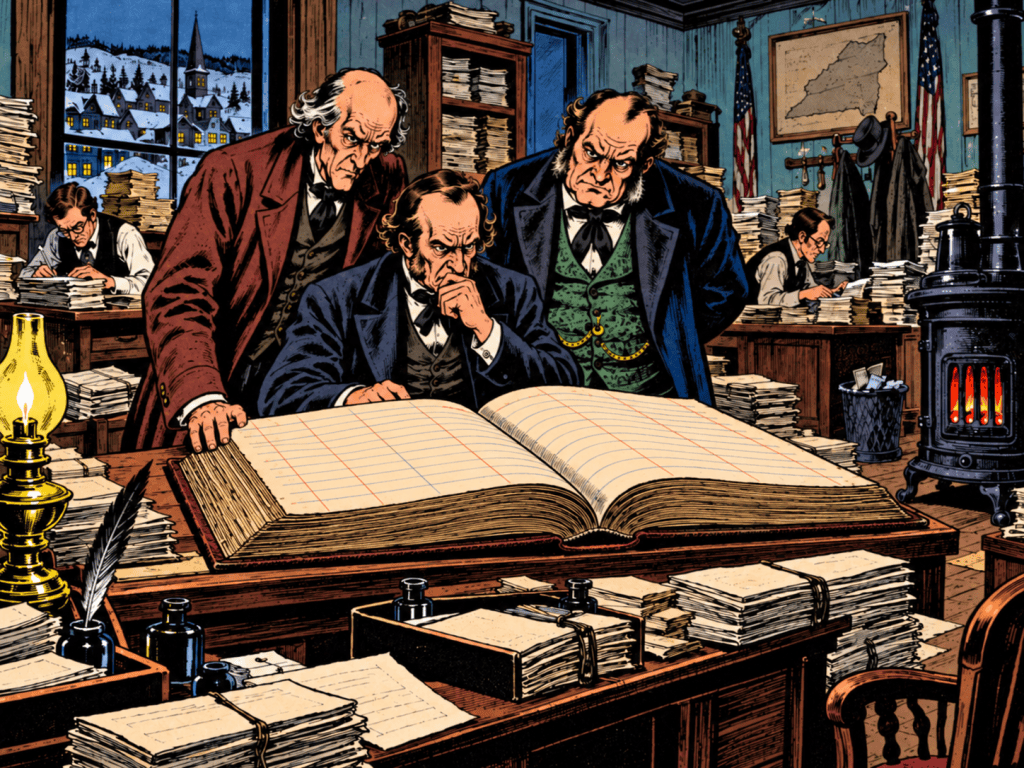
Contains municipal reform, abolished offices, proliferating forms, stubborn duties, quarterly meetings, and one seventeen-pound ledger. Readers sensitive to government becoming larger while documenting its own disappearance may recognize the administrative weather rather quickly.
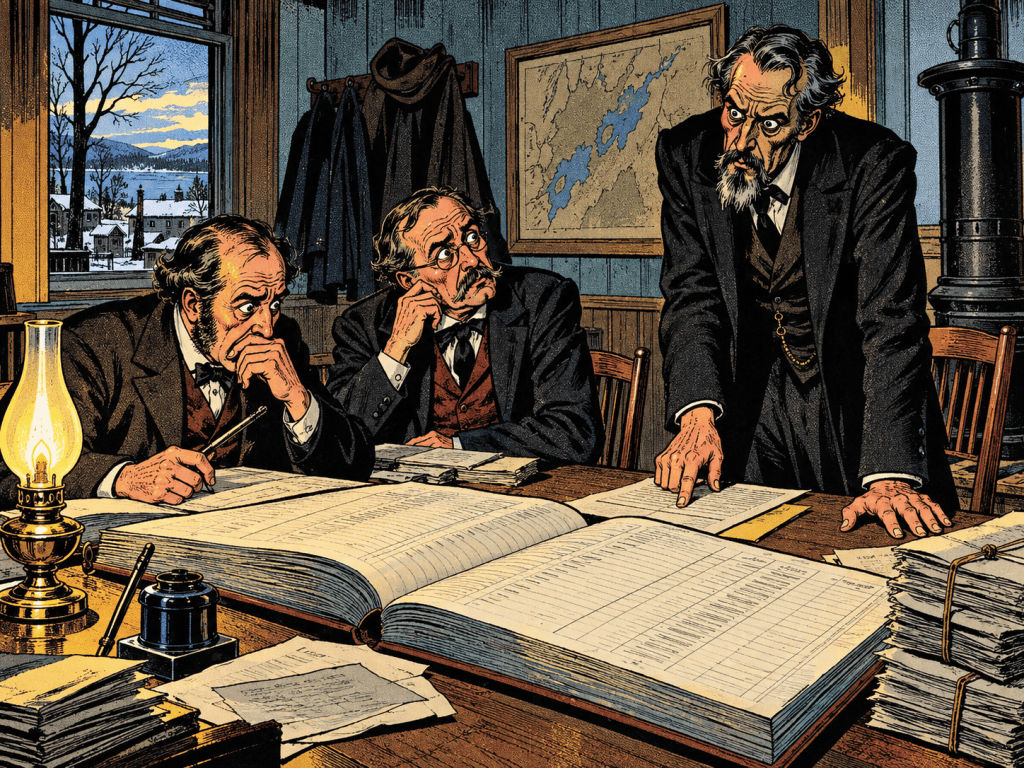
THE LEDGER OF THINGS NO LONGER DONE
We have before us the annual reports of the Chateaugay trustees for the years immediately preceding the Reform Administration, together with the larger and much handsomer volume which finally superseded them; and as several persons now living profess to remember the matter differently, we shall proceed by the documents.
The old reports measured government by what government did.
So many rods of road graded.
So many sidewalk notices served.
So many culverts repaired.
So many lamps attended, hearings held, accounts examined, crossings cleared, nuisances removed, bills audited, drains opened, and miscellaneous public inconveniences prevented from ripening into private lawsuits.
This, said Trustee Hiram Rounds, was backward.
“A man does not grow rich by counting what he spends.”
The proposition was received with favor.
Rounds therefore proposed that the next annual report should record, not the duties performed, but the duties no longer performed.
We confess that we admired the conception from the beginning.
What town in Northern New York could boast more magnificently than Chateaugay of work it had ceased doing?
The first inventory was splendid.
THREE COMMITTEES ABOLISHED.
TWO OFFICES ABOLISHED BY CONSOLIDATION.
ELEVEN FORMS DISCONTINUED.
SEVEN SUBSCRIPTIONS CANCELED.
ONE MUNICIPAL ROOM CLOSED.
FOURTEEN DUTIES TRANSFERRED ELSEWHERE.
Thirty-eight reductions!
There stood the achievement in black type.
Malone might build. Plattsburgh might enlarge. Lyon Mountain might dig deeper into the everlasting hills. Other communities could boast of bridges raised, depots opened, mills enlarged and fresh enterprises brought to town.
Chateaugay had discovered a nobler species of progress.
It advanced by subtraction.
Others add both stick and stone;
Chateaugay thrives by leaving alone.
The Record, whose duty it is to encourage every worthy enterprise until encouragement itself becomes a local industry, congratulated the trustees upon this evidence of municipal vigor.
Then Silas McPherson spoiled everything by asking where elsewhere was.
“Elsewhere?” said Rounds.
“The fourteen duties.”
“They have been transferred.”
“I understand that. Where?”
The minutes record a short interval.
Trustee Orin Spear finally observed that if the destination had been important it would doubtless have been entered.
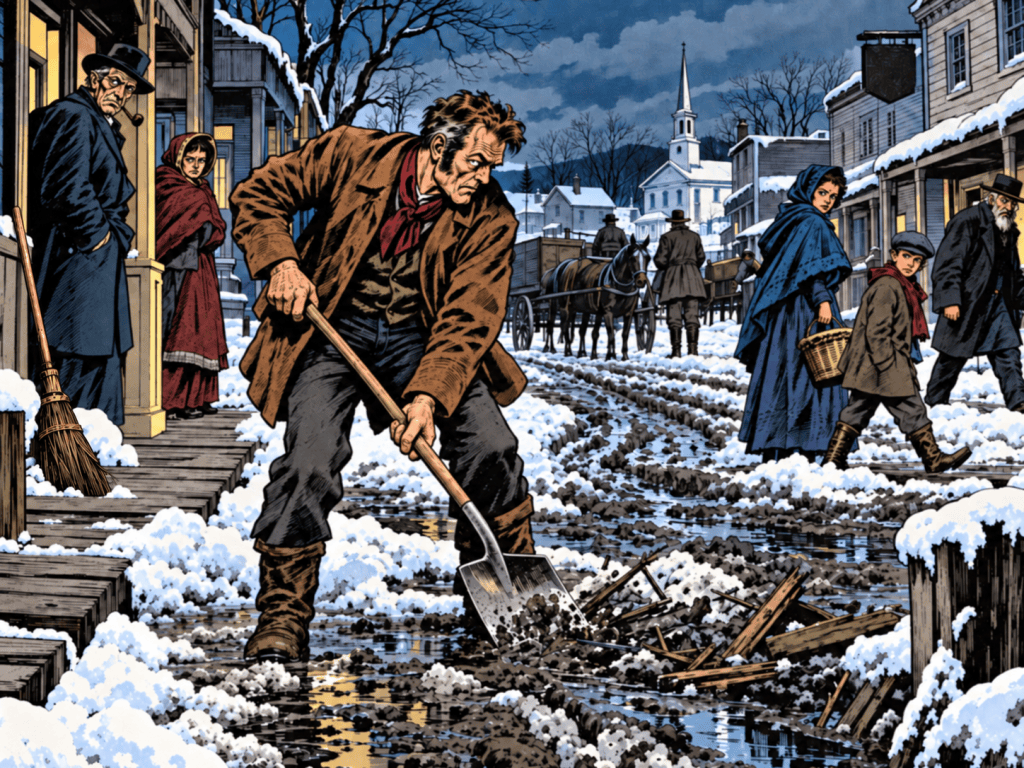
McPherson replied that the street crossing near his store was still being cleared after storms by Ezra Shutts, although Shutts’s position appeared among the abolished offices.
Shutts was summoned.
“Are you still clearing that crossing?”
“When it needs it.”
“Who instructed you?”
“Nobody.”
“Are you paid?”
“No.”
Rounds brightened.
“Then the office is abolished.”
This established the first great principle of the Reform.
A duty might continue after its office had disappeared, provided the person performing it had no official right to be doing so.
Shutts was entered as a TEMPORARY RESIDUAL FUNCTIONARY.
He objected to temporary, having cleared the crossing for eleven years.
The trustees ruled that permanence of practice did not alter temporariness of classification.
Such was their order.
The fourteen transferred duties were then examined one by one.
The former lamp man still attended two lamps because nobody else understood the wicks.
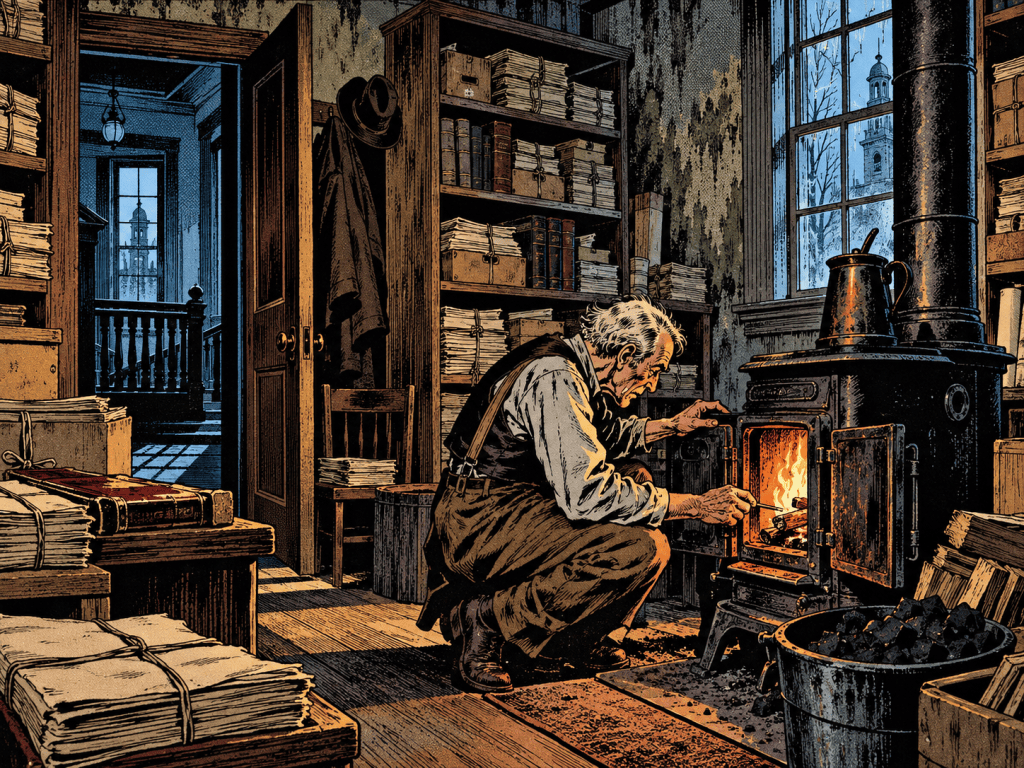
The former room keeper continued lighting the stove in the closed municipal store-room because certain records stored there became damp when he did not.
Caleb Thurber, whose duty of distributing notices had been discontinued, still carried notices whenever the clerk handed him one.
“Then the duty was not discontinued,” McPherson said.
“It was,” said Rounds. “The carrying merely continues.”
This distinction required a new heading.
ABOLISHED AND DISCONTINUED.
Below it came:
ABOLISHED BUT NECESSARY.
Then:
DISCONTINUED EXCEPT WHEN REQUIRED.
Finally, after three meetings and considerable improvement in penmanship:
TRANSFERRED, DESTINATION UNDETERMINED.
The report now began to assume a form worthy of our flourishing village.
For every discontinued form it became necessary to state the former purpose, date of discontinuance, present disposition, residual obligations, responsible person if any, location of surviving copies, and whether the discontinuance itself remained in force.
This required another form.
McPherson noticed it immediately.
“You abolished eleven forms and made a twelfth to describe them.”
Rounds corrected him.
“The new paper is not a form for doing business. It is a form certifying that business is not being done.”
McPherson looked at it.
“It has six blanks.”
“For greater certainty.”
The distinction was entered upon the form.
By September the trustees discovered that abolitions deteriorated unless inspected.
One committee listed as abolished had quietly met twice.
A discontinued subscription had renewed itself because nobody had informed the publisher that it had ceased to exist.
A discontinued notice concerning a discontinued duty had been reprinted because the printer had standing type.
The closed municipal room was open every morning from eight until ten because the records of things no longer done were kept there.
Plainly, reduction required maintenance.
Young Amos Bellows was therefore appointed Clerk of Municipal Diminution, charged with verifying that abandoned duties remained abandoned.
The trustees were careful to explain that this did not constitute a new office in the ordinary sense.
It constituted supervision of the disappearance of old ones.
Bellows approached the work scientifically.
First he divided the town by function.
Road matters.
Buildings.
Records.
Notices.
Subscriptions.
Committees.
Offices.
Miscellaneous cessations.
Then he divided each function by condition.
Things no longer done anywhere.
Things no longer done by the person formerly doing them.
Things still done but no longer officially.
Things officially discontinued and unofficially indispensable.
Things transferred to persons unable to explain why.
Things believed discontinued but afterward discovered in operation.
Things discontinued in principle and continued for convenience.
Things discontinued so completely that nobody could remember what they had been.
The last class caused difficulty because proof of successful abolition required identifying the thing abolished.
Bellows therefore opened a supplementary register headed:
UNIDENTIFIED CESSATIONS REQUIRING HISTORICAL DETERMINATION.
This made excellent progress.
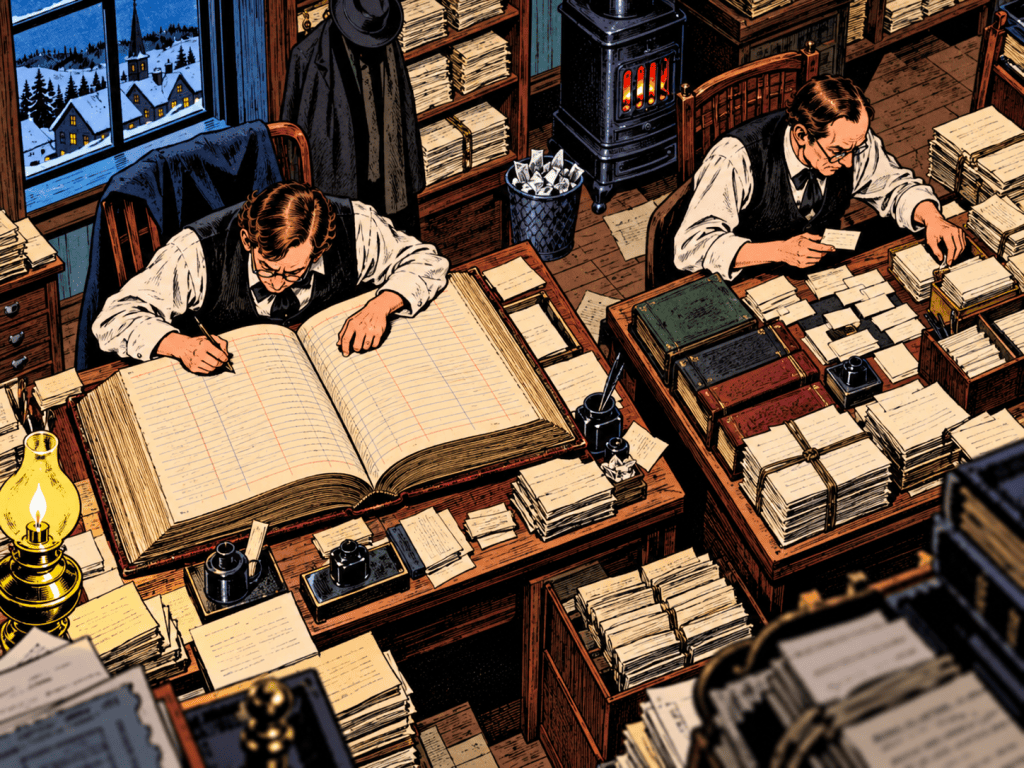
By October the principal ledger weighed seventeen pounds.
By November it required an index.
The index required cross-references.
The cross-references required quarterly correction, because several things no longer being done had altered the manner in which they were not being done.
Bellows asked for an assistant.
The trustees hesitated.
“A new employee would look bad,” said Rounds.
The difficulty was solved by appointing Nathan Spear Assistant Custodian of Retrenchment, which was judged not to constitute expansion because his duties concerned contraction.
Spear’s first assignment was to prepare a monthly statement showing whether the machinery of reduction had increased.
He reported that it had.
Rounds returned the report.
“You cannot call that an increase.”
“What shall I call it?”
Rounds considered.
“An enlargement of the means of diminishing.”
Spear entered the phrase.
Cut the clerk and save his pay;
Hire two men to mark the day.
We consider this rhyme inferior, but contemporary boys chalked it upon the closed room and thereby secured for themselves a place in the municipal record.
Bellows ordered the chalking removed.
Spear entered its removal under MISCELLANEOUS CESSATIONS.
By December the annual report appeared.
The previous year’s report had contained sixty-four pages.
The new report contained one hundred and four.
Nobody regarded the additional forty pages as an increase, since every additional page described a decrease.
Indeed, the trustees maintained that the greater size of the volume proved only the greater extent of the reduction.
The logic was admirable.
Had the report reached two hundred pages, economy would have been nearly complete.
Chateaugay could now show visitors something few municipalities possessed: an organized, numbered, indexed, cross-indexed, continuously verified and annually certified record of governmental absence.
The closed room had been reopened to house it.
Two men worked there full-time.
A third came in twice weekly to keep the stove going.
The former notice carrier delivered corrections.
The former lamp man attended the lamp outside the room so the clerks could leave after dark.
The discontinued subscription was renewed because the newspaper carried notices of meetings concerning discontinuance.
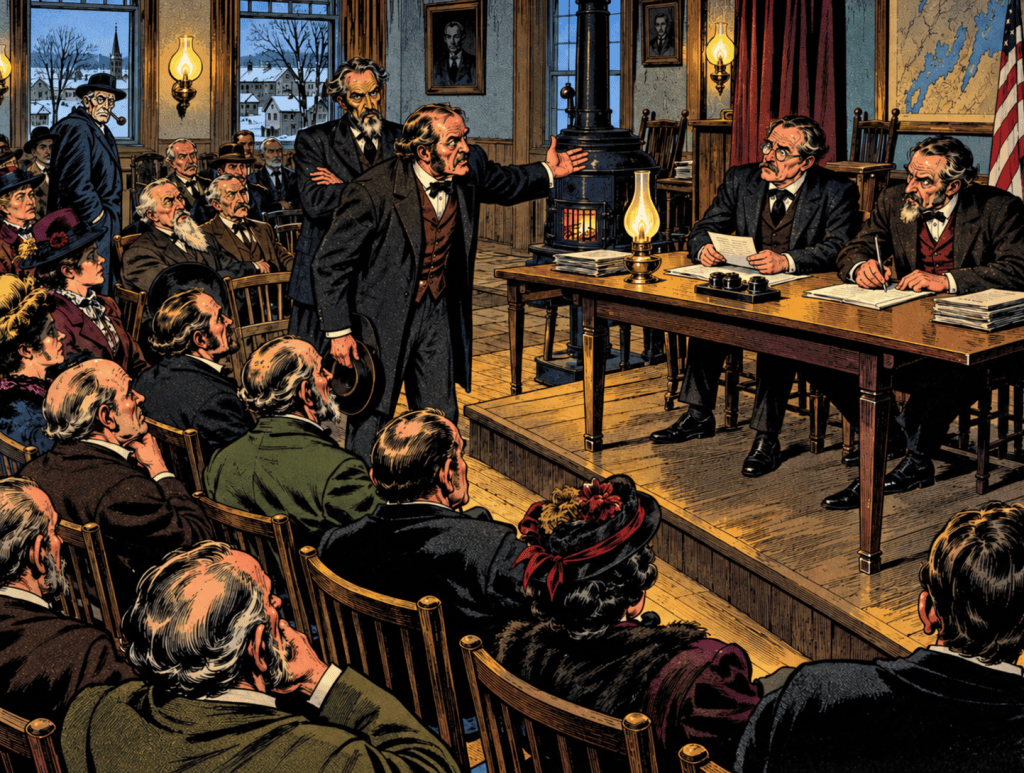
The abolished committee met quarterly to certify that it remained abolished.
At its December session the committee discovered that certification of its continued abolition required officers.
A chairman and secretary were chosen.
Rounds objected.
“You cannot elect officers to an abolished committee.”
The committee suspended proceedings while the question was referred to the trustees.
The trustees ruled that the officers existed solely for the purpose of proving that the committee did not.
This satisfied everybody except McPherson.
“And if the committee stops meeting?”
Rounds looked at him.
“Then who certifies that it has stopped?”
The committee continued.
At year’s end the trustees announced, with just pride, that no new institution had been created.
The Ledger was not an institution.
It merely possessed a room, two officers, an assistant, regular hours, printed forms, appropriations, procedures, classifications, standing instructions, quarterly reviews, an annual report, permanent records, a stove, a lamp and a committee responsible for proving that no committee existed.
We have examined the last surviving volume.
It is the largest municipal book from the period now known to us.
The roads have changed.
The old lamps are gone.
Offices have vanished; committees are forgotten; subscriptions have ceased without supervision; rooms have been put to other uses; men once considered indispensable have been dead half a century.
Of the thirty-eight original reductions, several cannot now be identified at all.
But the Ledger remains.
Its bindings have outlasted the reforms it recorded.
Its classifications survive the duties they classified.
Its pages preserve, with extraordinary precision, the names of functions nobody any longer remembers performing and offices nobody remembers needing.
This was the final triumph of the Reform Administration.
Chateaugay succeeded in abolishing nearly everything it set out to abolish.
Then, finding abolition too important to leave unattended, it constructed the machinery necessary to preserve it.
The machinery survived.
The savings did not.
#ShatageeWoods #ChateaugayNY #HistoricalFiction #CivicSatire #MunicipalBureaucracy #NorthernNewYork #ArchivalFiction #NineteenthCentury #LocalGovernment #DryHumor

What mysteries of Chateaugay Lake haunt you?