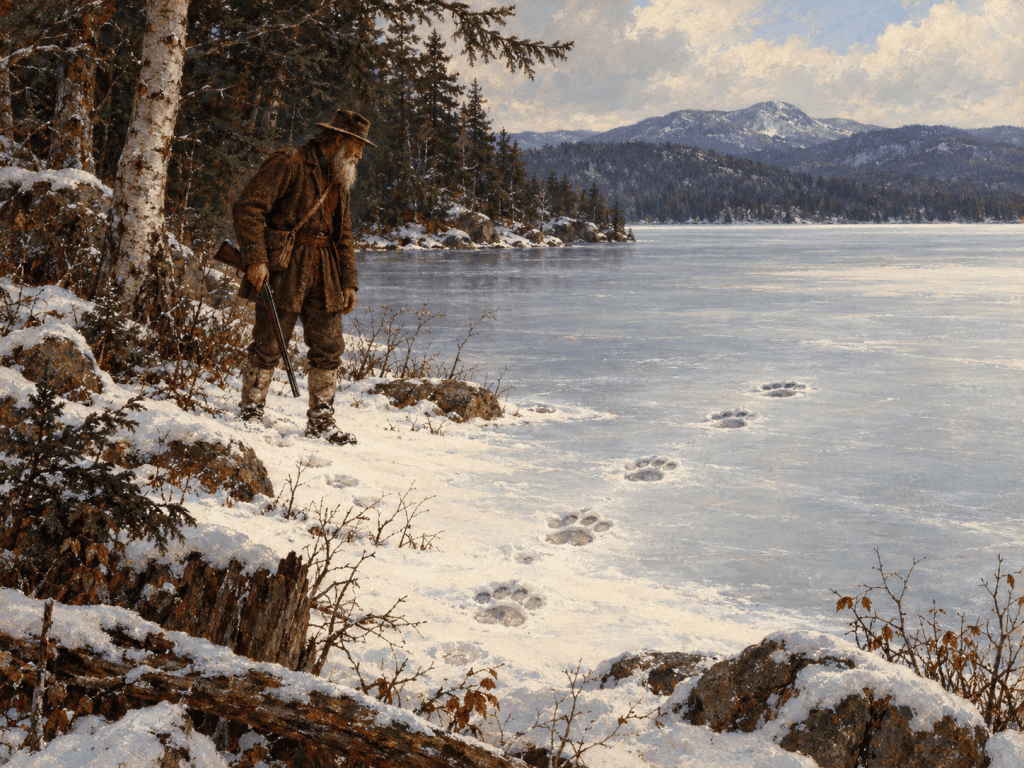
Readers inclined to follow unusually large panther tracks into concealed mine workings may wish to bring a lantern, company, and a firm policy concerning skeletons that appear to be kneeling before empty stone.
Lower Chateaugay Lake, N.Y.
To the Editor:
I noticed in your paper a reference to the panthers which were formerly heard about Lyon Mountain, and especially to the large tawny one said to have traveled between the mountain and the south shore of Lower Chateaugay Lake. There may be some old timer who would question whether these animals were true panthers, but that is what everybody called them, and I shall use the name familiar to us.
When I was a boy, it was not considered remarkable to hear that a panther had crossed a wood road during the night. Their cries were sometimes heard from the lake, particularly in the fall, when the air was still and sound carried farther than a person expected. My father said their crying resembled a woman in distress, though he added that a sensible man should first determine whether it was a woman before going into the woods to rescue her.
The particular animal I wish to mention was considerably larger than the others, according to the men who followed it. Its tracks were found several times near Lyon Mountain and once beside a deer yard west of the old ore road. The forepaws left marks nearly as broad as a dinner plate. I did not see those first tracks myself, but my father did, and his account did not change in later years.
The hunter who followed them was named Amos LaFountain. He trapped and hunted throughout that country and was not ordinarily inclined to make much of strange occurrences. He could identify a fox track in poor snow and tell whether a deer had passed before or after midnight by the frost in the print. His judgment in such matters was generally respected.
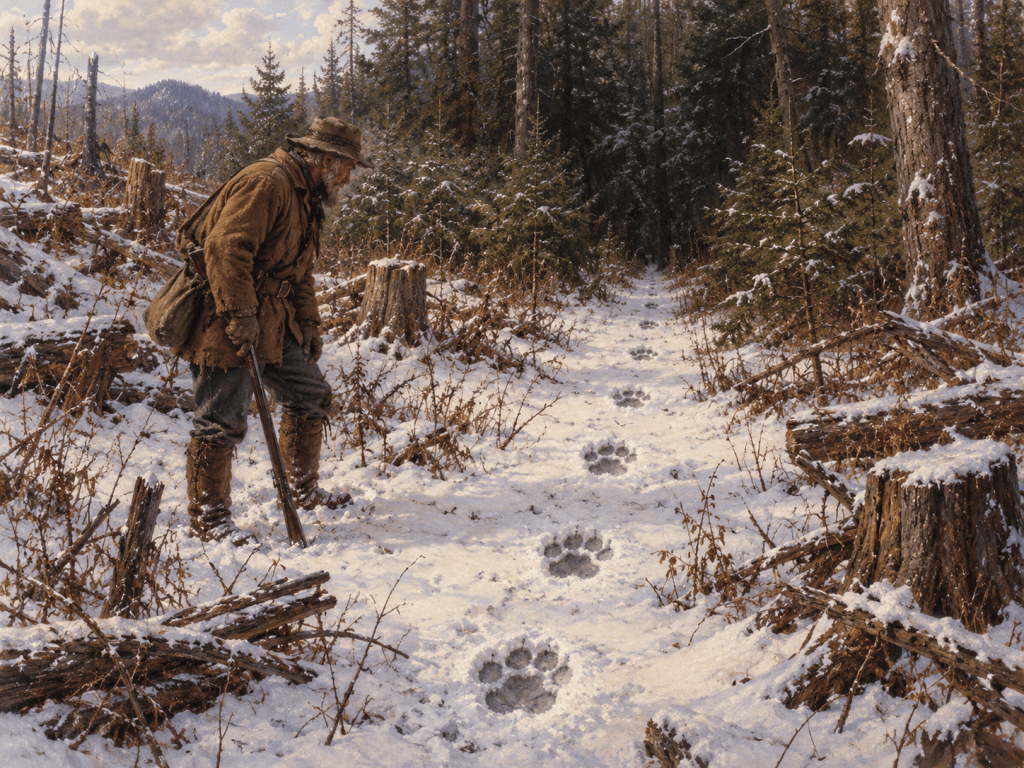
One morning, after a light snow, LaFountain found the great tracks crossing an old cutting northeast of the mountain. They were fresh and went in a straight course through cedar and young spruce, paying no attention to the easiest ground. There was no sign that the animal had stopped, hunted, or circled back. It appeared to be going somewhere it already knew.
He followed for nearly two miles.
The tracks ended at a rock ledge partly hidden by fallen timber. Behind the timber was the mouth of an abandoned mine shaft which LaFountain had never seen, although he believed he knew every prospect hole on that side of the mountain. The opening was low and had been concealed with stone laid so carefully that it did not resemble a natural fall.
The panther tracks went inside.
There were no tracks coming out.
LaFountain returned to camp for a lantern, a coil of rope and another man. The second man was my father’s cousin, William Bogart, who later worked for a time around the ore operations. I am quite sure it was William, although some years afterward my father referred to him merely as “one of the Bogart boys,” which does not narrow matters as much as might be supposed.
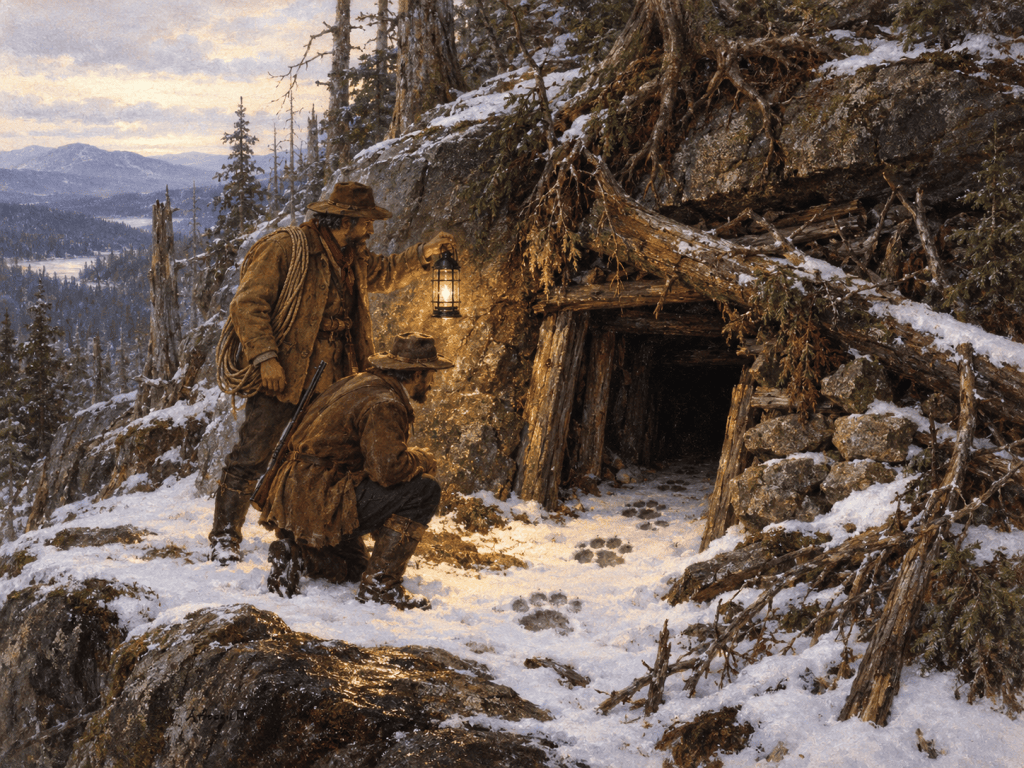
They entered shortly after noon.
The shaft descended gradually and was dry for the first hundred feet. Farther in, the rock became damp and unusually warm. William said there was a current of air coming toward them, though no second opening was ever found.
After passing several old timbers and a place where the roof had fallen, they came into a natural cavern much larger than the mine passage. The walls had been worked smooth in places. Upon them were carved figures which LaFountain believed to be Indian signs.
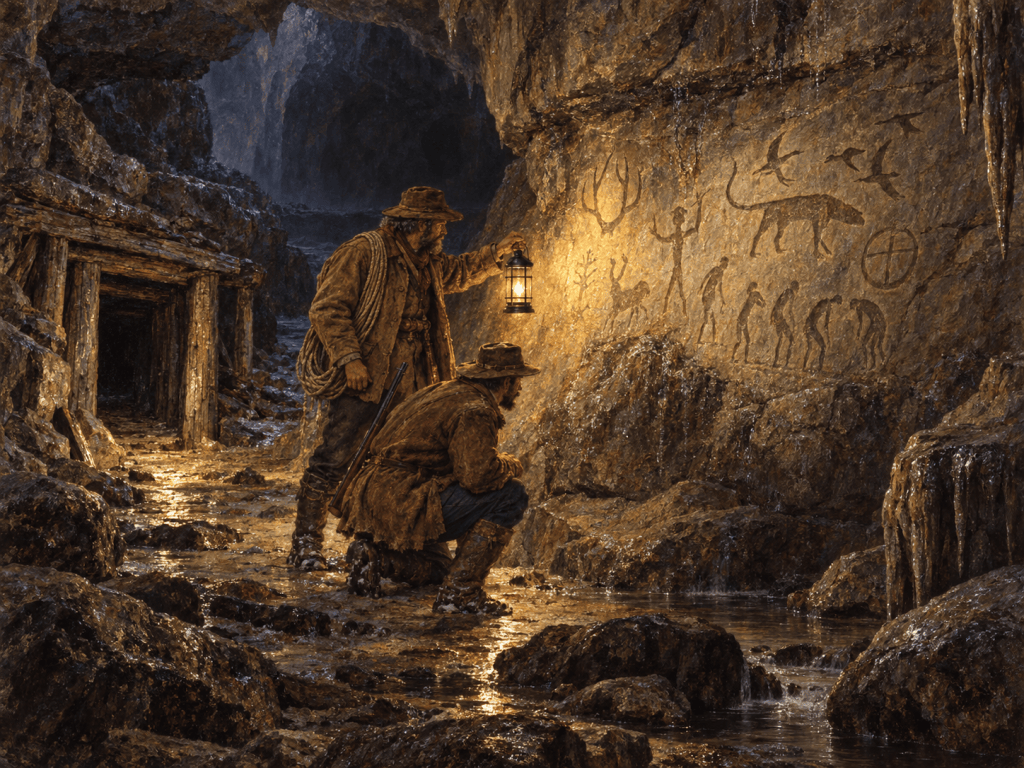
Neither man could read them.
Some resembled antlers, birds and crooked human forms. Others were circles divided by straight lines. One carving showed a long-tailed animal standing above several men whose heads were lowered. William later made a rough copy of this figure in a notebook, but the notebook disappeared after his death.
At the farther end of the cavern they found two human skeletons.
The bones were not lying flat. Both skeletons had been arranged upon their knees, with their backs bent and their skulls lowered toward a dark recess in the stone. Their arms extended forward along the floor. One had a broken iron trap beside it. The other wore the remains of a broad leather belt with a brass buckle of an old pattern.
There was nothing in the recess.
At least, the lantern showed nothing.
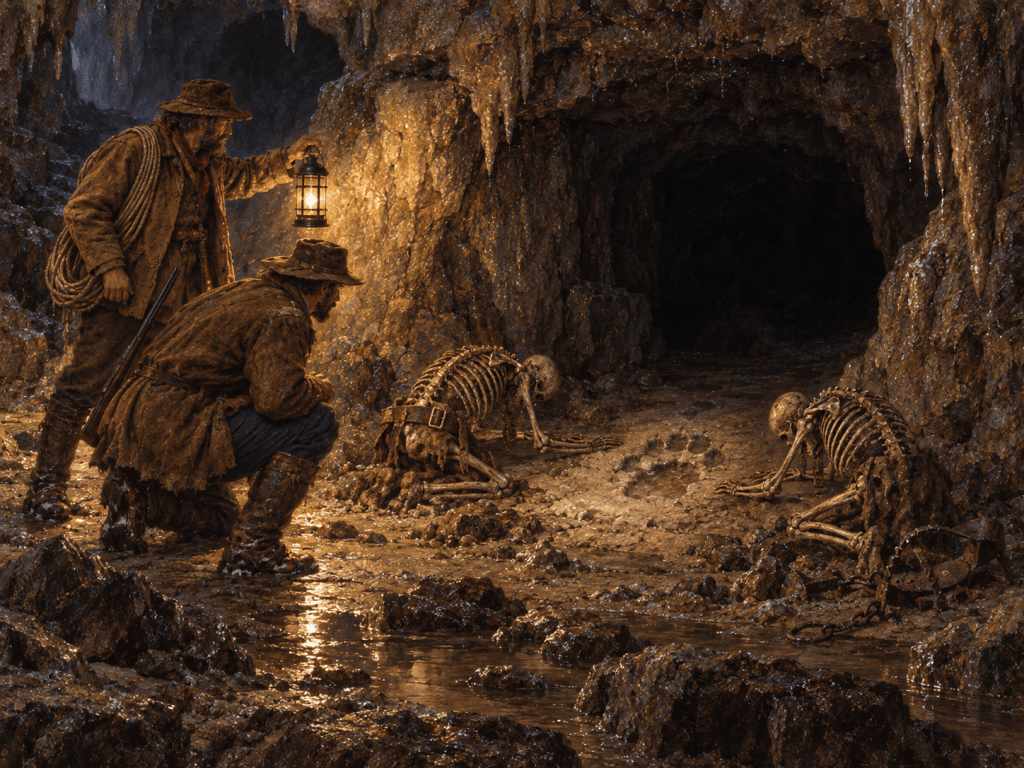
The floor before it was smooth except for one immense paw mark pressed into a patch of pale clay. The print was larger than any they had followed outside. It faced outward, as though the animal had been standing in the recess watching the two kneeling men.
LaFountain wanted to examine the bones, but William refused. He said the air had begun to smell like wet hair and that something was breathing beyond the reach of the lantern. LaFountain claimed it was only air passing through a crack.
Nevertheless, they left.
Upon reaching the entrance, they found the afternoon snow falling heavily. Around the opening were fresh panther tracks. These circled the ledge several times but did not approach the shaft.
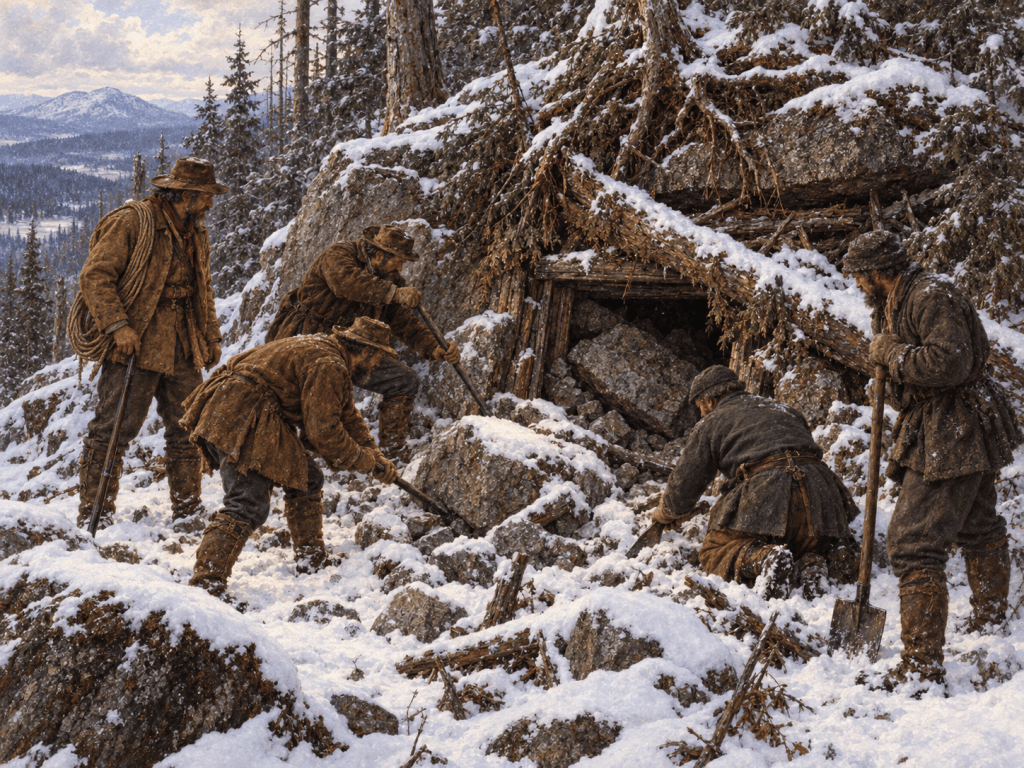
The men returned the next morning with three others. During the night, a section of rock had fallen across the passage. They worked several hours but could not reopen it. LaFountain marked the location upon a timber map, though subsequent cutting and mining changed the ground, and no one I knew was ever able to locate the entrance again.
It was afterward said that LaFountain would no longer trap near Lyon Mountain. This is not entirely true. He hunted there again, but never alone and never after the first heavy snow.
As for the great panther, its tracks were seen once more that winter near the lake. They came down through the timber and stopped upon the ice about twenty feet from shore. There was no mark showing where the animal had turned or continued.
The ice was sound and without an opening.
My father examined the place himself. He said the tracks merely ended, which was a fact he found more troublesome than any explanation offered for them.
I do not pretend to know who carved the cavern or who placed the two dead men in that position. The markings may have been Abenaki, or they may have been made by somebody acquainted with such designs. The skeletons may have belonged to prospectors who entered the shaft and were afterward arranged by another person.
These possibilities ought to be considered.
Still, there remains the matter of the paw print in the clay, the warm air, and the tracks which went into the mine but did not come out.
There are some accounts a man may improve by giving them additional thought. This is not one of them.
Sincerely yours,
Johqu Bogart
Lower Chateaugay Lake
#ShatageeWoods #ChateaugayLake #LyonMountain #AdirondackFolklore #NorthCountryMystery #AdirondackPanther #PantherLore #MiningMystery #LetterToTheEditor #AdirondackLegends

What mysteries of Chateaugay Lake haunt you?