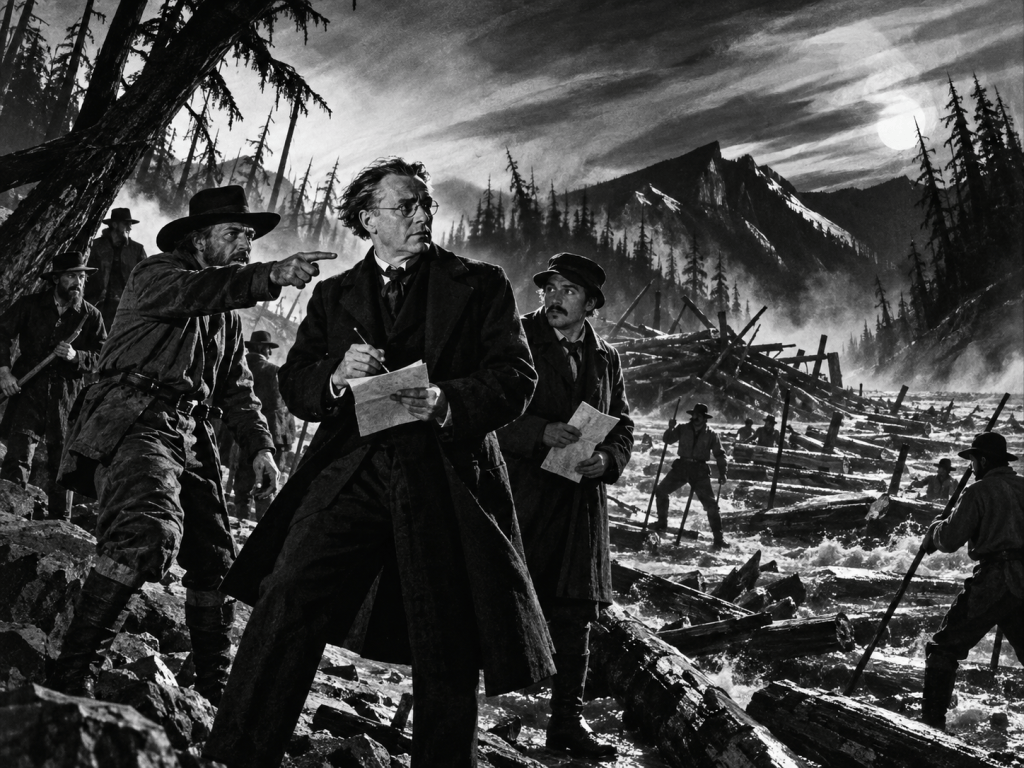
In 1883 Chateaugay, one doctor’s perfectly reasonable safety principle collides with timber, water, gravity, clerical zeal, and a whistle, proving that practical judgment can lose authority even when experience proves it completely right.
There are occupations in which a man may stop when hurt, occupations in which he ought to stop when hurt, and occupations in which stopping is itself one of the more energetic forms of danger.
In the spring of 1883, Chateaugay discovered the third kind.
The discovery began, as several improvements do, at the Academy.
Two students, Amos Bessette of Burke and Willard Trombley of Chateaugay, had obtained a pair of old swords from somewhere nobody afterwards cared to identify. They had also obtained, which was worse, a Sept.1883 article in the Record, describing the student duels of Heidelberg.
The article fascinated them.
It horrified Dr. Lucien Dufresne, a Malone physician then making a professional visit to Chateaugay.
Dr. Dufresne was a serious man, and we should say immediately that he was right about nearly everything.
He was right that two boys with swords ought not to be permitted to carve one another into educated men.
He was right that the presence of spectators did not convert stupidity into ceremony.
He was especially right in objecting to the curious Heidelberg custom, as he understood it, whereby a physician stood near the contest and permitted the affair to continue until somebody had received enough injury to satisfy whatever remarkable educational purpose had brought the swords out in the first place.
“A doctor,” he told the Academy boys, “is not a starter at a horse race. If a man is hurt, the proceedings stop.”
This was sensible.
Indeed, it was so sensible that everybody remembered it.
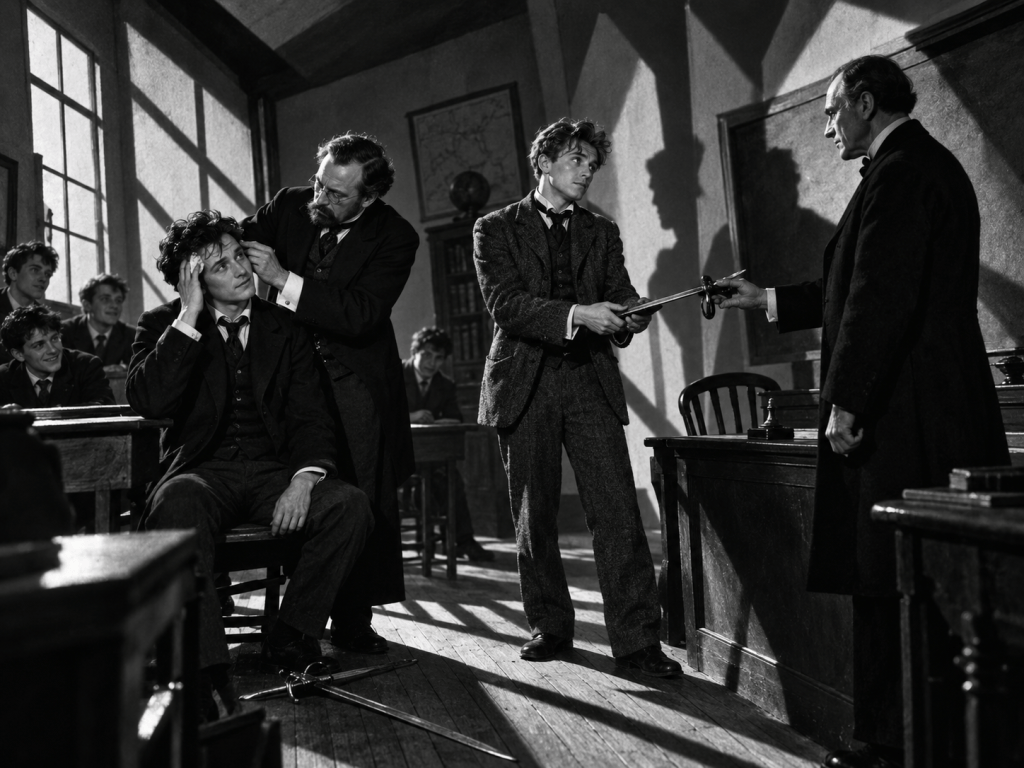
Bessette had received a shallow cut above the left ear. Trombley had received no wound at all, unless we count the surrender of his sword to the principal, which he described as surgical.
The affair might have ended there.
Instead, Dr. Dufresne explained the principle again that evening at the hotel, where Caleb LaFountain, foreman of a timber drive then preparing to move down the Chateaugay River, happened to be eating supper.
LaFountain listened politely.
A river foreman learns early that physicians, ministers, lawyers, lumber agents and men who have recently returned from Albany must be listened to politely, since none of them can ordinarily be thrown into the river without paperwork.
“You stop the contest,” said Dufresne, “the instant an injury occurs.”
“That so?” said LaFountain.
“Certainly.”
“What if the contest don’t stop?”
The doctor looked at him.
LaFountain buttered his bread.
“I mean,” he said, “what if it ain’t got ears?”
This was how the difficulty first presented itself.
The Chateaugay drive that year had been troublesome before Dr. Dufresne ever saw it.
Spring water had come generously. Logs were moving well enough, but they were moving in the particular fashion by which several thousand pieces of timber seem determined to arrive at one narrow place simultaneously and then quarrel about precedence.
LaFountain had twenty-seven men on the stretch below the lake.
Among them were Napoleon Charbonneau of Bellmont, Orrin McMartin of Churubusco, Dennis LaBrake of Constable, and Jasper Bombard, who had been born somewhere near Ellenburg and maintained that this entitled him to opinions regarding every stream between Lake Champlain and the St. Lawrence.
The men worked with peavies, pike poles, axes, boots with calks, and that North Country professional equipment without which nothing substantial was ever accomplished: criticism of the man standing nearest.
Dr. Dufresne came down to observe the operation two days after the Academy affair.
He had scarcely been there twenty minutes when Charbonneau caught his knuckle against a peavy socket.
It split the skin.
“Hold,” said the doctor.
Nobody held.
“Hold!”
Charbonneau put the knuckle in his mouth and continued rolling a log.
Dr. Dufresne stepped forward.
“That man is injured.”
LaFountain glanced at the hand.
“Napoleon?”
“Oui?”
“You dying?”
“Not before supper.”
“Good.”
The doctor was astonished.
“I must examine him.”
“Examine him tonight.”
“He may have damaged the joint.”
“He may.”
“You do not know.”
“Nope.”
“Then stop the men.”
LaFountain looked at the river.
Now there are glances which, if properly recorded, would save historians several paragraphs. The foreman’s glance at the Chateaugay River was one of these.
The river was not waiting for the consultation.
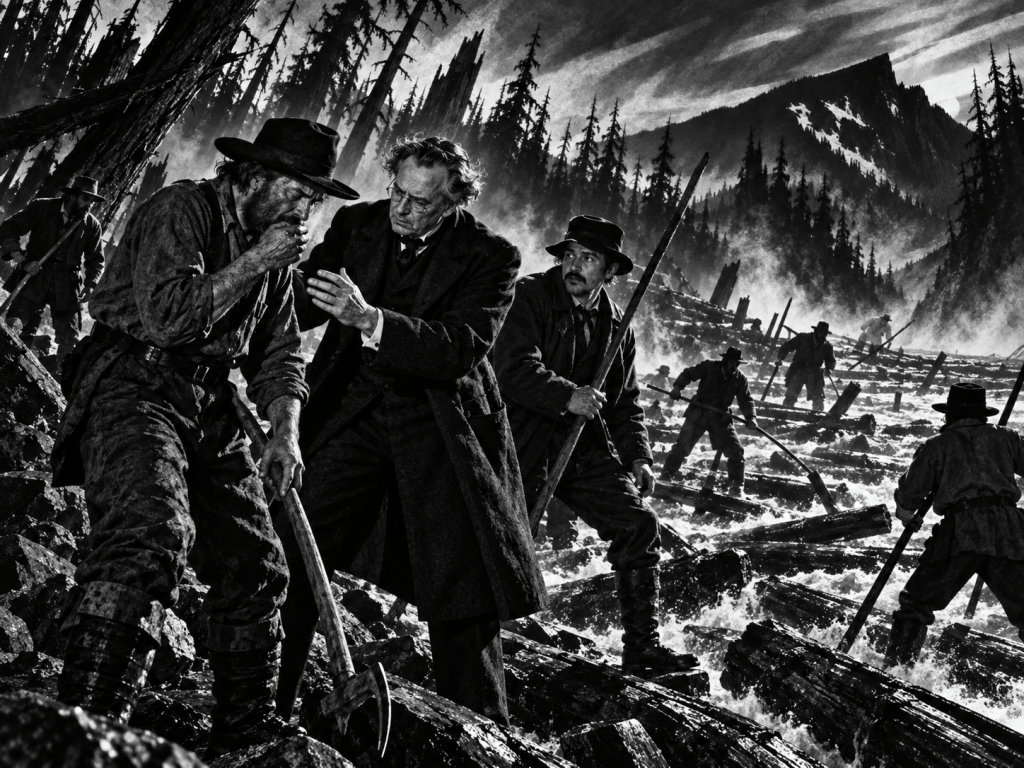
Water continued down from above. Timber continued with it. Logs rolled, struck, slewed sideways, separated and gathered again. The whole drive had the deceptive appearance of proceeding by accident while in fact being held in rough order by men who knew exactly which accidents could be tolerated.
“The river keeps arriving, Doc,” LaFountain said.
That sentence should have settled the matter.
Instead, it entered the record.
Orrin Bellows, clerk for the lumber concern, was present.
Bellows was a North Country clerk of the old and formidable school. He possessed a black coat, a narrow hand, and the conviction that anything written twice had acquired standing.
He wrote:
Dr. Dufresne advises cessation of operations upon injury pending medical examination.
Then, after some discussion, he added:
Foreman LaFountain objects that cessation may impair management of the drive.
The company agent read both sentences.
Here, gentlemen, civilization encountered its usual trouble.
Nobody wished to sign the second one.
The first sentence said that injured workmen ought to receive medical attention.
The second appeared to say that they ought not.
This was not what LaFountain meant, but it was what the paper had succeeded in making him look as if he meant.
By the following Monday, the company had adopted the Dufresne Rule.
No man called it that officially.
Bellows merely copied the doctor’s recommendation into a standing instruction:
UPON INJURY, SOUND WHISTLE. SUSPEND OPERATIONS UNTIL MEDICAL CONDITION IS DETERMINED.
A brass steam whistle at the works was designated for the purpose.
This was considered progressive.
The company agent said so.
Dr. Dufresne said the arrangement was humane.
Even LaFountain admitted that examining an injured man before putting him back onto a rolling timber drive was “a powerful handsome idea.”
His objection concerned the whistle.
“What about it?” Bellows asked.
“Everybody stops when it blows?”
“That is the rule.”
“What stops the logs?”
Bellows did not write that down.
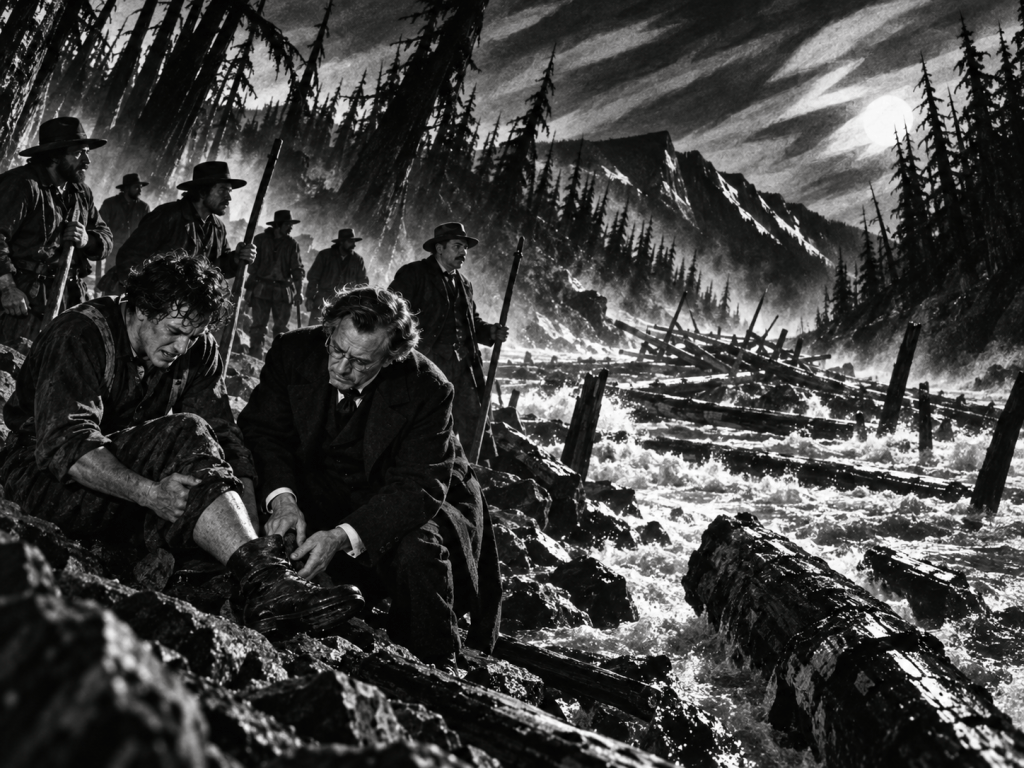
The first whistle was for Dennis LaBrake.
He turned an ankle between two wet logs shortly after nine o’clock.
The whistle sounded.
Men stepped back.
LaBrake was helped ashore.
Dr. Dufresne examined the ankle carefully and found no fracture.
This required perhaps six minutes.
Six minutes is not long at a school duel.
Six minutes on a moving river is a geographical event.
While the men waited, three loose logs swung crosswise below a bend. Others pressed behind them. One climbed partly over another. A fourth wedged beneath.
LaFountain watched the formation grow.
“Can I send two men?”
“No,” said Dufresne. “The order says suspension.”
“That ain’t suspended.”
“I mean the men.”
“I mean the river.”
When LaBrake was cleared for light duty, the crew went back in.
Breaking the little jam took forty minutes.
Jasper Bombard bruised his shoulder.
The whistle blew.
The men came out.
The river did not.
By noon there was a respectable jam.
By three o’clock it had acquired ambition.
There arose among the men a short verse whose author, perhaps mercifully, is unknown:
Whistle for a finger,
Whistle for a toe,
Every time the whistle blows,
Another thousand logs won’t go.
Dr. Dufresne disliked the song.
He disliked it not because it mocked safety but because the men had begun singing it before anybody was injured.
Now we must defend the doctor against the easiest version of this story.
He was not a meddling townsman who imagined himself wiser than men who worked the river.
He watched.
He asked questions.
He learned quickly.
He saw that when a driver slipped, the man beside him often had to move immediately—not recklessly, not heroically, but immediately—because the log under both men was continuing downstream.
He saw that a jam was not a pile.
It was pressure wearing lumber for a coat.
And he began to understand what LaFountain had meant at the hotel.
A duel consisted of danger produced by two men.
Remove the men and the danger ceased.
A drive consisted of men managing danger produced by water, timber, gravity and a considerable portion of Franklin County coming downhill at once.
Remove the men and the danger continued manufacturing itself.
The doctor therefore proposed an amendment.
Minor injuries, he suggested, might be examined while essential operations continued.
Bellows objected.
“Contrary to your original instruction.”
“It modifies my instruction.”
“On what medical grounds?”
“On the grounds that stopping creates additional hazard.”
Bellows dipped his pen.
“Then continued labor is part of the treatment?”
“No.”
“But medically indicated?”
“Under some circumstances.”
Bellows wrote this down.
Dr. Dufresne watched him.
“What did you write?”
Bellows read:
Dr. Dufresne advises that under certain river conditions continuous operation may be medically indicated.
“No,” said Dufresne.
Bellows looked up.
“No?”
“That makes it sound as though I prescribe log driving.”
“You said stopping may increase hazard.”
“It may.”
“And avoiding increased hazard is medically desirable.”
“Certainly.”
Bellows bent again to the page.
The doctor put his hand over the paper.
“Give me that.”
For a moment authority returned to the man who had originally possessed it.
But the sentence had been heard.
And once a sentence has been heard by a company clerk, it is rash to suppose destruction of the paper will entirely kill it.
The great jam formed three days later.
It began above a constriction and grew with appalling patience.
Nobody was hurt when it started.
This created an administrative difficulty, since there was therefore no reason to blow the whistle.
LaFountain stationed men along the edge and began working the outer timber loose.
Then McMartin tore the palm of his hand on a spike.
The whistle sounded.
LaFountain swore.
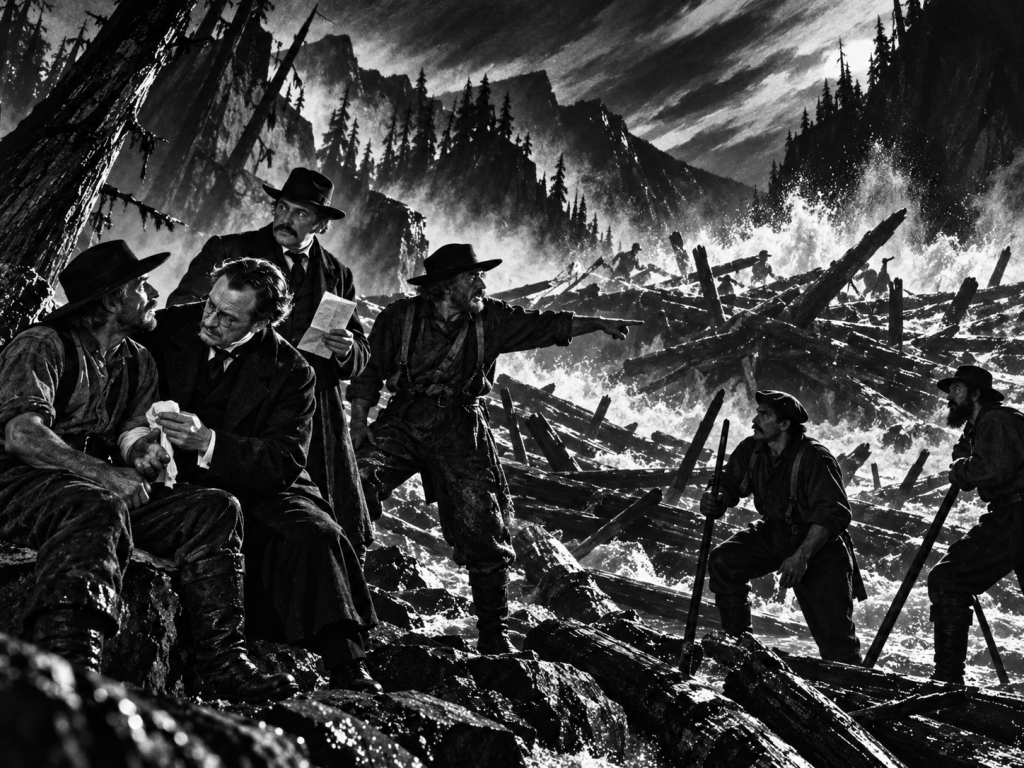
Dr. Dufresne ran to McMartin.
The cut was ugly but manageable.
“Wrap it,” McMartin said.
“I will determine that.”
“Determine quick.”
Upstream came the knocking of timber.
Not loud.
That was the disagreeable part.
The river sounded busy rather than violent.
LaFountain walked fifty yards along the bank, studied the jam, returned, studied it again, and finally pointed toward one log lying diagonally near the center.
“There.”
Dr. Dufresne followed the line of his finger.
“That one?”
“That’s the key.”
“You are certain?”
“No.”
This surprised him.
“No?”
“If I was certain, I’d be selling Bibles instead of lumber.”
Bombard laughed.
Nobody else did.
LaFountain called Charbonneau and LaBrake.
“We roll the top piece, take the strain off that cross-log, then pull the key.”
Dr. Dufresne looked at McMartin, whose hand he had not yet finished dressing.
“Wait.”
LaFountain did not move.
“Doctor,” he said quietly, “that’s what it’s doing.”
Water accumulated behind the jam.
Logs lifted.
Somewhere inside the mass came a single deep wooden report.
Every river man turned his head.
“What was that?” Dufresne asked.
“The river voting,” said Bombard.
LaFountain pointed again.
“If she shifts before we touch that key, I don’t know where she’ll open.”
The doctor looked from the wounded hand to the waiting men, then to the timber.
This was his rule.
It had his judgment behind it, his profession behind it, the company behind it, Bellows’s handwriting behind it, and a brass whistle prepared to announce it to both shores.
Nobody moved.
For the first time Dr. Dufresne understood the full dignity of having one’s advice obeyed.
He hated it.
“Charbonneau,” he said.
“Doctor?”
“Can you reach that upper log without entering the main pocket?”
“I think.”
“LaFountain?”
“Yes.”
“Is sending him safer than waiting?”
“Yes.”
“Do it.”
Nobody moved.
Dr. Dufresne stared at them.
“I said do it.”
Bellows, standing ten feet away with the instruction sheet folded inside his coat, cleared his throat.
“Operations are suspended.”
The doctor turned.
“By whose order?”
Bellows looked almost apologetic.
“Yours.”
There it was.
Not merely advice.
Not merely caution.
Authority.
And, being authority, it could no longer be defeated simply by the man who had first spoken it.
Dr. Dufresne held out his hand.
“Paper.”
Bellows gave him a sheet.
“What are you doing?” asked LaFountain.
“Practicing medicine.”
He wrote against the side of a timber box, using Bellows’s pencil.
The wording took less than a minute.
Bellows read it once.
Then twice.
That was enough.
“Men may proceed,” he said.
LaFountain shouted.
Charbonneau and LaBrake moved.
The key log turned reluctantly, stopped, moved again, and came free.
Nothing dramatic happened.
This disappointed several later tellers of the story.
There was no wall of water, no miraculous opening, no timber leaping fifty feet into the air.
The jam loosened by degrees.
A channel appeared.
Then another.
Pressure bled away into motion.
Within twenty minutes the river was once again carrying the danger downstream a little at a time instead of storing it all in one place.
McMartin received seven stitches.
Dr. Dufresne himself put them in.
The document he wrote beside the river was returned to the company office.
Bellows made a fair copy.
The company agent requested a second.
A third was placed at the works.
By June, foremen on two other stretches had been instructed that when suspension of a drive would materially increase danger to the crew, essential operations might continue upon medical authorization.
The doctor objected to this wording.
He had authorized one operation under one set of conditions.
Bellows agreed completely.
That was why, he explained, every future case would require authorization.
“You have turned an exception into a procedure,” Dufresne said.
“We have prevented anybody from using the exception without medical approval.”
The doctor considered this.
It was difficult to argue against.
LaFountain found it easier.
“You needed Doc’s authority to stop us,” he said. “Now you need Doc’s authority not to.”
Bellows brightened.
“That is exactly the safeguard.”
LaFountain removed his hat and scratched his head.
“Well, by God, Orrin, you have guarded both ends of the road.”
The company became quite proud of the system.
Injuries were reported.
Medical supplies were kept near at hand.
Men were not casually ordered back to work after being hurt.
Foremen could not ignore a serious wound merely because timber was moving.
At the same time, nobody again stopped an entire drive for a split knuckle while thousands of logs accumulated against a bend.
It was, by any reasonable standard, an improvement.
This is what makes the conclusion troublesome.
For the improvement did not restore LaFountain’s original authority.
It established Dr. Dufresne’s.
The foreman had said from the beginning that the river could not always be stopped safely.
Experience proved him correct.
Yet the official remedy was not to return the decision to the foreman.
It was to require a physician to certify when the foreman’s judgment might be obeyed.
Thus practical knowledge, after defeating the rule, returned wearing the rule’s signature.
By late summer, Bellows had prepared a printed form.
CERTIFICATE OF MEDICAL NECESSITY FOR CONTINUOUS RIVER OPERATIONS
Dr. Dufresne stared at the heading.
“That sounds,” he said, “as though continuous river operations are a treatment.”
Bellows considered this a criticism of style.
He crossed out FOR and wrote DURING.
The doctor stared at it again.
“That is not better.”
Bellows disagreed.
And there the matter rested.
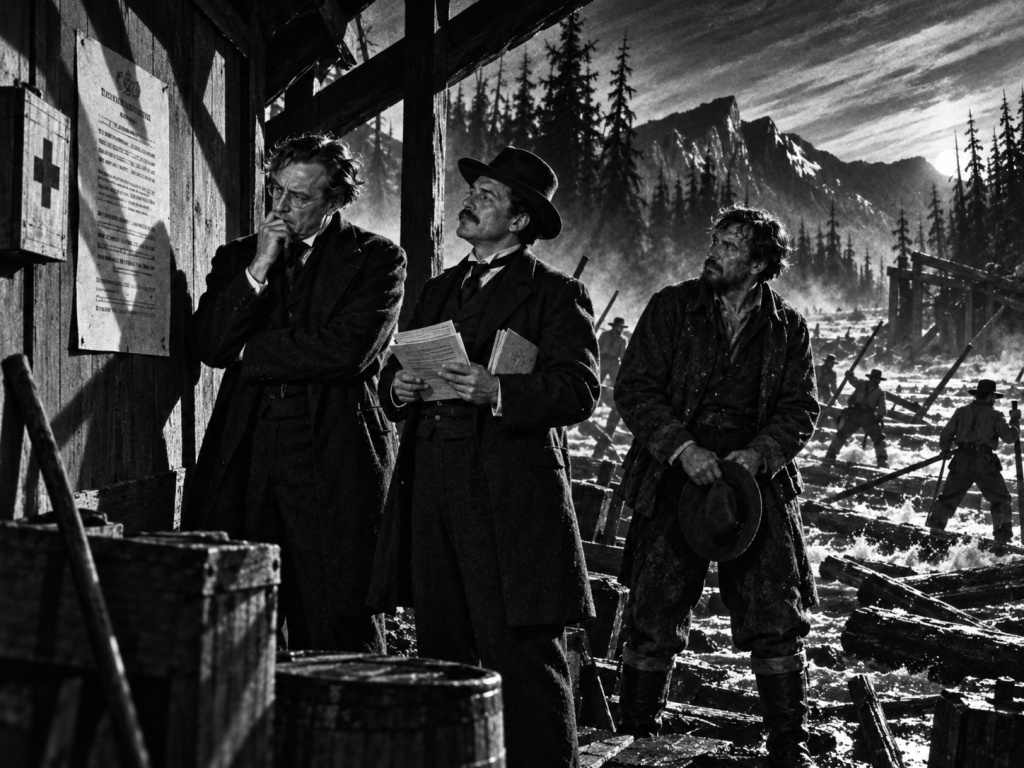
The certificate was posted beside the first-aid box, where every man on the drive could see it.
Beneath the heading appeared the sentence Dr. Dufresne had written while the jam was building:
INTERRUPTION OF NECESSARY MOVEMENT MAY, UNDER PRESENT CONDITIONS, CONSTITUTE THE GREATER DANGER TO LIFE.
No one disputed it.
That was the peculiar part.
The foreman approved it.
The company approved it.
The doctor, with qualifications, approved it.
Even the river appeared to approve, since it kept moving whether medically authorized or not.
And from that season forward, whenever a Chateaugay driver was hurt badly enough to stop the work, somebody first looked at the man.
Then somebody looked at the river.
Then somebody looked for the doctor.
#ShatageeWoods #ChateaugayRiverNY #NorthCountryStories #AdirondackLore #RiverDrivers #LoggingHistory #HistoricalSatire #ArchivalFiction #BureaucraticComedy #FranklinCountyNY

What mysteries of Chateaugay Lake haunt you?